Graham Spencer

917 posts on MacStories since January 2011

Former MacStories contributor.


Playing Devil’s Advocate, Arguing Apple Should Change Their IAP Policy

There’s been a lot of discussion in the past few days over Apple, its In-App Purchase (IAP) policy, and Dropbox after it rejected a few apps that employed Dropbox functionality because they offered links to the Dropbox website for signing up and logging in. At issue was that the option to buy a higher level of storage was also visible, and this contravened one of the App Store Review Guidelines. Some viewed this as Apple trying to kill (or at the very least, target) Dropbox – but as Federico explained, this was just Apple enforcing one of their existing policies.

After thinking about it for a while, I’ve come to the position that perhaps that policy isn’t the right one. So I decided to play the devil’s advocate, and try to argue the case for Apple adjusting their policy. Specifically my argument focuses on Apple’s policy going something like:

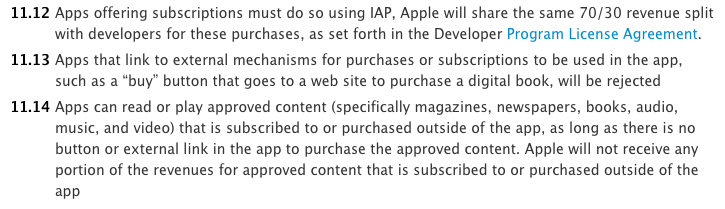
Apps may use external mechanisms for purchases or subscriptions to be used in an app, but only when those purchase mechanisms are undertaken in a web view within the app.

That could probably be further clarified in more simplistic language, but you get the general idea of what I’m proposing. The current policy prohibits any link to purchases or subscriptions that are undertaken through external mechanisms (ie. not IAP); I suggest that this should be allowed. So let’s quickly go through the benefits of the current policy and arguments for relaxing the policy. Read more


April 2012 In Review

April was a little bit of a slower month, with no keynotes or big announcements from Apple - with the exception of yet another huge earnings call. However, MacStories did celebrate its third birthday on April 20th, and welcomed our seventh MacStories writer, Lukas Hermann, who is focused on reviewing some great apps with Inspiring UIs - you’ll see a list of those articles below the break. In news, we did see the announcement of WWDC this month (it sold out in less than 2 hours) and some incredibly successful Kickstarter projects. On the apps front there continued to be a number of app updates for the new iPad, two Tweetbot updates, Clear 1.1 and Read It Later relaunching as Pocket. Lastly, we had a number of great stories this month including a great one on iCloud in which Federico interviewed some of the developers who have implemented it and what their thoughts on it are.

WWDC 2012

On April 25th, Apple “finally” announced WWDC 2012, to be held over June 11th to 15th this year in San Francisco. The $1599 tickets went on sale immediately at around 8:30am EDT and promptly sold out in less than 2 hours. Along with the WWDC dates and tickets, Apple also announced that nominations for the 2012 Apple Design Awards were open - so if you are a developer an want to suggest an app for the award you can do that here. If you’re a student and missed out on WWDC tickets (or they were too expensive), you have until tomorrow May 2nd to lodge an application for a WWDC Student Scholarship.

Apple’s Q2 2012 Earnings Call

Yet again, Apple had a stunning quarter - its second best ever, only beaten by the last (holiday) quarter. Apple sold 35.1 million iPhones, 11.8 million iPads and saw $39.2 billion in revenue for the quarter. Our full post includes the usual graphs that really highlight the growth Apple has had in nearly all aspects of their business over the past few quarters and even years.

Flashback

April saw what was perhaps the most serious malware incident the Mac has ever seen with ‘Flashback’. Apple, after taking some time to respond, eventually revealed they will provide a Flashback removal tool - which they soon did, as well as provide a Java update to remove various Flashback variants. F-Secure also released an automated Flashback removal tool (and did so before Apple released their tool).

Kickstarter Projects

The Pebble e-paper watch saw an absolute explosion of support when it launched on Kickstarter this month. As of today, about $7.5 million has been pledged to the project - far exceeding the initial goal of $100,000. Then there is the Bydge, an iPad dock that’ll turn your iPad into somewhat of a MacBook look-a-like. Not everyone is a fan of the premise, and it hasn’t set the world on fire, but it has also easily surpassed the $90,000 goal on Kickstarter with about $360,000 pledged so far (and there’s still a month to go).

Everything Else:


The Really Big Reviews

Everything Else

Lukas’ Inspiring UI Series


The NYT Investigates How Apple Sidesteps Billions In Taxes

The NYT Investigates How Apple Sidesteps Billions In Taxes

The New York Times this weekend published an in-depth article about Apple’s tax practices and specifically, how they have been able to “sidestep” billions in taxes through carefully chosen office locations for certain financial activities. For example, a small office in Reno, Nevada (shown above) manages and invests some of the companies cash - in a state where corporate tax rate is zero - compared to California’s 8.84% where Apple’s headquarters are.

Setting up an office in Reno is just one of many legal methods Apple uses to reduce its worldwide tax bill by billions of dollars each year. As it has in Nevada, Apple has created subsidiaries in low-tax places like Ireland, the Netherlands, Luxembourg and the British Virgin Islands — some little more than a letterbox or an anonymous office — that help cut the taxes it pays around the world.

The New York Times doesn’t suggest that there is anything illegal about what Apple does, every company tries to minimise the taxes they owe. Rather, it paints a picture of how tech companies in particular have been taking advantage of tax codes “written for an industrial age and ill suited to today’s digital economy”.

Apple, for instance, was among the first tech companies to designate overseas salespeople in high-tax countries in a manner that allowed them to sell on behalf of low-tax subsidiaries on other continents, sidestepping income taxes, according to former executives. Apple was a pioneer of an accounting technique known as the “Double Irish With a Dutch Sandwich,” which reduces taxes by routing profits through Irish subsidiaries and the Netherlands and then to the Caribbean. Today, that tactic is used by hundreds of other corporations — some of which directly imitated Apple’s methods, say accountants at those companies.

A particularly stark is example is to compare Apple to Walmart, Apple paid $3.3 billion in taxes from profits of $34.2 billion compared to Walmart who paid $5.9 billion in taxes from their $24.4 billion in profits last year. Apple was able to achieve that because it’s much easier to move digital products to low-tax countries than it is for Walmart to do the same, with their physical products.

When someone in the United States buys an iPhone, iPad or other Apple product, a portion of the profits from that sale is often deposited into accounts controlled by Braeburn, and then invested in stocks, bonds or other financial instruments, say company executives. Then, when those investments turn a profit, some of it is shielded from tax authorities in California by virtue of Braeburn’s Nevada address.

In their response to the NYT’s request for a comment, Apple focused on their US job-creation activities, stressing that their innovation and growth was providing benefits that go beyond just paying taxes. You can read their full response here.

Over the past several years, we have created an incredible number of jobs in the United States. The vast majority of our global work force remains in the U.S., with more than 47,000 full-time employees in all 50 states. By focusing on innovation, we’ve created entirely new products and industries, and more than 500,000 jobs for U.S. workers — from the people who create components for our products to the people who deliver them to our customers.

Permalink

Apple Offers 150 Student Scholarships For WWDC 2012

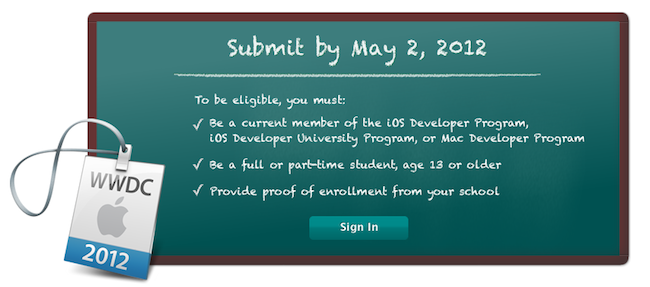
Full-time or part-time students over the age of 13 have the chance of winning one of 150 scholarships to attend this year’s WWDC. Apple says that it wants to  “reward outstanding student developers with the opportunity to attend this year’s conference on a WWDC 2012 Student Scholarship”. It means that for those lucky (and talented) students selected, they can attend the WWDC conference free of charge (tickets are on sale today for $1599). Apple will be judging the applicants on a few key criteria:

  • Technical ability
  • Creativity of ideas expressed in products/projects
  • Prior WWDC attendance
  • Technical and work experience

Due to the low age-limit, some events such as the WWDC Bash may restrict some students if they are under 18. Apple has posted a full list of eligibility requirements and more details on the application process and it should be noted that applicants also be a member of the iOS Developer Program, iOS Developer Enterprise Program, or Mac Developer Program, or an iOS Developer University Program Student and they must have been a member prior to August 1st, 2011.

You can lodge your own application for the 2012 WWDC Student Scholarship here, or view all the details on the 2012 WWDC page. The deadline for sending in your application is Wednesday, May 2, 2012 at 5:00 PM PDT.


Apple Opens Nominations For 2012 Apple Design Awards

Along with announcing the dates for WWDC 2012, Apple has today also opened nominations for this year’s Apple Design Awards. The award, which aims to “recognize state of the art iOS and OS X apps that reflect the very best in design, innovation, and technology adoption”  has become a staple of every WWDC and  is perhaps the most prestigious recognition an Apple developer can receive. The award criteria is founded in the following characteristics:

  • Well-Designed: Apps that are inviting, engaging, easy to use, intuitive, and compelling.
  • State of the Art: Apps that take advantage of the latest hardware, OS releases, and technologies to offer rich functionality, high performance, and extensive system integration.
  • Innovative: Apps that are revolutionary, inspiring, and do things in new and creative ways.

To be considered for the award, the app must be on the App Store or Mac App Store by May 1st in order to be eligible, but a nomination is not necessary (Apple can choose the award winner regardless of whether it was nominated or not). Developers can nominate an app via Apple’s developer portal.

You can also review the winners of the 2011 Apple Design Awards.


Apple Set To Open Second Perth Store Later This Year

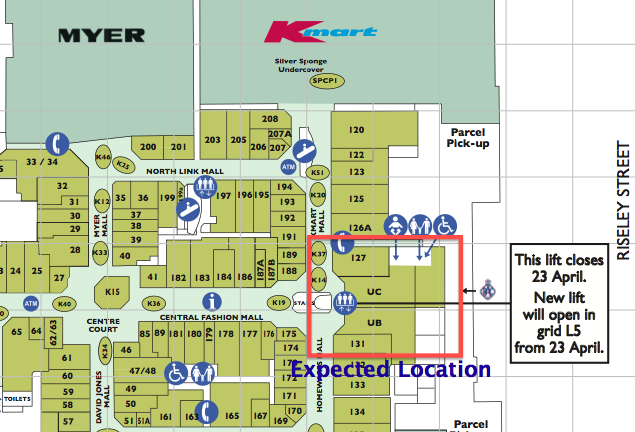
Apple is set to open their second retail store in Perth, Australia later this year according to a report by PerthNow. Apple has reportedly begun recruitment for the second store, named in their job advertisement as “South Perth”. PerthNow believes that the store will be located in the suburb of Booragoon, inside the large Garden City shopping centre.

Apple has apparently taken over two of the shops in the centre (Esprit and Sportsgirl) and possibly others that are near Kmart, whilst the centre is also relocating a lift and remodelling stairs nearby. When asked for a comment, the owner of Garden City said that they were currently “remixing the area” but did not specify who the new tenant was.  PerthNow believes the store will open sometime in the second half of this year, possibly even July.

[via PerthNow]


Apple Loses A Few Legal Battles, Wins One And Responds To DOJ Allegations

The last 24 hours has seen a number of developments regarding various legal issues that involve Apple. It’s not the most riveting news, so rather than writing them up as separate posts, we’ve decided to combine them into one, easily digestible post.

Apple Responds to DOJ Allegations

Late yesterday, somewhat belatedly, Apple issued AllThingsD with a statement responding to the DOJ’s allegations of collusion with the big book publishers. It was a similar statement that the other publishers made earlier and conveyed the idea that Apple’s entrance into the e-book market disrupted Amazon’s prior monopoly in the market.

The DOJ’s accusation of collusion against Apple is simply not true. The launch of the iBookstore in 2010 fostered innovation and competition, breaking Amazon’s monopolistic grip on the publishing industry. Since then customers have benefited from eBooks that are more interactive and engaging. Just as we’ve allowed developers to set prices on the App Store, publishers set prices on the iBookstore.

Apple Permitted To Intervene in Lodsys Case

You may recall that Lodsys filed lawsuits against a number of iOS developers last year for allegedly violating their patents. Apple filed a motion to intervene in the case last year, claiming that the licensing it has attained from Lodsys itself also protects third party developers on the App Store. The court yesterday agreed with Apple and has granted permission to Apple’s motion to intervene. Unfortunately, for many developers this is too little too late, with many settling with Lodsys early on to avoid costly legal fees.

Apple Loses Attempt To Restore Push Email to German iCloud Users

Apple had been forced to suspend email push services for German iCloud users earlier in February this year after Motorola succeeded in bringing an injunction against Apple. Today the Mannheim regional court upheld that decision and Apple will be required to pay damages to Motorola Mobility.

Apple Required to Compensate Tokyo Couple For iPod Nano that Burst Into Flames

In July 2010, a first generation iPod nano spontaneously burst into flames and caused burns to the owner’s hand that took more than a month to heal. Apple was required to pay the owner approximately US$7,400 for medical fees and compensation for the pain and suffering. Apple began a worldwide replacement program of the device last November.

[via, AllThingsD, TUAW, TNW, Cult of Mac]


Understanding The Agency Model And The DOJ’s Allegations Against Apple And Those Publishers

Yesterday, the US Department of Justice sued Apple and six publishers, alleging that they had conspired to fix prices. It all centres around the switch from a wholesale model of selling e-books from the publishers to retailers (such as Amazon) to using the agency model of selling books that Apple and the publishers agreed to adopt in early 2010. Some of the publishers have already settled with the DOJ, but other publishers and Apple have vowed to fight the allegations.

But what is the agency model and how does it work? I’ve done my best to explain the two systems and some of the details surrounding the model that was adopted by Apple and the publishers that are in hot contention. I’ve also summarised the DOJ’s allegations as well as their timeline of events that the DOJ goes into great detail in their court filing. Finally, if you find yourself fascinated by the topic, at the end of the post is a further reading section to get more details and some opinions on the issue.

Jump the break to view the full article and video explaining the wholesale and agency models.

Read more


Apple’s London Stores Prepare For Olympic Visitors And Journalists

Apple is beginning to  prepare its London retail stores for an onslaught of international visitors and journalists when the city hosts the 2012 Olympics in a few months time. TUAW learnt from a “high level Apple retail employee” in London that the stores will be stocking international replacement MacBook Pro, MacBook Air and MacBook keyboards. It’ll allow the retail stores to quickly repair any damaged laptops with the correct international keyboard, particularly for journalists from overseas, where time is of the essence. Traditionally such replacement keyboards for a non-UK MacBook would have to be ordered in.

As my source told me, “London is going to be overrun by an onslaught of journalists when the games begin. We want to be prepared should they need help with their equipment during the time they are here.”

As TUAW notes, the Olympics will bring in about 325,000 extra visitors to London during the event, as well as over 10,000 print journalists as well as photographers, TV and radio reporters. The source also noted that Apple may potentially also stock new MacBooks that feature American, Asian and other international keyboards - but this is apparently only under consideration at this point.

[via TUAW]