Posts in news

Apple Joins Silicon Valley Companies To Build $2 Billion Hospital

Apple is joining HP, eBay, Intel, Oracle and other Silicon Valley companies to build a $2 billion hospital in Stanford, with $550 million of the initial cost being donated and raised by the corporate partners program that Apple has joined as member. Steve Jobs and Vice President of Retail Ron Johnson are quoted in the press release and video of the upcoming hospital, which will feature technological advancements to “change the way people interface with the hospital” with ideas contributed by the companies mentioned above.

AppleInsider reports:

More than just contributing resources, the partners will work with New Stanford Hospital planners to develop innovative new approaches to providing patient access, information, education and navigation, a program that “has the ability to change the face of health care,” according to Stanford Hospital president and chief executive Amir Dan Rubin.

The project balances new technical innovations with the goal of creating a healing environment “responsive to the emotional, social and psychological needs of patients, families, visitors, medical professionals and staff,” said a report by the hospital.

Steve Jobs, quoted on the project’s website:

All of us are very fortunate to have Stanford’s world-class medical center right here in Silicon Valley. We are very excited about the development of their new hospital and really want to support their plans.

Full press release is available here, check out the video below featuring Apple’s Ron Johnson below. Read more

Apple Looking To Improve Sound Quality of iTunes Store Songs?

According to the CNN (via MacRumors), Apple is in talks with music industry executives to improve the sound quality of songs offered in the iTunes Store, bringing them to high-fidelity standards of 24-bit instead of the current 16-bit offerings:

Professional music producers generally capture studio recordings in a 24-bit, high-fidelity audio format. Before the originals, or “masters” in industry parlance, are pressed onto CDs or distributed to digital sellers like Apple’s iTunes, they’re downgraded to 16-bit files.

From there, the audio can be compressed further in order to minimize the time the music will take to download or to allow it to be streamed on-the-fly over the internet.

CNN reports Apple might as well offer these high-quality versions as separate “premium” purchases available as an option next to the existing iTunes Store 16-bit files. The move to 24-bit, however, would bring some issues with compatible hardware – considering that iTunes also works on Windows PCs:

Many models of Mac computers can play 24-bit sound, and the iTunes program is capable of handling such files. But most portable electronics, and many computers, don’t support 24-bit audio.

To make the jump to higher-quality music attractive for Apple, the Cupertino, California, company would have to retool future versions of iPods and iPhones so they can play higher-quality files.

In 2009, Apple made the first steps to increase the quality of iTunes digital downloads by offering “Plus” – a selection of albums and songs encoded at 256 kbps without digital rights management (DRM) protection copy. Regular iTunes downloads used to be encoded at 128 kbps with DRM enabled by default. Shifting to higher quality song downloads also rises some questions on Apple’s rumored streaming service for music and data center in North Carolina: will a section of the data center be dedicated to these rumored 24-bit songs? And if the rumors of “iTunes in the cloud” are to be believed, will Apple allow users to stream 24-bit audio files to their mobile devices?

As far as kbps stats are concerned, Spotify’s current Premium subscription enables users to stream 320 kbps songs from the cloud onto their computers and iPhones, offering an option to decrease quality on slower 3G connections.


iOS Dominant In European Smartphone Usage

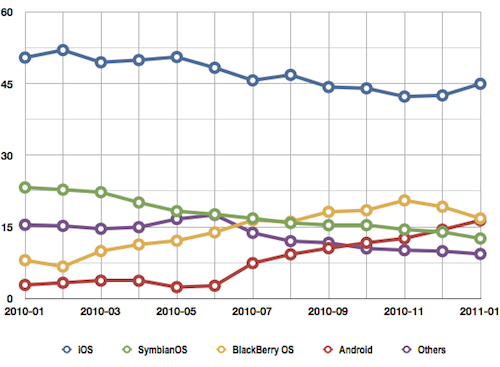
A report by RegHardware based on data from service StatCounter reveals that Apple’s iOS is still dominating the smartphone usage in Europe, in spite of its “gentle decline”. StatCounter isn’t of course installed on any website available on the internet, but it provides good indication of trends in the mobile space thanks to its 3 million tracked webpages.

Europe as a whole clearly favours iOS - its market share has run between 50 per cent and 45 per cent between January 2010 and January 2011 - which is well ahead of nearest rivals Symbian, BlackBerry and Android.

It’s no surprise to see the decline in Symbian usage - any more than it is to see the rise in Android mobile browsing, but BlackBerry usage certainly appears to have peaked, hitting 18 per cent and then falling back. And while Apple’s share is trending downward, it’s a very gentle decline.

UK stats provided by StatCounter also gives us a glimpse at the rapid increase of Android’s marketshare, while BlackBerry OS surpassed iOS’ web traffic in the last few months of 2010 in the UK. iOS and Android are clearly shaping up to be the two most important and relevant mobile platforms for years to come, with RIM’s BlackBerry and Nokia’s Symbian now left behind to generate lower numbers.

The number of tablets coming out in the next months running Google’s Android and Nokia’s adoption of Windows Phone 7 for its future handsets will likely affect the overall OS usage in the mobile environment, but analysts expect iOS to remain dominant throughout all 2011 with the release of the next-generation iPhone and an eventual price drop of the current-gen iPhone 4.


Rumor: iPhone 5 In September?

Right after speculation of a “delayed” iPad 2 launch in June, Business Insider reports FBR Capital Markets analyst Craig Berger said in a note to investors that the next-generation iPhone might not be ready until September:

For the iPhone 5, we continue to hear that a July launch is unlikely, with various casing suppliers and touch suppliers still ramping up, with some chip vendors not having yet received firm iPhone 5 orders, and with other sockets like the image sensor (most likely going to Omnivision exclusively, but with some potential for Sony to split that socket) still in flux. Given these factors, we think a September launch is more likely.

These reports of analysts claiming delayed launches of various Apple products keep on sounding very inconsistent to us. How come Apple is experiencing all these production issues in 2011? What about iPad 3 in September rumors, white iPhone 5? We think these reports are based on nothing but pure speculation – we really hope so.

Apple usually announces a new model of the iPhone at the WWDC in June, releasing it a few weeks later. A September launch would also possibly delay the iPod / iPod touch regular updates. A number of reports in the past indicated the new iPhone (dubbed iPhone 5) was on track for a summer / June release, featuring a new Apple A5 processor, NFC capabilities and a slightly bigger screen (this one not very likely to happen).

Here’s an idea: what of this September launch analysts have reported is about a smaller iPhone, and not the iPhone5? The New York Times wouldn’t agree.


Intel Updates Price List with New Sandy Bridge Chips

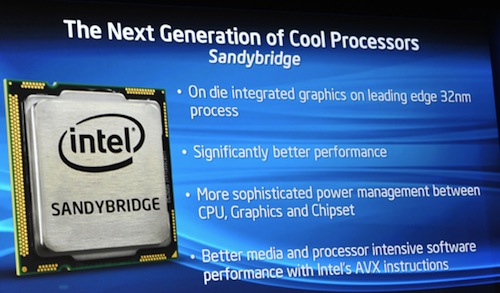
As noted by CNET, Intel has updated its price list to include details for the new dual-core Sandy Bridge chips likely to be implemented by Apple in the next-generation MacBook Pros that, according to the rumors, should come out on Thursday.

The chipmaker yesterday added i3, mobile i5, and mobile Core i7 dual-core chips to the list of Sandy Bridge processors for sale.

A low-power i5-2537M (1.4GHz) and standard-power i5-2540M and i5-2520M mobile chips have been added to the price list. They are priced at $250, $266, and $225, respectively, in thousand unit quantities.

A sizable cluster of new dual-core i7 mobile processors includes the i7-2620M (2.7GHz), i7-2649M (2.3GHz) and i7-2657M (1.6GHz). Those are priced at $346, $346 (also) and $317, respectively.

The new i3 processors include the i3-2120 (3.3GHz) and i3-2100 (3.1GHz). They are set at $138 and $117, respectively.

Intel previously confirmed the Sandy Bridge CPU line would ship on February 20th after initial issues encountered in the manufacturing process with SATA connectors on the new chips. CNET also reported two weeks ago Apple is set to release new MacBook Airs in June, powered by Intel’s Sandy Bridge processors.


iPad 2 Delayed Until June Due to Production Issues?

Bloomberg reports a research note issued by Yuanta Securities Co. indicates the next-generation iPad might be delayed until June due to “production bottlenecks” at Apple’s manufacturer Hon Hai Precision Industry Co.

The delay arose after Cupertino, California-based Apple made design changes before the Lunar New Year, according to a report by Vincent Chen and Alison Chen, analysts at Yuanta. Jill Tan, an Apple spokeswoman in Hong Kong, declined to comment on the report.

Our checks suggest new issues are being encountered with the new production and it is taking time to resolve them,” said Chen in the report. “As a number of Android 3.0 tablets are being launched in April and May, the delay in iPad 2 shipments may give the Android camp a brief window of opportunity.

The June timeframe does sound a little strange for Apple, which usually releases a new iteration of the iPhone in late June / first weeks of July, announcing it at the WWDC in the first weeks of June. A new iPad in June would have to face the obvious competition generated by the iPhone itself, although according to this report Apple has no choice because of “production issues”. The design changes also mentioned in the report would have been made three weeks ago, a few days before the Wall Sreet Journal weighed in to confirm a new iPad was in production. The timing of this rumor is somehow interesting in our opinion.

The design changes that are allegedly causing delays could go from new display technology or Retina Display to rear-facing camera adoption and a Light Peak interface for the new iPad. “Design changes” could mean anything, really, and the report doesn’t do much to address more details. We think it’s very unlikely that Apple will push the release of the much anticipated iPad 2 until June, which has become the month for the new iPhone. Another theory is that Apple will release the iPad 2 in late April / first weeks of May and the iPhone 5 in early July, thus putting roughly two months between the availability of each device. This, however, still doesn’t explain why Apple would release another iPad as early as September.


White iPhone 4 Still Missing, White iPhone 5 Rumors Begin

The white iPhone 4 has become some kind of a myth in the Apple rumor mill and production line with its multiple delays, reports of color and light issues, magical Japanese paint and presence on various international carriers websites. With a rumored release date of “Spring 2011”, we’re still waiting to hear of any updates from Apple in regards of this mythical device that Steve Jobs proudly showed on stage at the WWDC last year.

But forget about the white iPhone 4. Digitimes is reporting today the Chinese-language Economic Daily News paper indicated Wintek has been selected to be the “sole touch panel supply for white iPhone 5s” – reportedly shipping in June.

Wintek reportedly to be the sole touch panel supply for white iPhone 5s and may replace TPK Touch Solutions to become the leading touch panel maker worldwide in 2011 as Apple plans to focus on white models for the iPhone 5, according to a Chinese-language Economic Daily News (EDN) report.

How is this even possible, we don’t know. The white iPhone 4 is nowhere to be seen and the well-informed people in China are already talking about suppliers for a white iPhone 5. If this is true, the white iPhone 4 with a Spring 2011 release would be just a few months ahead of the white iPhone 5 in June – which doesn’t really make sense. Perhaps Apple killed the white iPhone 4 altogether and it’s using the Japanese paint for the iPhone 5? Maybe there’s no white iPhone 5 at all? Maybe a little bit of both?

We don’t know. But we’re pretty sure our next iPhone is going to be black.


Steve Jobs: “We Created Subscriptions for Publishing Apps”

Following yesterday’s concerns in regards of Apple’s new subscription and in-app purchase policy for third-party publishers and developers, a MacRumors reader emailed Steve Jobs asking for clarification on the matter.

Yesterday, the developers of online reading service Readability announced that they would stick with the web platform as Apple rejected their iOS application that has a subscription feature, but it’s more of a “Software as a Service” (SaaS) rather than a “publishing” app. Readability aggregates articles saved from the web and displays them in an elegant and uncluttered view. Similarly, the TinyGrab developers (a screenshot taking tool) said they would soon cease App Store support because of the in-app purchase policy implemented by Apple. Read more


Another Leaked Case Suggests iPad 2 Will Simply Be Called ‘iPad’, Comes with Rear Camera Hole

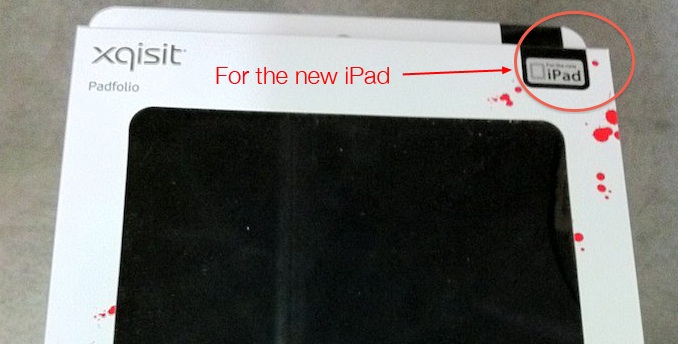
As noted by Apple Bitch, a new leather case for the next-generation iPad leaked to German website Macerkopf.de (Google Translation) confirms a series of rumors we’ve been hearing about the device like tapered edges, thinner design, rear-facing camera and flat back, but also provides some details on the actual name of the ‘iPad 2’. The term ‘iPad 2’ was indeed created by journalists and bloggers to indicate the second iteration of the tablet likely to ship in April; the retail packaging of this new case, however, comes with a simple “For the new iPad” label that may or may not suggest the ‘iPad 2’ will actually be called…iPad.

Of course, we can’t confirm on the authenticity of this leather case – which was allegedly leaked from a Swiss dealer that received more than 100 of these cases. The accessory also puts a lot of attention on the larger speaker cutout, supposedly implemented to let the new iPad achieve a much higher volume output comparable to Apple’s MacBooks.

Check out more pictures of this new case here. Another case surfaced on the internet last week reaffirmed other iPad 2 rumors such as smaller design, cameras and tapered edges.

Update: it also needs to be noted that current iPhone 4 accessories don’t come with labels like “Made for the iPhone 4”. Instead, Apple went for a simple “Made for iPhone” that doesn’t point to the “iPhone 4” name in any way. Still, we think ‘iPad 2’ isn’t really a great product name at all - especially considering Apple hasn’t named a product “x 2” since the Apple II and the iPhone is the only product that has gotten some kind of a numeric update on each generation.

On a personal note, I remember reading on videogame magazines a few years back that Microsoft didn’t choose to name the second-generation Xbox ‘Xbox 2’ to avoid the sound of an “inferior product” against Sony’s PlayStation 3. And so Microsoft went for the Xbox 360 brand that would play nice with PS3. Following this theory, Apple might not want to call the second-gen iPad ‘iPad 2’ to avoid confusion and confrontation with the iPhone 4, or even iPhone 5.