Posts tagged with "apple"

New Mineral Discovery Will Ease Component Supply Pressures For Consumer Electronics

As the market for consumers electronics continues to grow, there is one problematic question that faces the industry - can supply keep up with demand? More specifically, there are a number of “rare earth” minerals that are crucial in creating electrical components for an array of consumer electronics that include the iPhone and iPad but also more generally in LCD TVs and laptops, but have been very hard to locate in large quantities.

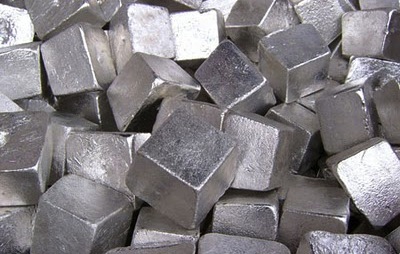
The concern about supplying such rare earth minerals may be quelled, however, with Japanese scientists discovering huge deposits of these rare earth minerals on the floor of the Pacific Ocean around Hawaii. more promising is that the deposits are of a heavy concentration with just “one square kilometer (0.4sq miles) of deposits [from the region] able to serve one-fifth of the current global consumption”. The discovery was made by a team from the University of Tokyo, led by Yasuhiro Kato, an associate professor of earth science.

He estimated rare earths contained in the deposits amounted to 80bn to 100bn tonnes – compared to global reserves currently confirmed by the US Geological Survey of just 110m tonnes that have been found mainly in China, Russia and other former Soviet Union countries, and the US.

The news has been met with positivity by consumer electronics companies and has seen a boost in share prices of non-Chinese mining companies that specialise in rare earth mineral mining. It comes after consumer electronics companies last year faced uncertainty when China last year slashed rare earth exports. The move, primarily in trade of the minerals of tantalum and yttrium, was frowned upon because China currently produces 97% of the global supply.

Sony said at the time that the move was a hindrance to free trade. Japan, which accounts for a third of global demand, has been stung badly, and has been looking to diversify its supply sources, particularly of heavy rare earths such as dysprosium used in magnets.

[Via The Guardian]


The New York Times Enables In-App Subscriptions For Their iPad And iPhone Apps

The New York Times has today released an update for their iPad and iPhone apps that now enables users to purchase in-app subscriptions for their content that is behind a paywall. There are three subscriptions available for the content, the first is $15 for website plus iPhone access, then $20 for website plus iPad and finally all digital access (website, iPad and iPhone) for $35 – all of which are charged on a monthly basis.

The implementation of Apple’s subscription service comes the day after the rumored deadline that was imposed by Apple. Although that deadline was made somewhat easier for content providers after Apple backed down on certain requirements of the subscription guidelines. Most notably is that they are no longer forced to offer in-app purchases or subscriptions for content and that they can offer the content at a different price to what they offer on their websites.

However, one rule that didn’t change was that if an app offered In-App purchases or subscriptions, they cannot offer users an external link to purchase content from outside the Apple ecosystem. The New York Times seems to have played nice with this rule, but has offered existing subscribers an easy way to gain access to the content for free – as is permitted by Apple. Today’s implementation comes after they first implemented their paywall for the iPad app in April of this year and nearly four months after they first promised that they would implement iOS subscriptions. It also follows the adoption of iOS subscriptions by other publications such as Wired Magazine, The Daily, The Telegraph and Bloomberg’s BusinessWeek.

Read more


Report: iPhone 5 Components Being Prepared For October Release, iPad 3 Too?

DigiTimes is today reporting that the supply chain for the iPhone 5 and iPad 3 is beginning to prepare materials for production of the two devices. According to DigiTimes’ sources, both devices are expected to make their debuts in September and launch to the market in October.

According to the sources, production of both the iPhone 5 and iPad 3 will begin in August with volume starting to pick up in September and October as they launch. The sources also note that roughly 6-7 million units of the iPhone 5 will be produced in the third quarter, in addition to continued production of the iPhone 4.

Upstream component makers including Foxconn Electronics (Hon Hai Precision Industry), which is in charge of assembling the devices; Simplo Technologies and Dynapack International Technology, in charge of manufacturing batteries; TPK Holding and Wintek, in charge of touch panel modules; Catcher, in charge of chassis; and Largan Precision, in charge of webcams, are all expected to benefit from the orders.

Whilst this report affirms previous rumors and analyst expectations of an imminent start of iPhone 5 production, this reports claim of an iPad 3 in October is somewhat questionable. DigiTimes has somewhat of a hit-and-miss record of Apple related rumors, although it should be pointed out that the timeline of an iPad 3 release date is a bit murky. Earlier this year there were rumors of two iPad releases this year, but then more recently DigiTimes itself claimed Apple is beginning their component certification process with a 2012 release time frame for the iPad 3.

[Via DigiTimes]


More Details Surface Over A Possible Mac Pro Refresh

MIC Gadget has an interesting article today that has some details of what could be an imminent Mac Pro update. You may recall that a few weeks ago, Cnet’s Brian Tong tweeted that an updated Mac Pro and Mac Mini would come out in August. Most interestingly, MIC Gadget managed to take a screenshot of the Apple Store a few days ago when the Promise Thunderbolt RAID system went on sale. Curiously, in one of the promo images, it was shown beside a Mac Pro. This is despite the device being a Thunderbolt-only device, which the Mac Pro does not currently support.

The image was subsequently pulled and whilst it could just have been an error by the graphics department, it does fit in line with the suggestion that Thunderbolt capability is slowly being rolled out onto every Mac with every hardware refresh. The MacBook Pro refresh earlier this year started the trend, followed by the iMac refresh and recent rumors are suggesting that the MacBook Air refresh will similarly get Thunderbolt capability. The image also suggests that the current design of the Mac Pro will go unchanged from what it currently looks like.

In a similar vein, Intel’s Sandy Bridge hardware has also been making its way across the Mac refreshes and MIC Gadget believes this trend will continue with a Mac Pro refresh. They are claiming that the Mac Pro will feature an 8 core CPU that will be ‘exclusive’ to Apple for a few months before other PC manufacturers can have access to it in Q4 of this year. They note that this isn’t particularly new, with Intel previously working with Apple on the first MacBook Air which received similar treatment.

Our sources indicate Apple is making headway with access to this technology, and they are investing heavily into the Mac Pro. Sandy Bridge will be integrated with the new Mac Pro CPU as well, but issues remain with the heat being produced by such powerful CPUs.

[Via MIC Gadget]


Apple Expected To Surpass HP In Global Portable PC Shipments In 2012

DigiTimes is today reporting that industry sources are expecting Apple to become the number one portable PC vendor globally. Hewlett-Packard (HP) is currently the number one vendor for portable PCs, but if tablets are included in the calculation, Apple will far surpass HP in 2012.

According to the sources, Apple is expected to ship 60 million iPads in 2012, accounting for 75% of all tablet shipments, which are expected to hit 80 million units in 2012. Meanwhile Apple’s MacBook line is expected to total 15 million units in 2012, bringing a total of 75 million units of portable PCs if tablets are included.

HP will continue to increase their portable PC shipments in 2012 but would be unlikely to match the success of Apple, instead shipping between 45-50 million portable PCs. Shipments of HP tablets aren’t expected to add much to this total, leaving Apple to ship roughly 20-30 million more units of portable PCs.

[Via DigiTimes]


Jailbreak Tweak Could Let You Run Multiple iPhone Apps Side By Side On The iPad

In what can only be described as borderline ridiculous, but a very awesome tweak, Aaron Ash has managed to hack together a way in which two iPhone apps can run side by side on the iPad. In a blog post, Ash makes it clear that at this stage it is only really a proof of concept, not yet ready for a public release. In particular there are some bugs that are preventing audio from playing and accelerometer data from being detected by the apps.

The bottom right button turns on “edit mode” which allows you to rearrange applications, and rotate them (Angry Birds normally runs in landscape, here they’re turned). I’m debating on if I should go for the typical desktop feel or make it more SpringBoard-like and keep apps in preset locations.

Nonetheless he says he managed to “waste plenty of time already playing 2 games of Angry Birds at the same time” on the same screen. In fact he managed at one stage to play 3 at a time, which worked until he added a fourth, which crashed the tweak. He notes that “performance is actually pretty good, definitely useable” but with those bugs he says he probably wont release it for a few months. That said, he does note that he might show the tweak off at the jailbreak meetup in New York that is happening on Saturday, July 10th.


Apple Set To Renovate The New York SoHo Store

Apple seems to be on a Apple Store renovation spree, with reports today that its landmark SoHo store is also set to undergo renovations sometime in the next three months in order to increase the space of the store. It follows the renovations of the Fifth Avenue store, also in New York, that started earlier this month as well as reports that a store in Miami and Hawaii will also be undergoing renovations.

Whilst under renovations, the SoHo Apple store will be relocated to a temporary location, somewhere within Manhattan to accommodate the thousands of customers that visit the SoHo store every day. As ifoAppleStore points out, the SoHo store, which opened in July of 2002, is currently the smallest Apple Store within Manhattan and is constantly crowded.

The renovations will apparently primarily consist of a reconfigured first floor, with the exception of the glass staircase which will not be changed – it was the first such glass staircase to be built in an Apple store. Because the Apple store is housed in the heritage listed Prince Street building the construction work did also have to receive approval by the ‘Landmarks Preservation Commission’. They did approve the works, finding that they “will have no effect on significant protected features of the building”.

[Via ifoAppleStore]


The iPad: Now With 100,000 Apps Available

At the end of March we ran a story on the iPad App Store reaching the 75,000 apps milestone in less than 365 days since the original iPad came out in April 2010. Considering the competition the iPad had to face in the past year (though some people say there really isn’t a tablet market) and the options given to developers when it came to choosing which platform to develop for, seeing iPad users gaining access to almost 100,000 apps in roughly 12 months was a surprise – looking back at those statements from tech pundits who claimed the iPad was “dead in the water”, the 75,000 milestone surely helped putting things in perspective.

Yet Apple and third-party developers have set a new record: in 453 days since the original iPad came out on April 3, 2010, the App Store has more than 100,000 iPad-exclusive apps available. Either specifically targeting the tablet, or released as universal updates to existing iPhone apps, at the moment of writing this there are 100,161 iPad apps in the Store. How do I know? The App Store app itself on my iPad shows that.

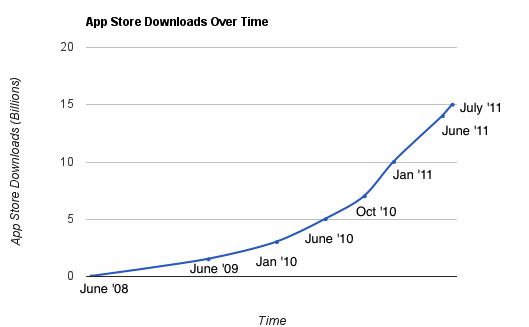
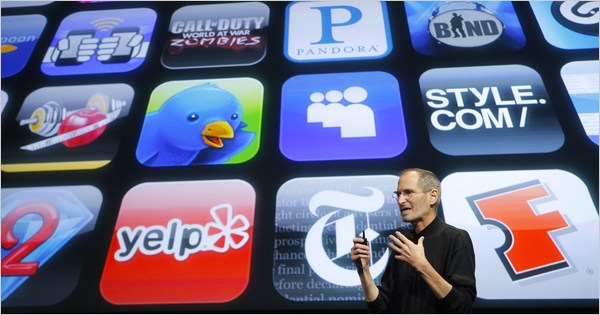
Obviously, one could argue that the iPad’s development scene was “helped” by the success of the iPhone in the previous years. The original iPhone came out with no SDK in 2007, and developers were told to create web apps for it. Apple listened, and months later they released the first developer tools to create native apps for the iPhone. With the release of the iPhone 3G in 2008, Apple also launched the App Store, a unified marketplace to browse and download apps. The rest is history: a few graphical enhancements, sections, and 10 billion downloads later, the App Store is Apple’s crown jewel as far as digital downloads go. A success that has inspired the company to create an OS X version and name it Mac App Store which, unsurprisingly, is once again helping developers sustain their business because of the ease of use of the whole process. On the other hand, users love discovering and buying apps from the App Store because it’s simple, it’s full of apps, and it’s regularly updated. It’s a win-win scenario for Apple (who keeps a 30% cut off every transaction), the developers, and the users.

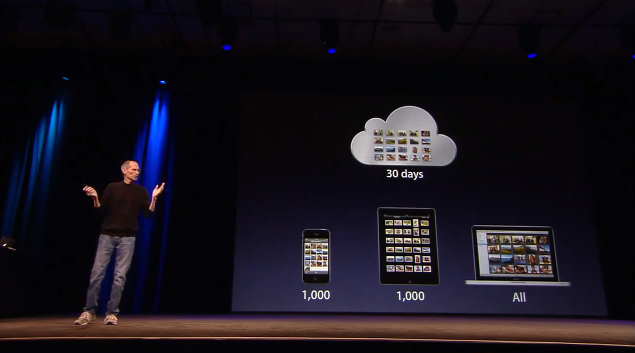
What’s next for the App Store and, more specifically, apps for the iPad? 100,000 is an important milestone, but don’t expect things to change dramatically in a short period of time. Considering how Apple rolls, the App Store will be slightly tweaked to accomodate new sections as it’s always been, more apps will be released in the next weeks, and users will keep buying apps and games. Don’t expect a revolution because Apple has reached 100,000 apps for the iPad. But that’s not to say the result isn’t remarkable or that new things aren’t coming: with iCloud going public this fall and Automatic Downloads already set in place, Apple wants to make the process of buying and syncing apps to iOS devices even simpler. With Lion approaching its public launch on the Mac App Store in July, it’s clear Apple is betting on the App Store brand as the de-facto solution for downloading software for iOS and OS X devices.

Congratulations, developers. Now onto 200,000 apps.


More Details On What Makes The Thunderbolt Cable Tick

Apple eventually started selling Thunderbolt cables and peripherals on Tuesday but many have asked why the Apple Thunderbolt cable costs, the rather expensive, $50. Ars Technica and iFixit decided to dig into the cable to find a bit more about it and discover why exactly it is so expensive.

First contacting a support technician, they were told that the Thunderbolt cable was “smart”, containing firmware inside it. Subsequently reaching out to Intel, they wouldn’t discuss anything regarding “firmware in the cable” but they did note that any Thunderbolt peripheral or device will require a specific Thunderbolt cable.

Only Thunderbolt cables can be used to connect Thunderbolt products using Thunderbolt connectors, the cables have been designed for the 10Gbps signalling as well as power delivery that are part of Thunderbolt technology.

Digging a little deeper however, Ars found this EETimes article, which noted that Thunderbolt cables use ‘active cabling’ and have different electrical characteristics from Mini DisplayPort to achieve full duplex 10Gbps transmission. Such ‘active cabling’ cables contain “tiny chips at either end that are calibrated to the attenuation and dispersion properties of the wire between them”.

iFixit decided to tear open the new cable and found that it contains two Gennum GN2033 Thunderbolt Transceiver chips which are described by the company as follows:

The GN2033 provides the sophisticated signal boosting and detection functions required to transfer high-speed data without errors across inexpensive Thunderbolt copper cables

[Via Ars Technica, iFixit]