Posts in news

iOS 5 Won’t Feature Apple’s Maps Service, Google Maps Still In?

Following today’s reports on iOS 5 coming with completely revamped notifications and widgets, 9to5google claims the next major version of iOS 5 won’t feature the maps service Apple was rumored to be working on, but it will keep using Google Maps as in the current versions of iOS.

Now, sources have told 9to5Google that although Apple is working to improve the iOS Maps application, iOS 5 will not bring an Apple developed maps service and Google Maps is still in. Besides Apple’s purchase of both Placebase and Poly9, some speculated that Apple is building their own maps service to either compete with Google or step away from their input into iOS.

The speculation on a map service developed by Apple to replace Google Maps integration on iOS devices indeed started after the company purchased Poly9 and Placebase – two companies focused on mapping softwares and location databases – also followed by various job postings Apple put up on its site, asking for map engineers and navigation experts to bring Maps for iOS “to the next level.” Putting this information together, many believed Apple skipped iOS 4 only to bring its new and improved maps to iOS 5, set to become publicly available later this year, perhaps in the Fall. Apple also briefly mentioned in the location tracking Q&A that they’re building an “improved traffic service” to launch in the next couple of years, giving more credence to the reports of Apple developing its own system, rather than an additional layer to Google Maps.

Others also suggested the disputes between Steve Jobs and former Google CEO Eric Schmidt, as well as the competition with Android might be the reason behind Apple’s intention to drop Google Maps from iOS. While it might be true that Apple would rather use its own map solution rather than someone else’s, it’s worth noting that Google Maps is the de-facto solution for online maps (used by millions of users every day) and other Google services are embedded in iOS, such as Gmail integration and search.


iOS 5 To Feature “Completely Revamped” Notifications and Widgets

TechCrunch reports today a couple of interesting tidbits about the upcoming WWDC and the announcements Apple is expected to make at the developer event. First off, MG Siegler says the reports of Apple issuing invites to British and Australian press seen as “proof” of an iPhone 5 / iPhone 4S announcement are incorrect, as Apple clearly stated months ago that WWDC ‘11 would be about software and the “future of iOS and Mac OS X.” As the iPhone PR team is handling these invites, TechCrunch notes the team is the same that covers major iOS announcements, which is obviously why Apple wants journalists at the WWDC keynote – to unveil iOS 5. As for the new features in the OS, MG Siegler quickly mentions iOS 5 will feature “completely revamped” notifications and widgets – two parts of iOS that were long rumored to be going under a complete rewrite at Cupertino. On another interesting note, he says Nuance’s voice-recognition technology (which Apple is rumored to implement with some licensing deals on iOS and OS X Lion) isn’t being used in the current internal version of Voice Control for iOS 5. Voice Control is a functionality that allows users to quickly call a contact or control music playback only using their voice.

The second bit of information we have heard is about iOS5 itself. First of all, while we’ve been leading the reports of Nuance technology being fully baked into iOS 5, one place we’ve heard it won’t be used (at least not yet) is Voice Control. That’s odd since it’s perhaps the most obvious usage. But apparently, in the builds of iOS 5 currently being tested, the little-used feature hasn’t changed at all, we hear.

That could obviously change before the release (which is still likely months away, even though it will be previewed at WWDC), but apparently the Nuance technology is meant for bigger things more core to the OS than that one feature.

The other big news for iOS5 — and yes, I’ve completely buried the lede here, thanks for reading! — two things: completely revamped notifications and widgets.

A series of fan-made concept videos in the past weeks showed how Apple could improve notifications, bring more powerful voice-recognition features and implement Lion-like Dashboard and home screen widgets, capturing the interest of Apple watchers and fans that have been looking forward to a better management of notifications and the possibility to turn some apps into widgets visible on the iPhone’s Home screen. Apple was also rumored to be considering an acquisition to improve the iOS notification system, though the report failed to provide additional details (many pointed to Boxcar as the ideal notification app for iOS) leading us to believe that Apple itself has rebuilt notifications from the ground-up for the new iOS. The WWDC kicks off in San Francisco on June 6, and Apple is expected to make a formal announcement about the keynote (and speaker) in the next days.


How Amazon’s Mac Download Store Works

Yesterday, Amazon launched a software store for Mac applications that, using the online retailer’s usual interface to browse and buy products, allows users to purchase apps and download them on their computers without waiting for a boxed copy to arrive. In what it sounded like Amazon’s response to the Mac App Store, which as of today counts thousands of apps available from all kinds of developers, we noted Amazon’s new store launched to roughly 250 titles, and didn’t allow independent developers to submit their apps for release, as the company apparently only worked with existing large sellers (like Adobe and Microsoft) to make their applications available digitally.

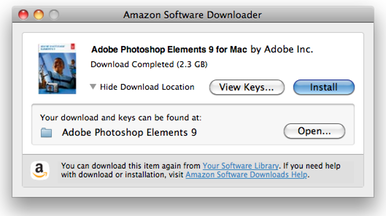
Whilst the initial impression was that Amazon’s store couldn’t compete with the ease of use of the Mac App Store but competition is always good (especially when it comes to software deals), Dan Frakes at Macworld took the Mac Download Store for a spin, and it turns out the download and installation process might be worse than expected. First off, Amazon lets you save a direct link for later in your software library, but what you get when you decide to get a new app onto your desktop is not a .dmg file or an .app – Amazon gives you an additional “app downloader” to download the actual app on your Mac:

This is where the process gets quite a bit less convenient than buying through the Mac App Store. The first thing you actually download is a small disk image (2.1MB in size, in my case) containing an application-specific [Software Name] Downloader program. Open this disk image, if your browser doesn’t mount the image automatically, and double-click the Amazon Software Downloader.app inside. After a few seconds, the Downloader program begins downloading the purchased software—not to your Downloads folder, or even to your Applications folder, but to a new folder on your Desktop.

There’s more. When trying to install Photoshop Elements with Amazon’s downloader, Frakes ended up with a new .dmg and he had to figure out by himself what to do with it:

I double-clicked the Adobe Photoshop Elements 9 item, expecting it to launch an installer, but it turns out that was just a folder with a custom icon. Inside that was Install.app (along with several folders named deploy, packages, and payloads). Double-clicking Install.app launched the Photoshop Elements installer, which prompted me to enter my 24-character license key, to sign up for an Adobe ID, and to choose which components of Photoshop Elements I wanted to install.

Obviously, it’s possible that Adobe chose a convoluted process and other apps will come with an easier installation method. However, the fact that a separate downloader needs to run in order to get the stuff you bought online seems to be the norm. Personally, I wasn’t really expecting Amazon’s new Mac store to offer the same experience of the Mac App Store (which, small bugs aside, truly is the best way to discover, install and recover Mac apps), but reading Dan’s article makes me wonder how many average and “geek” users will choose this over Apple’s own store or even a boxed copy just for some small discounts or the fact that you can pay with your existing Amazon account. Make sure to read the entire post to know more about the post-installation and, more importantly, how Amazon handles licenses and software keys on multiple computers.


Back to School Announcement at WWDC with Special iPad Discounts?

BGR reports one of Apple’s announcements at the upcoming WWDC will be about the Back to School 2011 program, which was initially rumored to launch this week. According to the website, this year’s Back to School will continue offering a free iPod touch to students who purchase a new Mac, although it’s possible that Apple will also kick off a new promotion with a $200 discount off an iPad following the purchase of a new Mac.

We have been told Apple will continue to offer educational discounts on computers and either a free iPod touch, or $229 towards the purchase of any other iPod. Our source also let us know that there might be something new in the works, as well… they heard that it’s possible Apple might offer students up to $200 off an iPad with the purchase of a new Mac.

The Back to School program has usually been announced in late May or early June. With the WWDC starting on June 6, the promotion could play nice with other major announcements such as Lion and iOS 5 made on stage. In the past years, Back to School allowed students to get a free 8 GB iPod touch, and the current family of iPod touches starts at $229 with the 8 GB model featuring the Retina Display and FaceTime camera. Apple’s push in the educational market was brought to the press’ attention again two weeks ago as the University of Delaware said an “Apple Store” would come on campus, enabling students to check out and buy products directly next to university’s library. With a wide selection of apps targeting students available on the App Store, $200 off an iPad combined with, for example, a MacBook Air indeed would be a good deal.


Spotify on the Back Burner as Labels Sign Deals for iCloud

According to an article by Eliot Van Buskirk at Evolver.fm (republished by Gizmodo), US record labels are waiting for Apple’s rumored iCloud music service to launch publicly before closing the remaining deals that are preventing Spotify, a popular music streaming service, from launching in the United States. Several rumors claimed Apple is working on an online interface for iTunes to allow users to upload and stream their music collections from the cloud, with a report from last night suggesting Apple will adopt a system similar to Lala (which they acquired last year) to scan a user’s library and mirror songs to their servers, also offering subscriptions and possibility to get access to higher-quality versions of the same songs.

We heard an interesting theory the other day from a well-connected source: Record labels accustomed to receiving big checks from Apple want to give Steve Jobs and company a crack at offering a music subscription service to Americans before Spotify enters the ring, so they’ve been dragging their feet (i.e. demanding too-high payments) in their negotiations with Spotify, preventing it from launching here until after Apple’s cloud music service does.

Spotify has long been rumored to be getting ready for a US launch, though the European company never managed to ink the final deals with the Universal Music Group and Warner Music group. It was previously reported that Spotify had signed papers with Sony Music and EMI for a US launch, alongside the fact that record labels were demanding the adoption of premium subscriptions only, forcing Spotify to ditch their freemium model if they wanted to launch in the US. On the other hand, Apple is believed to be approaching the final stages of negotiation with Universal Music Group, as EMI, Sony and WMG are already on board for the iCloud announcement at WWDC. Others have also reported Apple will have to finalize deals with music publishers, besides labels, before launching any music service, with negotiations also quickly moving forward on that end.

Evolver’s article reminds of an old rumor that claimed Apple executives (including VP of Internet Services Eddy Cue) were pressuring labels to decline Spotify’s offers to prevent the European company from launching a freemium music service in the US. However, the new theory seems slightly different in the way the labels are willing to wait for Apple’s iCloud to become available before closing deals with Spotify. Spotify currently offers desktop and mobile applications to listen to an online music catalogue thanks to the deals the company has signed with European labels. Apple’s new service is rumored to offer a similar setup, with iOS devices capable of streaming music from the cloud and iTunes for Mac and Windows handling uploads and other functionalities.


Rumor: Apple Testing A5-powered MacBook Air

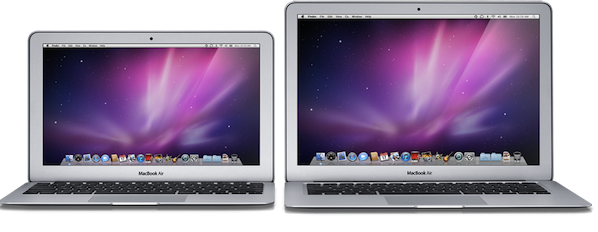
According to a new report by Japanese blog Macotakara, Apple is testing internally a new version of the MacBook Air powered by an ARM-based A5 processor and Thunderbolt connectivity. The website reports the machine is made by Quanta Computer, and this speculation comes amidst rumors of a MacBook Air refresh featuring Intel’s Sandy Bridge and Thunderbolt set for a June or July launch.

According to this source who saw live A5 MacBook Air actually, this test machine performed better than expected.

Though it’s not clear which Mac OS X or iOS is pre-installed on this A5 MacBook Air, iOS seems to have difficulty to use features of Thunderbolt without Finder. And even if Mac OS X is installed, developer should spend time to support A5 on Universal Binary Applications. As considering these situation, this A5 MacBook Air seems to be made just for experiment.

The shift to an ARM architecture on OS X would require Apple to rewrite parts of the operating system (though iOS, derived from OS X, runs on ARM chips) and, most of all, third-party developers to update their applications to be universal binaries capable of running both on Intel and ARM CPUs. This would be a resource and time consuming process according to many, similarly to when developers had to switch from PowerPC to Intel years ago, though a recent report claimed that Apple was willing to implement ARM on the desktop, perhaps also offering converting tools and other utilities to make the transition easier. Still, Macotakara seems to suggest this alleged A5-powered Air is being tested as an experiment, which, if true, wouldn’t come out at least until next year; the website correctly pinpointed many of the iPad 2 hardware and design features in the past months, offering credible mockups of the device ahead of its launch.


Group Plans Protests At Apple Stores Over Proposed Tax Breaks

On June 4, just days prior to WWDC, the US Uncut group plans to target Apple retail stores in protest against Apple’s support of the ‘Win America Campaign’ (WAC). The goal of the US Uncut organization is to fight companies that try to avoid taxes, and they are unhappy with what they claim is Apple lobbying Congress for a $4 billion tax cut. The group will be protesting for Apple to leave the WAC, cease such lobbying activities and to refrain from engaging in tax loopholes.

Apple plays huge games with their taxes. By disguising profits in the U.S. as foreign earnings in low-tax countries, Apple dodges billions of dollars of taxes they should be paying. We are all disappointed to see a great company like Apple participate in such a deceitful campaign that violates their commitment to operate in a socially responsible manner

The WAC group, which is supported by a number of other technology conglomerates including Microsoft, Google and Adobe, is currently lobbying Congress for the Freedom Invest Act of 2011 to lower taxes on American companies involved in selling goods and services overseas. The drafters of the bill claim the money companies save from taxes could be re-invested within the country.

Apple is US Uncut’s main target in the demonstrations on June 4th and has put together an “action kit” with signs, leaflets, chants and slogans. The group will even enter Apple Stores and perform a “dance-in flash mob”, audaciously planning to record the result on the Apple computers on display. CNet contacted Apple for comment, but they did not respond. Jump the break for a video from US Uncut campaigning against Apple and the WAC.

[Via CNet]

Read more


OS X Lion Nearing Public Release?

According to a report from TUAW, Mac OS X Lion has gone “live for internal testing” at Apple last week. Whilst it’s not clear what that means, we assume Apple has begun widespread internal testing of a new build of the OS that’s nearing GM status. TUAW suggests Lion might see a public release at WWDC in two weeks, or at least sooner than previously expected considering many had pointed at Lion on track for a late July / August release:

This suggests the new OS might possibly ship as early as WWDC with an “available today” mention at the keynote – or it might not. But Lion is looking to be one step closer to availability for Apple customers.

The latest developer preview of OS X Lion brought minor graphical changes to apps Apple had already updated in previous DP builds, as well as tweaks and performance improvements to make the OS more stable and faster. Developer builds of Lion have been seeded through the Mac App Store with a redeem code system, though Apple is also believed to make the OS available on DVDs or portable USB keys for users with slow Internet connections, unable of downloading GBs of data from the Mac App Store.


iCloud Will Scan iTunes Libraries, “Mirror” Songs Online

In a post detailing the current state of cloud-based music services from Google and Amazon, Businessweek relays some information on Apple’s upcoming iCloud service, rumored to include streaming of iTunes collections to a variety of devices and computers and said to be formally introduced at the WWDC keynote on June 6. Similarly to a rumor posted a few months ago that indicated Apple was working on a solution to let users backup & upload their collections to the cloud directly from the desktop, Businessweek says “three people briefed on the talks” (between Apple and music labels) have suggested Apple will provide a scanning tool that quickly mirrors songs to iCloud’s servers, also offering a way to replace those songs with better-quality versions if quality is not deemed “good enough.”

Armed with licenses from the music labels and publishers, Apple will be able to scan customers’ digital music libraries in iTunes and quickly mirror their collections on its own servers, say three people briefed on the talks. If the sound quality of a particular song on a user’s hard drive isn’t good enough, Apple will be able to replace it with a higher-quality version. Users of the service will then be able to stream, whenever they want, their songs and albums directly to PCs, iPhones, iPads, and perhaps one day even cars.

Businessweek also briefly mentions Apple could use a subscription-based model to give users access to these functionalities and stream songs they purchased or uploaded. Whilst the general consensus among bloggers seems to be that Apple will either allow users to upload entire music collections or listen to songs they don’t own like Spotify enables subscribers to access the company’s online database with a subscription, the technical details on Apple’s iCloud service are still unclear. A patent design suggested Apple could make users sync small bits of music locally and fetch the rest online to avoid buffering between songs; others claimed it will be a simple system revolving around uploads and streaming like Amazon’s Cloud Player; several reports also pointed at Apple building a new service that combines subscriptions, partial uploads and scanning tools to reduce upload times on a user’s end. Businessweek seems to believe the latter option, with a subscription-based payment and a desktop utility that scans iTunes and somehow mirrors everything quickly to the cloud.