Federico Viticci

10766 posts on MacStories since April 2009

Federico is the founder and Editor-in-Chief of MacStories, where he writes about Apple with a focus on apps, developers, iPad, and iOS productivity. He founded MacStories in April 2009 and has been writing about Apple since. Federico is also the co-host of AppStories, a weekly podcast exploring the world of apps, Unwind, a fun exploration of media and more, and NPC: Next Portable Console, a show about portable gaming and the handheld revolution.

Measures for iPad Is A Powerful Unit & Currency Converter

Back in 2009, I installed a simple currency and unit conversion utility on my iPhone called Measures. Developed by Michael Neuwert, I remember Measures as one of the first “popular” converter apps for the iPhone, one that actually managed to move thousands of sales back when the App Store was still relatively small. Two years and hundreds of thousands of app later (let alone the iPad and two new App Stores), Measures is coming back with an HD version built specifically to take advantage of the iPad’s screen. Retaining the same icon and UI color scheme of its iPhone counterpart, Measures HD packs 170 currency exchange rates (constantly updated over the air) and 1000 different units, organized in 40 categories.

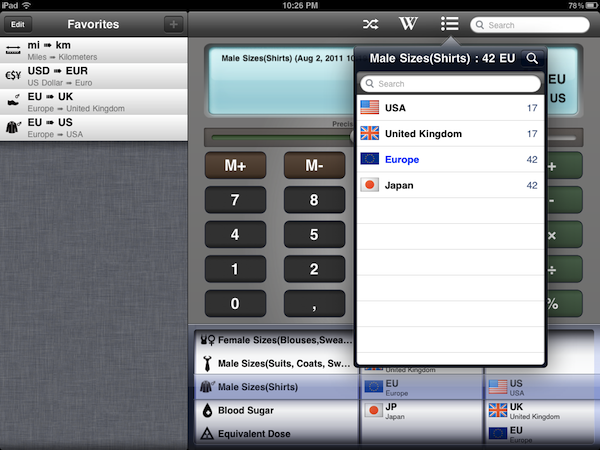
I like Measures HD not because of its design, but because it’s functional. Measures may lack the amount of polish seen in any Tapbots or Iconfactory app, but as far as the actual unit and currency conversion goes, Measures works better than anything else I’ve tried on the iPad to date. There are two aspects of the app that truly stand out to me: the Favorites sidebar, and the fact that Measures doesn’t stop at normal units like those pertaining to length, area, speed, or temperature. Measures adds dozens of categories ranging from Male Shoe Sizes and Data Storage to Radioactivity, Male Sizes for suits/coats/shirts, and Typography. With all these types of “units” available at your fingertips, Measures lets you convert, say, a European shoe size to a UK or US one, or your milligram/deciliter blood sugar level to millimol/liter. And again: you can easily convert megabytes to yottabytes, short tons to pounds, and obviously US Dollars to Euros and other currencies as well.

Measures’ unit database is huge, and if it’s not the biggest one on the App Store yet, then it definitely get very close to it. Whilst most converter apps focus on providing a fresh interface for the usual units and currencies, Measures sacrifices some attention to the overall design (I don’t like the slider to adjust decimals and the looks of the keypad – but this is just personal taste) to focus on “real life usage” with options like the aforementioned shirt sizes, or fuel consumption and data storage. This is the kind of stuff I always need to check (especially when buying some cool t-shirt from a website that doesn’t list EU sizes), but that very few apps provide. In fact, most of the times I’m forced to look it up on Wikipedia. Speaking of which, Measures HD comes with a Wikipedia search function to look up the selected unit on the website’s database. Multiple Wikipedia articles (when found, otherwise it’s just a single one) are listed inside a popover, and you can decide to open the webpage within Measures, in Safari, or in Sophiestication’s Articles. Next to the Wikipedia button in the top toolbar, there’s also a “list” icon to see all converted results without being restricted to a single conversion.

Another nice feature is the Favorites sidebar, which enables you to save any conversion for quick access at a later time. If you find yourself converting Euros to Dollars pretty often, you might want to consider saving that conversion as a shortcut in the Favorites so you won’t have to use the (gimmicky) unit picker at the botton; Apple itself suggests in its Interface guidelines to use a “date and time picker” for iPad  inside a popover rather the main screen – I agree, as the result is not really pleasant in Measures and it feels unresponsive if your finger runs down to the iPad’s bezel.

Overall, I enjoy having Measures on my iPad because it’s useful. The app could use some UI refinements and re-thinking, but as it stands now it is the converter app for iPad with the largest array of options I’ve seen so far. You can download Measures HD at $1.99 on the App Store. Check out more screenshots of the app after the break. Read more


Facebook Acquires Award-winning iOS Publishing Platform Push Pop Press

It was only last February that Push Pop Press started teasing a brand new kind of digital books for the iPhone and iPad, promising to revolutionize the way users interact with text, images, and video on a multi-touch screen. Started by former Apple employees, Push Pop Press built a unique publishing platform and physics engine that was best demonstrated in Our Choice, Al Gore’s book ported over to Push Pop Press’ platform, released on the iPhone and iPad and winner of an Apple Design Award in June.

With an update on their website, Push Pop Press has announced that they’ve been acquired by Facebook. It’s unclear how the technology will be integrated into the “world’s largest book”, but the blog post says “although Facebook isn’t planning to start publishing digital books, the ideas and technology behind Push Pop Press will be integrated with Facebook, giving people even richer ways to share their stories”. Push Pop Press’ first book Our Choice will remain available for sale with profits donated to The Climate Reality Project; future books planned with Push Pop Press’ closed beta won’t be published following this acquisition.

Now we’re taking our publishing technology and everything we’ve learned and are setting off to help design the world’s largest book, Facebook.

TechCrunch also reports a statement from Facebook:

We’re thrilled to confirm that we’ve acquired Push Pop Press, a startup whose groundbreaking software changes the way people publish and consume digital content. We can’t wait for co-founders Mike Matas and Kimon Tsinteris to get started, and for some of the technology, ideas and inspiration behind Push Pop Press to become part of how millions of people connect and share with each other on Facebook.

You can read our original review of Push Pop Press’ Our Choice here. Whilst Facebook apparently has no plans to enter the publishing market, Push Pop Press’ interaction methods and innovative engine might be a good fit for Facebook’s iPhone and upcoming iPad app.


iCloud Storage: International & Competitor Pricing Comparison

Last night, Apple launched a first developer beta of iCloud.com, a set of web apps based on the iCloud functionality originally introduced in iOS 5 beta that mimic the appearance of Apple’s Lion desktop apps like Address Book and iCal, or the Mail app for iPad. The new web apps, seen as replacements for MobileMe’s existing web offerings, have been completely rewritten to take advantage of iCloud’s faster and invisible sync of content between devices, and they also include a new web-based version of iWork that, however, isn’t live yet. Screenshots (and videos) of the iCloud web apps have surfaced online and partially on Apple’s website too; early screenshots of the login page had been leaked ahead of the WWDC in June.

The iCloud web apps provide an alternative to their iOS and OS X counterparts – being entirely web-based, they can come in handy “if you happen to be away from home without your computer or one of your iOS devices” so that “you can access your mail, contacts, and calendar — ad-free — from any computer at icloud.com”. Read more


Skype for iPad Released

Skype for iPad, first “leaked” online back in late June, has finally been released for free in the App Store as a standalone app, as noticed by TUAW. The app isn’t a universal update for the iPhone version, meaning you’ll have to download it as a separate app on your iPad, and it’s not yet available in the US App Store. The app will likely be released in the US Store later today, perhaps in a few hours.

Skype for iPad features an all-new interface design with larger contact pictures, a buddy list on the left, and possibility of starting a new video-calling session in full-screen with video being captured from the iPad’s rear or front-facing cameras. The app can do video and audio calling both on WiFi and 3G, much like the iPhone version already can.

A list of features from the iTunes page:

  • Talk face-to-face or show what you’re seeing with front and back-facing cameras.
  • Use Skype for iPad to call anyone else on Skype – and enjoy near CD quality (SILK) sound.
  • Instant message and add emoticons to personalize your messages.
  • Make cheap calls to landlines or mobiles from your iPad.
  • Get an Online Number from Skype so people can call you on your iPad.
  • Pay As You Go with Skype Credit - great for when you’re using Skype every now and again.
  • Pay monthly with a subscription – best if you use Skype a lot.

We will update this story with more details on the app and first impressions as soon as we get our hands on it. More screenshots and original “leaked” promo video below.

Update: Skype for the iPad is now live in the United States. Download it here.

Update 2: We have first impressions and some screenshots up past the break.

Update 3: Skype has pulled the app from the App Store, saying that it went live “prematurely”.

Update 4: It appears the app is back and can be downloaded from the App Store.

Read more


Apple Seeds iWork for iOS Beta Apps With iCloud Support

Following the launch of iCloud.com beta to developers, Apple updated its iCloud beta for Developers page including special versions of the iWork for iOS apps. Labelled “iWork for iOS beta apps” by Apple, the package includes new versions of Pages, Keynote and Numbers for iOS that will allow developers and testers of iCloud to start working on a new document on a device, and find it after a few seconds on another iCloud-connected device or the web counterpart, which also comes with web apps to edit documents.

The functionality was first demoed by Apple at the WWDC in June, and an iOS developer program membership is required to test the new iWork beta apps.


TweetFire: A Lightweight and Fast Twitter Companion for iPhone

In my review of the first version of Tweetbot, I asked whether it was still possible to bring innovation to Twitter clients for iPhone, a category of apps that have offered more or less the same features for quite some time now, with the focus now being on interface design to make an app feel “unique”. With different takes on the same concept (interacting with Twitter) and with the company itself advising against “regular” third-party client apps that most users won’t install (they say people fire up the App Store, download Twitter’s official app, and that’s it), mine was a legitimate question. Is there still room for something new?

As Tweetbot’s successful launch has proved, there’s a niche of users willing to try out what’s new in the Twitter ecosystem. Tapbots have managed to build a loyal new userbase of customers interested in their unique spin on Twitter clients – these people have stuck around long enough to wait for push notifications and the consequent rapid rollout per Twitter’s own API approval. But I also take a look at Twitterrific from The Iconfactory, another third-party client that has built its own ecosystem across the Mac and iOS and which, from what I’m hearing, is about to introduce great new features in an upcoming update. I’ve mentioned Tweetbot and Twitterrific so far, but there are dozens of clients from both big and smaller indie companies that are thriving in spite of Twitter’s official free tools for the iPhone, iPad, and Mac.

And then there’s Apple’s initiative with Twitter and iOS 5, which will bring native Twitter access (single sign-on, contact lookup, tweet integration) to its mobile operating system. Users will be able to tweet photos and webpages, addresses in Maps and cool videos they find on YouTube. But they won’t be able to read their timelines, or receive push notifications through Apple’s native implementation. For these reasons, and because it is my job to look out for what’s next, I believe innovation in Twitter clients is far from done (that is, unless Twitter adopts changes that will make it impossible for developers to keep creating third-party tools), and we just need to keep looking to find the next app that may, in some way, improve the way we share information on Twitter from a smartphone or tablet. Read more


Mockups Show Lion Inspired Changes For Future Firefox

Like Google’s Chrome browser, Mozilla announced earlier this year its intention to move to a fast release cycle for new major versions of its popular browser for Windows, Linux and Mac, Firefox. Following the launch of Firefox 4 in March – which brought major design changes from Firefox 3 – Mozilla moved up its schedule and released Firefox 5 in June, just three months after the previous upgrade, adding a “Do not track” feature for all browsers and platforms, as well as other HTML5 and CSS improvements, although the UI design remained largely unchanged from Firefox 4. As part of Mozilla’s new channel-based alpha and beta testing, Firefox 6.0 is already available as beta, whilst Firefox 7.0 has been made available as early developer preview (or alpha) in the Aurora channel. You can read more about Mozilla’s new “every six weeks” policy here.

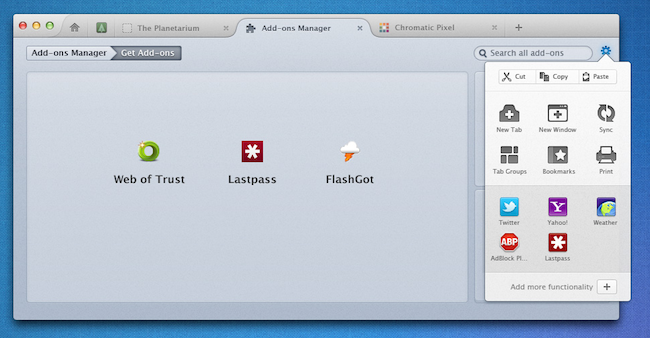
While waiting for the future Firefox 6.0 and 7.0, Mozilla’s Product Visual Designer with the Firefox team, Stephen Horlander, has posted some mockups of what the future Firefox could look like on Windows and OS X machines. The images, posted as a presentation on Mozilla’s website, don’t necessarily reflect any upcoming feature in the next versions of Firefox, but they provide some kind of insight into the kind of discussions the team is having in regards of what could come next.

As you can see from the image above (more here), the proposed solution unifies Firefox’s top bar to accomodate tabs, a Home button, a new tab button, as well as integrated add-on manager that has its own tab (much like Google Chrome opens its settings in new tabs, rather than windows). The mockups have been built on top of OS X Lion, as you can tell from the window texture and the traffic lights in the upper left corner. Speaking of which, Horlander has also played around with Lion’s monochrome and popovers, implementing monochromatic icons for cut/copy/paste, bookmarks and tab controls inside a settings popover accessible from a gear icon next to the address bar. Another screenshot shows native full-screen support with minimal chrome when browsing a website. On the PC side, the proposed changes are similar, but based on Windows’ default theme.

It’ll be interesting to see whether these Lion-inspired changes for Firefox on the Mac will evolve into an actual release in the coming months. Meanwhile, Windows users can install this fan-made theme that takes some of Horlander’s UI elements, and applies them to the current version of Firefox.


Apple Releases iOS 4.3 for Apple TV [Updated]

Apple has just released a new version of iOS for the Apple TV second-generation – iOS 4.3 with build number 8F455. Whilst there is no official changelog for the update yet, a series of tweets from Daring Fireball’s John Gruber suggests iOS 4.3 brings the possibility of streaming purchased TV Shows, including all the shows you’ve already bought in iTunes. Since the introduction of iCloud at the WWDC in June, Apple rolled out new features in iTunes to let users re-download every single purchase they made with their Apple IDs – this applied to music, apps, and books. With a new tab in the same Purchased section, Apple now allows you to re-watch TV Shows you’ve bought through iTunes. The “Purchased” option in iTunes was announced alongside iCloud (which will launch this Fall) and the broader iTunes in the Cloud initiative – in spite of iCloud still being a “beta” for developers, every Mac, iPad, iPhone and Apple TV can benefit from these re-download functionalities now. Read more


Forbes Profiles Comex, The iPhone Hacker Behind JailbreakMe

Forbes Profiles Comex, The iPhone Hacker Behind JailbreakMe

Forbes has published an interesting story on comex, the 19-year old hacker and Cydia developer who has released jailbreak tools for the iPhone multiple times in the past years. Namely, the latest iteration of JailbreakMe (which relied on a vulnerability in the iOS’ PDF rendering library that Apple patched after 9 days) has been used over 2 million times to jailbreak iOS devices (including the iPad 2) running iOS 4.3.3. Last year, comex released JailbreakMe 2.0, again based on a bug in the PDF engine, which allowed users to jailbreak devices running iOS 4.

The popularity of comex (his Twitter account alone has over 172,000 followers) and the anticipation that precedes every jailbreak release had the unpleasant side effect of a leak of an early beta version of JailbreakMe 3.0, which forced comex to rush the public release fearing Apple’s upcoming fix.

Perhaps the most interesting part from Forbes’ story is this little tidbit about comex’s background:

The young hacker taught himself to code in the programming language Visual Basic at the age of nine, gleaning tricks from Web forums. “By the time I took a computer science class in high school, I already knew everything,” he says. When he found that he couldn’t save a screenshot from the Nintendo Wii video game Super Smash Brothers to his computer, he spent hours deciphering the file, and later worked on other Wii hacks, getting a feel for its obscure operating system.

“I didn’t come out of the same background as the rest of the security community,” he says. “So to them I seem to have come out of nowhere.

Whilst Apple is seemingly “borrowing” ideas from the jailbreak community to implement them in iOS 5 in a more polished way, questions remain whether the future of the iPhone has much room left for jailbreakers. The way I see it, as long as Apple won’t allow users to freely customize the experience of iOS at the same degree the Mac does, and as long as people like comex will be around, there will always be a reason – we’re not talking about the necessity – to jailbreak a device.

Read the full story over at Forbes[image via]

Permalink