Posts tagged with "iOS"

Mela: An Elegant and Innovative Recipe and Cooking App for iPhone, iPad, and Mac

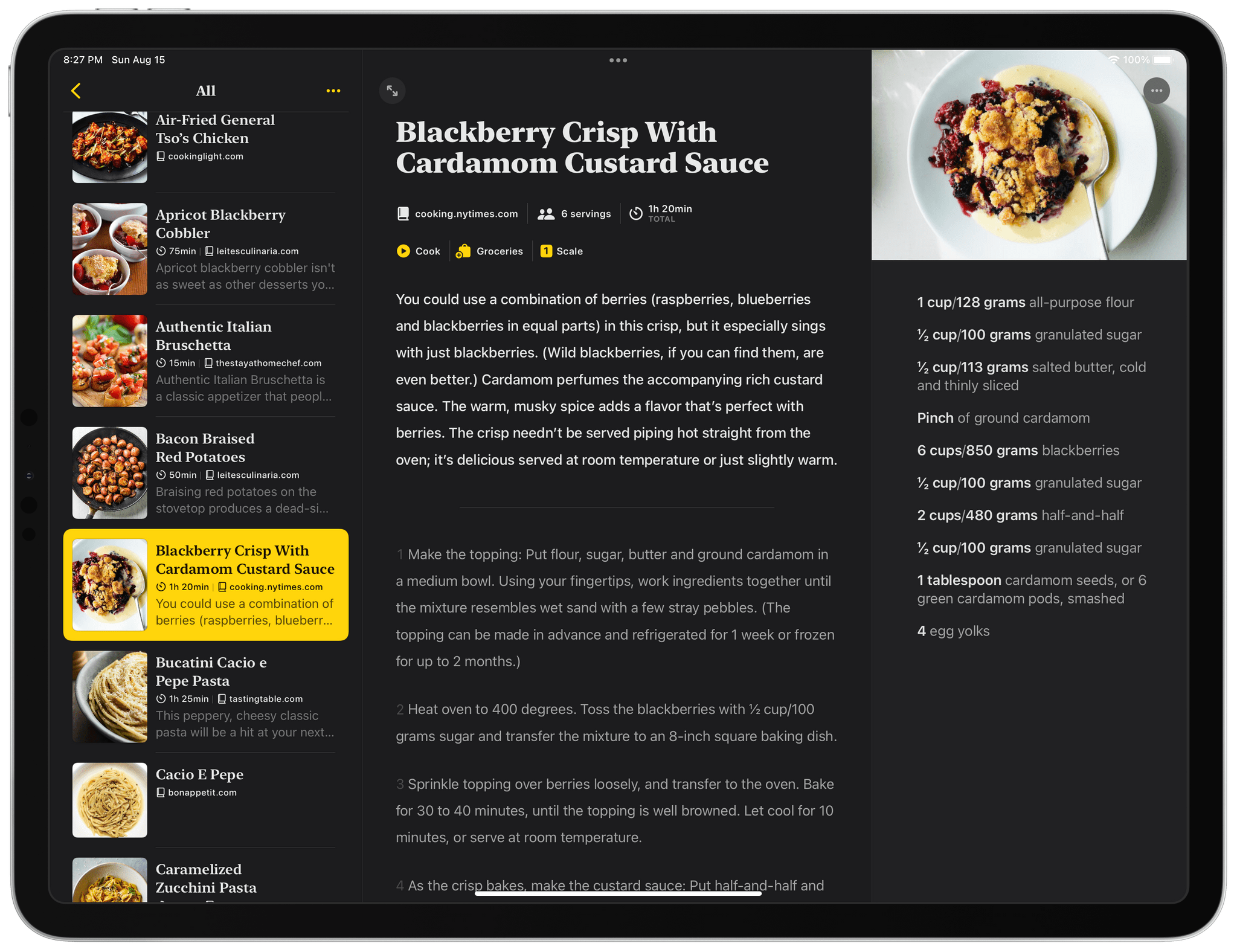
Silvio Rizzi, the developer of RSS client Reeder, has released a brand new recipe and cooking app called Mela for the iPhone, iPad, and Mac, which has immediately become my favorite apps for planning and preparing meals. For me, the two essential aspects of an app like this are how it handles adding new recipes and whether it is easy to use while you’re cooking. Mela excels at both.

I’m going to focus primarily on the iPad experience for this review because the iPad strikes the best balance of portability combined with a large screen that works well when you’re in the kitchen cooking, but the app is also available on the iPhone and Mac. Although my overwhelming preference is to use Mela on an iPad, an equal amount of attention has gone into the design of the iPhone and Mac apps, accounting for the different screen sizes and making the most of each. That’s true on the iPad, too, where the experience differs depending on the size of the iPad you’re using.

Read more


Apple Maps for iOS and iPadOS 15 and macOS Monterey: The MacStories Overview

Maps is unique among Apple system apps. Most system apps, like Notes or Reminders, are only updated at the same time that major revisions of the company’s underlying operating systems are released. Tweaks are sometimes made with OS point releases but never separate from the OS updates themselves.

Maps is different because so much of the experience is tied to the data that the app delivers. That allows Apple to add mid-cycle updates that aren’t tied to an OS release. There are many recent examples, like the addition of COVID-19 travel guidance for airports, vaccination site locations, and places offering volunteer opportunities. At the same time, the company continues to expand and enhance the accuracy and detail offered by Maps at a deeper level with its ongoing initiative to rebuild the app’s underlying maps worldwide.

Apple has been at it, improving Maps since iOS 6, and it’s a task that by definition will never truly be finished. However, the introduction of new features in recent years and broader expansion of its effort to deliver rebuilt maps to more of the world has allowed Apple to refine the app across the board. Using the latest map data the company has collected has enabled it to redesign the Maps experience, providing more relevant information to users, and expanding its view of the world around us.

Read more


Things Adds Extensive Markdown Support and Search for Extended Notes Attached to Tasks

The intersection of tasks and notes poses an interesting problem. Often, a task requires notes for context and details that can’t be captured with a single line of text. Likewise, notes very often spawn tasks of their own. The difficulty is how to harmonize the two coherently.

If you’re a Club MacStories member, you know this is something that has bedeviled Federico’s annual iOS and iPadOS review for years. He solved the problem by combining Obsidian with Todoist’s web API linking the two apps together in a way that complements the way he writes.

Federico’s approach takes advantage of the web technologies underlying those apps. It’s a powerful solution, but it’s not a fully native approach technically or from a design standpoint. The technique is also less suited for someone who isn’t writing thousands of words most days, and instead, just needs to flesh out their tasks with context than the single line of text many apps offer. Fortunately, there are many alternative approaches to the task and note-taking conundrum, including a new one out today from Cultured Code, the maker of Things that I like a lot.

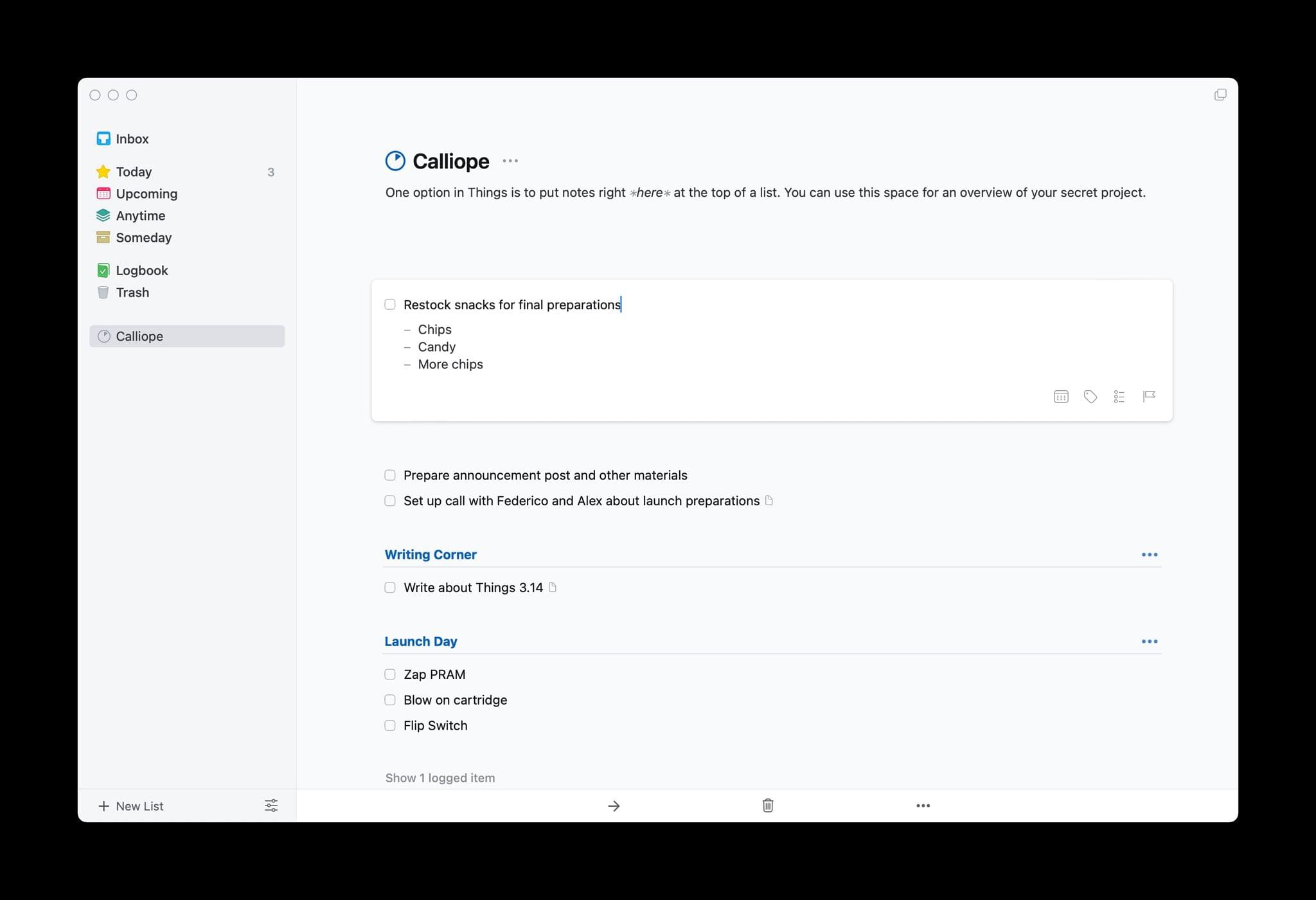
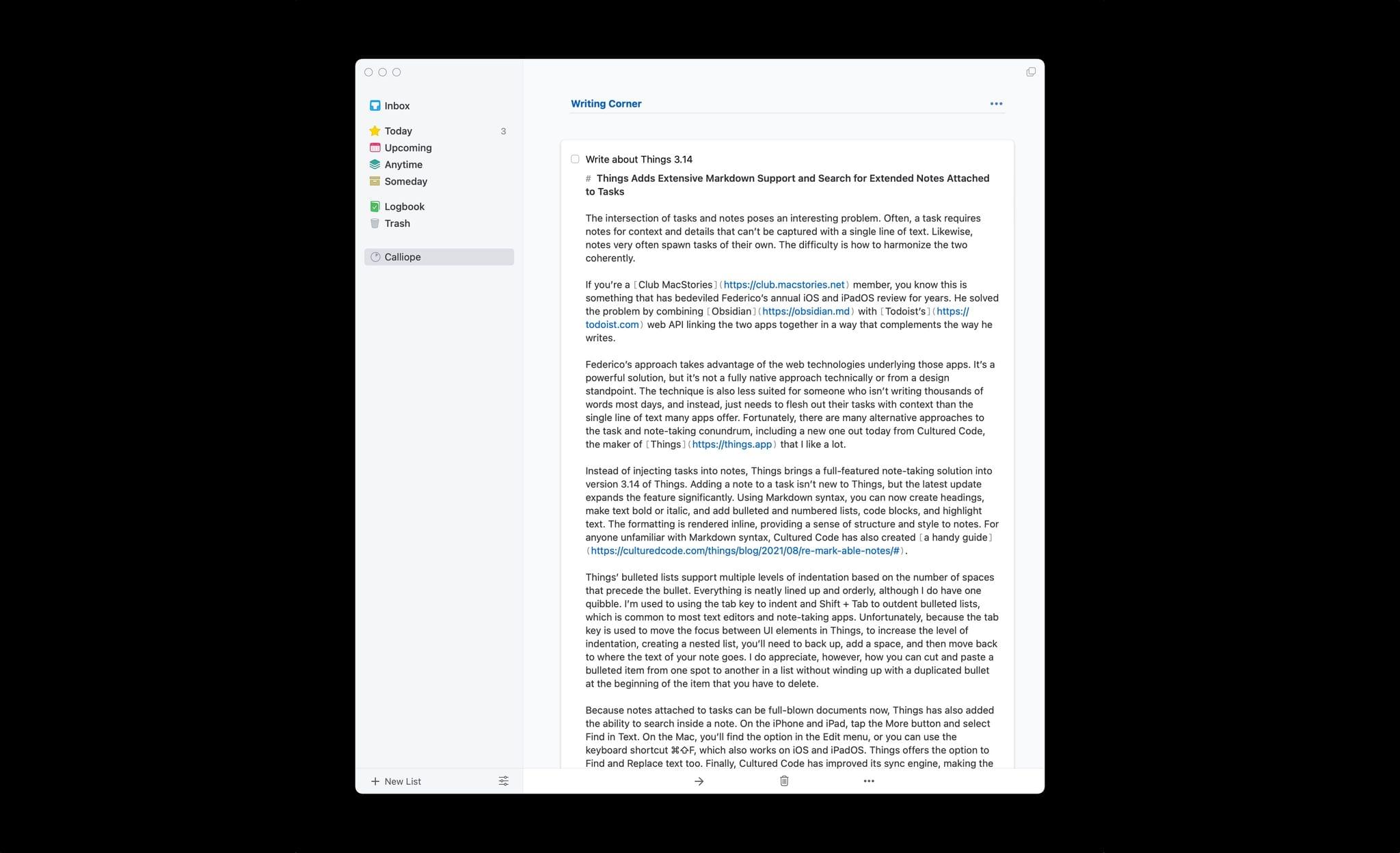
If you write in Markdown, Things is fully capable for a drafting a story like this one.

If you write in Markdown, Things is fully capable for a drafting a story like this one.

Instead of injecting tasks into notes, Things brings a full-featured note-taking solution into version 3.14 of Things. Adding a note to a task isn’t new to Things, but the latest update expands the feature significantly. Using Markdown syntax, you can now create headings, make text bold or italic, and add bulleted and numbered lists, links, code blocks, and highlight text. The formatting is rendered inline, providing a sense of structure and style to notes. For anyone unfamiliar with Markdown syntax, Cultured Code has also created a handy guide.

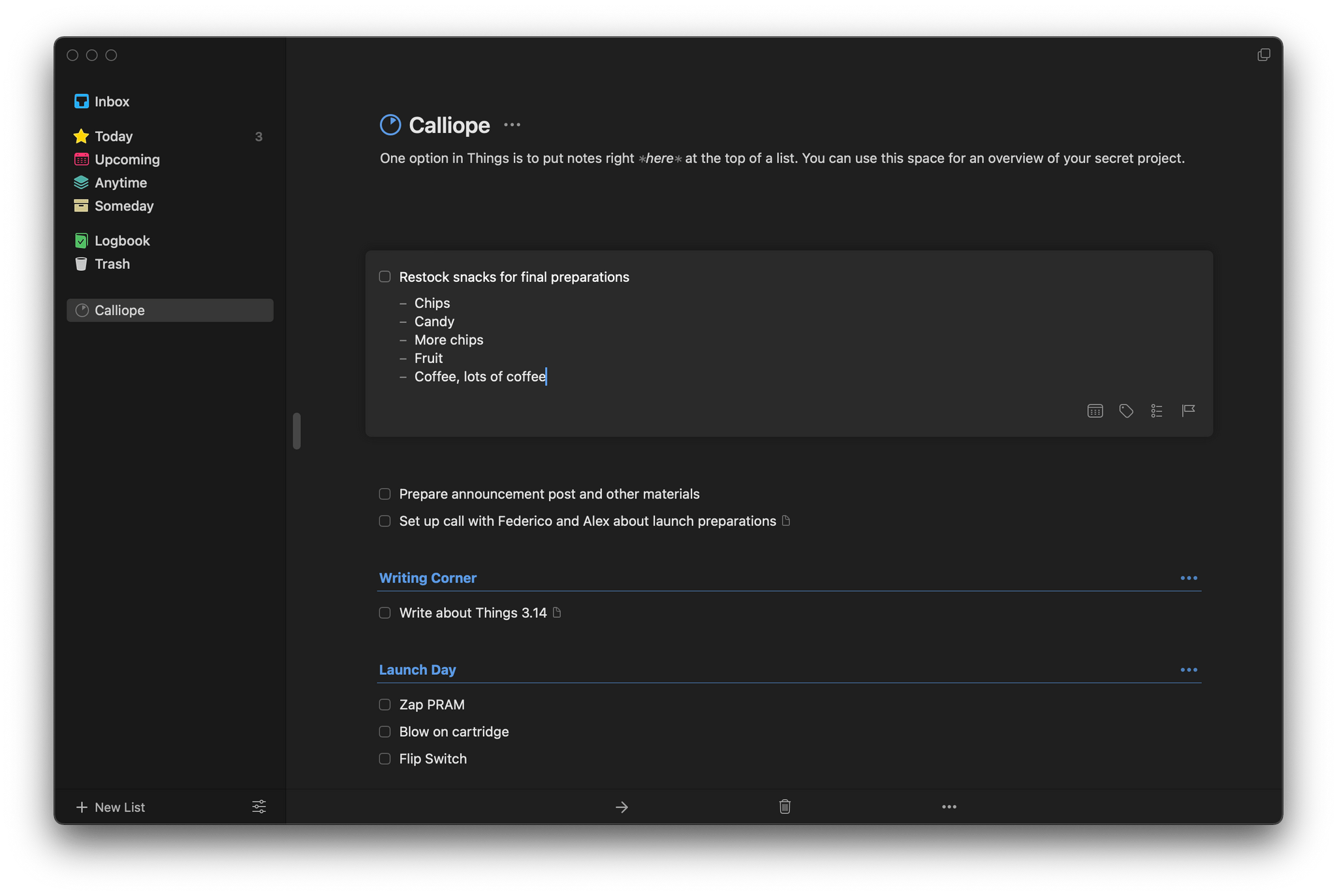
Things’ bulleted lists support multiple levels of indentation based on the number of spaces that precede the bullet. Everything is neatly lined up and orderly, although I do have one quibble. I’m used to using the tab key to indent and Shift + Tab to outdent bulleted lists, which is common to most text editors and note-taking apps. Unfortunately, because the tab key is used to move the focus between UI elements in Things, to increase the level of indentation, creating a nested list, you’ll need to back up, add a space, and then move back to where the text of your note goes. I do appreciate, however, how you can cut and paste a bulleted item from one spot to another in a list without winding up with a duplicated bullet at the beginning of the item that you have to delete.

Bulleted lists are easy to reorganize in Things.

Bulleted lists are easy to reorganize in Things.

Because notes attached to tasks can be full-blown documents now, Things has also added the ability to search inside a note. On the iPhone and iPad, tap the More button and select Find in Text. On the Mac, you’ll find the option in the Edit menu, or you can use the keyboard shortcut ⌘⇧F, which also works on iOS and iPadOS. Things offers the option to Find and Replace text too. Finally, Cultured Code has improved its sync engine, making the syncing of notes more efficient and faster, which should benefit anyone who uses it to take extended notes.


I wish every developer that offered notes functionality in their app would put as much care and attention into them as Cultured Code. Few apps provide formatting, let alone what is effectively a mini Markdown text editor just for notes. It’s the sort of flexibility that sets Things apart from other task managers. I expect the new notes functionality will be perfect for anyone who has felt constrained by the typical one-liner plain text notes found in most alternatives.

Things is is sold separately for the iPhone, iPad, and Mac for $9.99, $19.99, and $49.99 respectively.


Sofa 3.0 Adds New Ways to Manage Your Media Lists Along With a New Business Model

Sofa 3.0, an app that I last reviewed in March, is out with loads of new ways to track, organize, and browse the media lists you create. The app also has a new subscription business model for its pro features.

Media recommendations come at us all from every angle, whether it’s friends and family or sources like reviews. You can save lists of books, movies, videogames, and other media you want to try in lots of ways. You could use an app like Apple’s Notes or Reminders, but they’re general-purpose apps that don’t address the specific needs related to media consumption. Plus, trying to track media in something like a task manager gets out of control and messy fast.

Another option is to turn to an app designed for a specific type of media, and there are many good options available on the App Store. The advantage Sofa has, is that it makes it just as easy to pick a book as a movie or something else when you’re deciding what media to try next. It’s a subtle but important distinction. With single-purpose apps, you need to decide what kind of media you want to consume and then turn to an app to pick something. Sofa dispenses with the first step allowing you to answer a broader question: “How do I want to spend my free time?” That a one-stop approach is one of Sofa’s greatest strengths and one that the app leans into hard with the latest excellent update.

Read more


CARROT Weather 5.3 Adds Smart Layouts and a Fun Weather Reports Feature

My nighttime Smart Layout.

My nighttime Smart Layout.

Apple Design Award winner CARROT Weather offers an unprecedented amount of user control over its interface, something which Federico and I recently discussed at length on AppStories and interviewed developer Brian Mueller about last month. The customization options that were introduced in January with version 5 of the app allow users to define the look and layout of multiple weather tiles along with the date presented by each. Since that UI overhaul in January, Mueller has continued to extend the customization system, most recently adding a preview system and other refinements to make it easier to experiment with and create different layouts.

My default, rain, and nighttime layouts.

My default, rain, and nighttime layouts.

With version 5.3 that was released today, Mueller has added Smart Layouts, allowing users to create different layouts for nighttime and when it’s going to rain. I like these new options a lot for a couple of reasons. The first is practical: if it’s nighttime, you probably don’t care about the day’s high temperature because it likely happened hours ago. Likewise, if it’s going to rain, a graph of when the rain is going to start and when it will be most intense is far more important to you than on a beautiful, sunny day.

Picking Smart Layouts.

Picking Smart Layouts.

With Smart Layouts, you can adjust your weather layouts for each circumstance. For example, I created a Smart Layout for nighttime based on the Siren template that emphasizes the current conditions followed by the hourly and daily forecasts. When rain is in the forecast, I’ve got a layout that moves a precipitation graph and radar view to the spots just below the current conditions. The changes I made were relatively minor but have made CARROT Weather more relevant as conditions change.

I also enjoy Smart Layouts because they’re another outlet for trying new layout templates and experimenting with setup options. The process is fun and adds an extra touch of personalization and variety that I enjoy. Smart Layouts require a Premium Club subscription to CARROT Weather.

The other headline feature of CARROT Weather’s update is Weather Reports, which lets you create 30-second weather report videos and share them. Whether you’re flexing from the beach on vacation or just want to complain about how hot it is to your friends, Weather Reports are a ton of fun. Videos are recorded with the front-facing camera, and CARROT Weather lends a hand by providing an overlay to help frame yourself. Videos can be scripted randomly by CARROT or unscripted, and you can even pick a funny weatherperson name if you’d like. If you pick a scripted video, the words scroll up the screen as you record yourself teleprompter-style. Here’s one I did from my backyard yesterday afternoon:

Weather Reports are a blast to create and will undoubtedly show up in droves on social media networks before you finish reading this.

Today’s update also adds a variety of smaller updates, including new layout components and multiple formats for taking screenshots of weather conditions for sharing.

CARROT Weather 5.3 is available as a free update on the App Store.


Transloader 3: A Simple, Versatile Way to Remotely Manage Mac File Downloads from an iPhone or iPad

Matthias Gansrigler of Eternal Storms Software recently released Transloader 3, an app for remotely controlling Mac file downloads from an iPhone or iPad. Although the app has been around for a long time, version 3 might as well be a completely new app because it’s packed with new features, making it worth revisiting if you haven’t tried it in a while.

Transloader is one of those utilities that reduces the friction of working on multiple devices by solving a common problem that Apple’s OSes could handle better: cross-device downloads. There are a couple of scenarios where I run into this all the time. The first is with email. With no TestFlight for Mac yet, developers often send me links to a ZIP or DMG file of their apps to try. Going through email messages is one of those tasks that I often leave until late in the day when I’m away from my desk, using my iPad or iPhone. The second scenario is when I’m researching apps and find one or a related press kit I want to download to check out later.

In both cases, I could save the app or other files to iCloud Drive’s Downloads folder and revisit the materials the next time I’m at my Mac. However, with Transloader, I’ve got many more options thanks to its built-in automation tools as well as other features that make managing downloaded files easier.

Read more


iOS and iPadOS 15: The MacStories Overview

This morning at Apple’s second fully-remote WWDC keynote address, Craig Federighi introduced iOS and iPadOS 15. This year’s updates include significant improvements to core first-party apps, new controls for maintaining focus, system-wide text and object recognition in images, and much more.

On the iPad-only side of things, Apple has announced a variety of new multitasking interface elements, feature parity with the iPhone’s Home Screen, quick note capturing available at any time in any app, and an overhauled Swift Playgrounds which supports building and shipping complete SwiftUI apps to the App Store.

As usual, developer betas are available today, with final versions scheduled to ship to all users this fall. Let’s take a look at all the details that Apple has in store for us this year.

Read more


iOS and iPadOS 14.6 Released with Apple Card Family, Podcasts Subscriptions, Updates to AirTags and Find My, and More

Apple has released iOS and iPadOS 14.6 today with a handful of new features, including Apple Card Family and Podcasts Subscriptions, along with Updates to AirTags and the Find My app.

Announced during Apple’s spring event, Apple Card Family is now available in iOS 14.6. Up to five people over the age of 13 can share an Apple Card, allowing them to track expenses and manage spending. All family members on an Apple Card will build credit histories, and parents can set spending limits for their children too.

iOS and iPadOS 14.6 also includes Podcasts Subscriptions, which allows podcasters to offer paid versions of their shows. Shows can be offered as paid-only subscriptions or enhanced versions of free shows that add a combination of bonus features like extended, ad-free, and early-release episodes. The new subscription service is baked directly into the Podcasts app, allowing users to access paid subscriptions alongside free shows.

One of the features of AirTags at launch was the ability to add a phone number to call if a tagged item was lost somewhere. With iOS and iPadOS 14.6, users can add an email address. Also, Apple release notes say that when an AirTag is tapped with an NFC-compatible device, it will show a partially masked phone number.

Apple has also added the ability to unlock an iPhone for the first time after a restart using their voice, which is a Voice Control feature.

Not released with the update today is anything related to Spatial Audio or Lossless streaming of Apple Music content, which is not unexpected since Apple previously said the feature is coming in June.


Apple Announces SignTime and Many Other Accessibility Features Coming to Its Products

Source: Apple.

Source: Apple.

Tomorrow, Apple will launch SignTime, a service that will pair Apple Store and Apple Support customers with on-demand sign language interpreters. The company has several other accessibility features coming too, which will be released later this year.

SignTime will allow customers to communicate with AppleCare and Retail Customer Care inside their browsers using American Sign Language, British Sign Language, and French Sign Language. The service will also be available in-person at retail stores without making arrangements ahead of time. For now, the service is limited to the US, UK, and France, but Apple says it will roll out to more countries over time.

Later this year, Apple will add AssistiveTouch to the Apple Watch. The feature uses hand clenches, pinch gestures, and hand shaking to navigate and select controls in Watch apps. Assistive Touch for the Apple Watch takes advantage of the device’s gyroscope and accelerometer along with the heart rate sensor and machine learning.

Also, coming later this year, the iPad will gain support for third-party eye-tracking devices to assist users in navigating the iPad’s UI. VoiceOver is also being enhanced with new details about people, text, table data, and other objects. The feature will offer far more descriptive information for blind and low vision users than ever before. Users will also be able to add their own image descriptions to their photos using Markup.

For deaf and hard of hearing users, Apple is adding bi-directional hearing aid support. The company is also including support for audiograms, which can be used with Headphone Accommodations to tune playback to a user’s hearing. Background sounds like balanced, bright, or dark noise, and ocean, rain, and stream sounds are being added too.

Source: Apple.

Source: Apple.

Also coming later this year are Sound Actions for Switch Control that uses mouth sounds in place of switches and buttons, customizable display and text size settings for colorblind users, and new Memoji customizations to allow users to add oxygen tubes, cochlear implants, and a soft helmet for headwear. Many of Apple’s apps and services will also be marking Global Accessibility Awareness Day, which is tomorrow, with features, curated collections of content, and sessions.

It’s fantastic to see such a long list of accessibility features being added to Apple’s devices tomorrow and later in the year, which presumably means this fall when the company’s OSes are expected to be updated. It’s also unusual for upcoming OS features to be revealed before WWDC, but with Global Accessibility Awareness Day coming tomorrow, it’s an excellent opportunity to spotlight these important additions to Apple’s OSes and perhaps to free up time at WWDC for other announcements.