The Heist 1.1: Highly Addictive Puzzle Fun

I’m a huge fan of puzzle games. Throughout the years I installed almost every interesting game from this genre on my iPod touch: Cross Fingers and Smart Sokoban are some of my all-time favorites. I have to confess, I didn’t notice MacHeist coming up with their first iPhone game about a year ago. But today, their very sophisticated iPhone game The Heist got updated to version 1.1 and I had the great pleasure to beta test its new features and gameplay. Finally, I also recognized what a great game concept and visual effects The Heist has to offer.

Let’s start out with the actual game features. The Heist has got a small “story” around it:

Some puzzle-obsessed nut has rigged up this vault with state of the art defenses! You’ll have to crack a variety of puzzles to short circuit the lasers, security cameras and electrified bars. Are you up for the challenge?
Because of that, you frequently get calls by your spying colleague Sophia who gives you more instructions and (not really existing) time limits. Every time she calls you, new levels and difficulties are unlocked until you finally reach the vault.

In version 1.1 this story and the whole app has been enhanced by various features and fixes (taken from its App Store description):

  • iPod play through with remote control support
  • Game Center enabled on older devices (iPad 1 and iPod Touch 2nd generation)
  • Awards earned achievements if any were missed
  • Support for unlocking secret Clear theme
  • Vault exit button

As the app is developed by the curators of MacHeist, there are some real loots deposited in this vault: with the new 1.1 version you can get steam codes for various games; you can even unlock a secret theme for Clear 1.1. To get there you have to solve four different puzzle games with 15 levels and four difficulty stages. These games actually include Smart Sokoban-style box puzzles, two sliding puzzles with bars and rectangle pieces. The most difficult — and unique — puzzle game in my opinion was the fourth one: a game where you have to sort differently colored stones marked with symbols on the field without having the same symbol two times in a horizontal or vertical row.

These games are not just addictive: they are surrounded by stunning visual effects and endowed with easy gameplay as well. The Heist is a very good example of how extensive and detailed design and the goal of keeping the gameplay smooth and simple should be mixed. Its use of LED effects, light reflections, and other more or less decorative elements is never disturbing the game’s content, and The Heist is easy and intuitive to play and understand.

With its Game Center integration (which now also works on iPad 1 and the 2nd generation iPod touch) and new achievements, The Heist is a quite substantial and addictive collection of tricky puzzles, and it definitely has the capability of captivating you for some time. If you like small time killers for short train or bus rides, go and get The Heist 1.1 right now for $0.99 (introductory sale price) .

Apple Offers 150 Student Scholarships For WWDC 2012

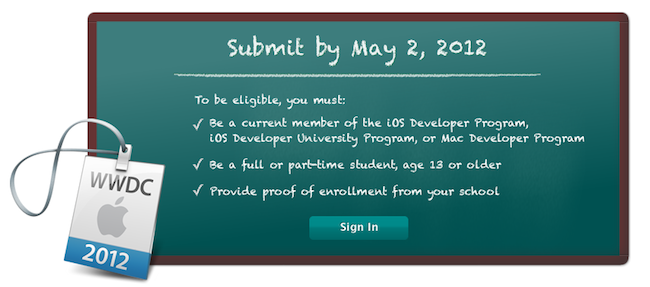
Full-time or part-time students over the age of 13 have the chance of winning one of 150 scholarships to attend this year’s WWDC. Apple says that it wants to  ”reward outstanding student developers with the opportunity to attend this year’s conference on a WWDC 2012 Student Scholarship”. It means that for those lucky (and talented) students selected, they can attend the WWDC conference free of charge (tickets are on sale today for $1599). Apple will be judging the applicants on a few key criteria:

  • Technical ability
  • Creativity of ideas expressed in products/projects
  • Prior WWDC attendance
  • Technical and work experience

Due to the low age-limit, some events such as the WWDC Bash may restrict some students if they are under 18. Apple has posted a full list of eligibility requirements and more details on the application process and it should be noted that applicants also be a member of the iOS Developer Program, iOS Developer Enterprise Program, or Mac Developer Program, or an iOS Developer University Program Student and they must have been a member prior to August 1st, 2011.

You can lodge your own application for the 2012 WWDC Student Scholarship here, or view all the details on the 2012 WWDC page. The deadline for sending in your application is Wednesday, May 2, 2012 at 5:00 PM PDT.


Apple Opens Nominations For 2012 Apple Design Awards

Along with announcing the dates for WWDC 2012, Apple has today also opened nominations for this year’s Apple Design Awards. The award, which aims to “recognize state of the art iOS and OS X apps that reflect the very best in design, innovation, and technology adoption”  has become a staple of every WWDC and  is perhaps the most prestigious recognition an Apple developer can receive. The award criteria is founded in the following characteristics:

  • Well-Designed: Apps that are inviting, engaging, easy to use, intuitive, and compelling.
  • State of the Art: Apps that take advantage of the latest hardware, OS releases, and technologies to offer rich functionality, high performance, and extensive system integration.
  • Innovative: Apps that are revolutionary, inspiring, and do things in new and creative ways.

To be considered for the award, the app must be on the App Store or Mac App Store by May 1st in order to be eligible, but a nomination is not necessary (Apple can choose the award winner regardless of whether it was nominated or not). Developers can nominate an app via Apple’s developer portal.

You can also review the winners of the 2011 Apple Design Awards.


Apple Announces WWDC 2012: Kicks Off June 11

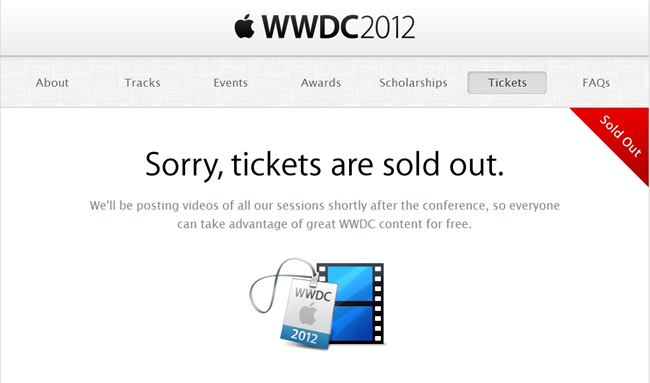
UPDATE: Apple has confirmed that tickets for WWDC 2012 are already sold out.

Apple has announced the official dates for WWDC 2012. The developer event kicks off in San Francisco on June 11 and runs through June 15. Tickets are on sale for $1599, and are limited to one ticket per person or five tickets per organization. This year, app developers under 18 years old (13 - 17) can have their legal guardian purchase a WWDC ticket and approve their attendance at the conference — budding developers do not have to miss out on this year’s events.  Despite being an ever popular event that sells out quickly, WWDC 2012 still takes place at Moscone West.

We have a great WWDC planned this year and can’t wait to share the latest news about iOS and OS X Mountain Lion with developers,” said Philip Schiller, Apple’s senior vice president of Worldwide Marketing. “The iOS platform has created an entirely new industry with fantastic opportunities for developers across the country and around the world.

Registration for the event will take place on June 10th starting at 9:00am. If the event cannot be attended, videos from this year’s sessions will be made available for download. It’s best to go in person so experts can answer your development related questions. This year’s topics will include information about OS X Mountain Lion, which will be made available later this summer, alongside iOS app development sessions.

WWDC 2012 will cover six technical tracks with over 100 sessions and labs. Tracks include:

  • Essentials
  • App Services
  • Developer Tools
  • Graphics, Media, and Games
  • Safari and Web
  • Core OS

Alongside ticket sales, Apple has opened nominations for the 2012 Apple Design Awards. Nominated apps will be considered for an ADA and must be made available on the App Store or Mac App Store by May 1st. Students can also look forward to a great time at WWDC, and earn the chance to attend the conference free of charge on a scholarship.

Activities at Apple’s WWDC 2012 include:
more than 100 technical sessions presented by Apple engineers on a wide range of technology-specific topics for developing, deploying and integrating the latest iOS and OS X technologies;100 hands-on labs staffed by more than 1,000 Apple engineers providing developers with code-level assistance, insight into optimal development techniques and guidance on how they can make the most of iOS and OS X technologies in their apps;the opportunity to connect with thousands of fellow iOS and OS X developers from around the world—last year more than 60 countries were represented;engaging and inspirational lunchtime sessions with leading minds and influencers from the worlds of technology, science and entertainment; andApple Design Awards which recognize iPhone®, iPad® and Mac® apps that demonstrate technical excellence, innovation and outstanding design.

PR after the break!

Read more


“Send to Kindle for Mac” Now Available

“Send to Kindle for Mac” Now Available

Jacqui Cheng, reporting for Ars Technica:

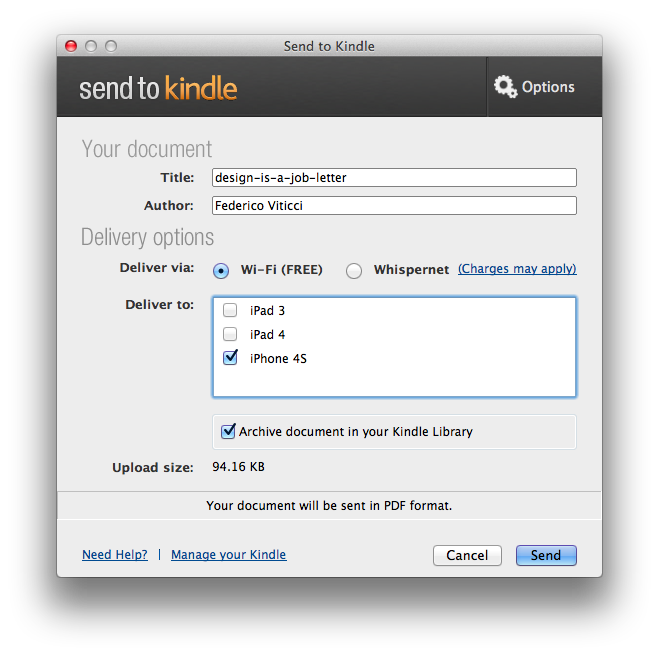
More than three months after releasing software for Windows-users to send documents to a Kindle, Amazon has now released the Mac version. Announced on Tuesday afternoon, the “Send to Kindle for Mac” application allows Mac users to wirelessly send personal documents to their Kindles via drag-and-drop in the Dock or within the app itself. Users can also send documents to the Kindle by printing from any Mac application.

I have tried the new Amazon desktop utility, and it also allows you to upload files to your Kindle library (devices and Kindle apps) with a contextual Finder menu. The app comes with options to select the Kindle device you want to upload files to, and gets rid of the old email-based “file forwarding” system by integrating a simple upload status indicator within the main interface. Documents can be archived in your Kindle Library (which was recently introduced on Kindle for iOS), and there is an option to convert PDFs to Kindle format. A Getting Started guide with a list of supported file formats is available on Amazon’s website.

Download the “Send to Kindle” Mac app here.

Permalink

Apple Q2 2012 Results: $39.2 Billion Revenue, 35.1 Million iPhones, 11.8 Million iPads Sold

Apple has just posted their Q2 2012 financial results for the quarter that ended on March 31, 2012. The company posted revenue of $39.2 billion, with 11.8 million iPads,  35.1 million iPhones and 4 million Macs sold. Apple sold 7.7 million iPods, a 15 percent unit decline from the year-ago quarter. The company posted quarterly net profit of $11.6 billion, or $12.30 per diluted share. iPhone represented a 88 percent unit growth over the year-ago quarter, while iPad reported a 151 percent unit increase over the year-ago quarter. International sales accounted for 64 percent of the quarter’s revenue.

We’re thrilled with sales of over 35 million iPhones and almost 12 million iPads in the March quarter,” said Tim Cook, Apple’s CEO. “The new iPad is off to a great start, and across the year you’re going to see a lot more of the kind of innovation that only Apple can deliver.”

“Our record March quarter results drove $14 billion in cash flow from operations,” said Peter Oppenheimer, Apple’s CFO. “Looking ahead to the third fiscal quarter, we expect revenue of about $34 billion and diluted earnings per share of about $8.68.

Estimates and Previous Quarters

For Q2 2012, Apple set its guidance at $32.5 billion revenue and diluted earnings per share of about $8.50.

The Street consensus’ estimate was earnings of $10.06 per share and revenue of $36.81 billion; on April 1, 2012, 16 independent analysts polled by Fortune forecasted earnings of $12.66 per share and revenue of $42.68 billion. On April 23, Philip Elmer-Dewitt put together an updated chart tracking predictions from 23 independent and 34 Wall Street analysts.

In Q1 2012 – the company’s biggest quarter to date – Apple posted record-breaking revenue of $46.33 billion, with 15.43 million iPads, 37.04 million iPhones and 5.2 million Macs sold. Apple sold 15.4 million iPods, a 21 percent unit decline from the year-ago quarter. The company posted quarterly net profit of $13.06 billion, or $13.87 per diluted share. iPhone represented a 128 percent unit growth over the year-ago quarter, while iPad reported a 111 percent unit increase over the year-ago quarter. In the year-go quarter, Apple posted revenue of $24.67 billion, with 4.69 million iPads, 18.65 million iPhones, and 3.76 million Macs sold.

As we reported in our Q1 2012 coverage:

Apple CEO Tim Cook remarked how the company was seeing China as “an extremely important market”, with “staggering demand” for iPhone. Cook also revealed that, in spite of the “bold bet” they took in terms of iPhone supply, Apple was short of iPhone supply throughout the quarter; the situation had improved by the time of the earnings call, but the company was still short in some areas. In the conference call, Cook also referred to iCloud as the company’s “big insight” for the next decade.

In his own estimates for the upcoming Q2 results, Asymco’s Horace Dediu had forecasted the following numbers:

  • iPhone units: 37.3 million (100%)
  • Macs: 4.7 million (25%)
  • iPads: 12.2 million (160%)
  • iPods: 7 million (-22%)
  • Music (incl. app) rev. growth: 40%
  • Peripherals rev. growth: 25%
  • Software rev. growth: 10%
  • Total revenues: $42.7 billion (growth: 73%)
  • GM: 44.7%
  • EPS: $12.0 (88%)

Apple will provide a live audio feed of its Q2 2012 conference call at 2:00 PM Pacific, and we’ll update this story with the conference highlights. You can find the full press release and a graphical visualization of Apple’s Q2 2012 after the break.

A recap of estimates and product releases happened during the quarter is available here. Read more


Google Officially Launches Google Drive

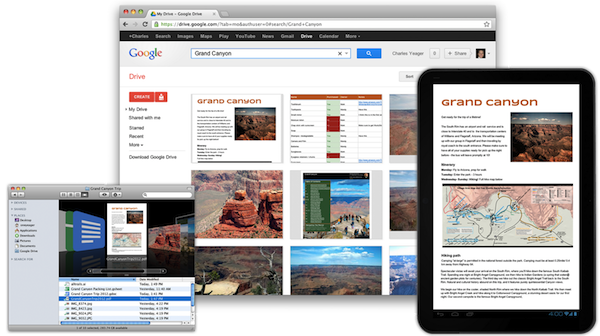
Rumored for years, Google has today officially taken the wraps off Google Drive, the company’s new solution to store, share, and collaborate on documents and files in the cloud. Available at drive.google.com, Google Drive allows users to open more than 30 file types (including video, Adobe Illustrator and Photoshop) directly in the browser even without desktop apps installed; Drive is connected to Google Docs for document editing and collaborative features, albeit Docs storage doesn’t count against Drive’s storage limits.

Today, we’re introducing Google Drive—a place where you can create, share, collaborate, and keep all of your stuff. Whether you’re working with a friend on a joint research project, planning a wedding with your fiancé or tracking a budget with roommates, you can do it in Drive. You can upload and access all of your files, including videos, photos, Google Docs, PDFs and beyond.

With a promised 99.9% uptime guarantee from Google, Drive starts for free at 5 GB of storage:

You can get started with 5GB of storage for free—that’s enough to store the high-res photos of your trip to the Mt. Everest, scanned copies of your grandparents’ love letters or a career’s worth of business proposals, and still have space for the novel you’re working on. You can choose to upgrade to 25GB for $2.49/month, 100GB for $4.99/month or even 1TB for $49.99/month. When you upgrade to a paid account, your Gmail account storage will also expand to 25GB.

Among the Drive features touted by Google, the company announced the service will support OCR (optical character recognition) for scanned documents, image recognition for uploaded pictures (for instance, you’ll be able to search for “Eiffel Tower” and have Drive find a picture of it in your files), and search. As with most Google products, great focus has been put on the search functionality, which will allow users to look for file names, content, activity, and owner information in the Drive accounts. Furthermore, Google says they have worked with a number of third-party developers to enable Drive integration with various online service starting today; similarly, Google Drive will work with other Google apps and services such as Google+ and Gmail to easily share files or attach documents to email messages.

The official Google Drive app for Android has gone live on Google Play, and the company says they are also “working hard” on a Drive app for iOS devices. ReadWriteWeb was provided with screenshots of the Drive iOS app directly from Google.

Check our more links, details, videos, and our first impressions with Google Drive after the break. Read more


Promoting Software

In the pre-PC era, we built dedicated tools to fit different purposes. In the PC era, we learnt how to shift some tasks over to a single, centralized tool called the “personal computer”; we started exploring the concept of “ecosystem” through “digital hubs”, although we didn’t see the PC – whether “desktop” or “portable” – as a meaningful replacement for objects we depended upon in our daily lives. With mobile devices from the Post-PC era, we’re seeing tremedous growth in one particular aspect: that software can do (almost) anything. We’re in the process of learning how to use a single tool to fit multiple purposes at once.

This is especially true with the iPad. Following yesterday’s news of Cargo-Bot, an iPad game made on the iPad using Codea, I had yet another example of how software is changing the way we think of the distinction between tools for “work” and “entertainment” – and how it’s blurring the difference between computers for “production” and devices for “consumption”. John Gruber calls it “a glimpse of the future”. He’s right: here we have a device that is now capable of programming a game for its own platform, and it seems totally obvious in retrospect.

I never quite got the argument that devices like the iPhone and iPad were made for “consumption”. In the past five years, we have seen people making music on tablets, writing novels on them, and film-makers using iPhones as solid alternatives to their mobile capturing needs. The portability of the camera reinvented citizen journalism and revolutionized mobile photo sharing. I have seen doctors pulling out iPhones to do quick calculations and compare MRI images. I have been increasingly using my iPad as an “anything device”; on the other hand, I may have played no more than 4 games on my iMac since 2008.

It’s not just about “niches” or “bloggers” who want to find a way to do more on tablets than “normal people” would think is feasible. While the App Store has certainly seen a surge in popularity of text editors, Twitter clients, note-taking apps, and other kinds of apps writers and bloggers use on a daily basis, we shouldn’t forget about Final Draft, Procreate, Paper, the Business category, Apple’s Cards app, travel guides, books…just to name a few.

Software can do anything, but sometimes it is the combination of hardware and software that yields new, unexpected results that take advantage of the interplay of bits and guts. Apple based its mobile business on this. And third-party developers, too, understand that, in some areas, Post-PC hardware needs to be “extended” to address more specific needs. The Jawbone JAMBOX is a fantastic portable speaker that can augment your music listening or gaming sessions. The Nest thermostat is proving to be a hit among early adopters. Ten One Design is working on a Bluetooth-enabled pressure-sensitive stylus with an SDK for developers. Note how, even when extra hardware is needed, Post-PC devices leverage one thing to make these additions more natural, powerful, and connected: software.

It’s not just Apple. Other companies are making smartphones and tablets (and glasses), and some of them also recognize the importance of an ecosystem that fosters innovation and a stable business model for all the parties involved. It appears to me – and the numbers speak clearly for themselves – that only Apple, though, has so far acknowledged that a third-party software ecosystem needs to be nurtured, carefully encouraged, and educated about the latest technologies available to consumers and developers. And then again, Apple can do better.

The Times They Are a-Changin’. The multi-purpose, constantly evolving nature of software has changed us: most people don’t want to upgrade their devices every six months anymore, but they are always looking for new ways to unify the “things they have to do or want to do” into a single, intuitive, affordable experience capable of changing context and functionality with just a few taps.

In the Post-PC era, we are promoting software.