Federico Viticci

10876 posts on MacStories since April 2009

Federico is the founder and Editor-in-Chief of MacStories, where he writes about Apple with a focus on apps, developers, iPad, and iOS productivity. He founded MacStories in April 2009 and has been writing about Apple since. Federico is also the co-host of AppStories, a weekly podcast exploring the world of apps, Unwind, a fun exploration of media and more, and NPC: Next Portable Console, a show about portable gaming and the handheld revolution.

This Week's Sponsor:

Inoreader

Build your own newsfeed and cut through the noise


Instadesk: The First Instagram Client for Mac

Thanks to Instagram’s huge success and the release of an API that allows third-party developers to plug into the service to fetch images, user information and much more, in the past weeks we’ve seen the quick rise of dedicated Instagram clients for iOS that don’t focus on shooting and uploading new images (the API doesn’t allow that, yet) but instead turn Instagram’s social aspect into a central part of the experience. Apps like Instagallery for iPad or the popular Flipboard make great use of Instagram’s API and third-party tools by letting you browse popular photos and read comments directly from the tablet’s larger screen; they also let you like and comment on pictures, see your own photos and profile or follow other people. Photo taking capabilities aside, these apps are proving that there’s a whole world of social interactions and media behind “a simple iPhone app” that deserves to be studied and implemented through native software for iPhones and iPad. Not to mention other clever experiments with the Instagram API we have covered on MacStories, such as printed photos and web apps.

But what about the Mac? When you follow a link to an Instagram picture from, say, your Twitter client of choice, the photo will open into the web browser. Instagram’s website lets you see the photo at higher resolution and check out the author’s details, but there’s no “social backend” to browse photos and people just yet. Instadesk, a new app available in the Mac App Store, wants to bring Instagram’s full experience to the desktop. The app has a clean and nice design with thumbnail previews and beautiful icons in the top toolbar; it enables you to create local “albums” to save photos for later; it lets you share photos from you or others through a variety of social networks supported by Instagram.

Instadesk is a full-featured Instagram client built specifically for the Mac. Once you’ve authorized the app with your credentials and granted permission to access your account through the API, Instadesk will place a link to your profile in the sidebar, right below links to the feed, most popular photos and tags, and status updates. In the profile tab you can check out all your photos, people you follow and your followers. As you click on a thumbnail in Instadesk, the photo is automatically brought in the foreground with a slick animation and a new screen that shows the author on the right (with buttons to follow / unfollow) as well as comments and likes,  and a box to leave a new comment yourself. You can like a photo or open it in the web browser, download it locally on your computer or hit the Share button to share the instagr.am link with your Facebook friends, Twitter followers and email contacts.

The popular section offers a selection of the most viewed photos and tags, whilst the Feed displays items posted by you and the people you follow. Instadesk also comes with a slideshow functionality and a “find user” option to manually search for a person on Instagram.

Instadesk provides a nice way to browse Instagram from your Mac. At $1.99 in the Mac App Store, it’s not a bad deal if you’re a loyal (and addicted) Instagram user. More screenshots below. Read more



Angry Birds Rio: 10 Million Downloads In 10 Days

Angry Birds Rio: 10 Million Downloads In 10 Days

Perhaps Rovio’s success with the Angry Birds franchise doesn’t surprise anymore as much as it did in 2010, but we still think the numbers these games for iOS and Android are generating are impressive. The latest game of the series, Rio, is based on a collaboration with Twentieth Century Fox to merge the gameplay of Angry Birds with the world of Rio. With a tweet, Rovio said that Angry Birds Rio hit “10 in 10” – suggesting 10 million downloads were achieved in 10 days since the release of the app for iOS and Android devices, both in free and paid editions.

A bit of investigation by Mobile Entertainment has proved that, as expected, said tweet referred to the number of downloads in the same number of days.

Rovio didn’t provide detailed numbers for iPhone, iPad and Android sales, nor did they specify whether the free version was downloaded more than the paid one. Still, 10 million downloads in 10 days is impressive. Now about that fake movie trailer…

Permalink

iPhone Has 25% Market Share In The US, Verizon iPhone “Most Acquired Handset” in February

Data released yesterday by market research firm comScore for the November 2010 - February 2011 period details smartphone market share numbers in the United States and provides additional insight into platform vendors’ stats and performances. First off, the study “study surveyed more than 30,000 U.S. mobile subscribers” to find Samsung the top cellphone manufacturer with a 24.8% market share; comScore also claims for the three month period detailed by their study 234 million Americans “ages 13 and older used mobile devices”. As far as OEM market share goes, Apple ranked 5th behind Samsung, LG, Motorola and RIM with a 7.5% share in February, up 0.9% from November 2010. As comScore notes Apple saw the “strongest gain” thanks to the release of the Verizon iPhone 4, which was the “most acquired handset in the month of February” in the United States.

The situation is different from the smartphone OS point of view, with Google’s Android operating system seeing the strongest growth:

69.5 million people in the U.S. owned smartphones during the three months ending in February 2011, up 13 percent from the preceding three-month period. Google Android grew 7.0 percentage points since November, strengthening its #1 position with 33.0 percent market share.

Data from Nielsen referring to the last months of 2010 indicated Apple’s iOS and Android were on the same level of market share in the United States with approximately 28% and 27%, respectively. Another report from January indicated Android had become the most popular smartphone OS worldwide with a 33% share in Q4 2010. comScore’s new numbers place Apple at 25.2% market share behind RIM with 28.9%. RIM, however, saw a 4.6% decrease from November 2010, whilst Apple had a 0.2% increase – not as significant as Google’s Android but still growth.

It’s also worth considering that, as comScore only tracks iOS’ market share on the iPhone, Apple can’t compete by the numbers with the variety of Android and BlackBerry devices available. It would be interesting to see statistics about iOS and Android total market share on every mobile device (media players, smartphones, tablets) to gain better insight into the US’ market trends and sales.


iPhone 5 To Feature 8-Megapixel Camera from Sony?

9to5mac reports Sony CEO Howard Stringer, in an interview with Walt Mossberg at Carnegie Hall in New York City, said shipments of camera sensors to Apple will be delayed due to Sony’s facility in Sendai that was affected by last month’s earthquake and tsunami. Stringer’s statements come as a surprise considering Sony has never been a supplier for Apple’s camera-enabled mobile devices (iPhone, iPad 2, iPod touch 4th gen) as the company chose to implement Omnivision’s image sensors in the past years. Omnivision’s lens modules are used in the iPhone 4 (5 megapixel sensor), iPod touch and iPad 2.

Stringer just said that their camera image sensor facility in Sendai was affected by the tsunami. Getting image sensors to Apple will be delayed.

MacRumors also points to a transcript of the interview by the Wall Street Journal itself, which seems to confirm Stringer’s hints at image sensors set to be shipped to Apple in the near future:

Early on, he raised the irony of Sony supplying camera components for Apple devices. It “always puzzles me,” he said. “Why would I make Apple the best camera?”

It is unclear what devices he was talking about as Sony isn’t known to supply key camera components, known as image sensors, to Apple; A Sony spokeswoman declined to comment and an Apple spokesperson couldn’t be reached for comment.

Following Stringer’s interview, speculation is running wild on the Internet about whether he was referring to a brand new Apple product still in early production stages, or a new version of the iPhone or iPad. A report from April of last year, however, provides more insight into Stringer’s mention of image sensor for Apple: analyst Ashok Kumar claimed that Apple had signed on with Sony for an 8-megapixel camera lens to be used in the “2011 iPhone” – which would be the iPhone 5 set to be announced sometime between summer and fall. The report from Kumar also correctly indicated that Omnivision would be the supplier of a 5-megapixel sensor for the iPhone that Jobs would announce at WWDC 2010 – indeed, the iPhone 4 with a 5 MP camera module from Omnivision. In the past months, several bloggers also speculated Apple could implement Omnivision’s new 16:9 CMOS image sensor in the iPhone 5, although the reports didn’t provide any additional details. The iPhone 5 is also rumored to feature a bigger screen, the same Apple A5 processor seen in the iPad 2, NFC capabilities and a new aluminum design with internal antenna.


dPad Is A Lightweight iPad HTML Editor for Bloggers

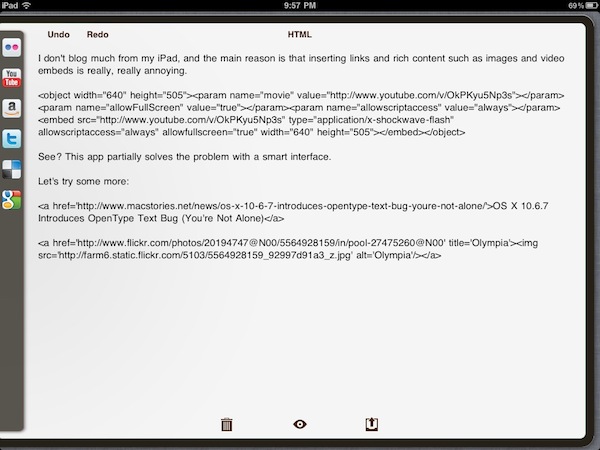
I haven’t written many blog entries from my iPad, and the main reason is that inserting links and rich content like images and video embeds can be really, really annoying on the tablet. No HTML editor for the iPad nailed it when it comes to offering an interface and a set of tools that allow bloggers to rely on the device as their main blogging machine; and especially if you write for blogs with several articles every day and you need to keep up at a fast pace, wasting time trying iPad apps is impossible. But I believe also those folks that post status updates and journal entries on their personal blogs must have noticed the iPad is far from being an ideal mobile blogging device, and the lack of dedicated apps is worrying. Sure, there are plenty of iOS text editors out there, even with advanced HTML and Markdown formatting capabilities; for bloggers like me, though, that is not enough. Either with WordPress, Movable Type, Drupal or a custom CMS you might be using on your blog, there are usually a lot of writing and management options to consider that most apps don’t support. The official WordPress app doesn’t even accept custom fields and many, many other things that millions of bloggers rely on every day. The situation is almost unacceptable, and I really don’t understand why – with more than 15 million iPads out there – someone hasn’t set out to create the ultimate iOS blogging app. I really don’t. Yet we keep hoping. Read more


iBackupTunes: Copy, Backup & Share Your iOS Music Library

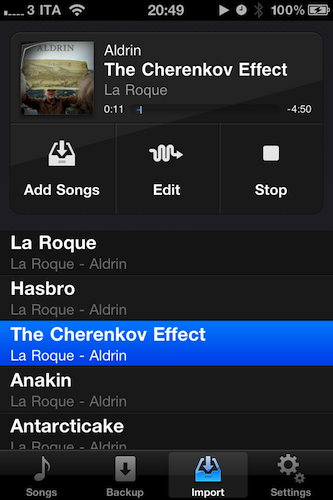
Released yesterday in the App Store, iBackupTunes by drahtwerk is one of the most powerful music apps for iOS I’ve recently installed on my iPhone and iPad. This time, though, I’m not talking about a new iPod replacement app that aims at enhancing music playback with Wikipedia or last.fm integration: instead, iBackupTunes is “powerful” in the way it lets you copy songs and albums off your synchronized iPod library, back them up locally on your device and share them with others, even wirelessly. Whilst the procedure of importing songs might sound a little too complicated at first, iBackupTunes provides a graphical user interface that makes it easy to choose music, listen to it, and back it up. Read more


The Onion iPad App Now Available

Right in time for April Fool’s Day, The Onion – “America’s Finest News Source” – has released its first official application for the iPad, available now for free in the App Store. The Onion delivers hilarious fake news, stories and reports every day, and releasing the tablet app today, with all those pranks and not-so-clever fake stories that are floating around on the Internet, seems more than appropriate to us. In fact, we love The Onion and reading its articles directly on our iPads is something we’ve been looking forward to.

The app is very simple: it lets you read, share articles on social networks with a few taps and watch videos without leaving the app. It’s also got support for Instapaper and Google Reader, among others. The interface design doesn’t look exactly beautiful, but all the content from The Onion is there. It should be enough for now.

You can find The Onion for iPad here.


OS X Lion: Multi-User Remote Access, New Auto Save & iChat Options

Following the release of the second Developer Preview of OS X Lion two days ago, several blogs have posted details and screenshots of what’s new, improved and changed in this build and, overall, Mac OS 10.7 itself. Together with the new features we covered in the past, Lion introduces a brand new multi-user screensharing system that will allow users to remotely log into their own computer even while it’s being used (locally) with another account. This is a major change that turns Mac OS’ Screen Sharing tool into a powerful remote computing solution with fast users switching options.

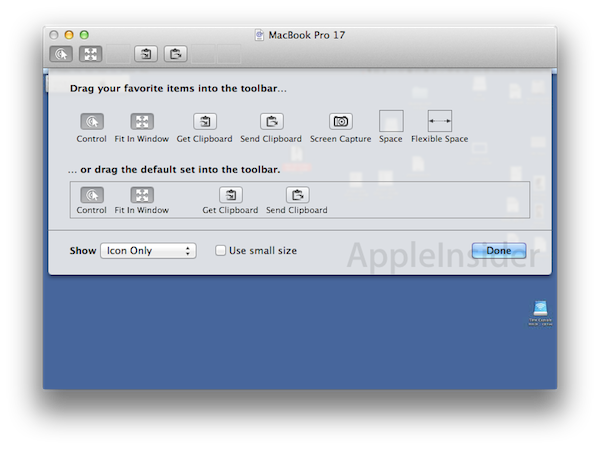
AppleInsider has posted details and screenshots of the new feature. A user has the possibility to log into a computer with his own account while another account is currently managing and using the machine; the “remote user” will still see his desktop environment, all his files and applications. In previous versions of OS X, when a user tried to connect remotely and share the screen, the “local user” would have to give up on the possibility of controlling the screen – or otherwise find a way to communicate in real-time with the remote user to decide who should move the mouse and control the computer. We’ve all been in this situation: when a friend asks us to control his machine for troubleshooting purposes, we have to make sure he doesn’t do anything while we’re controlling his desktop UI. Or, we tried to remotely log into our home computer only to find out a family member was using it and we had no way to independently access to our apps, files and folders. Lion will change this, and we believe it’s quite possibly one of the most interesting features unveiled so far, as it opens to a lot of possibilities for remote access, troubleshooting and, overall, effortless management of a machine not in our local network. Read more


Want Lion’s Scrolling on Snow Leopard? This Free App Enables It

One of the most discussed features of Mac OS X 10.7 Lion is the “backward scrolling” that, in an attempt to resemble the behavior of iOS devices, is enabled by default in System Preferences. In the Lion Developer Preview (both 1 and 2), if you move your fingers down the screen scrolls up, and vice versa. This is activated by default to make iOS users feel comfortable when using the new desktop OS, but has annoyed several long-time OS X users as the preference is automatically enabled and is buried deep down into the Trackpad settings as a checkbox.

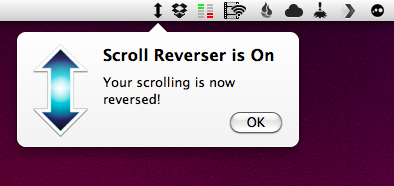
If you believe, however, that changing the scrolling system is actually a great idea and you want to practice before Lion is released to the public, free app Scroll Reverser lets you do just that – on Snow Leopard (and 10.5, too). Once downloaded, it’ll sit in the menubar waiting for you to choose whether you want reversed scrolling or the normal one. A click on the dropdown menu allows you to make the change in seconds, and revert back again. The app can start at login, and has no additional preferences.

Download here. [via Lifehacker]