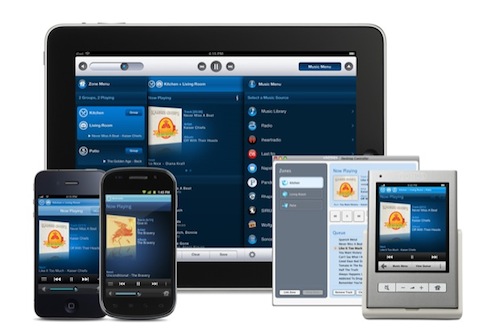
I love iTunes Home Sharing. Introduced almost two years ago with iTunes 9, Home Sharing allows you to share your music and movies, TV shows, podcasts and playlists with friends and family on a local network. With an active Internet connection and an Apple ID configured with the iTunes Store, you’ll be able to easily share your entire iTunes library and enable other users to connect to your iTunes installation to stream songs, video files, and so forth. It is a great feature of iTunes, and with the latest iOS 4.3 update for iPhone and iPad it also works exceptionally well with mobile devices: once activated on the desktop, your entire iTunes library will be sent to the iOS iPod app without the need of syncing or manually copying anything. Just make sure you’re on the same WiFi network, and you’re all set. Read more
Witness Remotely Locks Your Mac, Detects Motion, Sends You Mugshots
Developed by Orbicule, the creators of computer-tracking utility Undercover, Witness is a new application that’s aimed at remotely locking your Mac, and detecting motion in front of your computer’s camera. Let’s face it: every time we’re away from our Macs, we think about what could ever happen if someone broke into our house or office and stole them. Whilst data protection is essential and there many things you can do to hide critical information stored on your machine (such as disabling automatic login, choose a strong system password or keep everything safe into 1Password, possibly synced with Dropbox), knowing the identity of the person that actually took possession of your computer – or entered your office without authorization – is a whole different story. Unless you’re planning on setting up a relatively expensive home monitoring security system (even with DIY sets, you’re still going to spend a couple of hundred bucks + software to monitor everything) or just carrying your MacBook away with you all the time, there’s no easy to know what’s happening in front of your computer’s screen, and take action at the same time. Orbicule wants to provide an easy and powerful solution to remotely lock a Mac from virtually anywhere, detect motion and be notified with photos and video of who’s doing what in your house.
There are many tweaks and hacks available online to turn your iSight into a security system, as well as utilities to lock your Mac from an iPhone or iPad while on the go. I bet many of you have heard of these methods or at least tried to follow one of those tutorials once. Witness, however, does exactly what a great app has to do: it combines multiple functionalities into a beautiful, easy to use and full-featured package that requires minimal setup and just works. Witness can lock and unlock your Mac from an iPhone, an iPad or the web browser thanks to a system that’s based on an account you’ll have to create on Orbicule’s website. Once authenticated with the account on your Mac, iOS devices and browser, you’ll be ready to start using Witness and be alerted of activity in front of your Mac’s iSight. Witness also requires a desktop companion app that comes as an installer and will restart your computer upon successful installation. The Mac app handles the location of your computer, your account’s credentials, and also lets you decide whether Witness itself or the screensaver should be used to lock OS X. If you choose Witness, a panel will come in the foreground asking for your system’s password. If you don’t want to use the iSight and you have configured other cameras with your Mac, you can choose a different capturing device from the Preferences.
On the iOS side of things, Witness comes with a free remote app that runs universally on iPhones and iPads. The UI is gorgeous, and the app provides a set of functionalities to lock a Mac with a simple swipe, monitor your various machines associated with a Witness account, and browse the history of alerts you’ve received. Being heavily based on the cloud, Witness for iOS will constantly check for updates, pulling images and videos from the Internet if they’re available (meaning: you’ve locked your Mac and something’s going on). If an alert comes in via push notification, you’ll be able to see pictures and videos recorded by your iSight (audio is supported, too). You can email photos directly within the app, and delete alerts you’re no longer interested in. All these features are available on the web counterpart as well.
In my tests, Witness has been very reliable and quite fast both on WiFi and 3G. I was able to lock / unlock my iMac in seconds, receive push notifications moments after motion was detected and download full sets of photos and videos shot through my iSight. A Witness account will cost you $39 as a one-time fee (student licenses available) and gives you access to OS X, iOS and web tools. I highly recommend Witness not only because of the beautiful interface approach and usability – it’s the “just works” factor that combines a utility to lock a computer and turn it into a home alarm system that truly impressed me. You can create a Witness account here, and check out more screenshots below. Read more
Analysts: Did Apple Sell 19 Million iPhones in Q2 2011?
Two weeks ago, Apple officially announced the Q2 2011 conference call, where the company will unveil the financial results for the quarter that ended on March 26. The second fiscal quarter usually marks a decline in sales after the holiday season, but this year analysts are facing an interesting scenario: in the second quarter, Apple released the Verizon iPhone after years of rumors and speculation, and launched the iPad 2 both in the United States and internationally. Whilst previous Q2s have followed the unspoken standard of lower sales than the big boom of Thanksgiving and Christmas shopping, this year’s conference call is set to provide more insight into Verizon iPhone’s sales (which were rumored to be “below expectations”, although many disagree) and the (allegedly) huge success of the iPad 2, which is still nowhere to be found in most Apple retail stores and has a 2-3 weeks shipment delay on Apple.com.
Just like last quarter, Fortune has posted the predictions of pro and “amateur” analysts about how many iPhone units did Apple sell in the quarter. According to the analysts contacted by Fortune, Apple might have sold between 13 million and 20 million iPhones, with most predictions averaging around 16 million devices sold.
The health of Apple’s quarterly earnings – and its stock price – will depend heavily on how those two factors balanced out. The iPhone is the company’s biggest money maker; in Q1 2011, it represented nearly 40% of total revenue.
The 43 analysts we polled – professionals and amateurs – were split on the question of whether iPhone sales rose or fell in Q2. Twenty five believe Apple sold more; 18 think it sold less. Their estimates ranged from a high of 19.8 million from Susquehanna’s Jeff Fidacaro to a low of 13.24 million from Goldman Sachs’ Bill Shope.
In Q1 2011, Apple posted a record revenue of $26.74 billion with 7.33 million iPads sold, 16.24 million iPhones and 4.13 million Macs; a graphical analysis of the Q1 offers a good overview of where Apple’s sales are and what’s generating profit for the company. In the past weeks, other analysts claimed 2011 could be a $100 billion revenue for Apple. While we look forward to see whether or not Horace Dediu and Turley Muller will go close to Apple’s actual results this time around too, you can check out the full chart if predictions and estimates below. Read more
Jailbreaking iPhones Made This Student $50,000
Can jailbreaking iOS devices become a real business with an actual annual profit? Apparently, yes. And even if we wouldn’t recommend basing your monthly income entirely on the process of hacking phones and installing apps Apple doesn’t approve, $50,000 a year doesn’t sound that bad.
The Washington Post published a piece yesterday profiling Kevin Lee, a George Mason University senior that has managed to earn $50,000 a year by jailbreaking and unlocking iPhones. What started as a hobby to help out friends and relatives eventually evolved into a “real business” with 30-40 clients per week asking for jailbreak, Cydia installations, graphical customizations and “unlocks” to use the iPhone on wireless carriers otherwise unsupported by Apple. The procedure of unlocking iPhones has in fact turned out to be quite lucrative for Lee, thanks to international customers buying an iPhone in the United States, and looking for a way to use the device overseas. Lee says he recently unlocked an iPhone for a member of the Mongolian embassy who was about to go back to Ulaanbaatar (Mongolia’s capital) and needed to have a device compatible with his local carrier.
But how did a student get a massive traction for a business that – let’s face it – can be easily achieved with a computer and a couple of tutorials? With a Craigslist ad, that’s how. By posting a “Get Your iPhone Jailbroken Today” ad on the popular online community, Lee got hundreds of requests from people who didn’t have the knowledge, or simply didn’t have time to mess with redsn0w, Geohot’s tools, or Cydia itself.
Personally, I wouldn’t run a business that’s clearly going against Apple’s rules (even though the Library of Congress ruled last year jailbreaking a phone in the US is legal) and requires my friends to pay actual money for something that can be done for free in 2 minutes. Curiously enough The Washington Post reports the Craigslist ad has been taken offline since the original article. [via iPhoneDownloadBlog]
The New York Times Brings Paywall To iPad App
The official New York Times app for the iPad was updated a few minutes ago to include the new subscription system the publication first announced in March. The latest 2.0.5 version, bug fixes and performance enhancements aside, introduces the so-called paywall that restricts access to several sections of the app and only enables you to check out the Top News and Video section. You can find the updated version in the App Store here.
What’s interesting is that The New York Times still isn’t using Apple’s iOS subscription system to sell digital access to the newspaper. The app still relies on an embedded browser login to unlock all the features or sign up for a new subscription plan, and we guess it’s because developers of existing App Store apps can wait until June before being forced to update their software to include the iTunes subscriptions. From the app’s Settings, in fact, there’s no way to easily purchase a subscription like in The Daily with your iTunes account – you’ll have to manually log in The New York Times’ website from a popup window. We assume an upcoming update to the iPhone app (recently updated to version 3.0) will also activate the NYT’s paywall for sections.
On March 17th, the New York Times announced they will offer three different packages for unlimited digital access:
- NYTimes + smartphone app: $15 per month
- NYTimes + tablet app: $20 per month
- NYTimes full access: $35 per month
At the moment of writing this, however, it appears that The New York Times is running a promotion with discounted access for early subscribers:
The New York Times has also started offering 1 year of full digital access to long-time subscribers of the print edition. Check out more screenshots of The New York Times iPad app below. Read more
Here’s A Digital Whiteboard Running On 40 iPads Simultaneously
Back in January Cody reviewed SyncPad, a collaborative online whiteboard with web, iPhone and iPad applications that allow people to collaborate on sketches, wireframes or PDFs in real-time. SyncPad is a very powerful app, as it lets you create multiple rooms, work locally or over the Internet, share with Dropbox and even import PDFs in seconds to quickly mark up a document and show it to your colleagues. From the review:
As soon as you open SyncPad, you’re asked to enter a room name. You can make up anything, and a URL will be spit out enabling you to share that room with collaborators. With no sign-up required, collaborators can simply plug the URL into a web browser to watch you markup content in realtime. There may be a slight delay between what someone will see in a room as you draw on the screen, but it’s rather minor and personally unimportant. The WOW! factor is immediate as the simplicity behind SyncPad is astounding, and it’s an easy way to impress others on the other end. They’ll tell you, “it’s the future,” and I’m not exaggerating - SyncPad is a great way to share content with others because it’s such a fascinating little tool.
The “WOW” factor Cody mentioned is indeed well visible in the video shared by the developers, in which 40 iPads are running the same whiteboard simultaneously. The devices are on the same local WiFi network (they’re not connected over the air from different countries in the world – like Cody and I did in our tests), but the tech is still impressive. The animations are smooth, everything happens in real-time, and we can only imagine the possibilities offered by SyncPad during, say, meetings or conferences where all attendees have an iPad with the aforementioned app installed.
Check out the video below. Read more
iOS 4.3.2 Coming In Two Weeks?
BGR reports this morning that Apple is looking to launch another version of iOS 4.3 within two weeks. The update, labelled iOS 4.3.2, should contain various fixes and enhancements, address security issues (quite possibly a jailbreak fix) and it “will also fix several bugs that have affected users.”
On March 21st, BGR reported iOS 4.3.1 would be released within “one or two weeks”, and the OS was released on Friday, March 25th. If BGR’s track record is of any indication, there is the small chance to see iOS 4.3.2 becoming available next week if Apple really wants to close security holes and fix bugs quickly. In the past weeks, several users running iOS 4.3.1 reported bugs in the FaceTime application for iPad and iPhone, WiFi connectivity issues after the 4.3.1 upgrade and other minor glitches in the Camera app.
FileBrowser for iPad Lets You Access Computers, Network Drives, Shared Folders
Earlier today I mentioned (again) Cloud Connect Pro, a universal $24.99 app that enables you to access online services like iDisk and Dropbox, local and remote computers, AirPort Disks and much more. Cloud Connect is a pricey app, but it also packs a whole screensharing app, runs on iPhone and iPads and it’s got the possibility to navigate a computer’s filesystem with a Finder-like interface. For quite some time, however, I’ve been using a cheaper alternative to Cloud Connect called FileBrowser that runs only on the iPad, it doesn’t have screensharing functionalities or Dropbox / iDisk / Google Docs integration but enables you to connect to your computers, shared folders and network drives just fine.
FileBrowser uses the CIFS and SMB protocols to connect to Windows and Mac computers, and NAS drives. Linux is also partially supported but you can’t connect using Apple File Sharing (AFP) or FTP. Once File Sharing is enabled on your Mac, FileBrowser should be able to see your machine on a local network. There’s no support for automatic computer discovery, but you can easily add a new computer by typing “username.local” in the “Name or Address” field – where “username” is the actual name you chose for your Mac’s Home folder. With the same .local domain, FileBrowser can connect to an AirPort Extreme station (and thus open the contents of a shared drive) or recognize the folders you’ve decided to share (besides Home) in your Mac’s System Preferences. This app is quite powerful in the way it lets you remotely connect to a machine using a DynDns hostname, enter username and password in the Settings (to avoid being asked every time), or tweak the Advanced Settings to change the SMB port number and pipelining.
FileBrowser can also open and preview a variety of file types, including music files and video formats supported by the iPad (no, it won’t do live conversion for your AVIs like Air Video). Songs can play in the background and be shared through AirPlay, but the app goes fullscreen when playing them and there’s no way to keep browsing or creating a queue. I’m okay with having videos in fullscreen, but the developers should find another implementation for music playback. The app can load images and documents like PDFs too, plus every file can be saved as a “bookmark” for quick access or emailed as an attachment. Again, these files come from your computer and network drives, not the iPad itself. There’s a temporary file cache that you can “purge” from the Settings, alongside many other options to enable admin shares or change the remote permissions for file creation / deletion, for example. There’s a lot of stuff to play with to turn FileBrowser into a powerful app, finely tuned to connect to your computers and network drives. FileBrowser doesn’t have the best interface the iPad has ever seen, but as far as functionality is concerned we have a great piece of software here. Fast, stable, feature-rich and being actively developed by Stratospherix.
At $3.99 in the App Store, FileBrowser gives you the tools you need to access and browse computers and drives from your iPad. Make sure to also check out NetPortal for iPhone, from the same developers, which brings most of the functionalities of FileBrowser to the iPhone.
Atari Introduces “Greatest Hits” App with 100 Retro Games
If you love retro gaming as much as I do, Atari’s latest app for the iPhone and iPad (which will launch in the US App Store later today) might as well be a dream come true: with Atari’s Greatest Hits, you’ll have access to 100 old Atari games from a single app that presents them in a beautiful interface with arcade cabinets and original box arts. That’s right, 100 games in a single universal app. Where’s the catch? The app is free and comes bundled with PONG, but if you want to download the other included games you’ll have to choose between some in-app purchases options. The huge deal is the following: games have been organized in 25 game packs; each game pack will cost you $0.99 via in-app purchase. Alternatively, you can buy all the packs (and thus 100 games) together with a single purchase at $14.99. Which brings us to: 15 bucks for 100 old Atari games, on the iPhone. Some of them have even been updated to include local Bluetooth multiplayer. I won’t be missing this offer as soon as the app goes live, for sure.
The app is available now in the New Zealand store and will go live at this link in the US tonight. Full list of included games after the break. [via Touch Arcade] Read more