Federico Viticci

10768 posts on MacStories since April 2009

Federico is the founder and Editor-in-Chief of MacStories, where he writes about Apple with a focus on apps, developers, iPad, and iOS productivity. He founded MacStories in April 2009 and has been writing about Apple since. Federico is also the co-host of AppStories, a weekly podcast exploring the world of apps, Unwind, a fun exploration of media and more, and NPC: Next Portable Console, a show about portable gaming and the handheld revolution.

Video Of iOS 5 AirPlay Mirroring

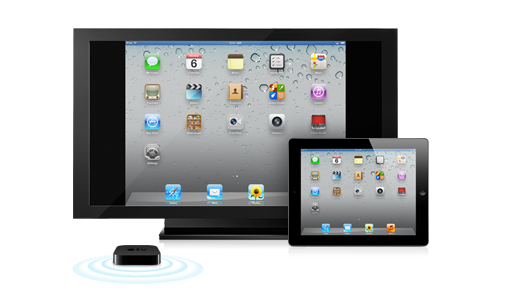
One of the big features coming with iOS 5 on the iPad 2 is AirPlay mirroring, a new functionality that, using the AirPlay technology for streaming content introduced in iOS 4.2, will allow users to beam their iPad’s screens directly to an Apple TV without the need for a cable. In spite of the iPad being capable of mirroring its screen through HDMI to a TV, Apple has decided to step its game up and allow Apple TV owners with a decent local network to stream apps, games, and whatever it is people do on an iPad without anything but a WiFi connection and a control button in the multitasking tray.

TUAW points today to a video posted by Apple’n’Apps that details how AirPlay mirroring will work with the iPad 2. The setup is very easy: once you’ve made sure both the iPad and Apple TV are running iOS 5, all you have to do is enable AirPlay Mirroring from the switcher’s controls and check out the iPad’s screen on the TV right away. In the video, you can see the Springboard, as well as regular apps and games being beamed from the tablet to the Apple TV. Scrolling doesn’t look as smooth as it is on the device when you’re directly interacting with it, but we assume it depends on the kind of wireless connection you have.

In a similar post, Engadget shows AirPlay Mirroring with Angry Birds Rio HD for iPad and Real Racing 2 HD.

For this game (and we imagine many more to come), you use the iPad as the controller – both while navigating through menus and in race mode – while the game appears only on your TV (though the tablet does display some vitals, and a map of the track). There’s noticeable lag between the iPad and Apple TV when using AirPlay, which may be an issue for games where timing is important, such as Rock Band, but didn’t seem to set us back while playing Firemint’s racing game.

Firemint has announced that Real Racing 2 HD will support AirPlay Mirroring once iOS 5 comes out this Fall, and it appears that the feature is already enabled in the first beta of iOS 5 available now to developers. Check out the videos after the break. Read more
Dropkick Brings Its Task Cloud Sync To The iPad

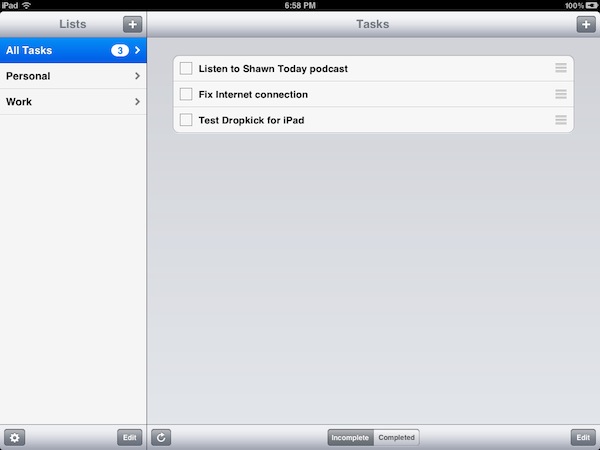
Sure, Apple may have unveiled a gorgeous Reminders app at the WWDC that looks great, does location-based alerts and will come for free with iOS 5, but until then, those looking for a simple to-do list application that sync seamlessly over the air and runs now on iOS and OS X might want to give another try to Dropkick, an easy to use and useful app we’ve already covered a couple of times on MacStories. The big news today is that Dropkick finally has a native iPad counterpart, which is free on the App Store and, like the iPhone version, can be unlocked to enter unlimited tasks with in-app purchase. Whilst the iPhone app will set you back $2.99 (and the Mac app is also available as free trial on the developer’s website, paid app on the Mac App Store), unlocking the iPad app comes at $3.99.

The iPad version of Dropkick is really, really simple. You can create tasks and lists, delete them, sync back to the cloud with your account. You can move tasks around, and see them in the greater detail using the popover menu. That’s it - the interface doesn’t get in the way and everything’s kept super-accessible. As usual with Dropkick, tasks are pushed almost instantly to the Mac and iPhone, and I can’t wait to see this taking advantage of iCloud’s unified sync service for developers (and users).

Dropkick for iPad doesn’t have all the fancy features and graphics of Reminders for iOS 5, but it’s available now and it’ll help you stay focused and get things done. Go download it here.


Alien Blue Reddit Client Coming To The Mac

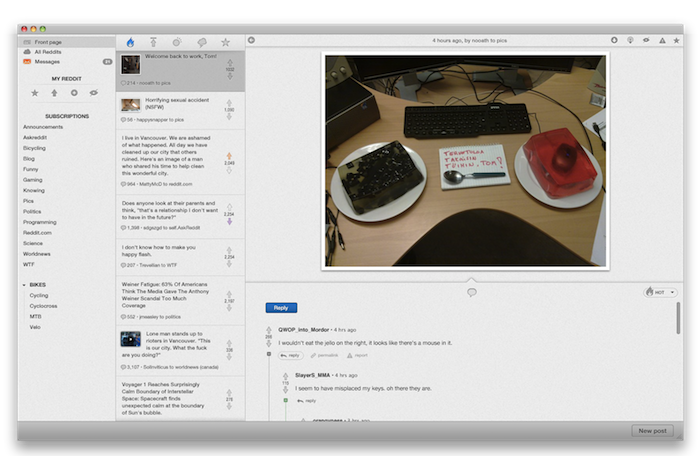
Alien Blue, the popular Reddit client for iPhone and iPad, is coming to the Mac with a native version that will be released on the Mac App Store. For those who haven’t tried Alien Blue, it’s an unofficial Reddit application that’s been very successful on the App Store thanks to its clean design, possibility to create shortcuts for subreddits (categories) to reduce the number of taps to navigate the website, as well as inline media viewing for pictures and video, undoubtedly a huge part of Reddit’s success. Alien Blue for iOS (an app that I’ve personally enjoyed using over the past months), is a full-featured Reddit client with login features to check on your Reddit account and leave comments, Read It Later, Instapaper and Readability integration and many more functionalities including a “search” feature to look into Reddit’s archive of posts.

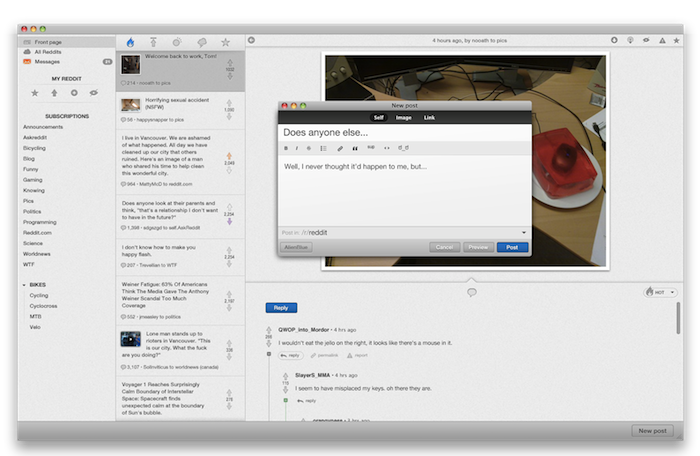
The Mac version of Alien Blue, teased on the app’s website today, looks very elegant and falls in line with the iOS counterpart’s minimal, yet powerful approach to the social sharing / commenting website. Alien Blue for Mac will have a three-panel interface with a column on the left to switch between front page, subreddits and your account’s sections. The mid panel will be used to scroll posts, or check on your messages and notifications. The right panel, the larger one, will allow you to see the actual posts, images and videos. As you can see from the screenshots, everything will be reformatted and redesigned to fit Alien Blue’s aesthetics and color scheme. From a first impression, the app seems to be slightly inspired from Reeder, Sparrow and OS X Lion in general in the way it makes use of monocrome icons, large rounded buttons and a compose window similar to the one seen in the alternative mail client. It looks very intriguing overall, but of course some things may change come the final release.

The developer also writes on the website Alien Blue for Mac will integrate HTML5 technology for YouTube and Vimeo videos, implement Readability to elegantly lay out webpages, and folder for groups of subreddits.

To follow the development of Alien Blue, you can check out Reddit’s dedicated section, or follow the developer on Twitter.


Survey Claims iTunes Has 10% Market Share Of Online Video

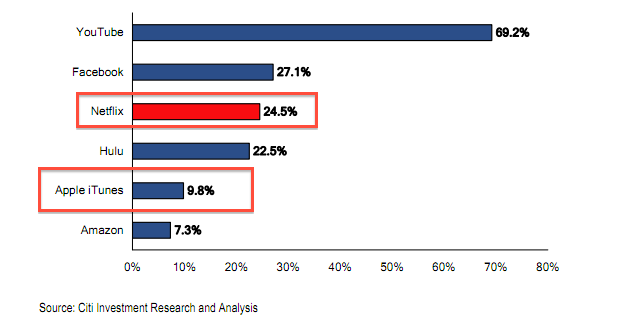
In a survey based on the results of a poll of an unspecified number of “Web users” over the last week, Citigroup analyst Mark Mahaney says Apple’s iTunes Store has roughly 10% of market share for online video. In the poll, the usual suspects are mentioned by users: YouTube leads with 69.2%, and surprisingly enough Facebook comes at #2 with 27.1%, leaving Netflix in the third spot with 24.5%. However, as the analyst notes, if you’re paying to watch web video, you’re using Netflix; neither YouTube or Facebook have premium subscriptions for videos in place, although Google’s video platform has tried several times in the past to expand to other possible profitable segments like live streams and movie rentals. However, the standard YouTube experience remains free and users are able to upload high-quality, HD videos without restrictions of sorts. These videos are then consumed on YouTube.com or connected devices such as the iPhone, iPad, Apple TV and Android handsets, thus making YouTube the leader of online video, without a price.

The “Hulu” seen in the graph above sits right below Netflix, but it’s worth mentioning that most of its visits come from free subscribers, and not Hulu Plus accounts. Similarly, Apple’s iTunes at 9.8% doesn’t include streaming options like its competitors – unless we consider the second-generation Apple TV as part of the reported 9.8% market share, but it’s unclear how many Apple TV units Apple sold since September 2010, and it’s also not clear which devices the users polled by Mahaney own. Apple was rumored to be planning an expansion in web video with the launch of a Netflix-like service, an Internet-connected television and a massive upgrade for iTunes video storage, though recent announcements at WWDC put the focus on iCloud as a delivery platform for iOS devices, rather than a video service. [via All Things Digital]


NYT: Facebook iPad App Launching “In The Coming Weeks”

Nick Bilton at The New York Times reports Facebook is in the final stages of testing its first official iPad application, which should launch in the App Store for free in the coming weeks. The lack of an official Facebook app for the tablet contributed to the rise of third-party solutions in the past year that were nothing but redesigned versions of Facebook’s website wrapped inside the iPad’s screen; according to The New York Times, Facebook’s iPad app has been carefully designed and tested by Mark Zuckerberg himself to ensure the quality of the product and a great Facebook experience on the tablet. For instance, the app will sport chat and Groups integration and will allow users to upload photos shot with the iPad’s cameras. Or, users will be able to browse photos in full-screen in a completely new, beautiful Facebook UI.

People briefed on Facebook’s plans say that in coming weeks the company plans to introduce a free iPad application that has been carefully designed and optimized for the tablet.

The app has been in production at Facebook for almost a year, going through several design iterations, and is now in the final stages of testing, according to these people, who declined to be named because they were discussing confidential product plans.

With more than 600 million Facebook users out there and 25 million iPads sold since April 2010, the potential for adoption is huge. There’s been some talks lately as to whether Facebook is really planning to launch an HTML5-based development platform to take on Apple’s Mobile Safari, and indeed The New York Times is also reporting Facebook will launch a new version of the regular website for the iPad’s browser. It’s unclear when all this will launch (NYT says the iPad app will be available in the “coming weeks”), but it’s safe to assume the new website won’t offer as many features as a native app. The Facebook app for iPhone has been around since 2008 and it’s the most popular free App Store download of all time.


Send2Mac: An Easy Way To Send Webpages To A Mac Browser

Over the past few weeks I’ve mentioned on Twitter and in a couple of articles a service I’ve started using on my Macs and iOS devices, a simple tool that has contributed to making the process of sending webpages to remote computers incredibly easy. Send2Mac, a free service by developer Bastian Woelfle, installs as an app on your Mac and a bookmarklet in your browser to enable you to instantly send a webpage from any device or computer, to another Mac. It doesn’t matter where the target Mac is, or what kind of Internet connection you’re using on your iPhone, iPad, or office PC: as long as you can run a web browser and the remote Mac is connected to the Internet, the webpage will magically open in a few seconds.

In the past months, I’ve actually been busy trying to find the best way to remotely send webpages from a device to another. First, I came up with a Dropbox tweak to email links to myself, and watch them open in my desktop browser. Then I stumbled upon Push Browser, an iOS app and Chrome extension that enables you to send webpages back and forth between devices and desktop computers. I love Push Browser, but it’s got one major downside: on a Mac, it’s limited to Google Chrome, and I haven’t heard back from the developer about a possible Safari or system-wide integration. That’s why I thought of giving Send2Mac a try: rather than having a dedicated extension for each browser, this app directly plugs into a Mac’s default browser, whatever it is, and can send webpages to it. Simple. On the other end, Send2Mac generates a unique bookmarklet for each of your target machines, based on an API key thet you’re given randomly every time you visit send2mac.com to set up a new computer.

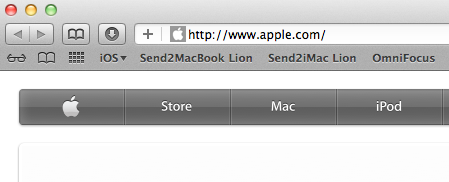
It works like this: I have two Macs, and both of them run the Send2Mac utility in the background. My MacBook Pro and iMac, however, have been assigned different API keys: they’re different, because they correspond to two different bookmarklets that let me send webpages from my iOS devices – or other computers I might happen to have. So when I’m on my iPhone and I find a webpage I’d like to check out later on my iMac, I hit the “Send2iMac” bookmarklet and it goes straight to the iMac, in a couple of seconds. If I want the page to open on my MacBook Pro, I hit the bookmarklet for that computer. If I want the page to open on my iMac, but while running Lion, I have another bookmarklet. It’s really simple: each target machine and OS has its own key and bookmarklet. No menus to navigate and no interface, you hit a button and the webpage travels from a browser to another.

I’d pay for Send2Mac if it were a premium service, but it’s surprisingly free and “might be really buggy”, as the developer writes on the app’s website. In my tests, I’ve found Send2Mac to work reliably as it’s even capable of launching a closed browser with the new webpage I sent because it’s a process that runs in the background all the time, alongside the default browser of your Mac. You can configure Send2Mac on iOS and Mac browsers, send webpages from Mac to Mac, iOS to Mac and even Windows to Mac as long as you have the bookmarklet installed.

You can start using Send2Mac by heading over here with your device, and generating a new API key for your Mac.


Report Claims No New Macs Until Lion Launches

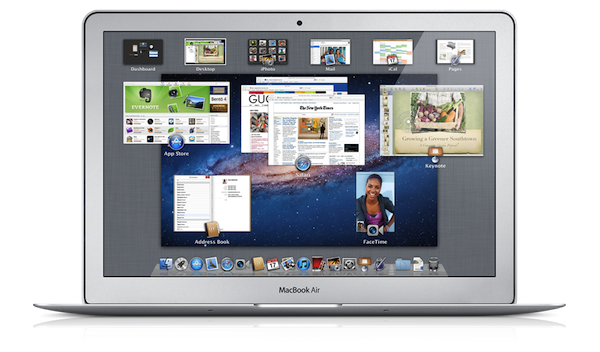
As Apple is getting ready to launch the next major version of OS X, Lion, in July, AppleInsider reports the company has decided to postpone the release of refreshed Mac models until the OS is available, so customers buying new computers will find Lion already installed. The move would make sense considering the new features being introduced in Lion: a customer that doesn’t need to manually upgrade (in spite of the simple upgrade process of the Mac App Store with one-click install) may result in a customer already tied to the new iCloud ecosystem once the suite launches this Fall, as well as immediate access to new functionalities like AirDrop, full-screen apps, or Mission Control. To put it simply: by releasing new Macs with Lion built-in, Apple would eliminate the risk of users putting off the upgrade for any reason.

Apple management is so pumped up over the advantages presented by its forthcoming Mac OS X Lion operating system that the company has been holding back the release of at least one new Mac refresh until the software is finalized, AppleInsider has learned.

For instance, new Thunderbolt-enabled Sandy Bridge MacBook Air models expected to go into production this month have been ready and waiting for some time, according to people familiar with the matter. But management is currently unwilling to usher the new models into the market with the current Mac OS X 10.6 Snow Leopard operating system.

With Apple’s Lion Up-To-Date program, customers will also be able to request the OS for free for Macs purchased between June 6, 2011, and the day OS X Lion comes out. This means that, even if the rumor’s untrue and Apple is not considering waiting for Lion’s release to unleash new Macs, customers would still have the chance to spend $0 to get the latest operating system.

As for the Macs rumored to be getting an update soon, the most notable ones are the MacBook Airs, allegedly set for a Thunderbolt and Sandy Bridge spec bump following the MacBook Pro and iMac refreshes from earlier this year. According to the rumor mill though, the Mac mini and Mac Pro lines are also due an update, with the server counterparts specifically mentioned in a report last week.


Alternative Ways To Add Actions Into OmniFocus

It is no secret I’m a big fan of The Omni Group’s OmniFocus for Mac and iOS, as over time it has become my “trusted system” (as people like to call great applications you can rely on nowadays) to organize actions (tasks), contexts and, in general, stuff I have to do and don’t want to forget about. If you’ve been reading MacStories in the past few months, you know we care about the latest OmniFocus updates and new features implemented by the developers, but more importantly we, like many others, have fallen in love with the iPad version of OmniFocus, which contrary to expectations has turned out to be a great portable counterpart that retains most of the functionalities of the desktop OF without sacrificing usability – actually adding new intuitive schemes, navigation options, and more. With an update to the iPhone app around the corner and a major 2.0 update for the Mac coming out sometime in the next months, there’s plenty of features to look forward to.

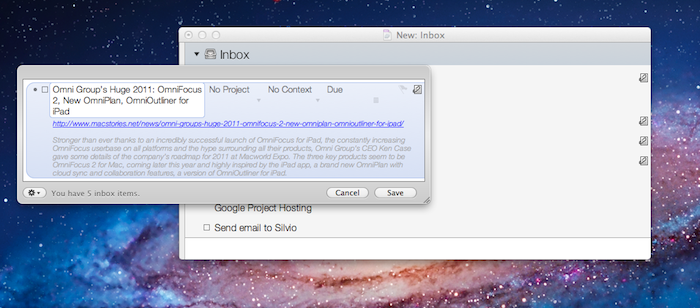
Over the past weeks, however, rather than reading tutorials on how to get the most out of OmniFocus or learning about other users’ setups (something that I usually love to do, by the way, as my Instapaper queue can prove), I decided to play around with tools and utilities provided by The Omni Group to customize the way you can get actions into OmniFocus without actually using OmniFocus. That’s an interesting concept: as OmniFocus can be integrated with OS X, accessed to from a web browser or even linked to by other apps, there are ways to quickly get items into it without following the usual pattern of opening the app + writing down a new action, or launching the desktop Quick Entry window manually. And as much as I love the iOS versions of OmniFocus, there’s always something that bothers me when I’m in a hurry but I need to get some actions saved quickly: as others have outlined before, I think I’d really enjoy a “mini OmniFocus” that’s exclusively aimed at entering tasks in seconds without loading the entire database. Or, there could be a way to send an action quickly to OmniFocus’ cloud server, without having to open OmniFocus at all. While this is not possible today – but I have a pretty good feeling The Omni Group is considering it for future updates – there are ways to quickly create tasks outside of the main OmniFocus environment and save them in seconds.

After the break, I take a look at some of the tools I’ve been using to add actions in my OmniFocus using an iPhone, iPad, or Mac. Read more


Discovr Apps Is Like Pandora For The App Store

Back in January I reviewed Discovr, an interactive music map that was aimed at letting you easily and joyfully discover new artists and songs based on your tastes. By providing an original interface that turned classic hyperlinking into an interactive experience with animated maps and multitouch, Discovr still holds up as one of the most original iPad apps to explore the iTunes Store in an alternate view that, eventually, also made its way to the iPhone. But after music, the Filter Squad developers might have asked themselves what is that iOS users want to discover on a daily basis. And that is apps, obviously. Discovr Apps, a new version of Discovr available in the App Store at $0.99, runs on the iPhone and iPad and, just like its music counterpart, wants to turn the App Store categories and links into a map that changes every time according to the suggestions you’re given and the apps you’re interested in.

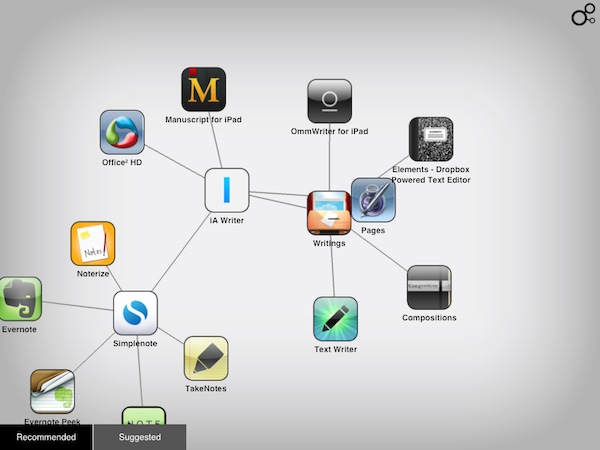
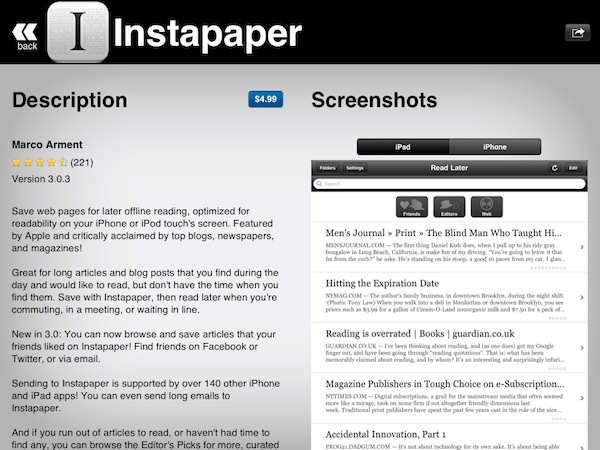
In the main page, you’re presented with a search box to manually start looking for an app, or two tabs at the bottom: recommended for you, and suggested apps. For those who don’t know how Discovr works: after the first element – in our case, an app – pops up on screen, a tap will generate related items connected to it, thus creating a map. As you keep tapping to view related items, the map grows and the connections expand. To view an item in detail, you just have to double-tap and you’re brought to an App Store-like page with description and screenshots. If you want a broader view of the map you’ve generated, pinch to go back.

You can share discoveries on Twitter and Facebook or via email, but the main point of the app is to sit down, check out the recommendations or start with an app you like, and see where Discovr brings you with its interactive system. And as far as recommendations go, I’m very satisfied with this app-focused version of Discovr: even more than Discovr for music, I found app suggestions to be really tailored to my tastes and needs, with gems like Twitterrific, Evernote, Simplenote and Writings often showing up in my maps.

Discovr is, once again, an interesting experiment that offers an intuitive way to discover media you’d probably miss in the sea of App Store apps and updates. At $0.99 in the App Store, that’s an investment you should consider to discover more great apps in the future.