Federico Viticci

10766 posts on MacStories since April 2009

Federico is the founder and Editor-in-Chief of MacStories, where he writes about Apple with a focus on apps, developers, iPad, and iOS productivity. He founded MacStories in April 2009 and has been writing about Apple since. Federico is also the co-host of AppStories, a weekly podcast exploring the world of apps, Unwind, a fun exploration of media and more, and NPC: Next Portable Console, a show about portable gaming and the handheld revolution.

App Journal, Episode 4: Moom, 4Eyes, Quotes Plus, Easy Timeline

App Journal is a weekly series aimed at showcasing apps we have enjoyed using on our iPhones, iPads, and Macs, but decided not to feature in a standalone, lengthy review here on MacStories. App Journal is a mix of classic reviews, weekly app recommendations, and a diary of our experiences with apps that still deserve a proper mention.

For this week’s App Journal episode, I asked my fellow writers Don, Chris, and Graham to come up with iOS and Mac apps to highlight in our weekly roundup. The result has turned out to be “quite a team effort” and, as I was reminded in our internal chat group, I still needed to come up with a proper introduction for the episode. So there you have it: window utilities, text-based search tools for iOS, timelines and famous quotes – there’s a variety of apps in App Journal Episode 4, and we’re increasingly looking forward to the updates and new apps the release of iOS 5 with iCloud support will bring.

Stay tuned for more App Journal episodes in the next weeks.

Don: Moom

Moom is a utility for moving, resizing, and manipulating application windows. It uses a mixture of pre-defined and user-defined window settings which are accessible by hovering over the green zoom button or through customizable keyboard commands. This is one of those apps that I didn’t think I needed until I gave it a chance. I was happy using a set of AppleScripts to move the front window to pre-defined locations but the problem was it only worked with applications that supported window bounds in AppleScript. This left Twitterrific and Preview out in the cold. Thankfully Moom has no issue working with these applications.

When using Moom there are two types of controls: Mouse and Keyboard. The keyboard controls are undeniably more powerful because of their speed and plethora of alterable configurations. Despite that I still found that the mouse features were treated with equal attention. Hovering over the green zoom button displays a beautiful transparent popover that has five pre-defined and extremely useful shortcuts.
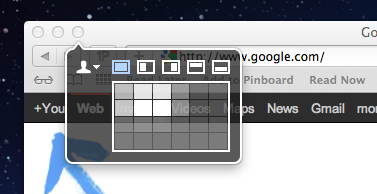
Below the five icons lies a grid that can be used to dynamically draw out where you want the window to be located. The grid must be enabled under Mooms Mouse preferences. There you will find options to adjust the size of the grid as well as an option to enable access to your custom keyboard controls. Another great mouse feature is the ability to move windows across displays with nothing more than a gesture (clicking down on an icon and dragging it towards the second display).
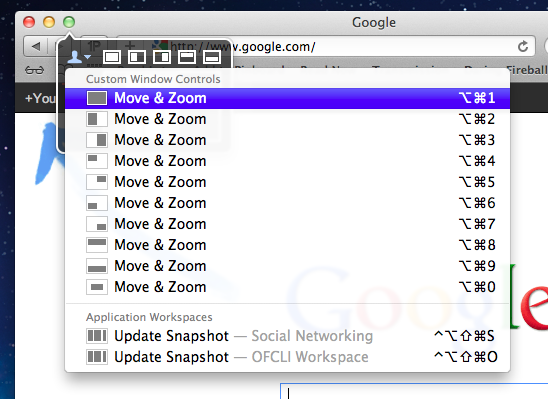
The keyboard functions are also quite interesting. There are basically two types. The first type allows you to define window positions and set them to a keyboard shortcut. It is the reason I bought the program and it did not disappoint. The ability to use a keyboard shortcut to resize a window to fill half the screen or even just a quarter of it depending on the situation is invaluable. The second type is a keyboard mode which is triggered by a hotkey and allows you to move a window around with your arrow keys for more granular on-the-fly positioning.
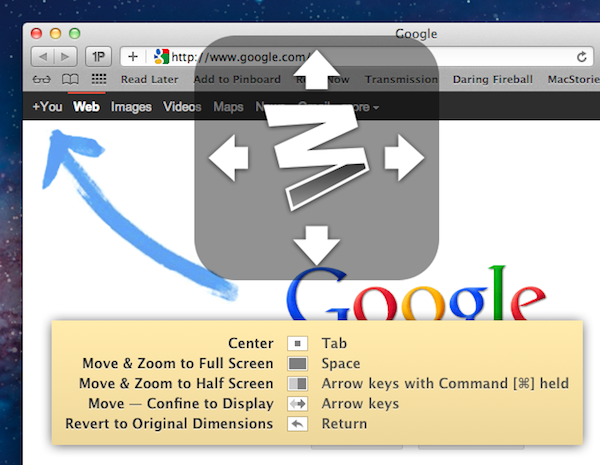
The real gem of this program is its ability to save window layouts. It basically memorizes the current positions of your windows and it saves a snapshot of them so it can restore those windows to their exact locations by way of a keyboard shortcut or from the mouse-based pop-over menu. If that wasn’t cool enough, they even added AppleScript support so you can call those saved layouts from a script!

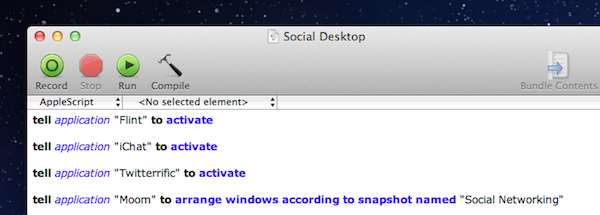
Example: I like to keep a Desktop just for social networking applications. Now with Moom I can automate the process of opening all of my social apps and then arranging them instantly by calling the saved layout I created called “Social Networking” from an AppleScript.
The last feature I wanted to mention was its ability to run in what Moom refers to as Faceless mode. This is a mode with no dock icon and no menubar icon. Moom can also be set to show the settings panel on launch which is perfect when calling Moom from a program like Alfred. No icons to stare at and quick access to Moom’s settings from a launch bar, what could be better?

Overall this app has great functionality and a very pleasant interface, all for a conservative price. $4.99 on the Mac App Store. Read more


Financial Times’ Web App “More Popular” Than iOS App

Reuters reports on the Financial Times’ web app’s performances, noting that the HTML5-optimized version of FT.com has now 700,000 users, proving it to be “more popular” than the newspaper’s iOS app. Financial Times made headlines when it couldn’t agree with Apple on iTunes’ subscription rules for publishers – which require companies to give a 30% revenue cut to Apple, and make sharing of subscriber data opt-in. It was previously reported that 50% of iTunes subscribers opted to share their personal information; however, the Financial Times wanted more control over its mobile application, and decided to develop an HTML5 version instead. The iOS app was then pulled from the App Store.

People who are using the app are spending much more time with the content,” he said. “They are consuming about three times as many pages through the app as they are through the desktop in an average visit.”

The FT’s Web-based mobile app accounts for 15 percent of FT.com subscriptions and 20 percent of total FT.com page views from mobile users, Grimshaw said.

After launching the new web app on June 7, the Financial Times reported after three weeks they achieved 200,000 downloads, with 100,000 in the first week alone. In spite of its web app nature, the iOS-optimized FT app recommends users to “add it to their home screens”, requesting access to increased database size for local cache.

Apple has been doing a number of things to address the issues with subscriptions and delivery of content on iOS devices. They first launched iTunes app subscriptions in February, making it easier for users to subscribe to newspapers and magazine with their existing iTunes accounts. Then at WWDC the company announced Newsstand, a new unified virtual shelf on iOS devices for content a user is subscribed to. Adobe has already announced its publishing tools will be updated to take advantage of iOS 5’s Newsstand. The Financial Times is not the only publisher to find an alternative route out of Apple’s App Store, as Amazon released a web-based version of its Kindle reader with direct integration with the Kindle Store.

Both the Financial Times and Amazon couldn’t comply with Apple’s subscription rules, even after Apple slightly modified them to open up to more publishers in June.


“iPhone 4S” Name Shown On OtterBox Case Packaging

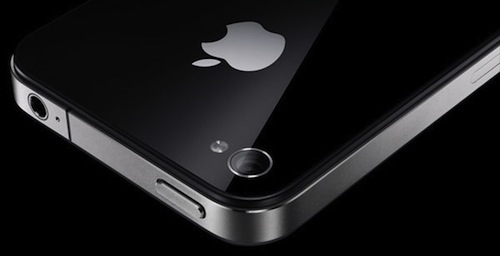
According to a series of tweets posted earlier today by @chronic on the @chronicwire Twitter account, accessory maker OtterBox has built over 3 million cases for a rumored upcoming “iPhone 4S” device. As seen in the photos posted online, the packaging of one of such cases depicts the “iPhone 4S” name, as well as what appears to be a redesigned position for the iPhone’s volume buttons, seen on the right of the device. You can check out more photos over at Twitter.

Chronic has been a source of Apple-related “leaks” in the past. For instance, he posted screenshots of several internal iOS 5 settings (high-quality YouTube and FaceTime over 3G), as well as information in the weeks that lead up to Apple’s Back to School promotion in June. Chronic was, however, incorrect in reporting MacBook Air updates weeks before Apple actually shipped the refreshed models.

There’s been a controversy in iPhone-related rumors in the past months as to whether Apple will ship a “completely redesigned” iPhone 5 in October, an iPhone 4-like “iPhone 4S” device (such name was first used by 9to5mac in discussing an A5-powered iPhone 4), or both. According to recent speculation, Apple is set to hold a media event to introduce the next iPhone on October 4th. A number of cases from third-party manufacturers have surfaced in the past months, showing both signs of a redesigned device and something very similar to the iPhone 4 – thus the discrepancy in iPhone 4S-iPhone 5 rumors. You can read more about this in our iPhone rumor roundup and retrospective.


Labeling iOS’ Back Button

Labeling iOS’ Back Button

Neven Mrgan shares a solid piece of advice for iOS app designers and developers: A Back button labeled “Back” is never a good option.

As he notes, Apple never labels the “Back” button – the left-pointing arrow at the top of most iOS apps – “Back”. They provide context as to how a parent view (the previous screen) should be shown in the button’s label.

This is a widespread issue, present in many extremely popular apps.

This is redundant and it provides no context. Note that Apple never does this, not in any app. Instead, they provide either the full title of the previous view, or an abbreviated/truncated version of it.

He offers some do/don’t examples in his blog post. Here’s a series of screenshots from my iPhone, showing apps that correctly use the “Back” button:

One of my favorite examples, the Rdio app for iPhone:

And here’s Apple in the Apple Store app:

The button itself means “back”, so the additional “Back” label is not an option. These are the minor details that make great apps, well, great.

Permalink

Gmail Mobile Web App Gets Multiple Sign-In

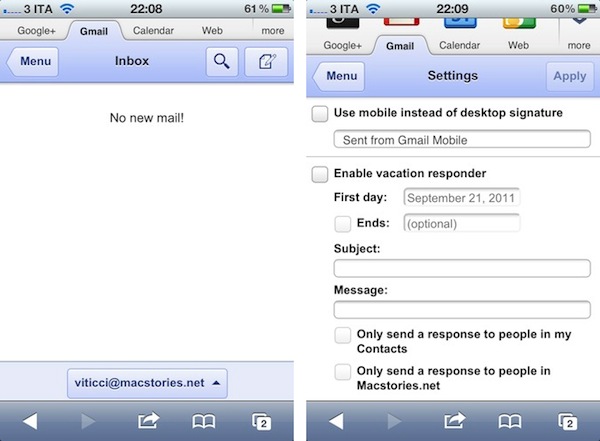
In the past months, Google has released a series of updates to improve the overall experience of the Gmail mobile web app, which works on iOS devices such as the iPhone and iPad, as well as other smartphones and tablets. Google made the mobile web app more accessible and usable with notifications, undo bar, Retina graphics and “pull to refresh”, and today they’ve announced another update that brings Preferences and multiple sign-in to the service when viewed from mobile devices.

Multiple sign-in has been around in the Gmail desktop website for quite some time, and it’s a useful shortcut to quickly switch between multiple Google accounts (and thus Gmail inboxes or Google+ profiles). Starting today, a new sign-in button will appear at the bottom of the iOS web app, allowing you to jump to another account, which will automatically load its Gmail inbox. The feature is already live in Mobile Safari (tested on an iPhone 4 running the latest iOS 5 beta).

Furthermore, Google is now allowing users to set Preferences directly from the mobile web app. The company is highlighting the possibility to create a mobile-only signature, so your friends will associate typos to a smartphone’s keyboard. Also, the Preferences come with vacation auto-responder settings, and a few more options.

We know that autocorrect and other mobile spell-checks can be frustrating as you are typing on the go. Let your friends know that you are responding via your mobile phone so that they understand why you might have sent a message that you are meeting for “monitors” and not “mojitos”. It’s an easy way to make them understand why your message might be short or have a few typos. To create a mobile signature, from the menu view, press the new settings icon, choose your signature, and then check the box that tells us you want to activate it. If you ever want to disable the mobile signature, you can uncheck the box and we will use your desktop signature instead.

Google notes that each Gmail account can have a separate bookmark. On iOS devices, you can save a Gmail shortcut to the Home screen by tapping on the Action icon in Mobile Safari, and then Add to Home Screen (Gmail’s webclip icon has been optimized for the Retina Display as well).


Bill Gates Still Richest American, Steve Jobs Ranks at No. 39

Bill Gates Still Richest American, Steve Jobs Ranks at No. 39

From the press release about Forbes’ annual list of 400 Richest Americans: [via]

Bill Gates (No. 1) retains his top spot on Forbes’ 2011 ranking of the richest people in America (“The Richest People In America,” p. 39 and p. 210) with $59 billion, followed by Warren Buffett (No. 2) with $39 billion and Larry Ellison (No. 3) with $33 billion. George Soros (No. 7) joins the Top 10 for the first time, with $22 billion, and is one of several of the 27 hedge fund managers – 7% of the Forbes 400 – featured in “Hedged Fortunes,” p. 82.

Former Apple CEO and now Chairman of the Board Steve Jobs ranked at #39 with $7 billion. Jobs ranked at No. 42 last year with $0.9 billion less; globally, Forbes ranked Steve Jobs at #110 earlier this year. Also seen in this year’s list: Amazon’s Jeff Bezos (#13), Facebook’s Mark Zuckerberg (#14). Zuckerberg is this year’s “biggest dollar gainer” by adding $10.6 billion in the past 12 months. Google’s Sergey Brin and Larry Page ranked both at No. 15 with $16.7 billion each.

Forbes has a complete analysis of their list here. Combined, the nation’s wealthiest are worth $1.53 trillion.

Permalink

FaceMan, Unofficial Photo Booth for iPhone, Gets 3.0 Update

Here’s a fun app that, for some reason, Apple still hasn’t delivered to iPhone and iPod touch users. FaceMan, created by fellow Italian developer Libero Spagnolini, is an unofficial alternative to Apple’s Photo Booth, which allows users to apply funny effects and distortions to their faces in real-time using the iPhone’s rear or front-facing camera. I first reviewed the app in January, but since then lots of work has been put into FaceMan – and a major 3.0 update released today adds a completely redesigned UI, a faster engine, and many optimizations to the code.

The new FaceMan lets you scroll between effects at the bottom (with live previews both on the effect’s thumbnail, and the bigger camera view at the top), and swipe vertically to change between effects, camera controls, and intensity slider. A new effect has been added, camera controls now rotate properly in landscape mode, and recording performance (FaceMan does both photos and videos) has been improved by 200%, the developer says. I haven’t been able to verify such percentage, but it’s clear FaceTime 3.0 is faster than the previous version on the same hardware (my iPhone 4). The app runs on the iPhone 3GS and iPod touch 4th generation, too, and requires iOS 4.1 or later. I have tested the app on iOS 5 beta 7, and it worked with no issues, although the developer told me more iOS 5-related fixes are on their way.

It’s not completely clear to me why wouldn’t Apple create a simpler port of Photo Booth for the iPhone and iPod touch. The software was previewed at the March 2 event as an addition to iOS for the iPad 2, and has proven to be a fun and delightful way to snap and share silly pictures with friends and family. The iPad 2 runs on Apple’s faster A5 processor, however, so that might be the reason why Apple’s official Photo Booth app hasn’t made it to existing A4-based hardware yet.

Still, FaceMan works nicely on the iPhone 4, and the new interface is fast and fluid at applying and switching between effects. If you’re looking for a Photo Booth alternative now, you should give FaceMan a try. It’s only $0.99 on the App Store.


Apple’s Next Keynote Scheduled for October 4?

According to AllThingsD, Apple’s next media event – where the company is set to officially unveil the next-generation iPhone – will be held on Tuesday, October 4th.

That’s the day Apple is currently expected to hold its next big media event, according to sources close to the situation, where the tech giant will unveil the next iteration of its popular iPhone.

AllThingsD previously claimed the new iPhone would be announced in mid-October, and whilst Apple hasn’t publicly disclosed plans of any new iPhone or device in any time frame, the timeline seems likely at this point. Apple usually sends invites to the press a week ahead of the event, and multiple rumors are suggesting iOS 5 – which the iPhone 5 will likely run out of the box, like new Macs come with Lion pre-installed – is approaching the GM status by the end of this week.

AllThingsD also claims newly-appointed CEO Tim Cook will preside over the event, and that the plan is to release the iPhone 5 a few weeks after the announcement. Previous rumors pointed at the next iPhone being available on AT&T, Verizon, and Sprint in the United States in mid-October.

Update: The Loop’s Jim Dalrymple, who has a solid track record when it comes to Apple news and rumors, has commented on AllThingsD’s article with a single “Yep”, suggesting that the original report is indeed accurate.


Apple Releases Updated ProApps QuickTime Codecs

Following the release of Final Cut Pro 10.0.1, Motion 5.0.1 and Compressor 4.0.1 earlier today on the Mac App Store, Apple has pushed a separate update for ProApps QuickTime Codecs. This download is recommended for all users of Final Cut Pro X, Motion 5, or Compressor 4, and it adds the following codecs to QuickTime-based apps:

  • Apple Intermediate Codec
  • Apple ProRes
  • AVC-Intra
  • DVCPRO HD
  • HDV
  • XDCAM HD / EX / HD422
  • MPEG IMX
  • Uncompressed 4:2:2

The update is available now through Apple’s Downloads website. Updates to FCP X, Motion and Compressor are available now on the Mac App Store.

ProApps QuickTime Codecs (1.1 MB)