Posts tagged with "iPad"

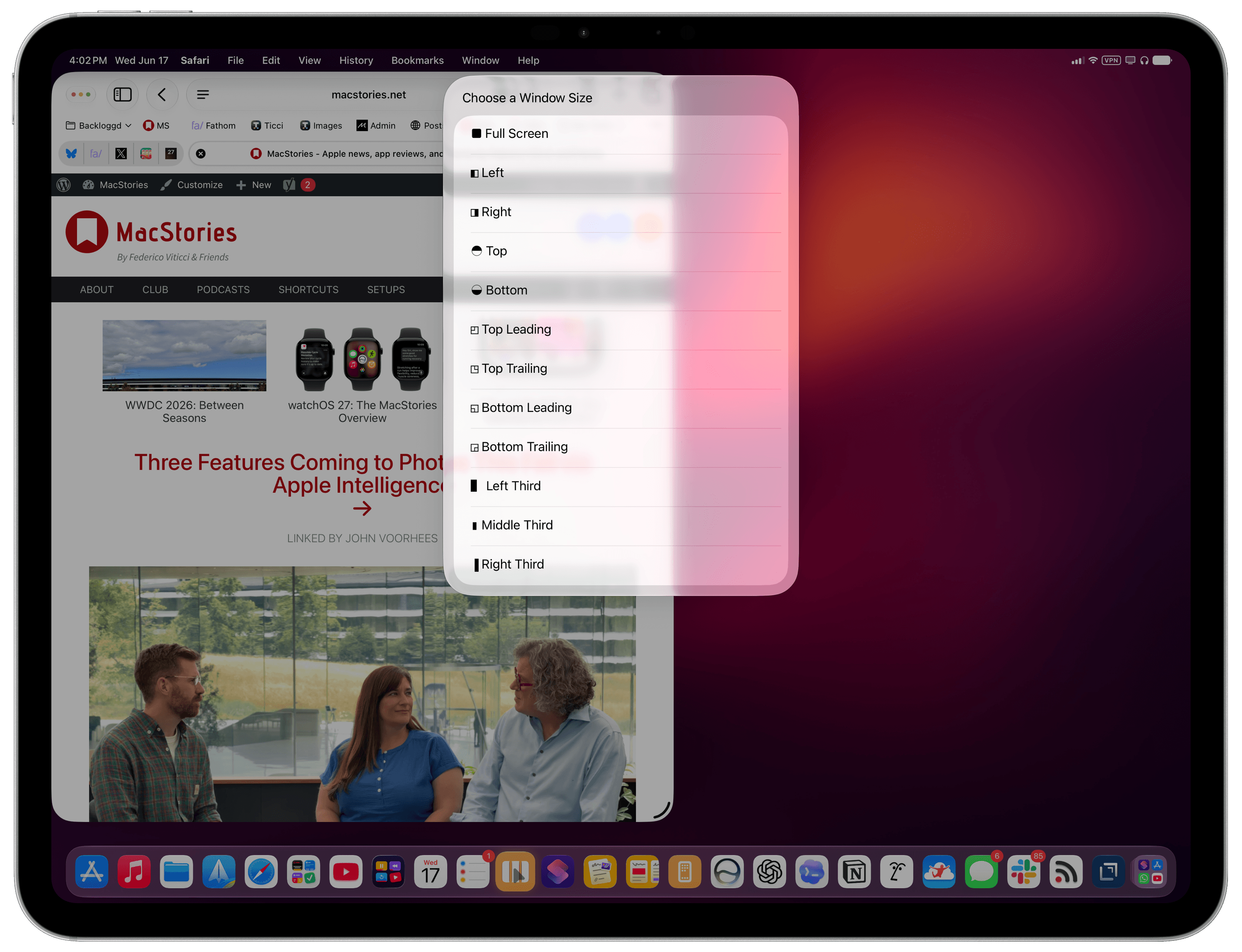
iPadOS Lets You Automate Window Placement with Shortcuts

MultiSwitcher for iPadOS.

MultiSwitcher for iPadOS.

Update: An earlier version of this article referred to this feature as having been introduced in iPadOS 27, but it was actually introduced in the iPadOS 26 cycle. I missed it. My apologies.


In iPadOS’ Shortcuts app, the existing ‘Open App’ action was recently updated with the ability to launch an app with a specific window placement parameter. This means you can now automate window positions on iPad by opening a bunch of apps and programmatically selecting where their windows be placed.

Read more


Apple Releases Watch Band, Watch Face, and Wallpapers to Celebrate Pride Month

Source: Apple.

Source: Apple.

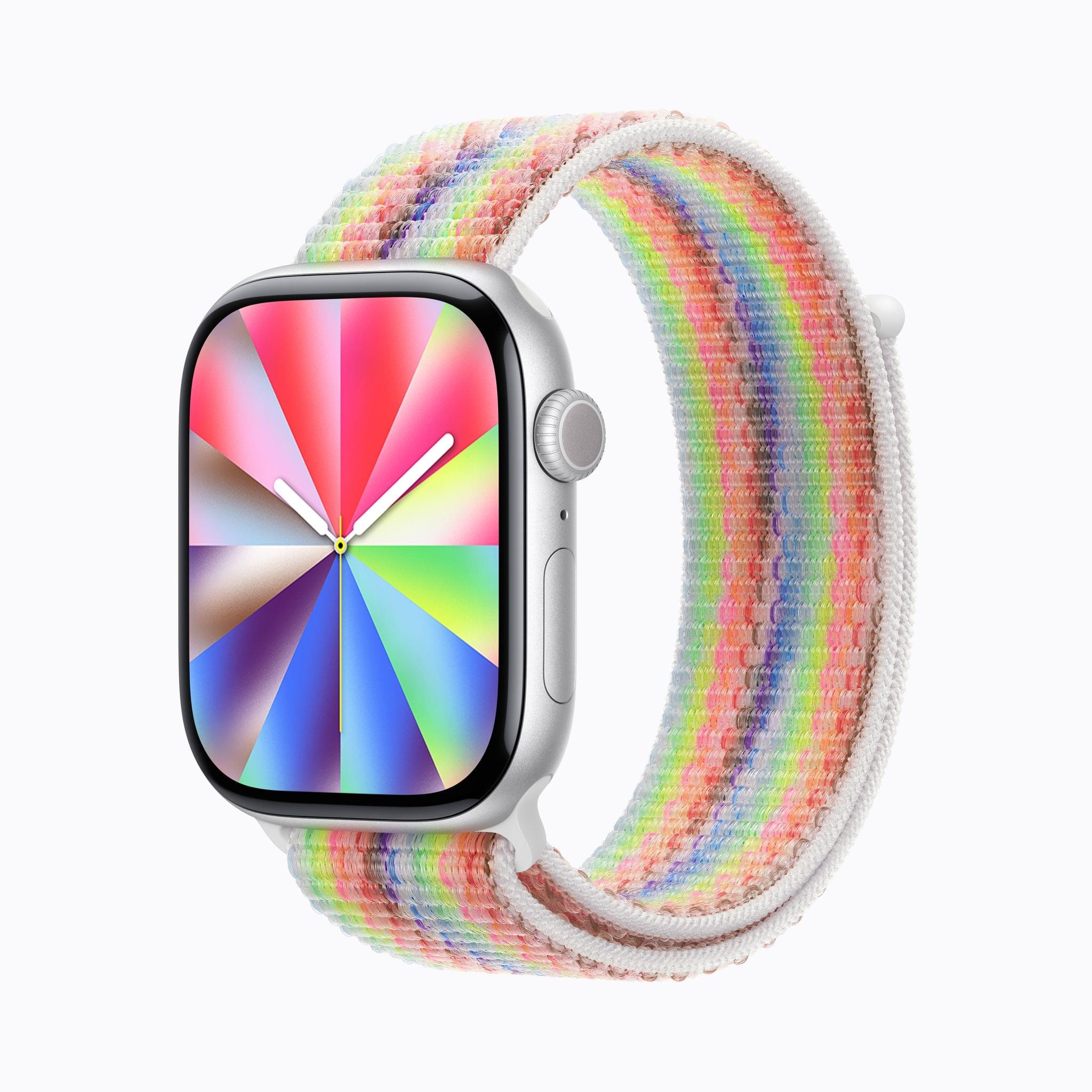
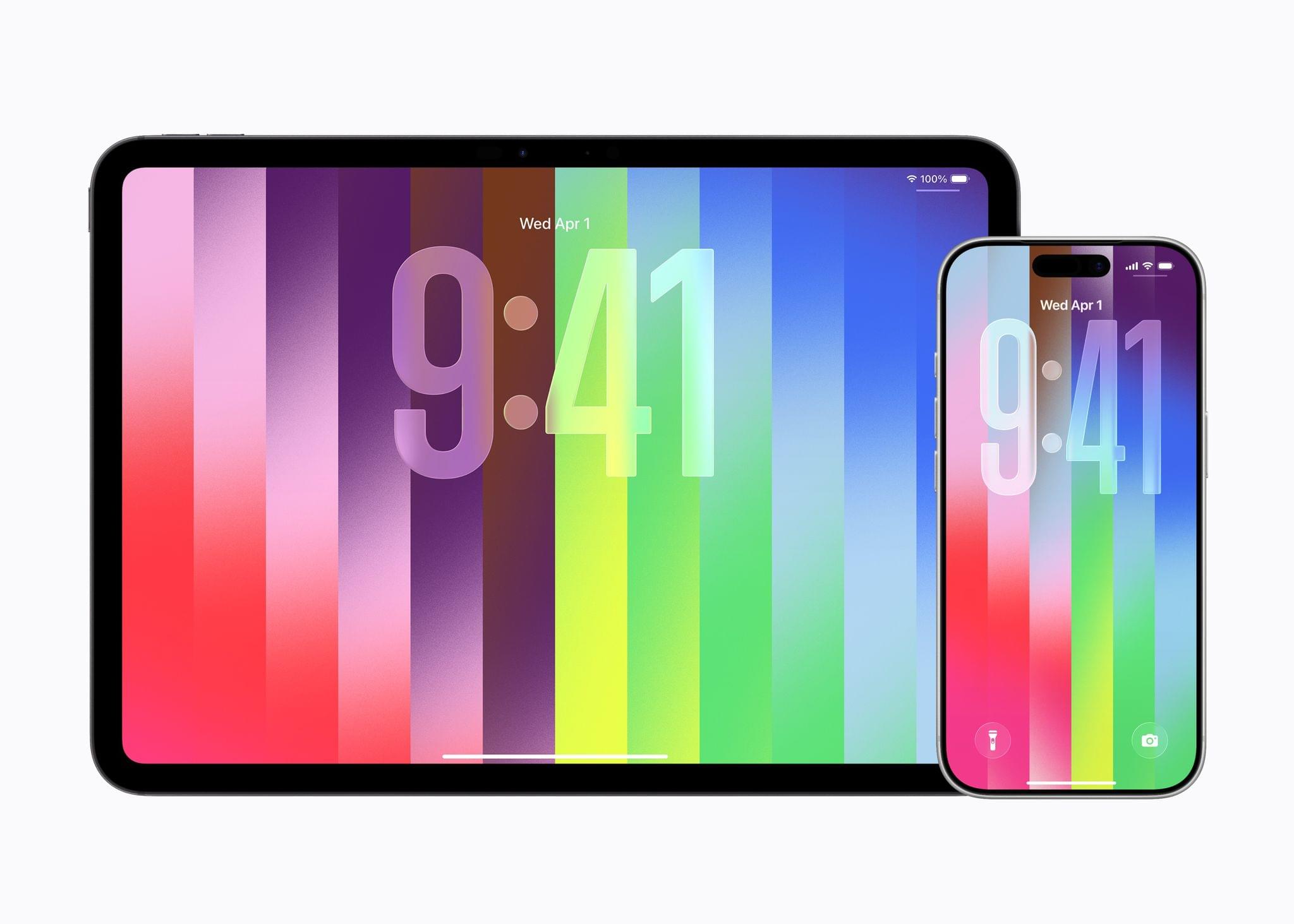
Apple has released its annual Pride Collection, including a new Apple Watch Pride Edition Sport Loop band, watch face, and iPhone and iPad wallpapers celebrating LGBTQ+ communities.

The commemorative Sport Loop uses 11 colors of nylon thread that blend the colors together in a unique way. As Apple’s press release puts it:

The intricate weaving blends one color into the next, creating depth and movement across the band. The resulting design is joyful and vibrant, showcasing a full spectrum of colors that reflect the unique identities that shape LGBTQ+ communities worldwide.

Source: Apple.

Source: Apple.

The watch face and wallpapers share a similar style of gradient strips of bright colors radiating out from the watch face’s analog clock design and in vertical strips on the wallpapers.

As usual, Apple’s designers have done great work with the band, watch face, and wallpapers. There’s a vibrancy and energy to them that brings them to life.

The Apple Sport Loop is available to order today online and in the Apple Store app for $49 and will be in retail stores later this week. The watch face and wallpapers will be available as soon as the 26.5 releases of watchOS, iOS, and iPadOS are released to the public.


Well, I Guess I Like Safari’s Compact Tab Bar in iPadOS 26.4 (Also: Using Vertical Tabs in Safari for iPad)

We're so back.

We’re so back.

Yours truly, back in September 2021:

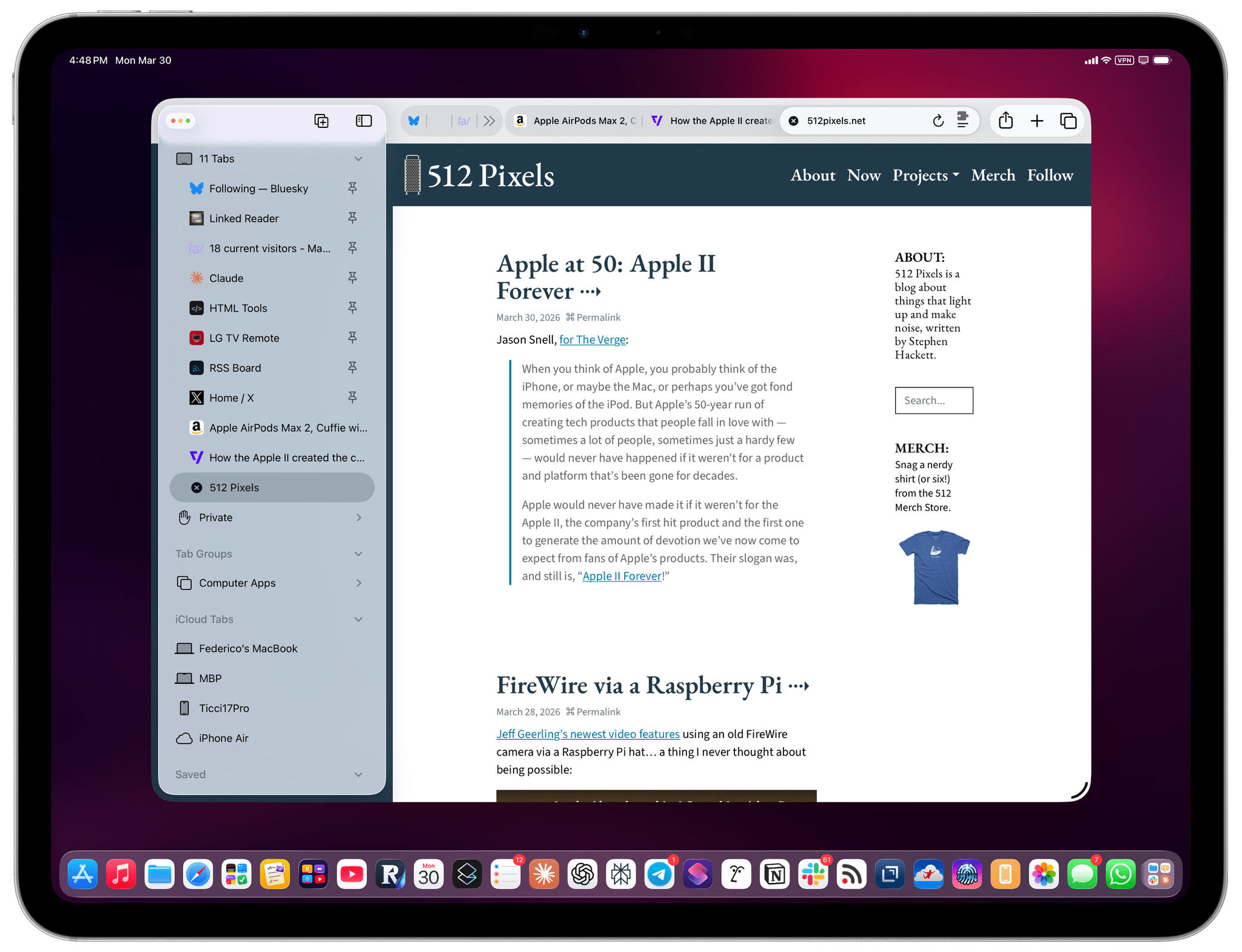
In case I haven’t been clear enough above, I’ll be blunt: I don’t understand why the compact tab bar exists on iPad, and I think this design shouldn’t have shipped to customers.

My understanding is that Apple thought the benefit of removing a separate address bar, therefore saving a few vertical pixels on the page, would have made all the compromises we’ve seen so far worth the trade-offs in usability. I think that’s a wrong and mismanaged decision driven by an unmotivated pursuit of an iPhone-like design that has no place on iPad. If slightly increasing vertical space on webpages is Apple’s only argument here in favor of the compact tab bar, you tell me if it’s worth the trouble by judging from the screenshots below.

If, like me, you missed this in the release notes for the recently released iPadOS 26.4, the compact tab bar has returned to Safari for iPad after mysteriously disappearing in iPadOS 26.0. And I’m here to tell you that not only do I not despise it like I did five years ago, but I actually like this mode and have been working with Safari on my 13” iPad Pro like this for the past two weeks.

Read more


The iPhone Fold Doesn’t Need iPadOS to Be a Great “Tablet”

I meant to link this at the beginning of the year, then I forgot, but I guess the story is still as timely as ever given the state of the latest rumors. A few months back, Jason Snell 3D-printed a mockup of the upcoming iPhone Fold (which I still think should be called iPhone Duo), which revealed a surprising design decision:

If these mock-ups are real, this folding iPhone is not going to be what you may have pictured in your head: a modern iPhone, roughly the shape of an iPhone Pro, that folds open to reveal a larger screen inside.

Instead, Apple may be making a device that’s much wider and squatter than existing iPhones when it’s folded up. The mock-ups people are printing show a phone that’s squatter than an iPhone mini and wider than an iPhone Pro Max! If that shape is right, the iPhone Fold will look a bit more like a mini notebook when it’s folded, unlike any iPhone that has ever existed.

And:

The shape makes sense, however, when you imagine what that phone looks like when it’s unfolded: a screen with a 4:3 aspect ratio, the shape of an old-school television and—more importantly—an old-school iPad. In fact, this rumored design would make the unfolded iPhone the shape of an iPad, just slightly smaller than the iPad mini. (The iPad mini’s screen is 8.3 inches when measured diagonally, while this screen is rumored to be 7.76 inches.)

Read more


MotionVFX Team Joins Apple

Source: MotionVFX.

Source: MotionVFX.

Earlier today, MacRumors reported that MotionVFX was acquired by Apple. Based in Poland, MotionVFX has been a go-to resource for YouTubers and other creators for years with its highly-regarded plugins, templates, and tools for Final Cut Pro, DaVinci Resolve, and other apps.

According to MotionVFX’s note:

For over 15 years, we’ve been on a mission to create world-class, visually inspiring content and effects for video editors. From the very beginning, we’ve been all about quality, ease of use, and great design. These are also the values that we admire most in Apple’s products, and we’re thrilled to be able to embrace them together.

This is exciting news for anyone who uses Final Cut Pro. My hope is that the acquisition will result in MotionVFX’s plugins making their way into Creator Studio and being extended to the iPad. For the Mac, that would add a lot of value to Creator Studio. For the iPad, it would add plugin support for the first time, a feature I expected Apple to have shipped by now.

Permalink

“This Is Not The Computer For You”

I loved this essay by Sam Henri Gold on the MacBook Neo but, really, about where the “wrong” computer in your life can take you:

There is a certain kind of computer review that is really a permission slip. It tells you what you’re allowed to want. It locates you in a taxonomy — student, creative, professional, power user — and assigns you a product. It is helpful. It is responsible. It has very little interest in what you might become.

The MacBook Neo has attracted a lot of these reviews.

The consensus is reasonable: $599, A18 Pro, 8GB RAM, stripped-down I/O. A Chromebook killer, a first laptop, a sensible machine for sensible tasks. “If you are thinking about Xcode or Final Cut, this is not the computer for you.” The people saying this are not wrong. It is also not the point.

Nobody starts in the right place. You don’t begin with the correct tool and work sensibly within its constraints until you organically graduate to a more capable one. That is not how obsession works. Obsession works by taking whatever is available and pressing on it until it either breaks or reveals something. The machine’s limits become a map of the territory. You learn what computing actually costs by paying too much of it on hardware that can barely afford it.

(The MacBook Neo is a lovely computer that feels futuristic despite its specs. I was about to return mine, then decided to keep it because there’s something special about it. You can listen to the latest episode of Connected to hear my take on it.)

Sam’s story resonated with me because I’ve been there, not as a kid, but as a 24-year-old who needed to get work done from a hospital bed and chose to do so with an iPad. I stuck with it after that, despite a lot of people telling me it was the wrong computer for me.

Sometimes the “wrong” computer is the right obsession for you. You never know where that can take you. Go read Sam’s full story if you need a reminder of why specs don’t ultimately dictate someone’s creativity.

Permalink

Apple Introduces M4-Powered iPad Air

Apple has announced a new iPad Air featuring the M4 chip and 12GB of unified memory. According to the company, the new Air is 30% faster than the M3 iPad Air and 2.3× faster than the M1 Air. Apple says the 50% boost in unified memory enables better AI performance. The new models come in blue, purple, starlight, and space gray, with storage configurations of 128GB, 256GB, 512GB, and 1TB.

Bob Borchers, Apple’s vice president of Worldwide Product Marketing, said of the new Air:

iPad Air gives users more ways than ever to be creative and productive, offering powerful performance and incredible versatility to help them turn their ideas into reality. With its blazing performance thanks to M4, incredible AI capabilities, and game-changing iPadOS 26 features, there’s never been a better time to choose or upgrade to iPad Air.

The M4 iPad Air is available in 11” and 13” sizes and features the Apple-designed N1 and C1X chips for networking and wireless connectivity. The N1 brings Wi-Fi 7 and Bluetooth 6 support to the Air, while Apple says the C1X reduces cell network energy consumption by 30% compared to the M3 iPad Air. Of course, the M4 chipset itself also unlocks new functionality for the Air, including hardware-accelerated mesh shading and ray tracing for gaming.

The 11” iPad Air starts at $599, and the 13” model begins at $799. Education market pricing starts $50 lower for each model. Both Air models support the Apple Pencil Pro, the USB-C Apple Pencil, and Apple’s Magic Keyboard case. Preorders begin this Wednesday, March 4, with deliveries and in-store availability starting March 11.