This Week's Sponsor:

Clic for Sonos

The native app Sonos should’ve made. No lag, no hassle, just music. Save up to 50%.


TechCrunch: Apple Is Acquiring Shazam

Ingrid Lunden, writing for TechCrunch:

As Spotify continues to inch towards a public listing, Apple is making a move of its own to step up its game in music services. Sources tell us that the company is close to acquiring Shazam, the popular app that lets people identify any song, TV show, film or advert in seconds, by listening to an audio clip or (in the case of, say, an ad) a visual fragment, and then takes you to content relevant to that search.

We have heard that the deal is being signed this week, and will be announced on Monday, although that could always change.

Assuming that Apple keeps Shazam’s standalone app around in the short term, I wonder if the built-in Spotify integration for streaming and saving songs will remain (I wouldn’t be surprised if it gets pulled). I’m a fan of Shazam’s iPhone and Watch apps, but it’d be great to have Shazam baked into Siri without having to ask any special song recognition command. Shazam’s discovery and recommendation features could also tie in nicely with Apple Music.

Permalink


Give the Gift of Club MacStories This Holiday Season

Starting today, you can give Club MacStories memberships as gifts for the holidays or any special occasion. Club MacStories extends what we publish at MacStories, which makes it the perfect gift for someone who wants more apps, automation, tips, and other coverage.

Club MacStories offers exclusive content delivered every week including:

  • MacStories Weekly, a newsletter that is sent every Friday and is packed full of our favorite apps, themed collections, tips, automation, answers to reader questions, featured Home screens, interviews, and much more.
  • The Monthly Log, a monthly newsletter that includes long-form and behind-the-scenes stories.
  • Access to giveaways, discounts, and other treats like a special members-only edition of our podcast called AppStories Unplugged and ebook versions of Federico’s annual iOS review and other long-form stories.
  • The full archive of over 125 issues of MacStories Weekly and the Monthly Log.

All told, that’s around 60 newsletters and lots of other perks over the course of a year.

So, if you have a MacStories reader on your holiday shopping list this season, consider a Club MacStories membership that they can enjoy all year long. Monthly ($5/month) and annual ($50/year) memberships can be given using the following links:

Also, thanks to all our loyal Club members who have joined since the Club’s debut over two years ago. You’re an essential part of what we do here at MacStories, and we hope you’ve enjoyed the Club as much as we enjoy creating its special content for you every week.

Happy Holidays!

- The MacStories Team


Apple Shares Differential Privacy Insights for Emoji and QuickType Keyboard

In the most recent issue of Apple’s Machine Learning Journal, titled “Learning with Privacy at Scale,” the team working on differential privacy shares details on exactly how its systems work. While much of the article is highly technical in nature, it concludes by sharing results from several real-life applications. Regarding emoji:

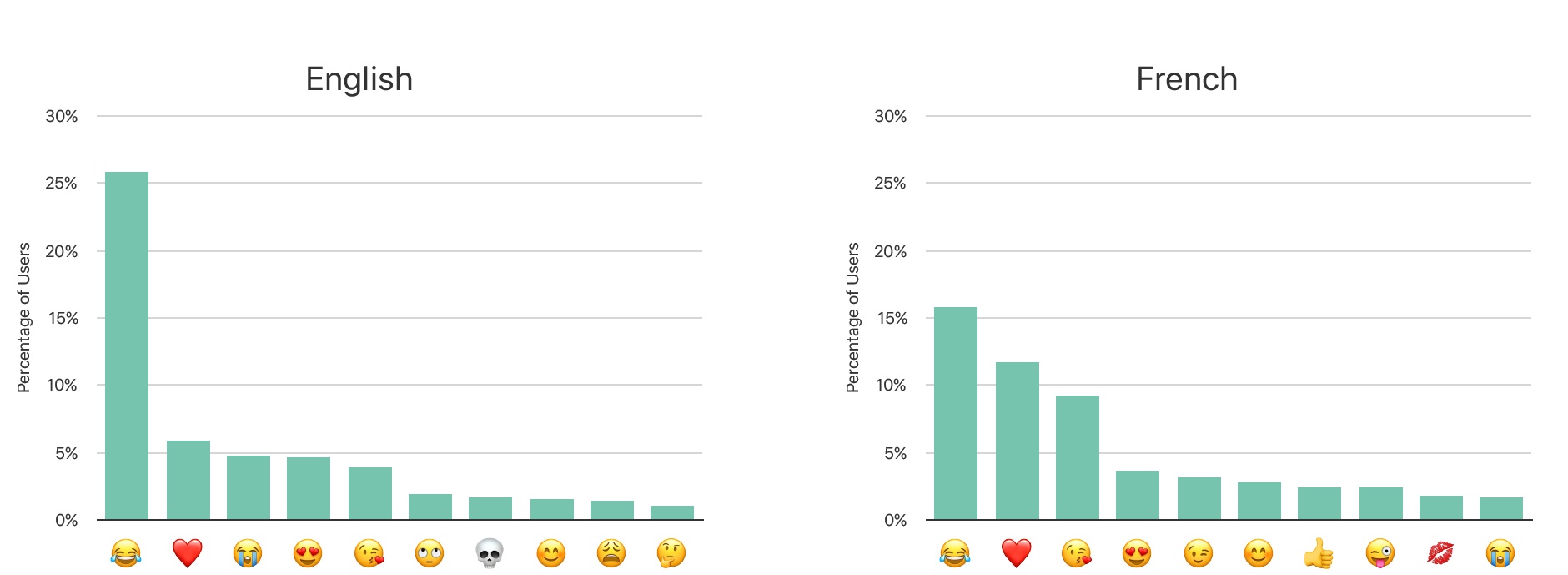
The data shows many differences across keyboard locales. In Figure 6, we observe snapshots from two locales: English and French. Using this data, we can improve our predictive emoji QuickType across locales.

The referenced chart is featured above, showing the popularity of certain emoji in different parts of the world.

The results regarding QuickType words aren’t presented in a chart, but the article does mention words in several specific categories that Apple has been able to learn about thanks to differential privacy.

The learned words for the English keyboard, for example, can be divided into multiple categories: abbreviations like wyd, wbu, idc; popular expressions like bruh, hun, bae, and tryna, seasonal or trending words like Mayweather, McGregor, Despacito, Moana, and Leia; and foreign words like dia, queso, aqui, and jai. Using the data, we are constantly updating our on-device lexicons to improve the keyboard experience.

Another category of words discovered are known words without the trailing e (lov or th) or w (kno). If users accidentally press the left-most prediction cell above the keyboard, which contains the literal string typed thus far, a space will be added to their current word instead of the character they intended to type. This is a key insight that we were able to learn due to our local differentially private algorithm.

Though the article doesn’t mention it, presumably the latter example of accidentally-tapped QuickType suggestions might lead to Apple adjusting sensitivity for its touch targets related to the ‘e’ button and the left-most prediction cell. It’s interesting to consider what other unexpected lessons may be learned from differential privacy data.

Permalink