MacStories Team

3447 posts on MacStories since July 2011

Articles by the MacStories team. Founded by Federico Viticci in April 2009, MacStories attracts millions of readers every month thanks to in-depth, personal, and informed coverage that offers a balanced mix of Apple news, app reviews, and opinion.

This Week's Sponsor:

Crickets

The first alarm app for families.


Crickets: Bring Your Family’s Morning Alarms Together [Sponsor]

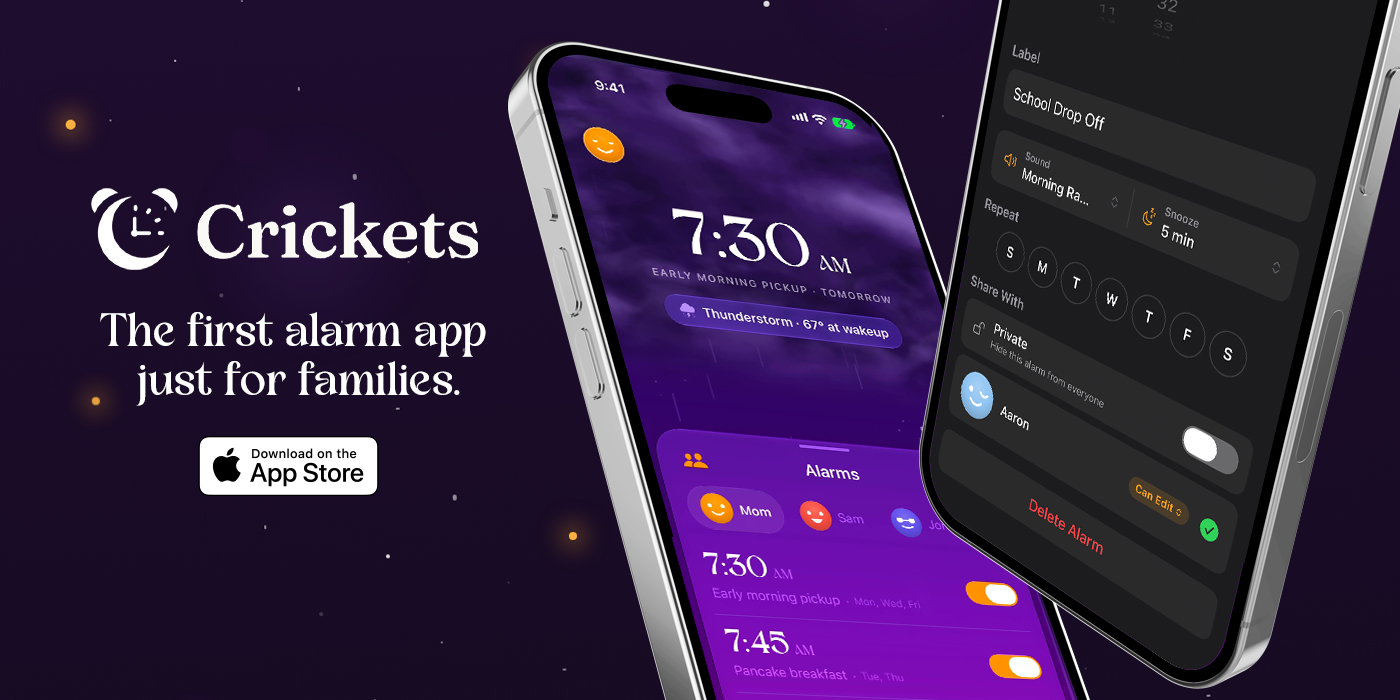
Getting your whole family up and pointed in the right direction every morning isn’t simple. Everyone’s on a different schedule, and schedules change day to day. It’s a mess that’s solvable with the help of Crickets, the first alarm built for the realities of everyday family life.

Crickets lets everyone in your family see the alarms others choose to share and, with permission, change them. So instead of asking everyone when they need to be up the next day, you already know. If you’re the first one up, that’s a superpower. Whether it’s a flight that got delayed in the dead of night or a 5:00 AM message from your kids’ school about a schedule change, you can adjust alarms without waking a soul. And it works both ways: when a practice is canceled or a trip departs later, anyone you’ve granted edit access can push your alarm back while you sleep in.

Crickets even gives you tomorrow’s weather as you head off to bed. That way, you’ll know things like whether you should get up a little early to deal with the snow that’s forecast overnight.

Everyone in your circle is right there on your Home Screen and Lock Screen, too. Plus, with widget and Live Activities support, you can keep track of who’s already awake and who’s been hitting the snooze button. You’ll see your morning coming together without even opening the app.

Each person in your circle stays in control. They decide which alarms to share and which to keep private, and they can grant or revoke editing access whenever they want. People can belong to more than one circle without those circles merging, too. That way, parents can be in a circle with their kids, but their kids’ friends circle remains theirs alone.

A single subscription covers every member of your Apple Family Sharing group, allowing you to coordinate everyone’s alarms at once, while keeping each person’s sharing choices their own.

For a closer look at Crickets and a more coordinated start to the day, visit cricketsalarm.app. And, for a limited time, MacStories readers and AppStories listeners can get 50% off for six months with code MACSTORIES2026. Select Redeem on the paywall and enter the code.

Our thanks to Crickets for their support of MacStories this week.


Apple Announces October 2026 Event

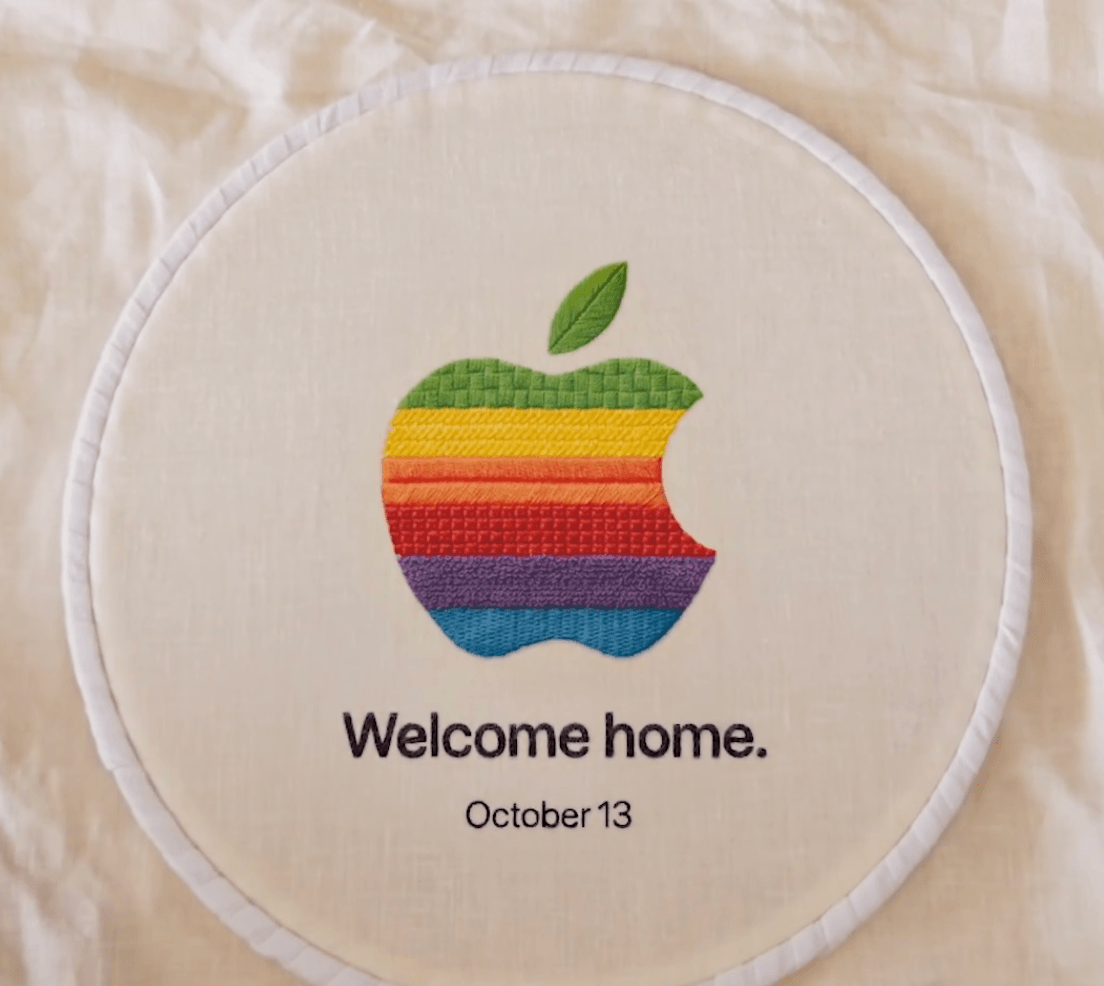
In a post by Greg Joswiak on X and email to creators and media outlets, Apple has said it will hold an ‘Experience’ in Tribeca, New York on Tuesday, October 13 at 09:00 am Eastern.

Speculation and rumors have circulated for months that a home hub product is imminent. The latest reports from Mark Gurman suggest it will sit on a semi-circular base reminiscent of an iMac G4 and control your HomeKit devices, incorporates SiriAI, and uses voice and facial recognition to identify with whom it is interacting. There have also been rumors that a new HomePod mini and Apple TV 4K may be launched. The ‘Welcome home’ tagline of the event certainly seems to suggest the announcements will be HomeKit-related.

As always, MacStories will be covering the event, so stop by next Tuesday for all the news.


GoodLinks: Read Later and Do More with Your Articles [Sponsor]

It happens to all of us. You come across an article you want to read, but you’re in the middle of something and don’t have the time. GoodLinks gives those articles a home on your iPhone, iPad, and Mac, with a clean, customizable reading experience when you’re ready to return to them.

Recently updated for iOS, iPadOS, and macOS 27, GoodLinks lets you organize the articles you save for later with tags and stars before sitting down to read with its highly customizable reader. Article Sync, which is part of GoodLinks Premium, can sync complete articles along with their images through iCloud, so they’re available on every device.

GoodLinks also lets you highlight your favorite passages of articles, export your highlights as Markdown, and add notes to your highlights. Plus, GoodLinks has extensive Shortcuts support, allowing you to use what you save with your other apps and workflows, and a local API on the Mac to script your links, tags, and highlights.

The app can summarize articles using Apple Intelligence on compatible devices or external AI providers when you provide your own API keys. That allows you to use the model that suits your needs best, or you can turn off summarization entirely.

A single universal purchase covers iPhone, iPad, and Mac and includes all current features plus one year of feature upgrades. Everything you unlock is yours to keep. After that, an optional GoodLinks Premium subscription unlocks new features, which you keep even if you cancel.

Whether you’re catching up on your latest saved stories or building a complex reading workflow to handle hundreds of articles, visit GoodLinks to learn more and download the app today.

Our thanks to GoodLinks for sponsoring MacStories this week.


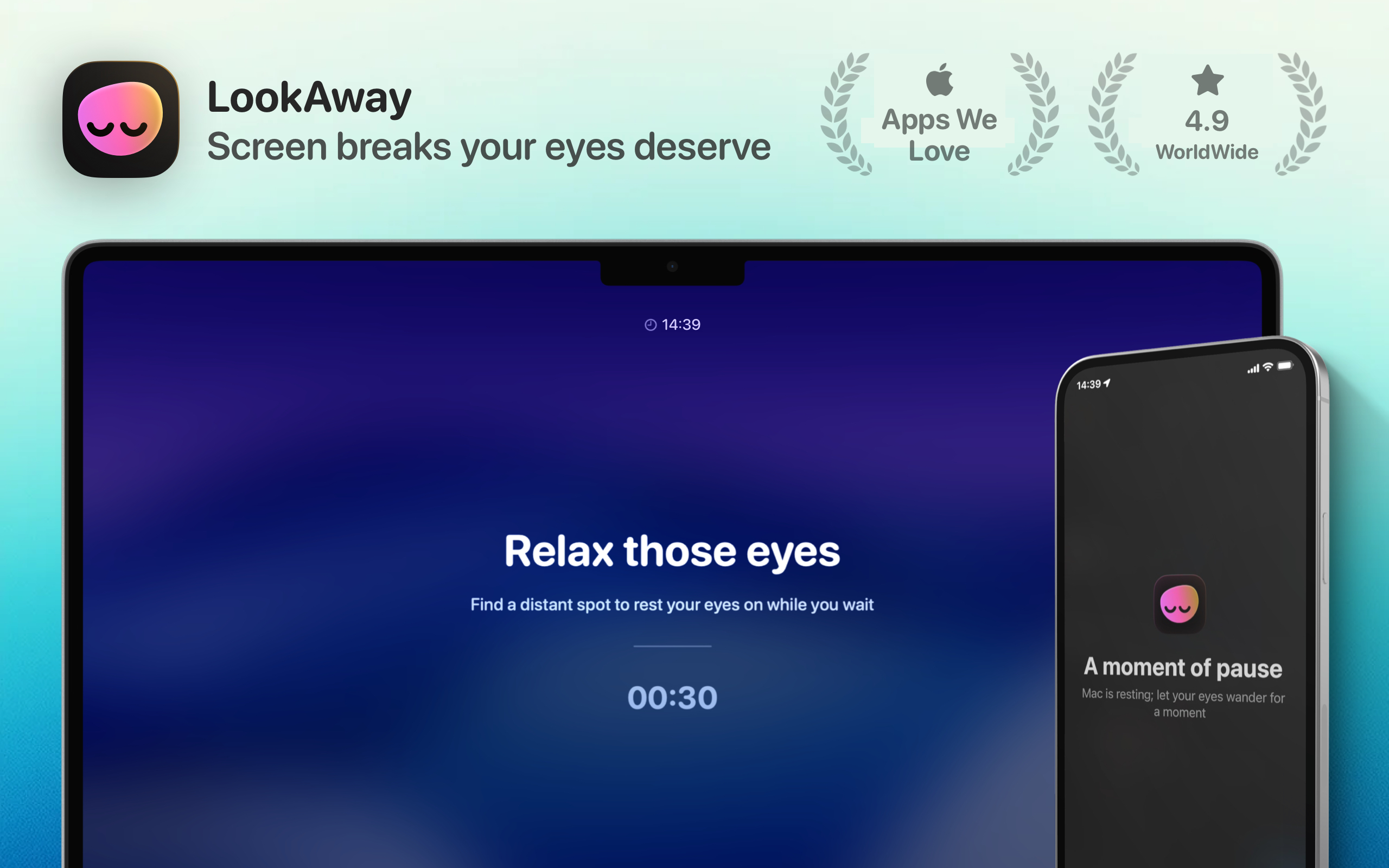
LookAway: The Screen Breaks Your Eyes Deserve [Sponsor]

Hi, I’m Kushagra, the indie developer behind LookAway.

It’s very easy to get into the flow, lose track of time, and end up sitting for hours in front of a screen. By the end of the day, your eyes are tired and your shoulders are stiff.

That’s exactly what was happening to me. I knew I needed to take more breaks, but remembering to take them was difficult. I tried reminder apps, but they kept interrupting me at the wrong moment, so I had to stop using them.

That’s why I built LookAway – a native break reminder app for macOS with a lot of thought put into when to leave you alone.

LookAway automatically waits during meetings, videos, screen recordings, and more. It also waits for you to finish typing, dragging, or dictating so that you are not interrupted mid-thought. It gives you enough heads-up before a break, so you have time to wrap up. Between breaks, there are also gentle blink and posture reminders to help you check in with yourself.

And finally, there’s LookAway Mirror — a free companion app for iPhone and iPad. When your Mac takes a break, it can also block distracting apps and websites on your phone, so you don’t end up doomscrolling another screen.

I’ve put a lot of care into making LookAway something you’ll want to keep using. I’d love for you to try it. This week, MacStories readers can get LookAway for 30% off with the code MACSTORIES30 when you purchase it directly from the website.

Our thanks to LookAway for sponsoring MacStories this week.


Our Favorite Indie Apps for iOS 27, Vol. 1

With our annual OS reviews out of the way, Federico and I will be covering our favorite indie apps that take advantage of Apple’s latest OS features. We have hundreds to draw from and instead of one big sweeping roundup, we’re going to do a bunch of smaller ones as we work our way through our lists.

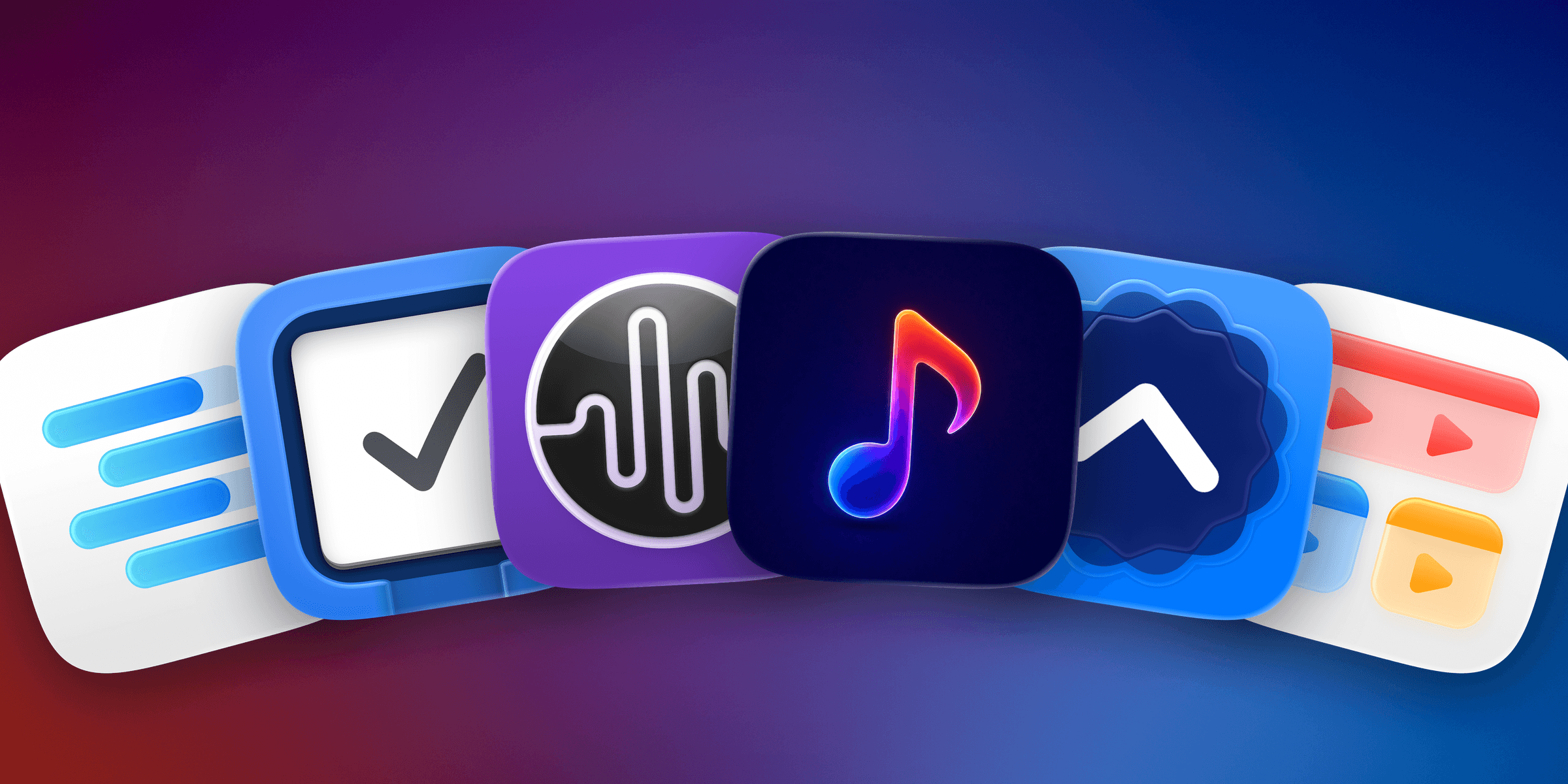
To start with, we have six excellent apps that make use of Siri AI, Apple Intelligence, extra-large widgets, and more. There’s a lot of innovation packed into this group, so let’s dive into the details, and check back soon for more roundups.

Things

Cultured Code’s beautiful task manager is no stranger to supporting major Apple OS releases: while the company is keeping quiet on their plans for a possible Things 4 (Things 3 was released in May 2017), for the past nine years Things has regularly received support for new versions of iOS, iPadOS, and macOS on day one. The app’s iOS 27 update is no exception, and it makes for a great demo of some of the new features of Siri AI as well as XL widgets for iPhone. It also serves as an example of the limitations of Siri AI – and not because of Cultured Code.

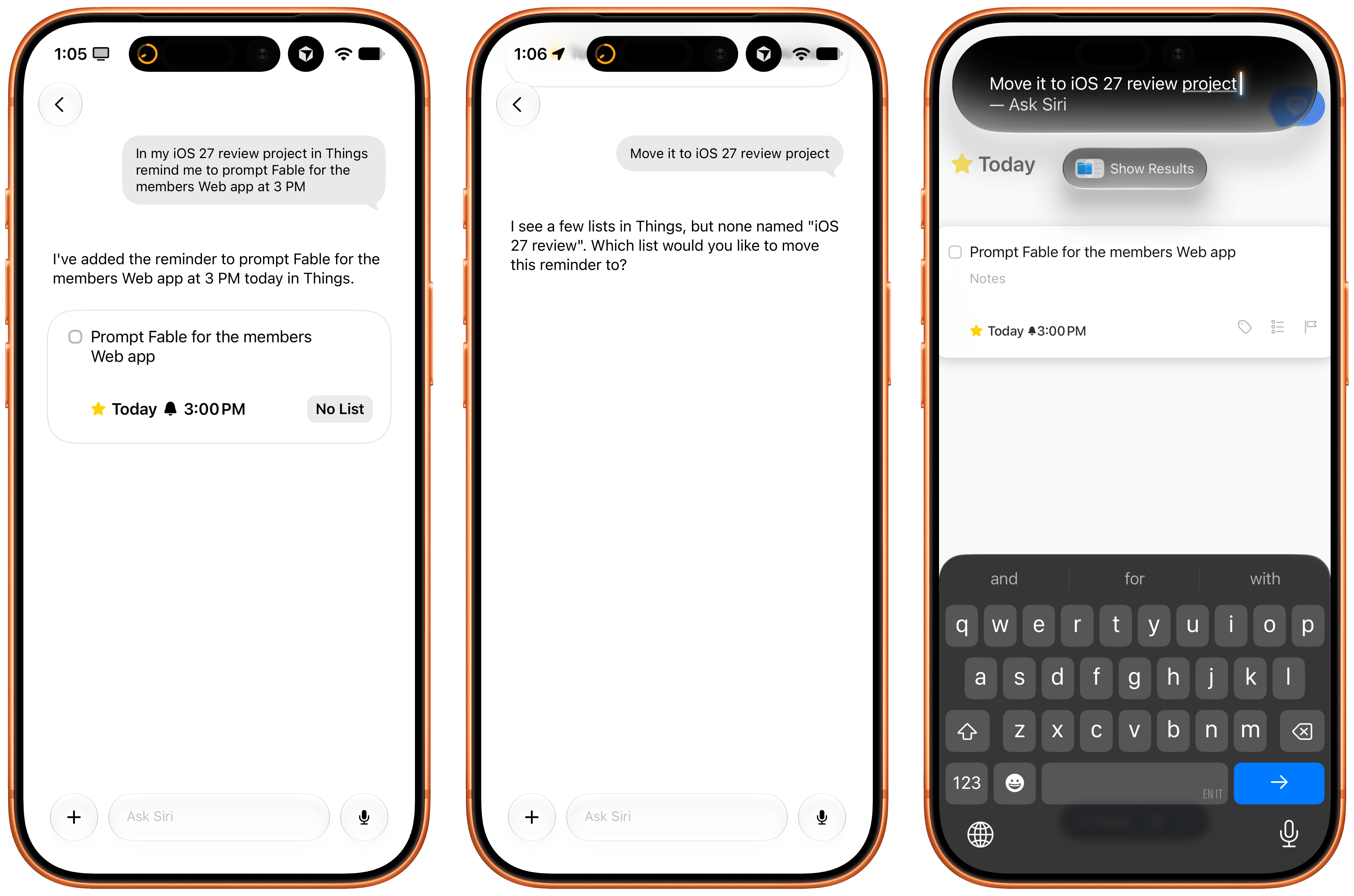
The updated Things app integrates with Siri AI and Spotlight, allowing you to retrieve and open tasks from anywhere on iOS and iPadOS, as well as manage tasks with the assistant using its several input methods. In my tests, Cultured Code’s integration worked well, but Apple’s slow on-device indexing was the problem. Soon after installing the app, I was able to ask Siri to create a reminder, and it prompted me to pick a destination app again because I’d installed a few more task managers since I last confirmed my previous choice. After picking Things, I was able to create a task, which landed in the inbox, and then follow-up with Siri AI by saying “make it due at 3 PM”, and it worked.

The issues I ran into, which are outside of Cultured Code’s control, are due to how long it takes iOS 27 and Siri AI to build an index of the app’s capabilities and data structure. For instance, I created an ‘iOS 27 Review’ list in Things, but, after three hours, Siri AI still can’t find it. As I noted in my review, I believe this is going to be a major challenge for most third-party apps in the short term as users download them, expect them to work with Siri, but the indexing isn’t going quickly enough.

Regardless of Apple’s technical problems, Things’ integration with Siri AI shows the path forward for third-party task managers on iOS. I also recommend reading the developers’ guide on how to prompt Siri AI for the app.

Locally AI

I covered the differences between Apple’s two flavors of local Foundation models (AFM 3 Core and 3 Core Advanced) in yesterday’s review, but there’s no better way to actually take the model for a spin than Locally AI.

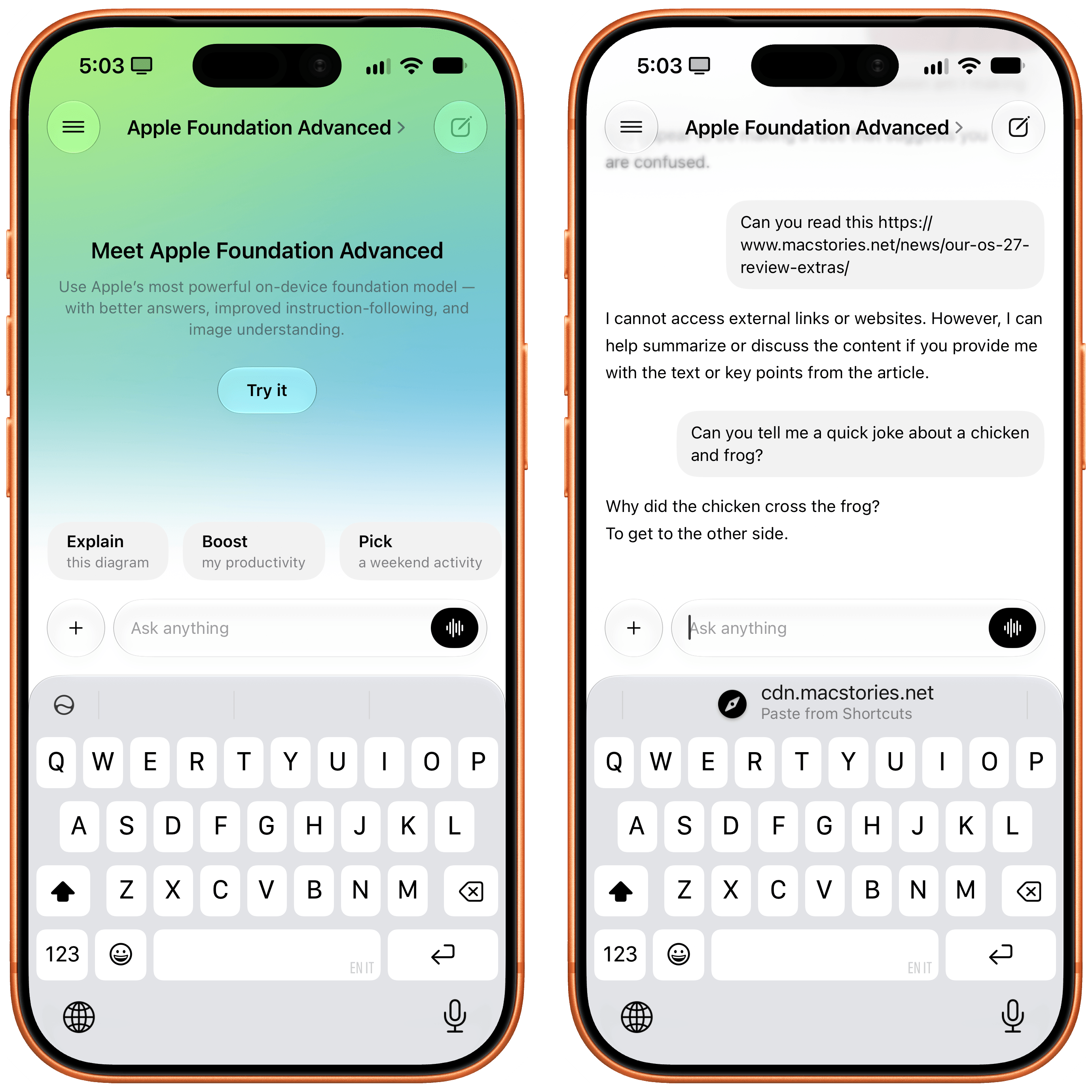
The app, which is now part of the LM Studio family of products and can connect to a remote Mac using LM Link, now offers an ‘Apple Foundation Advanced’ model that, assuming you have a compatible device, lets you prompt Apple’s new on-device model.

A good way to prompt this model is to give it an image: for the first time, a local Foundation model comes with vision capabilities, and I’ve found Core Advanced to be surprisingly strong at describing things like iPhone screenshots, selfies with different facial expressions, and more. Obviously, it comes with limits: Locally AI’s harness doesn’t expose tools to the model, which means it can’t fetch web content and, say, summarize articles for you in the app. Its knowledge and creativity are also quite limited, as you can see from the non-joke it created in the screenshot above.

Still, despite the limitations of the model itself, Locally AI is an excellent utility for running local models on iPhone and iPad, and if you’re curious to see what Apple’s bigger models feels like outside of Siri AI with your own prompts, I recommend checking it out.

Dark Noise

Charlie Chapman’s Dark Noise has long been my favorite utility to play white noise and other sound effects to relax or focus, and the app has received a substantial update for iOS 27 worth checking out.

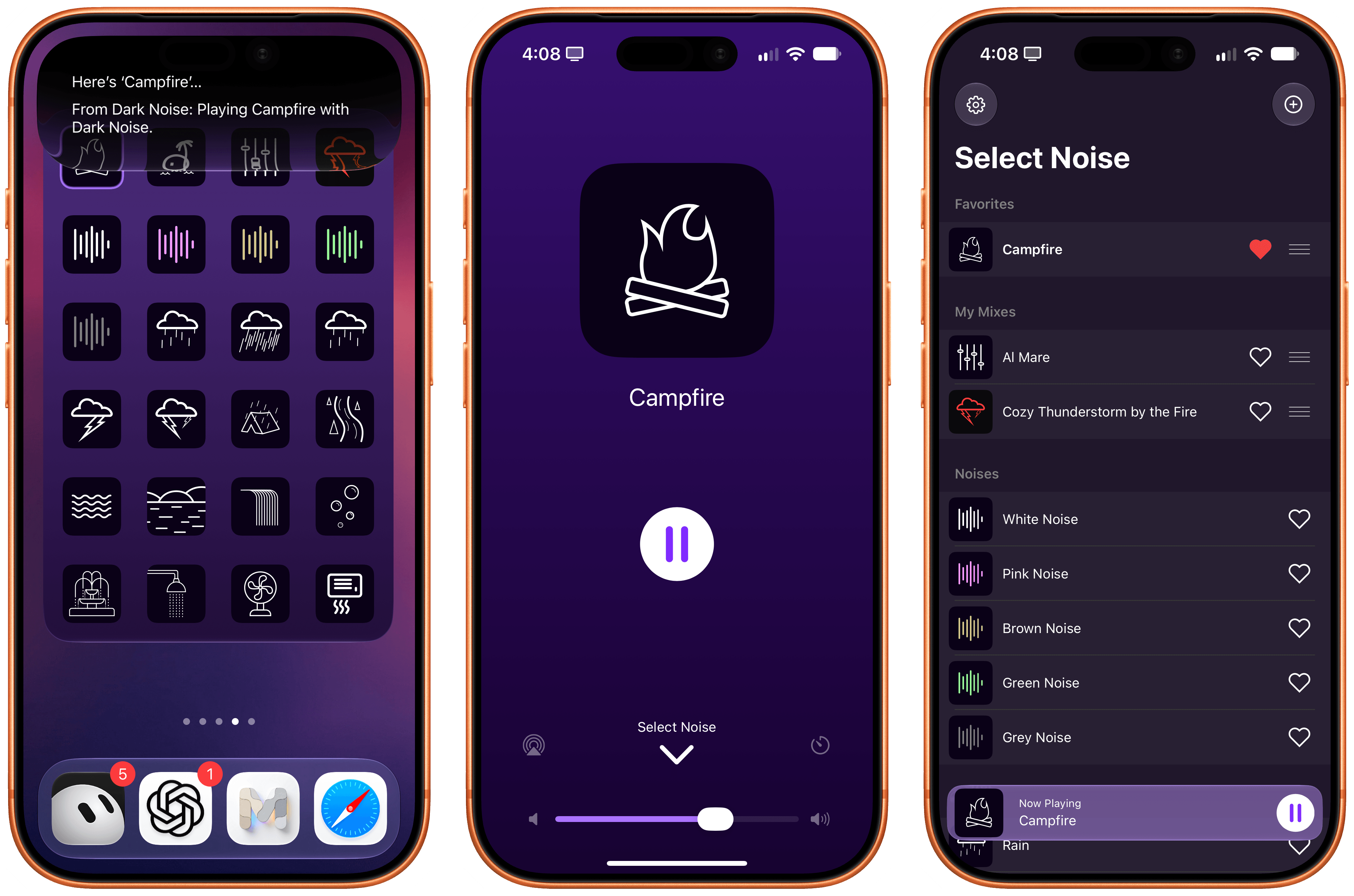
First, there’s a good-looking new Liquid Glass player that fluidly morphs on-screen from a mini-player docked at the bottom of the app into a full-screen view that lets you control playback, volume, and set a sleep timer. On the Home Screen, there’s a (customizable) XL portrait widget for iPhone that lets you configure any combination of up to 24 distinct sounds and mixes that you can play with a single tap without opening the app.

As you can imagine, the app also integrates with Siri AI now. Using Apple’s assistant, you can ask to play specific sounds from the app (make sure to add “…from Dark Noise” to your request) and you can also leverage on-screen awareness inside the app itself. While looking at your list of favorites and mixes, for instance, you can say something like “play the second mix”, and since Chapman has properly annotated the app’s views, Siri AI and Dark Noise will know what you mean.

If you, like me, struggle to get work done with music in the background but also do not appreciate complete silence, I recommend installing Dark Noise and creating a few mixes of your own.

AskPlay

I first covered Francisco Cantu’s AskPlay when it debuted on the Mac earlier this year in the App Radar for Club members, where I wrote:

Created by indie developer Francisco Cantu (a name that should be familiar to longtime MacStories readers!), AskPlay is one of the best new Mac apps I’ve tried in a long time, and we will properly review it on MacStories in the near future. The idea is simple: AskPlay gives you natural language control over Apple Music to play or queue songs. The app, which lives in the menu bar but can also be invoked with a system-wide hotkey, brings up a Spotlight-like floating search box where you can type or say things like, “Queue some ‘90s hip-hop,” or, “Play something like Oasis,” and have an AI carry out the request.

The app can build mixes for a mood or era, start stations, manage the queue (you can ask to move songs up or down), control playback, and add songs to your library or playlists, and it also answers questions such as, “Who sings this?” You can either type your requests or set a voice hotkey that summons the app already listening, pausing your music while you speak. AskPlay is a bring-your-own-key app, so you’ll need an API key from OpenAI, Anthropic, or OpenRouter in addition to an Apple Music subscription (and a subscription to the app itself).

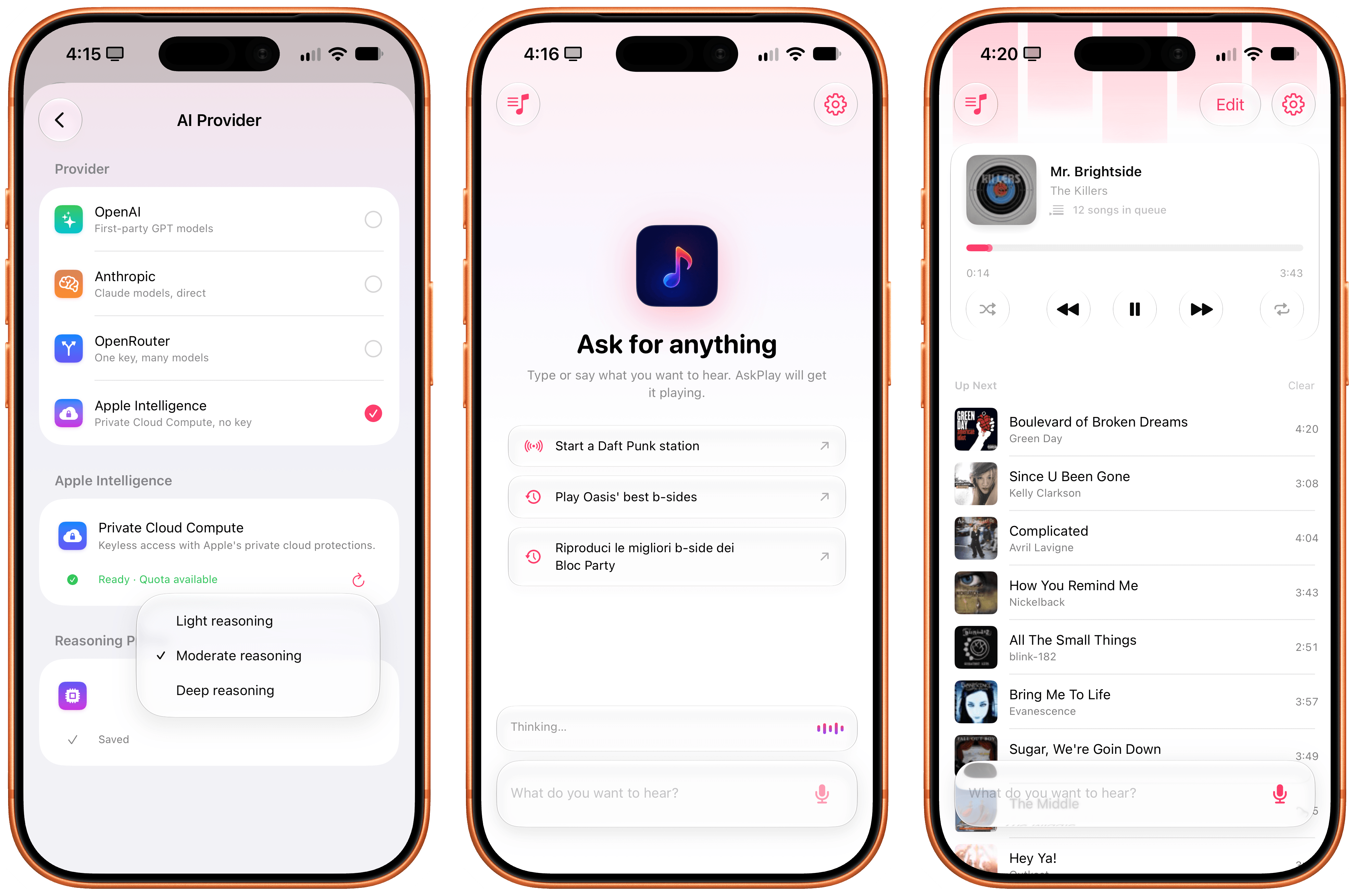
AskPlay is now on iPhone too, and thanks to iOS 27, it’s become one of my favorite showcases of Apple’s Cloud Pro Foundation model running in Private Cloud Compute. Unlike the original version, AskPlay now lets you hand off prompt processing to a reasoning model in the cloud at no cost thanks to Apple’s PCC framework for third-party developers. And not only that, but AskPlay is also the first app I’ve seen that lets you choose between the three reasoning modes supported on PCC: light, moderate, and deep.

In my experience, I’ve had the best results with the PCC model set to “moderate” reasoning. What this means in practice is that with AskPlay for iOS 27, we now have a way to generate Apple Music-based mixes using natural language with a quality that I find superior to Apple Music’s own playlist generation feature.

AskPlay remains one of the best app debuts of the year, and if you want to demo the capabilities of Private Cloud Compute for third-party apps, you should start here.

LookUp 13

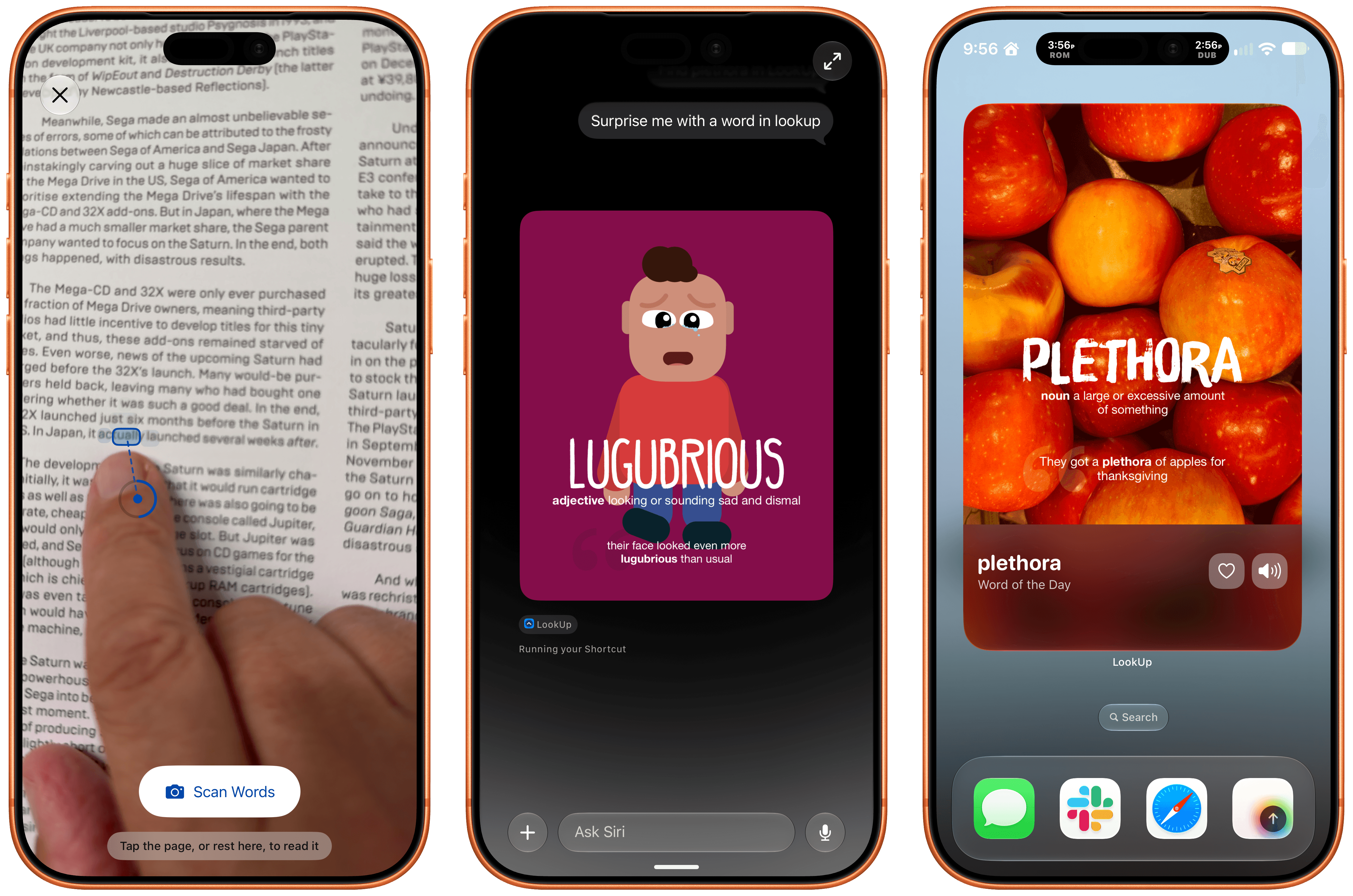
LookUp 13 from Vidit Bhargava has been released with a wide variety of features that make use of iOS and iPadOS 27. The app, which is available on the iPhone, iPad, Mac, Apple Watch, and Vision Pro, makes great use of Siri AI, allowing you to quickly ask Siri things like “Search the word plethora in LookUp,” which opens the app right to that word. Siri can also be used to find LookUp’s word of the day or a random word.

LookUp 13.

LookUp 13.

Beyond Siri, Vidit has added support for Apple Intelligence in the notes that can be tied to a word and combined Apple’s Foundation Models with the Vision framework and hand-pose tracking to let you scan a printed page for a word. Point at a word and the app’s scan mode uses your device’s camera to see which word you’re pointing at. It took a little practice to figure out the right distance from the camera to the page, but once I got that down, it felt like magic. The same feature can pick out other nearby words that might be difficult for the reader, too.

LookUp 13 also offers a Reading Mode that looks up words you speak as you read. The feature uses a Live Activity that listens to you speak, and returns a definition. Initially I ran into some trouble with Reading Mode, but when I tried again later, it worked every time. Also included in the latest release are interactive flash cards that ask for word definitions that are graded by Private Cloud Compute and new extra-large widgets for the word of the day and a shuffled word of the day.

LookUp is an excellent app. I love how Vidit continues to push the boundaries of Apple’s technologies every year, and while I hit a few rough spots in testing, which struck me as issues with Siri AI, not LookUp, I’m impressed by how much depth LookUp’s new Apple Intelligence features add to the app.

Play

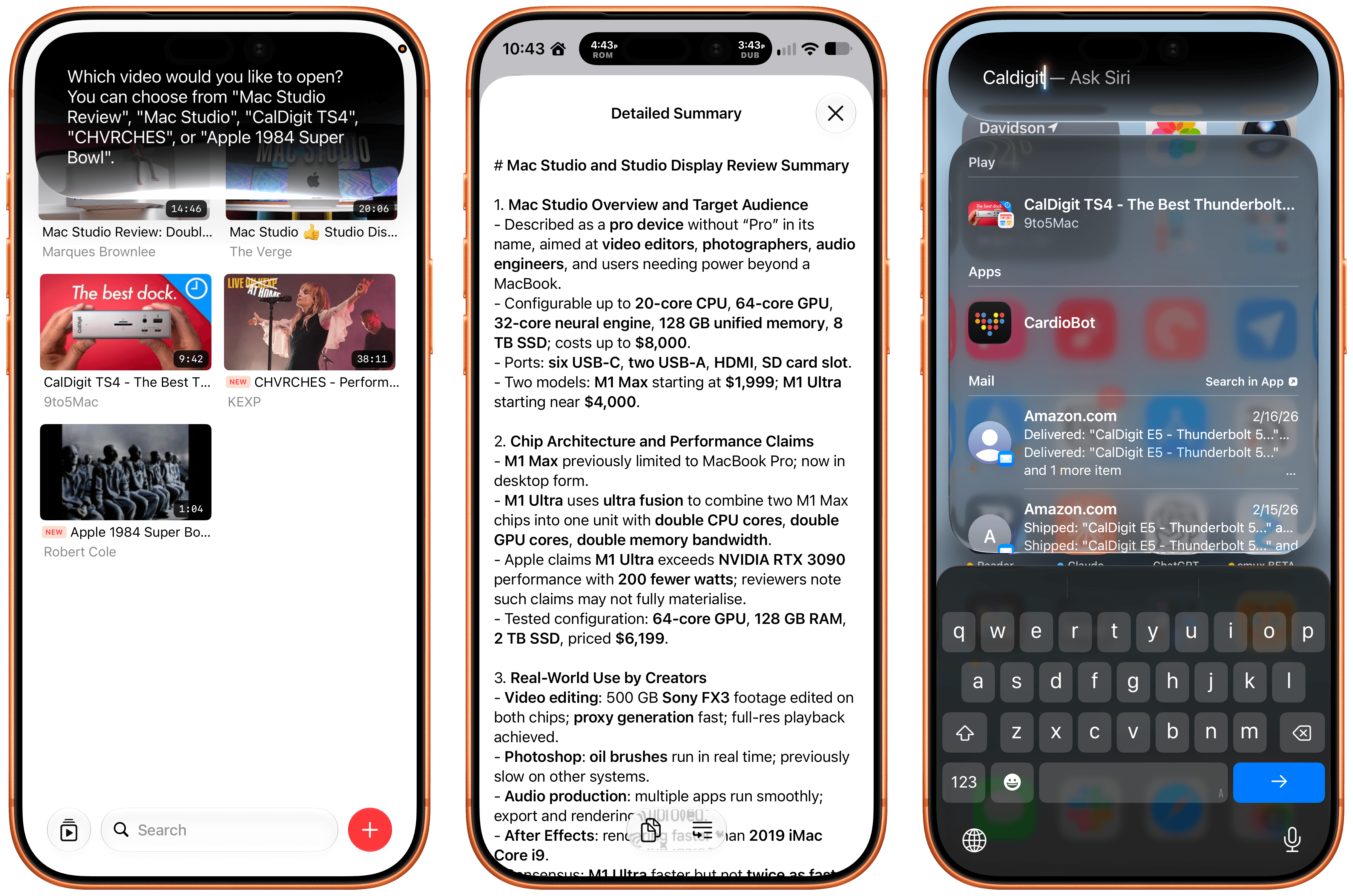
The latest update to Play, the watch-it-later app from Marcos Tanaka that works on the iPhone, iPad, Mac, Vision Pro, and Apple TV, includes a bunch of great touches. There’s a new Channels Inbox for navigating saved videos by source. Play has also added Siri AI support allowing you to search for and open videos. Onscreen content is made available to Siri, so you can do things like ask it to remind you to finish a video later, and it knows what you mean. In my testing, all three features work well.

Also, on an individual video’s detail view, you can use Apple Intelligence to create a summary of a video. There are options ranging from a concise summary to a simple explanation. I ran into a roadblock when I tried to create a summary of a fifteen-year-old YouTube video, but more recent videos all worked well. Apple Intelligence can also suggest tags and icons for videos and lets you ask questions, with the answers drawn from the video’s transcript.

Beyond Siri AI and Apple Intelligence, Play adds an extra large widget, a refreshed Liquid Glass design that I love, and Spotlight search. It’s a fantastic update to my favorite way to save videos for later.


Unlock 13 Premium FunnMedia Apps on Your Apple Devices for Less than $5 a Month

You’ve been paying a tax on being healthy. Four dollars here for hydration, five there for sleep, another subscription for fasting, another for habits, and each one only ever sees its own slice of you. Your Apple Watch is already collecting the whole picture; what’s missing is a set of apps built to work with it, and with each other.

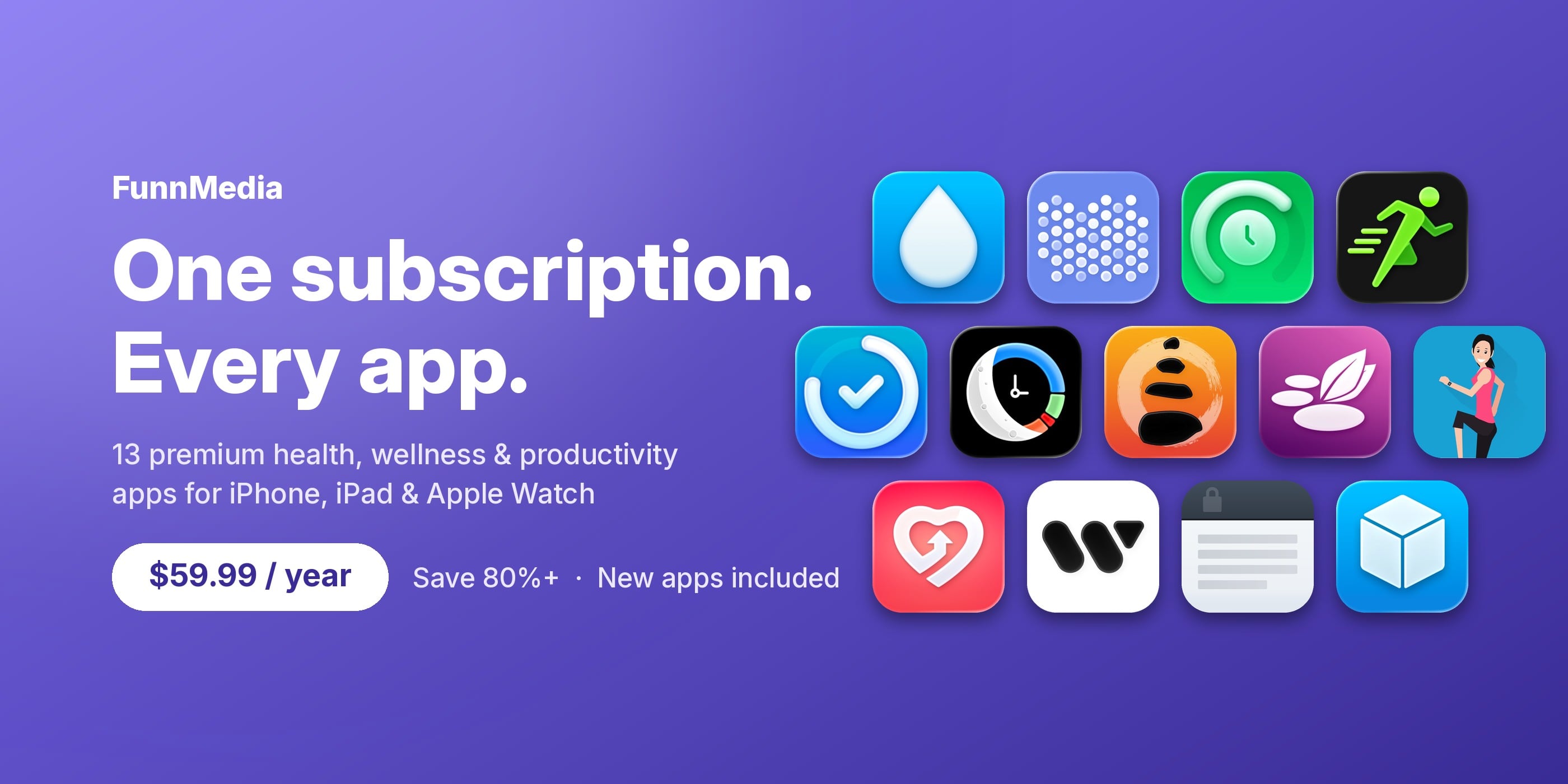
The FunnMedia Premium Plus Bundle Unlock 13 premium apps on your Apple devices for less than $5/month. fixes that with one subscription: 13 premium apps for health, wellness, and productivity, fully unlocked, for $59.99 a year.

What makes it work is that every app comes from the same small indie studio and is built around Apple Health, Apple Watch, and widgets. Because they all read from and write to Health, a log in one app shows up where it should, and the whole set shares one design language instead of feeling like a pile of downloads.

Replay

In practice, a day looks like this. SleepMinder scores last night before you’re out of bed. WaterMinder nudges you from your wrist before you’re thirsty. Calory scans your lunch barcode, FastMinder watches your eating window, and Couch to Fit squeezes in a seven-minute workout before dinner. FitnessView pulls all of it into dashboards that show real trends, HabitView keeps your streaks honest, and ZenMinder and RelaxTopia handle the wind-down. When your doctor asks for numbers, HealthExport hands over a PDF. Widgetive, NoteFolio, and ReplyCube cover the productivity side.

This isn’t an unknown lineup. WaterMinder is an Apple Editors’ Choice with more than 10 million downloads!

Bought individually, these subscriptions run past $300 a year. The bundle is $59.99, cancel anytime, and every app FunnMedia releases from here on is added automatically. Subscribe once and the next launch is already yours. Get it at funnmedia.com/bundle.


Soulver 4: The Notepad Calculator for Mac, iPad, and iPhone — Biggest Update in 7 Years [Sponsor]

Dear MacStories reader,

It’s Zac here, the developer of Soulver — a notepad calculator you might have heard of. You type your thinking in plain text, and live answers appear in a column alongside as you go.

I started working on Soulver all the way back in 2005. The reason I’m still improving it 20 years on is the enthusiasm of the people who use it: nearly every day, someone writes to tell me how useful it is in their daily work. For many of them it’s one of those apps that stays open all day — for every budget, quote, and what-if.

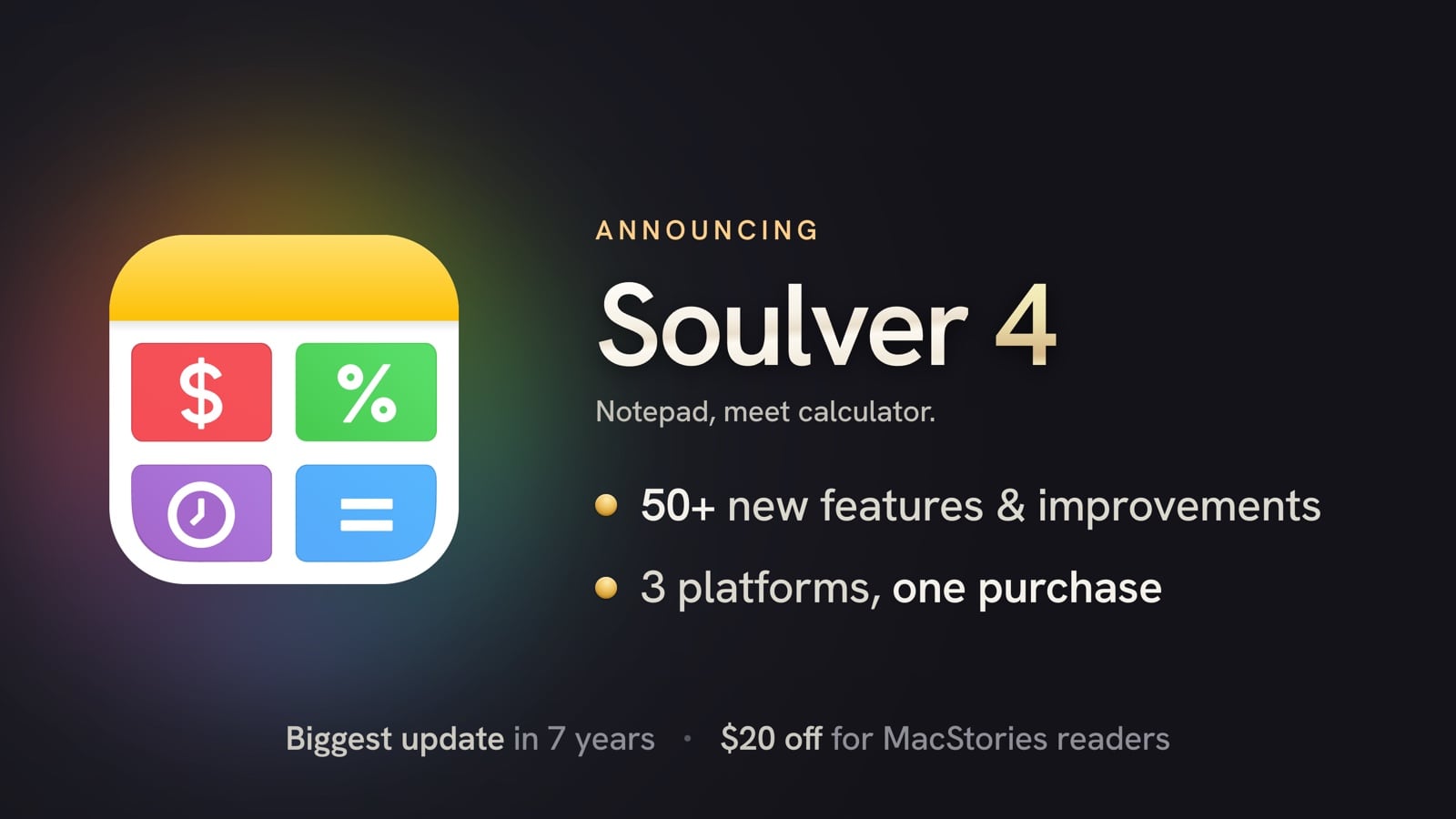
This summer I released Soulver’s biggest update in 7 years, with 50+ new features. My favorite is trip planning: write out how many nights you’d like to spend in each destination, and Soulver works out the dates of every leg. Rearrange the itinerary and the dates update. There’s nothing quite like it.

Soulver continues to be a one-time purchase, not a subscription. By popular request, it’s now also a universal purchase: buy it once and it’s yours on Mac, iPad & iPhone. And this week, MacStories readers can get Soulver for $20 off: $39 instead of $59. The offer runs through September 11.

Soulver isn’t for everyone. But if you’re the kind of person who likes to think through problems with numbers step by step, give it a try — there’s a free 60-day trial, so you can see if it clicks for you.

Get Soulver 4 for $39 — $20 off for MacStories readers through September 11

Our thanks to Soulver for sponsoring MacStories this week.


Finalist: A Paper-Inspired Daily Planner with Notes for iPhone, iPad, Mac, and Now Apple Watch [Sponsor]

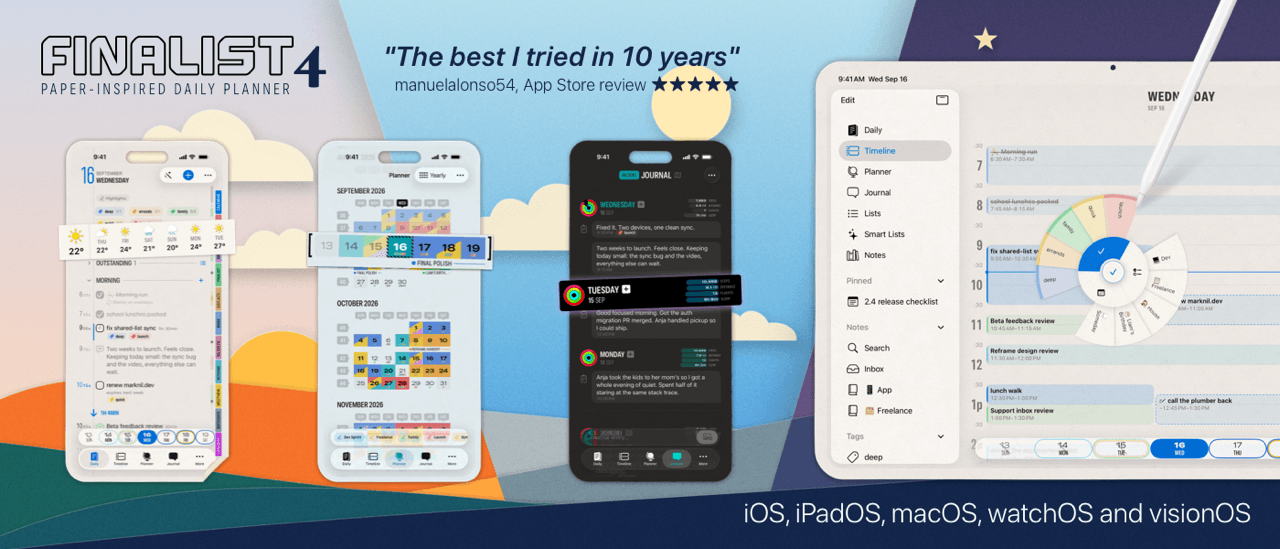
If you read MacStories, you might have caught John’s Finalist 1.0 review a few years back. A lot has changed since: version 4.0 is out this week, its biggest update yet. Finalist is a paper-inspired daily planner for iPhone, iPad, Mac, and now Apple Watch, giving you one place to plan your day, week and month. It wrangles all your stuff into one cohesive system to help you stay on top of it all: Reminders, Calendars, habits, tasks, notes, weather, and lots more.

New in 4.0 are Notes. Write native notes that sync to your iCloud, or point Finalist at a folder of markdown files and it round-trips cleanly with Obsidian vaults, GitHub, or any editor you like. Markdown tasks inside those files show up in your timelines as real tasks, on the right date, with the right tags. There are even timeline swimlanes per tag, to visualize any endeavour.

The Watch app is also new and it extends Finalist to your wrist. Its Now card answers the day’s current question: your first moves in the morning, the running time block with a countdown, an evening wrap-up with streaks to protect. It has some very nifty complications and a Smart Stack widget.

Or take a look at Broadsheet, a newsprint-inspired layout that shines on big screens. It has delightful touches throughout: tap a World Clock and the whole page retunes to another city, with date, weather, tasks, and appointments all in that timezone. The Timeline tab lets you sketch your day in pencil. Perfect for timeblocking, especially with Pencil Pro and its squeeze menu.

Apple has featured Finalist as App of the Day multiple times, and a large Discord community drives it forward. To help you try it, MacStories readers get 50% off their first year with code MACSTORIES40.

Our thanks to Finalist for sponsoring MacStories this week.


Cotypist: Smart Autocomplete for Your Whole Mac [Sponsor]

You think faster than you can type. Across a day of email, Slack, notes, and chatbot prompts, that gap quietly eats your time.

Cotypist closes that gap. It’s smart autocomplete for your Mac: as you write, it predicts your next few words and shows them inline, right at your cursor. Press Tab to take the next word or the whole line, then carry on. If a suggestion isn’t what you had in mind, keep typing and it catches up within a letter or two. Accept a word here and a line there, and you’ll have to type far less than you used to.

Most AI writing tools try to do too much and don’t sound like you. Cotypist only fills in the words you’d have typed anyway (just faster), and it picks up your vocabulary as you go, so the result still sounds like you. It works almost everywhere you write: Mail, Messages, Slack, Notes, Obsidian, your browser, even the prompt box in ChatGPT. And it all runs on your Mac, so nothing you type ever leaves your Mac.

Cotypist comes from the maker of Timing, the Mac time-tracker many MacStories readers already know, so it’s built to feel native and stay out of your way. Setup takes about a minute: drag it into Applications, launch it, then start typing, no account required.

Cotypist is free to download, with a 30-day Pro trial and no credit card. When the trial ends, you can keep Pro or drop to the free plan. Until the end of August, MacStories readers get 10% off their first bill at cotypist.app/macstories. Give it ten minutes and see if it can keep up with you.

Our thanks to Cotypist for sponsoring MacStories this week.