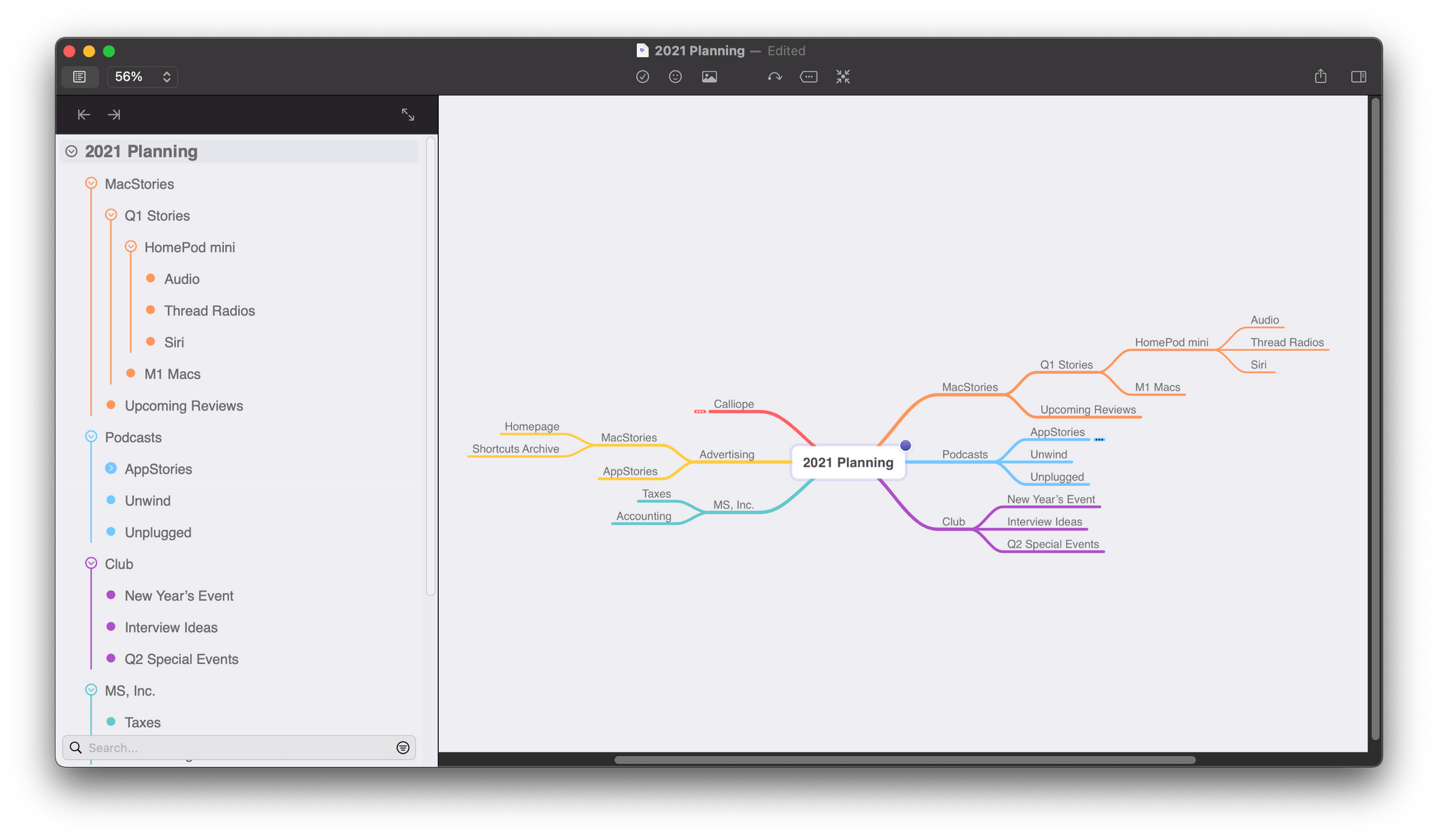
When I think about my writing, I think in outlines, which is a remnant of my days as a law student. A big part of every law school’s first-year curriculum is teaching students how to synthesize vast quantities of research materials into carefully-organized outlines. Outlines are a system of organizing my thoughts that have served me well, but it’s not the only approach, nor is it always the best.
Mind maps provide a more visual way to organize your thoughts and afford more room for creativity by making it easier to spot connections between related ideas and organize them in a less constrained way. Outlines suffer from a linearity and information density that makes those connections harder to find. However, when you pull back and consider most mind maps and outlines from a birds-eye perspective, they’re complementary rather than alternative ways to approach the same problem.
Last year, as I planned my Big Sur review, I briefly considered switching from MindNode to an outlining app to organize my notes. MindNode has included an outline view for years, but it wasn’t editable, which always bothered me. I appreciated the alternate visualization but wanted the ability to move nodes around within the outline’s hierarchy.