This Week's Sponsor:

Mindspace

A Private All-in-One Journal App Made for iPad, Offering 50% Off Your First Year.


iPhone 5: The Rumors

Written by Graham Spencer, Cody Fink and Federico Viticci.

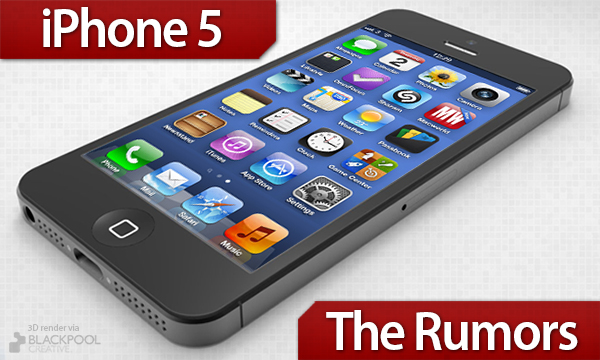
On Wednesday, September 12, Apple will likely announce the next-generation iPhone, rumored to be called “iPhone 5”. Initially reported by iMore in July, Apple’s September event will put the final word on what is believed to be the biggest upgrade to the iPhone’s line since the iPhone 4. And quite literally so.

Whilst CEO Tim Cook promised earlier this year to be “doubling down” on secrecy for unreleased products, a large number of alleged drawings, internal and external parts, and even software references have “leaked” in the past months, pointing to a device similar to the 4/4S family, but featuring a bigger screen. Moving to a taller screen would, supposedly, allow Apple to pose the iPhone 5 as a much more significant upgrade than the iPhone 4S (if only for the design alone), which, however, still managed to sell “fairly” well. And – again, based on ongoing speculation – a bigger display would allow developers (and Apple itself) to show more content to the users, enabling a new kind of experience for reading, browsing the web, playing games, and watching movies.

But it’s not just about the new screen. Below, we’ve assembled a timeline of sorts, organized by sections, linking to the most likely and popular rumors or leaked photos that have been posted to date.

While we don’t normally report on rumors that pop up on a daily basis, all signs at this point seem to suggest information posted online by various outlets is correct; recently, Jim Dalrymple of The Loop confirmed/denied a variety of rumors on the new iPhone. As Rene Ritchie of iMore wrote, while Apple could have spent some of its $100+ billions in the bank to orchestrate a complex series of “fake” leaks to create a “surprise effect” next week, they don’t have more time than anyone else on this planet, so the parts floating around – everyone seems to have one these days – are most likely accurate.

This, though, doesn’t mean we know how the next iPhone will be like. As you’ll see below, there are leaked displays, new dock connectors, motherboards, and even measurements, but this doesn’t necessarily imply we can be 100% sure this is what the next iPhone will look like. We can only attest with a certain degree of probability that, yes, Chinese manufacturers have given us a pretty good idea of what the new iPhone should be like, but only Apple can pull the curtain off what appears to be a major milestone for the iPhone’s product line.

So jump past the break, and check out the gallery of photos and links we’ve put together. Just don’t fall in the trap of believing this is all there is to the new iPhone’s story, because as we’ve learned in the past, there’s more to new Apple products than connector cables and leaked components.

The experience – how hardware and software integrate with the device – is still up for Apple to redefine next week.
Read more


Adobe Photoshop Touch Now Retina Ready

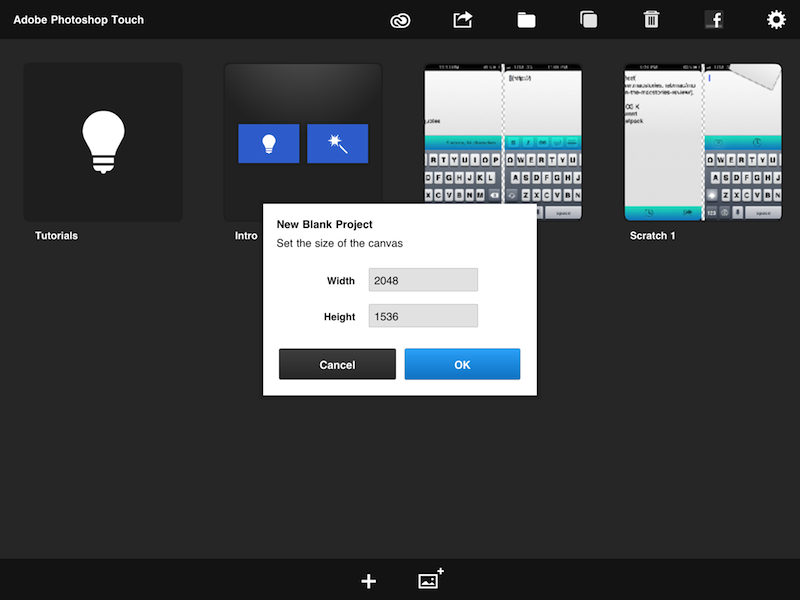
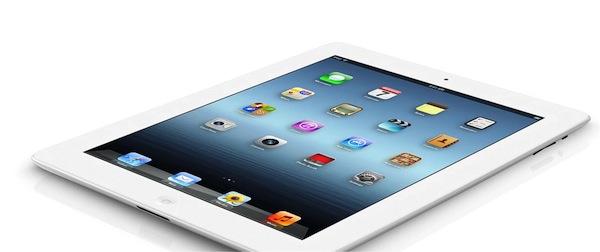
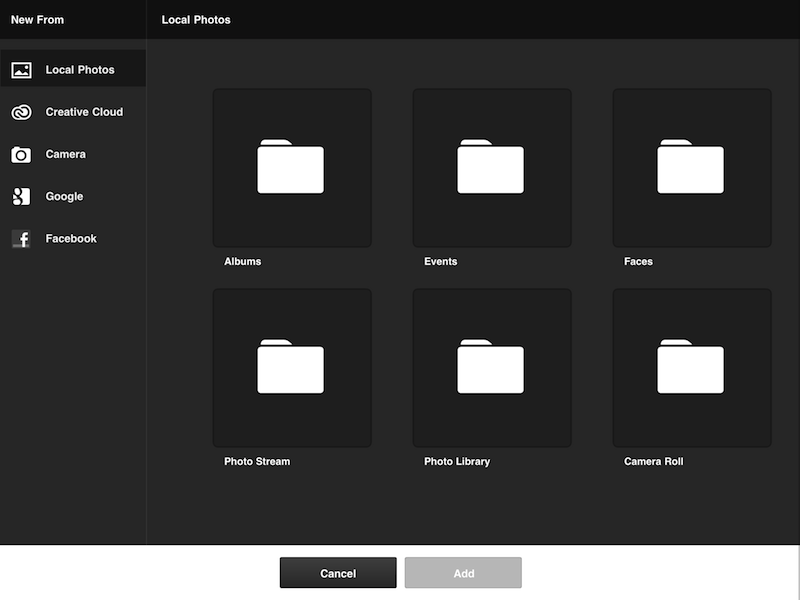
Released in February, Photoshop Touch, Adobe’s mobile version of the popular desktop photo editing software, has been updated today to include Retina support on the third-genereation iPad.

When the new iPad came out in early March, early adopters lamented the fuzziness of graphics and images of the then just-released Photoshop Touch; the lack of high resolution mode was particularly concerning because, as the market leader when it comes to photo retouching and image creation, many thought Adobe would do better, shipping a version of its app ready for the Retina display (as many indie developers did).

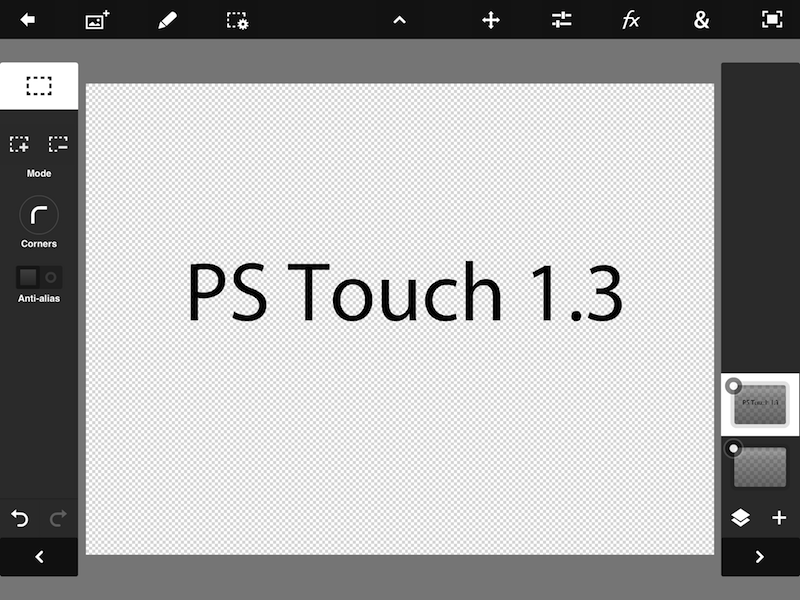
Today’s version 1.3 brings Retina display support with updated graphics (though some menus, like the font-picking one, are still low-res), and support for high resolution images; the app now supports images up to 12 megapixels and allows you to work on them maintaining the highest quality settings. Admittedly, while the app could produce and edit on the iPad’s Retina display, working with surrounding fuzzy UI elements wasn’t the best experience, and it’s good to see Adobe (finally) improving the app with up-to-date features.

Alongside support for the Retina display, Photoshop Touch 1.3 brings two new effects, faster animations (the app does seem snappier in navigating content), integration with Photo Stream, and addiitonal minor fixes and improvements.

Adobe Photoshop Touch is available at $9.99 on the App Store. Check out our original review of the app.


Harry McCracken: “One Year Later, the iPad Is Still My Favorite Computer”

Harry McCracken: “One Year Later, the iPad Is Still My Favorite Computer”

Harry McCracken has been working a lot from his iPad. And by “a lot”, I mean Harry McCracken was one of the first journalists to bring his iPad full-time and turn it into a serious work machine for writing. He shared some great tips and workflow ideas last year, and his experience was the inspiration for this article of mine, which analyzed the iPad’s journey from early adopters to mass market as a “Post PC” device. McCracken’s story also motivated me to use the iPad more for work-related purposes, and I was not alone.

One year later,  McCracken interviews himself about the pros and cons of the past 365 days as a proficient iPad user. More importantly, he argues that it’s not about the writers and bloggers anymore – the iPad is being used by “regular” people, who are finding the iPad to be a viable solution for variegate tasks like reading and checking emails, or more specific activities like screenwriting and managing medical records in healthcare.

I’m pretty sure it’s not just journalists who are using iPads as computers. I see people doing it in airplanes. I’ve seen them doing it on the subway. When I’m out and about, strangers run up to ask me about my keyboard. Something’s happening here, and it’s happening quickly — and so I thought I’d update you on my experiences as of the one-year mark.

Skipping the question as to whether the iPad can or can’t be a “computer” altogether, what we really should consider is that, ultimately, consumers aren’t wasting their time arguing on the nature of the device, they’re just using it. As it turns out, arguing on productivity isn’t nearly as productive as just getting work done, like McCracken (and others did).

Read Harry McCracken’s post over at TIME.

Permalink

Organizing Everything With Plain Text Notes

Organizing Everything With Plain Text Notes

nvALT

nvALT

In a guest post for Macworld, Macdrifter’s Gabe Weatherhead shares some tips about his note-taking workflow, based on plain text files.

Like everyone else, I need to keep track of lots of bits of information. Some of those bits are as simple as the brand of salad dressing my wife likes; others are as complex as an outline for a multi-year project at work. Whatever the size, origin, and purpose of these bits, I keep track of them all by saving them in a reliable system of plain-text notes—a system that enables me to find any bit of information whenever I need it, in a form that makes sense to me when I do.

My workflow is similar to Gabe’s one. I store all my notes – rigorously in plain text format for data portability – in a single Dropbox folder, and I use a variety of apps and hacks to work with these files on the device at hand. The advantage of working in plain text is that I never have to worry about file conversion and corrupted databases – and when combined with Dropbox, it really all just works. Plus, I can stay assured that, twenty years from now, an archive of my notes will still be there, as plain text – like PDF – will likely be around.

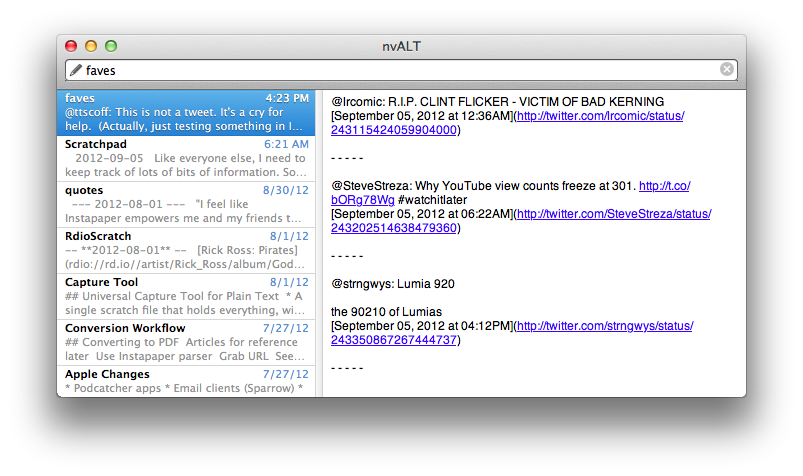
On the Mac, like Gabe, I use Brett Terpstra’s excellent nvALT to switch between all my notes. I don’t use tagging, but I do use Alfred to peek inside the contents of my plain text files to find links or bits of text I had previously saved (like favorite tweets). Occasionally, I might write in TextEdit or Byword, but generally – no matter the app I’m using – Markdown previews are handled by Terpstra’s other insanely useful app, Marked. On iOS, as I recently explained, I tend to access my notes with a combination of Nebulous Notes, Writing Kit, and WriteUp depending on what I need. To quickly save notes into Dropbox, I rely on Drafts, which was recently updated to version 2.0.

I like plain text because it lets me write and access my notes the way I want to. As David Sparks once wrote, it’s timeless. Make sure to read Gabe’s post here for some great tips.

Permalink

Quick, Effective Reminders with Sticky Notifications

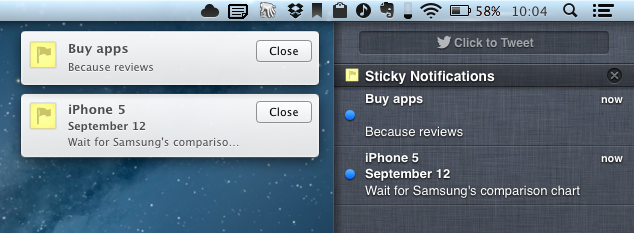
Sticky Notifications by Matt Gemmell is a utility to create “sticky” reminders on the OS X desktop using Mountain Lion’s Notification Center (Growl is also supported, and the app runs on 10.7 as well).

OS X comes with Stickies, but, admittedly, Apple’s own app feels outdated and out of shape. By integrating with a system-wide feature users are already accustomed to, and adding neat integrations like Automator and hotkey support, Sticky Notifications greatly simplifies the process of putting information on the desktop for later. And it has a lot of clever touches that, in spite of the app’s simplicity, show a profound attention to detail and care for optimal experience.

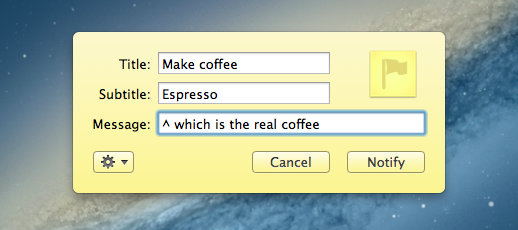
By default, Sticky Notifications sits in the menubar. Upon clicking its icon, a post-it, sharing sheet-like menu pops up, allowing you to write down your reminder. You can write down a title, hit Enter, and the reminder will be created on the desktop using Notification Center’s “alert” style, which is sticky and is displayed until manually dismissed.

Obviously, because it’s based on a native functionality, you can head over Notification Center’s preferences to set the app’s style to banner, but that would defeat the purpose of Sticky Notifications, at least partially (banners will be dismissed after a few seconds, but they’ll still be saved in Notification Center). You can also attach a subtitle and a message, and create multiple stickies to sit on your Desktop.

That would be it as long as the main functionality goes. But developer Matt Gemmell was clever enough to bake in some sweet integrations with system and third-party utilities to extend the capabilities of Sticky Notifications.

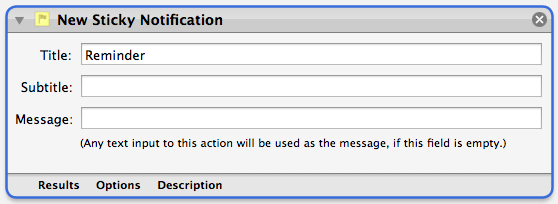
There is an Automator service to create workflows that trigger new reminders using the app. I would love to see AppleScript support in a future version of the app in order to further improve scriptability.

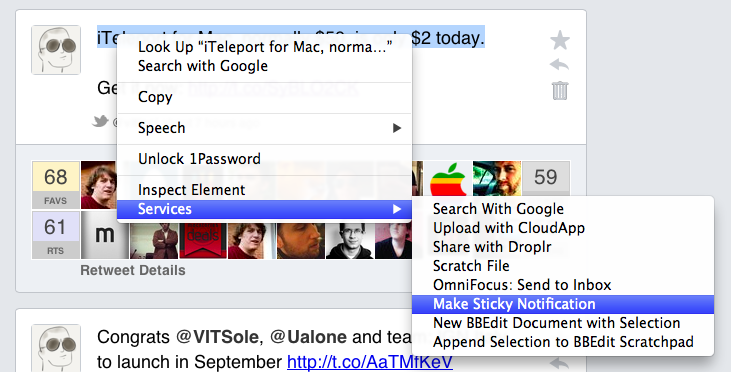
You can select any text on your Mac, and use a system Service (optionally paired with a keyboard shortcut) to save it as a message in a reminder.

Too, the app is smart enough to recognize URLs saved in a reminder’s message, so when clicking on one, the URL will automatically open in the default browser. I find this to be an excellent solution to save links for later without bookmarking them.

Speaking of URLs, Sticky Notification has a URL scheme. By URL-encoding parameters in a single string (just concatenate them using &), you can create new reminders outside of Sticky Notifications in the background, or bring up the app’s menu by using the prepare option in the URL. Because of this URL scheme, you can combine Sticky Notifications with Alfred (or LaunchBar) to set up custom searches. I really like having custom URL schemes in the apps I use daily, as they allow me to fiddle and build custom workflows tailored to my needs.

Sticky Notifications is the perfect example of a fairly complex piece of software presented as a simple and intuitive app. This doesn’t come as a surprise, considering, again, the amount of thought and work that Gemmell put into this app. As Matt wrote, it’s the little things.

Sticky Notifications is only $2.99, either from the Mac App Store or the developer’s website. If you’re looking for a modern, easy to use, and powerful Stickies replacement, you can’t go wrong with Sticky Notifications. Recommended.


Apple Confirms: Media Event on September 12


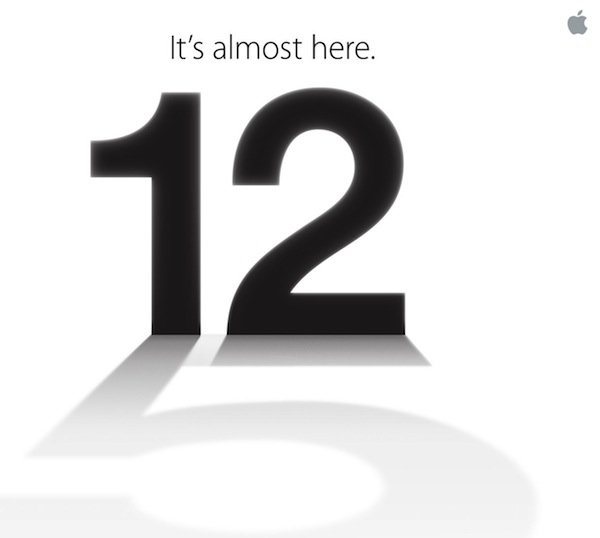
As first reported by The Loop’s Jim Dalrymple, Apple just sent out invitations to the press for a media event taking place on September 12 in San Francisco. The event will take place at the Yerba Buena Center for the Arts at 10:00 AM.

Apple is widely rumored to be introducing the next-generation iPhone at the event. As it can be seen in the invitation’s graphic, the shadow of the number “12” is a actually a “5”, suggesting the new iPhone will, indeed, be called “iPhone 5”. In recent months, there has been a lot of speculation as to whether Apple would call the new device simply “the new iPhone” (following “the new iPad” earlier this year), although some suggested “iPhone 5” would make more sense in terms of marketing considering the previous 4/4S monickers. However, others noted that, because the new iPhone would be the sixth generation model, the “iPhone 6” name would be more appropriate.

Obviously, the invite’s image is only a hint of a possible product name, but a strong one nevertheless. If previous invites are of any indication (see “let’s talk” as related to Siri last year), there’s a good chance the device will be called “iPhone 5”.

Lately, a lot of purportedly “leaked” parts of the new device have also pointed to a major redesign featuring a taller screen, thinner and lighter design, new speaker and dock connector, and more powerful A6 processor. iMore was first to report weeks ago about the future redesigned dock connector and September event. According to the website, the new iPhone should go on sale on September 21.

The next major version of iOS, iOS 6, is also currently being tested by developers, and it’s expected to become publicly available a few days before the launch of the next iPhone.


Denominations: A Simple Currency Converter

Developed by Abraham Vegh, Denominations is a simple currency converter that focuses on the concept of converting money to another currency, rather than the functionality alone.

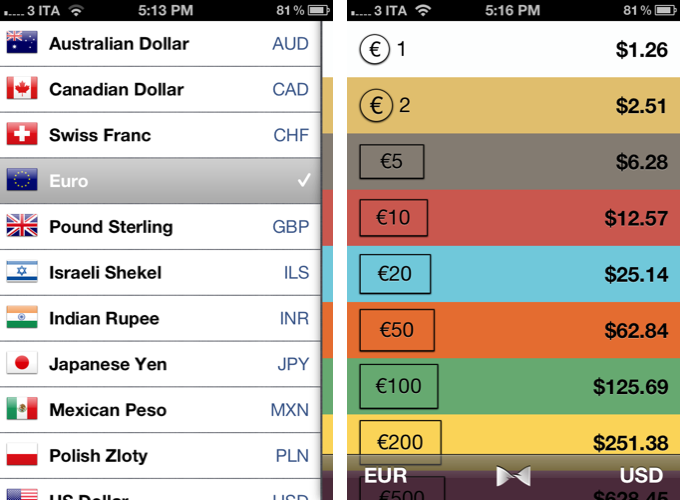
Most currency converters on the App Store feature a number pad for entering values – like a calculator – and a menu to choose currencies to compare. Denominations is different: instead of letting you enter your own numbers, it comes with a predefined set of amounts to compare. You can set two currencies, and quickly switch between them with the tap of a button. Denominations’ focus is on the idea of understanding conversions in another currency without having to think too much.

I don’t think Denominations can replace currency converters like Currencies – after all, I still need to convert the amounts I want – but I believe it has some neat possible usage scenarios worth considering. For instance, as a tourist I might just want to know “how many pounds are 10 Euros”, instead of doing my own manual conversion at the coffee shop. Or I might need to know that, approximately, my dinner will cost around 50 Euros, which Denominations says are worth 62 dollars today (rates are updated server-side every 15 minutes). Quick, at-a-glance information that doesn’t require me to think and manually enter numbers.

Denominations’ design is concise, with a flat color scheme that’s reminiscent of the simplicity of Clear, again signifying a trend in recent App Store releases to focus on information rather than ornamental menus. Developer Vegh is already working on adding more currencies, bug fixes, and tweaks for an upcoming version.

Denominations is available at $1.99 on the App Store.


Rovio Announces New “Bad Piggies” Game To Launch This Month

Finnish videogame maker Rovio has announced “Bad Piggies”, a spin-off of the popular Angry Birds franchise that will let users play from the pigs’ perspective. Titled “Bad Piggies” and set to launch later this month, the game will shift the focus from the birds – typically, the main characters – to the pigs. It is unclear how this will translate in terms of game mechanics, but Rovio promises “never-before-seen gameplay” without slingshots, Angry Birds’ tools to complete levels and clear them of pigs, the enemies.

There’s a lot of empathy towards the lovable enemies from the Angry Birds games, and we’ve been constantly asked: what about the pigs’ side of the story?” said Mikael Hed, CEO of Rovio. “Bad Piggies gives you the chance to play as the second-most-loved characters in the Angry Birds universe, and explore this rich world through their green eyes.

After the modest success of Amazing Alex – a new IP from Rovio based on the acquisition of a game previously called “Casey’s Contraptions” – Rovio kept on releasing updates to Angry Birds, adding new levels and options for free. Earlier this year, Rovio launched a new version of Angry Birds called “Space”, which was downloaded over 100 million times in just 76 days. Also earlier this year, back in May, Rovio announced the billionth download for the Angry Birds franchise, and reported revenue of over $100 million for the fiscal year 2011.

As a side note, an Angry Birds version featuring the pigs’ point of view was rumored all the way back in November 2010.

Bad Piggies will launch on Thursday, September 27, on iOS, Mac, and Android. A teaser website is available here.