Posts in news

Amid Rumors of Interest In iOS Devices, Intel Unveils Ivy Bridge Chips with 3D Transistors

Earlier today Intel officially unveiled the technology that will power its next-generation of chips, codenamed “Ivy Bridge”, with production set to start for PCs and servers by the end of 2011. After a decade-long research in Intel’s labs, the company announced a new 3D transistor structure named “Tri-Gate” that will allow to boost performances and efficiency in the new chips that Intel will also make for mobile devices and tablets. This announcement comes after speculation earlier this week about Intel willing to consider making processors for Apple’s iOS devices – which currently feature CPUs manufactured by Samsung, a company that’s at war with Apple over several patent infringement claims as previously reported. Intel hasn’t disclosed any plan to make chips for Apple nor did Apple comment on any of these rumors, but the mobile versions of Ivy bridge featuring 3D transistors for optimized speeds and battery life could surely be an option for Apple in future devices.

Intel’s 3-D Tri-Gate transistors enable chips to operate at lower voltage with lower leakage, providing an unprecedented combination of improved performance and energy efficiency compared to previous state-of-the-art transistors. The capabilities give chip designers the flexibility to choose transistors targeted for low power or high performance, depending on the application.

The 22nm 3-D Tri-Gate transistors provide up to 37 percent performance increase at low voltage versus Intel’s 32nm planar transistors. This incredible gain means that they are ideal for use in small handheld devices, which operate using less energy to “switch” back and forth. Alternatively, the new transistors consume less than half the power when at the same performance as 2-D planar transistors on 32nm chips.

Intel’s first 22nm Ivy Bridge microprocessor was demoed today running on a server, laptop and desktop computer. Production is slated by the end of the year, with Intel likely demonstrating the power of the Ivy Bridge platform with more demoes over the next months.

Apple Releases iOS 4.3.3 [Direct Links]

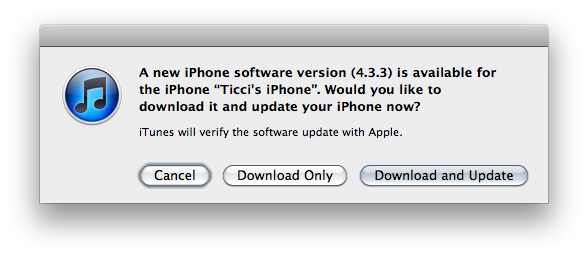
Apple just released iOS 4.3.3. It’s available now in iTunes if you check for updates, and direct links to the downloads will be available shortly.

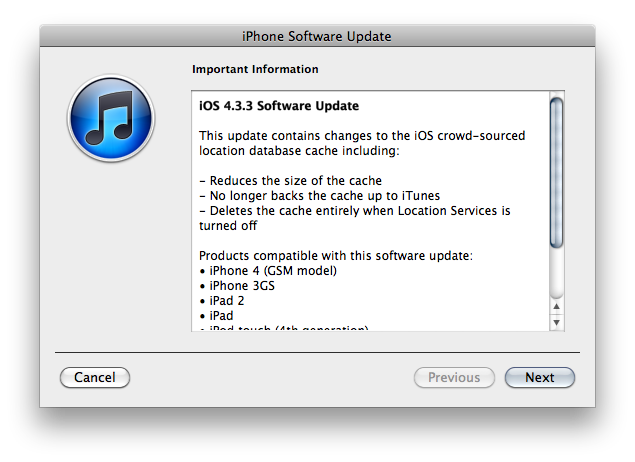
As previously reported, iOS 4.3.3 improves the way iPhones and iPads handle the location tracking database stored on-device by making it smaller in size. The location database will be no longer backed up to iTunes and it will be deleted entirely when Location Services are turned off.

Here are the direct links for iOS 4.3.3:

Apple also released iOS 4.2.8 for the Verizon iPhone. You can download it here. As for the build numbers: iOS 4.3.3 for the iPad 1 is labelled 8J3, with other iOS devices getting build 8J2. The Verizon iPhone’s iOS 4.3.3 is build 8E401.


New iMacs To Use SSDs As A “System Cache” For Spinning Hard Drives?

Yesterday, we noted the new iMacs featuring Sandy Bridge processors and Thunderbolt technology came with an option in the Apple Store’s online configuration page to pack a hybrid Serial ATA Drive + SSD setup at an additional cost. What’s curious about this hybrid setup is the note left by Apple to inform users that OS X will come preinstalled on the solid state drive, leaving space for documents and other media on the bigger (but slower) spinning hard drive.

iMac also offers an optional 256GB solid-state drive (SSD), which has no moving parts and delivers increased drive performance for many operations. The 256GB SSD can be purchased in place of the standard hard drive or in addition to it.

If you configure your iMac with both the solid-state drive and a Serial ATA hard drive, it will come preformatted with Mac OS X and all your applications on the solid-state drive. Then you can use the hard drive for videos, photos, and other files.

This led to speculation as to whether Apple was planning to install OS X on the SSD and show the other drive as a mounted volume in the Finder, or they developed a brand new system to automatically handle the processing of files and system info across the SSD and the spinning drive. Several bloggers and Mac users wondered how Apple could manage to easily allow the new iMacs to quickly switch between drives, save the OS on one drive and media on the other, symlink the user’s Home folder to content saved outside the SSD. These technical questions also had to face the 4-6 week delay that showed up when ordering a new iMac with hybrid configuration. However, the solution may be pretty simple, as it could lie in Apple’s use of Intel’s new Z68 platform, which – combined with the upcoming “Larsen Creek” SSDs – allows for a new caching system called ”Smart Response Technology.” Intel’s BD82Z68 Platform Controller Hub is indeed being used in the mid-2011 iMacs, as iFixit confirmed earlier today.

Intel’s Smart Response Technology works like this: in a hybrid configuration such as the one possible in the new iMacs, the smaller SSD acts as a “system cache” for the bigger & slower HDD. The OS (boot files, resources, extensions) are cached on the SSD for faster loading times, but the user only sees one drive in the Finder / Windows Explorer.

Smart Response provides a middle ground between capacious but slow and inexpensive hard drive storage, and fast but small and expensive SSD. With it, one can retain a high-capacity hard drive, and speed it up using a small SSD. The technology uses the small SSD’s low access times and high speeds to make it work as a cache of the HDD, it might even store copies of key parts of the HDD such as the boot volume and system files, to make booting faster, and the system more responsive overall.

It’s not clear at this point whether the delay in shipping times is caused by Apple waiting for Intel’s new solid state drives, and if Smart Response Technology will be enabled at all in Snow Leopard. Apple’s note on OS X coming preinstalled on the SSD surely raises some important technical questions, and we’ll know more in a few weeks when these hybrid iMacs will start showing up. [TonyMacx86 via 9to5mac]


“On the way to Woodstock” for iPad Takes You Back To 1969

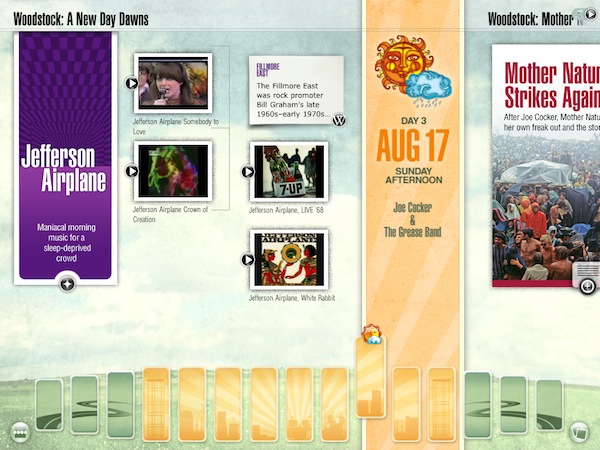
From the same creators of The History of Jazz, an interactive timeline about jazz music that was featured multiple times by Apple in the past, comes a new “book” for the iPad called On the way to Woodstock that takes where the previous digital experience left off to offer over 100 hours of video, audio, and editorial content related to the 1950’s, 1960’s and each of the artists that performed at the 1969 Woodstock Art & Music Fair. The History of Jazz was incredibly successful in the way it transcended the meaning of “digital book” to offer an experience that was closer to what Push Pop Press is doing now with Our Choice for iPhone and iPad: more than a simple book and closer to an interactive media gallery packed with content of all kinds, On the way to Woodstock is a digital, multitouch-based homage to the culture, politics and style of the 50’s and 60’s, as well as the historic bands and artists that performed at the legendary Woodstock festival.

I have downloaded the app a few minutes ago, and there’s so much stuff to do with its it’s difficult to get the hang of it in a short amount of time. You can look at photos and read descriptions; browse the timeline at the bottom by tapping on the colored bars and check out every single moment of the Woodstock fair with videos, bios, articles and exclusive photographs; you can even enter a special “screensaver mode” to turn your iPad into the perfect Woodstock-themed coffee table book. The app is full of content, information, and media. It’s definitely a rich experience that will engage you in reading and watching for hours, and perhaps even coming back a few times after you’re done consuming everything the app has to offer. Like I said I’ve been playing with On the way to Woodstock for less than an hour, but the attention to detail, the animations, the options and the selection of songs and videos are amazing. The app also packs related content from iTunes, YoutTube and Wikipedia and lets you check out the original Woodstock set lists as well.

On the way to Woodstock is the perfect app to showcase the versatility of the iPad, something Apple would be proud of. You can get the app here at $6.99, and watch the demo video after the break. Read more


New iMacs: Teardown, First Benchmarks

Following yesterday’s release of the new iMacs with Sandy Bridge processors and Thunderbolt technology, the guys over at iFixit immediately started tearing down a 21.5-inch model. In their official teardown article, available here, there are a few notes of interest: iFixit notes how, design-wise, nothing much has changed in the new iMacs, which can be opened in the same way of the old generation units by pulling off the magnetically-held glass and removing the screws holding the LCD in place. The display is manufactured by LG and it’s the same used in the previous-generation iMac. iFixit also gives the machine a 7/10 Repairability Score, noting that average users can easily replace RAM, but accessing the CPU and GPU requires to take out the whole logic board, which is described as a “tricky process.” The teardown also reveals the Thunderbolt connector is similar (but not the same) to the one found in the early-2011 MacBook Pros; one heat sink is reserved for the CPU, with the other assigned to the GPU. Read more


Spotify Now Lets You Sync MP3s To Your iPod Without iTunes

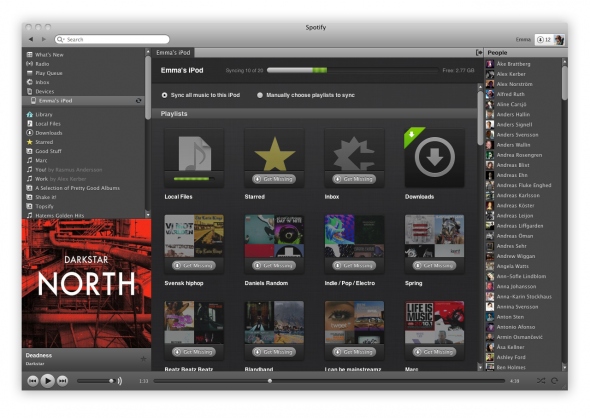
Spotify, the music streaming service that counts millions of active users in Europe but has been struggling to launch in the US due to the lack of deals with major music labels, announced some important new features last night, both for Premium and Free users. With an update to the official desktop app that will automatically roll out to all users in the next few days to “ensure technical quality”, Spotify now allows you to sync your music to an iPod Classic, iPod Shuffle or iPod Nano without using iTunes at all. With the new Spotify, users will be able to place the MP3s they bought (more on this in a minute) or saved locally inside a playlist (as they usually do) and sync these playlists to an iPod thanks to the new “Devices” section in the app’s sidebar. It’s worth noting that Spotify doesn’t allow sync via USB cable to iOS devices, as they’re only focusing on standard iPod models now. However, with the updated mobile app for iPhone and iPod touch (now also available to free users for playlist sync, whilst Premium subscribers retain the ability to stream everything) users get the possibility to sync playlists wirelessly. Clearly, Spotify has set out to become the standard music player for many both on the desktop and mobile devices, although the software still can’t sync back to iOS devices like iPhones and iPads through a USB cable. Plus, the lack of a native iPad app still makes it impossible for iPad users to properly enjoy the Spotify experience.

For the first time, seamlessly manage any iPod classic, iPod nano and iPod shuffle in Spotify. Simply connect your iPod to your computer via your USB cable and watch it magically appear in the new ‘Devices’ section of your Spotify sidebar.

iPod integration was your biggest request, but there are also a lot of Spotify Free users out there who are iPhone and Android phone owners. You asked for the ability to buy your MP3 playlists and sync to your phones. So we’ve got you covered too…

As of today, everyone can download the Spotify Mobile iPhone & Android apps to wirelessly sync your MP3 playlists in Spotify from your computer to your phone. Fire up your mobile app and see your phone appear in the ‘Devices’ section of the Spotify sidebar, ready to rock and roll. No cables required!

As mentioned above, users can now take the music they bought or already own on the go all the time. Spotify is, in fact, launching a new “download service” that, through a simple click&buy interface, allows you to purchase a range of MP3 bundles offered by the service starting at 50p per song. I haven’t managed to test the new music store and iPod Classic integration as the update is still rolling out and I don’t have it available, but from what Spotify unveiled last night, it really looks like the company’s intention is to take on Apple and (the future) iTunes with a mix of streaming, local cache, USB sync, and online store. The variety of apps offered by Spotify surely gives them an important head start in the music streaming scene for mobile devices, but they obviously still can’t compete with the music catalogue offered by iTunes. And when Apple finally rolls out is iCloud service for music with iTunes integration, it’ll be interesting to see how Spotify will react.

[image via TechCrunch]
Read more


AT&T Rep Says No iPhone 5 In June or July

In the past months, a number of reports from different sources have indicated Apple has no plans to introduce a new iPhone at the WWDC event in June, which is going to be software-focused with previews of OS X Lion and iOS 5. The next-generation iPhone – according to many simply called iPhone 5 following the trend set by the iPhone 4 and iPad 2 – is rumored to be unveiled at Apple’s usual September media event – where the company will also release a final version of iOS 5 and roll out its revamped cloud services. Again, according to the rumors, Apple is doing this in order to shift the iPhone’s release date against the much more profitable holiday season, and a September / Fall 2011 release would make sense for such a strategy.

MacRumors reports today an AT&T customer care representative told a reader that Apple didn’t inform the carrier of any new iPhone in June or July, though there will be one in the future. This customer called AT&T to ask about his eligibility date for a subsidized upgrade, which had been pushed back by five months without reason. As MacRumors reports, this is what the AT&T rep told the customer:

Apple has informed us that they do not plan to release the iPhone in the June to July timeframe, though there will be a newer version in the future. Unfortunately, we have not been given a release time for the new phone. We will release this information on our website when it is available to us.

Information coming from customer care representatives is usually unreliable as these people don’t have access to the company’s fully disclosed plans and operations, and they shouldn’t be able to inform customers of alleged plans and future release dates anyway. However, the statement does seem to confirm previous speculation of a new iPhone slated for a Fall release, with no new model this Summer as Apple has just released a white iPhone and a CDMA version before that in February.


Apple’s New iPad 2 Commercial: “If You Asked”

If you asked a child, she might call it magic. And if you asked us, we’d say it’s just getting started.

Apple just posted a new iPad 2 commercial which, following the lead of the first one posted last month, is aimed at showcasing the various functionalities of the product. The iPad 2 is being promoted as an inspiring device for musicians, a “groundbreaking” tool for doctors, or a powerful machine for a CEO. Again, Apple shoots for simplicity, elegance and minimalism in these new iPad 2 commercials. The iPad 2 sure is lighter and thinner than its predecessor, but it’s all about the software when it comes down to the experience. This is what they believe.

Check out the video after the break. [via YouTube]
Read more


Deflect the Damage with the G-Form MacBook Sleeve

Let’s say you’re traveling amongst the lions of Africa, nose-diving off a cliff in Australia, or out-backing in the great wilds of New Zealand. Packing your MacBook, catastrophe strikes and your backpack goes tumbling down a vertical rocky hill even the greatest mountain bikers wouldn’t cross. Not to worry, however, because your Mac is straddled by G-Form’s Extreme Sleeve, offering the same durability that battle-hardened kneepads offer extreme sports enthusiasts. Reactive Protection Technology (a fancy way of saving impact resistance) suppresses hard falls by stiffening upon impact and rippling the shockwaves of the fall evenly through the structure of the case. Crack-ready glass displays and scratch-easy aluminum frames are firmly protected. Thanks to the G-Form’s water resistant, damage deflecting padding, it’s the sleeve that’s ready for everything from the urban jungle to the great outdoors. I can’t vouch for the Superman-like armor, but I’ll be damned if I didn’t believe the home-movie after the break. Available for $69.95 at g-form.com for laptops and $59.95 for iPads, the same people who bring bone protecting gear have taken their technologies to the metal logic-boxes you clank on each day.

Read more