Posts in news

Apple Removes “iPod Click Wheel Games” From iTunes Store

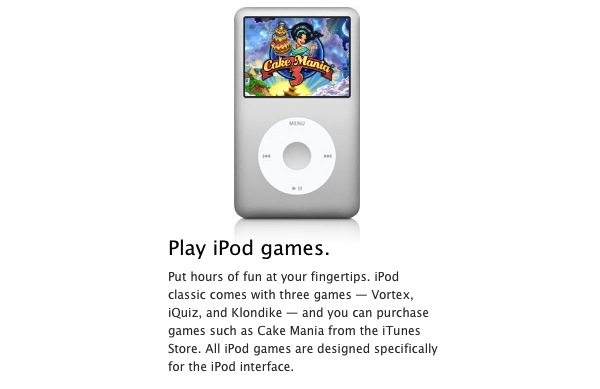
As noted by AppleInsider, Apple has removed iPod click wheel games from the iTunes Store, pulling a link to the category from the App Store’s dropdown menu inside iTunes, and also removing listings for those games that users could play on a click wheel-based iPod. It’s not clear when Apple made the change exactly, but it appears to be recent. Apple updates the App Store’s homepage every week with new features, banners and links to special sections, and the removal of iPod Click Wheel Games (which had their very own category) might have been part of a weekly refresh. There were around 50 games for click wheel iPods in the iTunes Store, including classics like Vortex and Klondike, or other titles like Song Summoner by Square Enix.

Click wheel games were compatible with the iPod classic, as well as older versions of the iPod, iPod nano and iPod mini. They allowed users to control games using an iPod’s touch-sensitive click wheel, and they’re still mentioned on Apple’s iPod classic Features page. Development of click wheel games never really took off with third-party developers, as Apple didn’t make a software development kit publicly available.

The FAQ page for iPod Click Wheel Games has been marked as “archived” and “old article” by Apple on September 21, 2011. The article still reports click wheel games are available in the iTunes Store, but old direct links for such games aren’t working anymore, and games no longer appear in iTunes’ search results.

The removal of click wheel games comes amidst rumors of the discontinuation of the classic and shuffle iPod lines, quite possibly with a formal announcement as early as next week at Apple’s October 4th keynote. The iPod classic was rumored to be nearing discontinuation before, as Apple didn’t announce a refresh at last year’s music event in a clear focus on iOS devices (and the updated iPod nano). Apple’s Steve Jobs allegedly confirmed in an email to a customer that they had no intention to cease production of the iPod classic, which remains the only iPod to offer high capacity with 160 GB of storage. Speculation surrounding the iPod suggests Apple would axe the Classic to make room for a new 128 GB iPod touch, although this year’s iPod touch refresh is believed to be a minor one and there have been no signs of a 128 GB iPod touch in the past months. A 64 GB iPhone prototype surfaced earlier this year, if this can be an indication of Apple looking to bump the storage sizes of its iOS devices.

In 2010, the iPod classic was the 5th most popular MP3 player in the United States.

Firefox 8 Enters Beta with Twitter Search, New Tab Features

As Firefox 7 hit the public channel earlier this week, Mozilla has published a new blog post detailing some of the features of the new Firefox 8, now available in beta. Keeping true to their renewed schedule for Firefox updates, Mozilla aims to release a new version of their browser every six weeks, which has lead to some confusion among users as to whether it’s really necessary to call every update a major release when there are only minor differences to test.

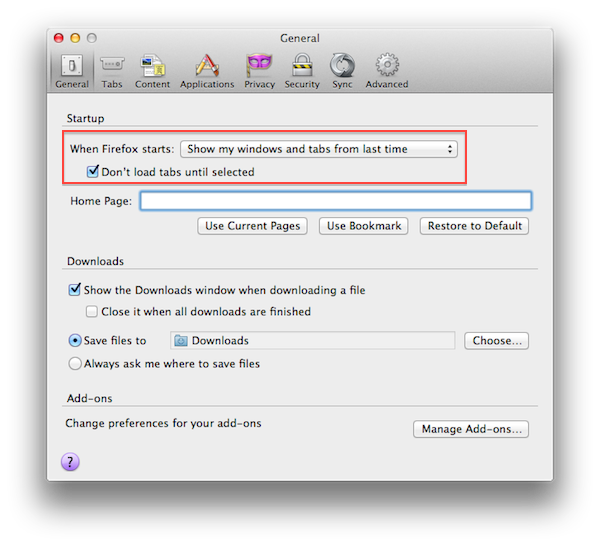
Firefox 8 will deliver some improvements to tab management, allowing users to choose whether tabs should load at start-up, or only when they’re selected. This should allow for faster start-up times when windows with many tabs are restored; from a first test, it indeed appears Firefox 8 will restore the last opened tab, display other tabs’ titles and favicons, but load their contents only when the user clicks on them. Mac users can find this new option under Preferences -> General. Also, a new tab animation should make it easier to re-order tabs.

Another new feature of Firefox 8 is Twitter integration in the search box. By clicking on the search provider’s icon (by default it’s Google), users will have the option to choose Twitter and enter terms to look up on the social network’s Search page.

Firefox 8 also includes:

  • Enhanced control of add-ons: Users will receive a one-time notification to review and confirm third party add-ons they want to keep, disable or delete. When Firefox starts and finds that a third-party program has installed an add-on, Firefox will disable the add-on until the user has explicitly opted in, giving users better control over their Web experience.
  • CORS for WebGL textures: Cross-Origin Resource Sharing (CORS) enables Web developers to load textures from other domains for WebGL in a secure way.
  • WebSockets updates: Firefox now prevents the use of plaintext WebSockets when created from an SSL page, which improves security for users.
  • HTML5 Native Right Click Menu: Web developers can now add items directly to the Firefox right click menu using simple HTML5 markup.
  • HTML5 media elements: Developers can add a lot of video and audio elements to a website without impacting performance

Firefox 8 is expected to be available later this year. The first beta can be download from Mozilla’s website here.


Apple To Stop Shipping Boxed Software to Educational Resellers

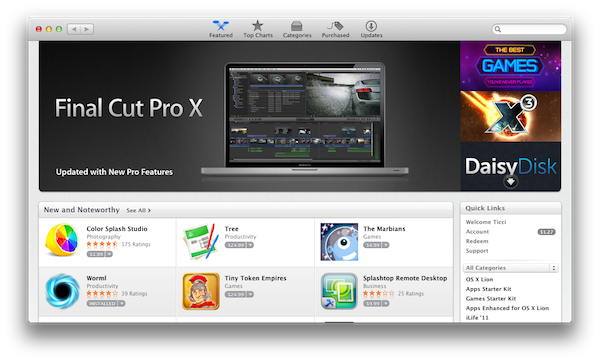
According to a report by ZDNet’s Jason O’Grady, Apple has informed educational resellers and customers of academic institutions that they will no longer receive boxed copies of Apple software like Snow Leopard, iLife, and iWork. With the exception of Snow Leopard, required to upgrade to OS X Lion and still available on Apple’s website, all the apps mentioned in the letter have been released on the Mac App Store, including Apple Remote Desktop and Aperture, the latter with a heavily discounted price compared to its physical counterpart.

Apple confirmed today that, with limited exception, they will cease to ship boxed software to campus resellers. This includes Mac OS X Snow Leopard , iLife, iWork, Apple Remote Desktop, and Aperture, among others.

We have a limited supply of copies of each in stock in the store, so consider this a “last call” for anyone who would like a hard copy before they are gone. Particularly anyone who would like to get Snow Leopard, as we just received our final shipment of that version of the OS.

The only products that will remain as boxed software offerings are Logic Express and Logic Studio.

The obvious move towards digital downloads falls in line with Apple’s recent Mac App Store-only strategy: the discontinuation of MobileMe boxes and less space for boxed software in Apple retail stores; the popularity of the Mac App Store as a digital distribution platform; the release of new major upgrades (Lion, Final Cut Pro X) exclusively on the Mac App Store. Clearly, Apple is putting all the pieces together to eliminate boxed software completely from its future offerings. There are a few exceptions of course – Apple had to release a physical copy of Lion for users unable to download the 4 GB installer, and recently made the old Final Cut Studio (boxed copy) available again through tele-sales. But as this “last call” to educational resellers confirms, Apple’s future software distribution won’t include boxed copies, not even for academic institutions.


Quora Releases iPhone App

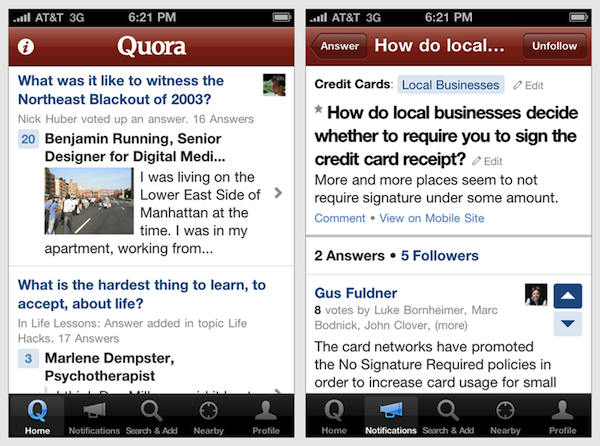
Quora, the question-and-answer website publicly launched in summer 2010, has released its first official iPhone app today, free on the App Store. For those not familiar with Quora, it’s a community-driven resource for answers on a variety of topics including technology, science, sports, media, health, and more. Quora aggregates topics and questions, allowing users to collaborate on them and vote the best answer to a specific question. Each “author” has a profile with detailed stats for recent posts and answers, activity and “related answers”. Quora has been widely regarded as a revolutionary knowledge platform comparable to Wikipedia.

The iPhone app brings many of the features that made Quora popular on mobile devices (the app also runs on the iPod touch) and adds a “nearby feature” to browse topics on a map, add or answer questions about a place near you, or simply explore questions on a map overlay. You can view your profile, ask and answer questions, or read your feed for interesting questions and topics you might want to follow.

The developers of the Quora app write:

When Neeraj Agrawal and I started working on the app earlier this year, we spent a lot of time thinking about how to translate both the experience and the technology of Quora to a mobile platform. We rethought the design from the ground up and worked hard to make it fast and native while strengthening the core product. Now, just like on the Quora web site, you can read your feed, search and add questions, check your notifications and add answers and posts.

We’ve also made existing features like Shuffle even better. You can find Shuffle at the bottom of your feed. It’s perfect for surfacing even more great content when you’re stuck at a bus stop and looking for something to read.

Quora for iPhone is available for free on the App Store.


Shazam’s Free iOS App Gets Unlimited Tagging

, the very popular music ID service for iOS, made a major change to the free version of its iOS app. “Shazamers” are now getting unlimited free tagging. Shazam believes this shift will give them more opportunities for users to discover and interact with their favorite music and television shows.

Andrew Fisher, Shazam CEO said, “Shazamers already identify over 1 billion songs each year and go on to purchase over $100 million in digital music via our service. Now, with no limits, people can Shazam even more songs they don’t know – or they already know - to conveniently purchase them, see the lyrics, watch the official music video, share on Facebook, Twitter or email, get recommendations and purchase concert tickets instantly. Unlimited free access means people can use Shazam even more as part of their daily lives.”

Users of the Shazam service can of course upgrade to the paid app, called Encore, and get the benefits of ad-free usage and features like LyricPlay, which allows users to view lyrics as the tracks play.

A link to the free Shazam app can be found here.
Read more


Facebook’s iPad App And Project Spartan Likely To Launch Next Week, Possibly At Apple’s Event

Back in July TechCrunch revealed that Facebook had already developed an iPad app that was live inside the iPhone app. It seemed feature complete, which has confused many as to why Facebook has taken so long to launch it — they didn’t even launch it at last week’s f8 conference. If MG Siegler of TechCrunch is correct (which he has been for many Facebook scoops this year), it has been waiting on another of Facebook’s Project Spartan and various negotiations with Apple - as was reported this week.

Earlier today another TechCrunch writer, Alexia Tsotsis found some screenshots of Project Spartan (see above) which MG Siegler believes to be the real thing. He writes this morning that “the planets are aligning” and that the Facebook iPad app and Project Spartan (of which both have seen delays and delayed each other) will launch next week.

According to him Apple has been involved with both projects and that the two companies have been collaborating on both projects. His sources note that the two Facebook projects may launch at next week’s Apple event (Mashable also suggests this), potentially as part of a demonstration that shows off improved HTML5 support on iOS. But if that arrangement falls through Facebook will apparently reveal the two projects during a Monday event.

But make no mistake, the relationship between the two companies is tenuous at best. Both know that they’d probably be better of working together, but both also believe that they don’t actually need each other. Hence, the dancing we’ve been seeing and hearing about. The two are frenemies. But the launch of Google+ has made the common enemy very clear…

Project Spartan is an HTML5-based development and distribution platform that’s being built with Mobile Safari for iOS in mind. When MG Siegler first posted about Project Spartan in mid-June, he described the purpose of it as:

Facebook will never admit this, but those familiar with the project believe the intention is very clear: to use Apple’s own devices against them to break the stranglehold they have on mobile app distribution. With nearly 700 million users, Facebook is certainly in the position to challenge the almighty App Store distribution mechanism. But they need to be able to do so on Apple’s devices which make up a key chunk of the market.

[Via TechCrunch]


The Daily Averaging Only 120,000 Readers A Week

The promised iPad-only newspaper, The Daily, that News Corporation created with some Apple support and launched in February this year has continued to sell poorly. Bloomberg reports from an advertising executive, John Nitti, that the newspaper is averaging just 120,000 readers a week (which includes those who are on a two-week free trial of the publication). He says the subscription numbers are less than a quarter the number that is required for the publication to make money.

When The Daily was unveiled in February, News Corporation Chairman and CEO, Rupert Murdoch said “We believe the Daily will be the model for how stories are told and consumed”. He spoke of how the publication would have the speed and versatility of new technology with the “serendipity and surprise” of newspapers - making ‘newspapers’ “viable again”.

News Corporation did reveal that more than 1 million people had downloaded the app between February and June but had declined to give out figures of actual readership. In May, News Corporation COO, Chase Carey defended the publication calling it a “work in progress”, and it being “early days”. Murdoch revealed in February that they had invested $30 million in the project, hiring over 100 staff and required a readership of 500,000 to break even.

[Bloomberg via The Guardian]


Dragon Go! Update Adds Support For Netflix, Wolfram|Alpha, Google+ And More

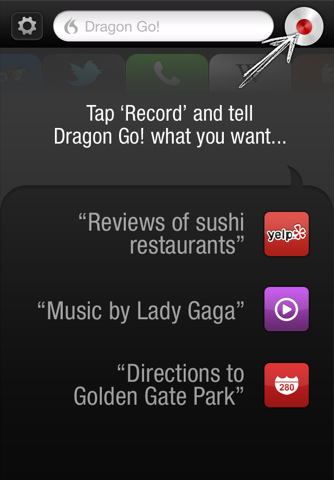
Back in July Nuance released a new iOS app, Dragon Go!, that we described as combining “Nuance’s top-notch voice recognition with the intelligence to do what is actually being said”. It will listen to a question or statement you make and then using the number of services it supports (from Yelp to Twitter to the iPod app), complete the task that you invoked.

Today Nuance has released an update to Dragon Go! that, in a sense, upgrades its intelligence that we described. It has improved it’s intelligence by adding support for a number of new services - meaning it can now understand more commands and actually do more things. It has added support for media services Netflix and Spotify, search engines Wolfram|Alpha and Ask.com as well as Google+.

It has also improved the Yelp experience from within the app by allowing users to access a map from within the Yelp tab. You can grab the update now, or if you haven’t yet tried Dragon Go! you can download it for free on the App Store.


iTunes Music Store Goes Live In 12 More EU Countries, iBookstore Coming To More Countries Soon

Following a report from yesterday that Apple was set to launch the iTunes Music Store in 10 more European Union countries, Apple has pressed the button and launched it in not 10 but 12 EU countries that did not have the service before. This now means that every single EU member nation now has the iTunes Music Store, with today’s countries that got the store being: Bulgaria, Cyprus, Czech Republic, Estonia, Hungary, Latvia, Lithuania, Malta, Poland, Romania, Slovakia, and Slovenia.

Apple is also about to launch the iBookstore in most EU nations including: Austria, Belgium, Bulgaria, Cyprus, Czech Republic, Denmark, Estonia, Finland, Greece, Hungary, Ireland, Italy, Latvia, Lithuania, Luxembourg, Malta, Netherlands, Norway, Poland, Portugal, Romania, Slovakia, Slovenia, Sweden and Switzerland.

These countries have now gone live in iTunes Connect, a back-end system where authors give Apple their content for distribution on the iTunes stores. Previously, authors could only sell their books on iBookstore in the US, UK, France, Germany, Australia, and Canada.

[Via MacRumors, The Next Web]