Posts in news

Apple Releases iOS 5.1 Beta 3

As noted by MacRumors, Apple has released a few minutes ago the third beta of iOS 5.1 to developers. The new beta comes almost a month after iOS 5.1 beta 2, which was released on December 12. Currently, it appears beta 3 is only showing up as over-the-air update with the Developer Center still reporting beta 2 as the latest available.

The new beta carries build number 9B5141a. The first two betas of iOS 5.1 brought bug fixes and minor new features to the operating system, and it’s still unclear whether Apple may be planning to add more functionalities throughtout various betas seeded to developers.

We’ll update this post with relevant information in case it becomes available. iOS 5.1 beta 3 should become available on the iOS Dev Center shortly.


Vimeo for iPad Previewed, Coming “Later This Month”

Originally released on the iPhone back in March, today web video platform Vimeo confirmed a major update for the iPhone client, as well as a brand new app specifically designed for the iPad are in the works and should become available “later this month”. The Verge has posted an initial preview of the iPad version, which sports a completely new design, various sharing options, and the built-in video editor that was introduced with version 1.0 for iPhone and iPod touch users.

The Vimeo iPhone app, in fact, besides allowing you to access your Vimeo account and thus check on liked videos, “watch later” queue and items from Vimeo’s popular picks, packs a rather impressive video editor to adjust media on the go and upload directly to the service without using a computer.

Vimeo is also launching apps for Android smartphones and tablets and Windows Phone 7, and it looks like interface-wise, Android and iOS users are at least going to share the same “dashboard grid” paradigm made popular by Facebook and several other iPhone apps.

Judging from the screenshots posted by The Verge, it appears Vimeo for iPad will allow for both shooting and browsing within the same app; similarly to the iPhone app (whose update hasn’t been revealed just yet), iPad users will be able to browse featured videos, liked items, subscriptions, videos saved for later and personal uploads.

Vimeo for iPhone is currently free and available on the App Store.


How Many iPhones Did Apple Sell In Q1 2012?

Philip Elmer-Dewitt reports on analysts’ expectations for iPhone sales in Apple’s first financial quarter of 2012 (which ended last week):

The numbers from the 22 Wall Street analysts who have responded so far to our call for estimates range from a high of 35 million iPhones from BTIG’s Walter Piecyk to a low of 25.2 million from Gabelli’s Hendi Susanto. The average among this group is 29.74 million, which would represent a year-over-year increase of 83%.

The average among our panel of 15 independents – an assortment of bloggers, enthusiasts and individual investors – is 33.42 million iPhones, or an annual increase of nearly 106%. Among this group, the estimates range from a high of 35.75 million from Posts at Eventide’s Robert Paul Leitao to a low of 30.17 million from Alexis Cabot of the MacObserver’s Apple Finance Board.

To put these predictions in context, here’s how Apple performed in its previous Q1s:

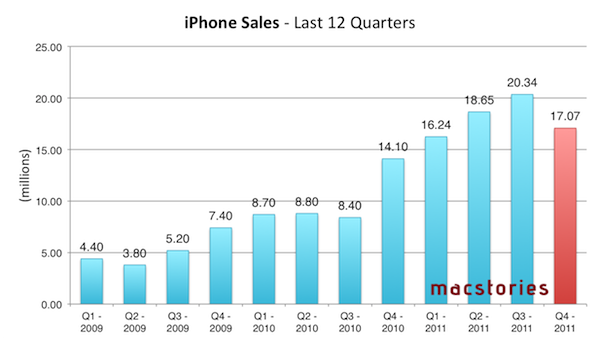
And here’s a graph showing every iPhone quarter to date:

Predictions for Q1 2012 (results will be announced on January 24) now range between 25.2 million and 35.75 million iPhones sold. Either way, it’s going to be a “blow-out quarter” for iPhone sales – even if we consider Apple’s Q3 2011, the biggest ever for iPhone sales to date with 20.34 million units sold.

It’ll be interesting to observe how Asia-Pacific will perform in relation to iPhone sales, too, as Apple reported overall sales more than doubled in Q4 2011. As for Q1 2012 itself, Apple CEO Tim Cook said they were confident to have enough 4S supply to go through the holiday season, and also confirmed the company was expecting record iPhone sales for the quarter with revenue guidance set at $37 billion (Asymco’s Horace Dediu, however, expects revenue to hit $44 billion).


iPad Users Have Downloaded 3 Billion Apps in One Year

Thanks to a rich marketplace, consistently good apps that are featured in the App Store, and the constant attention blogs like ours bring to developers and consumers, the iPad has had its fair share of owners downloading tons of applications. Not only did iPad users download more than 3 billion apps from the App Store since the iPad’s launch in 2010, developers published 120,000 apps specifically for the iPad in the third quarter of 2011. ABI Research notes that iPad downloads are only 19% of all the cumulative downloads by Apple users. With lots of choice and a device that just works, users are eager to try out the latest innovations in touch-based software.

In comparison, Android users have only downloaded 440 million applications. It could be that there simply aren’t as many Android tablets in consumers’ hands as there are iPads, or it could because that developers simply aren’t making apps formatted for the tablet experience like they are on the iPad.

According to Lim Shiyang:

Discounting all those apps that were originally developed for Android smartphones, Android still trails greatly behind the iPad in terms of its tablet app offerings. Many Android tablets in the market are still using older versions of Android, which disadvantages users from enjoying the better effects of apps produced from more advanced software development kits.

As for Android’s phone ecosystem, ABI Research expects Android users to rack up 58 billion app downloads by 2016, compared to only 27 billion by iPhone users.

I wonder how many of these downloads will be because of Angry Birds?

[ABI Research via GigaOM]


Infinity Blade Franchise Exceeds $30 Million in Revenue

Ever since Epic Games introduced Infinity Blade as Project Sword at Apple’s Worldwide Developer’s Conference in 2010, ChAIR Entertainment (subsidiary of Epic Games) has received remarkable attention for promising then delivering a gaming experience that pushes Apple’s latest hardware to its limits. After Infinity Blade was officially titled in November, 2010, and released for the masses a month later, the game sold 274,000 copies in the first five days — $1.6 Million in net revenue is impressive even for a highly anticipated gaming title. A year later, Infinity Blade II has hit the market after another impressive tech demo, earning $5 million in revenue since its December 1st launch. The original Infinity Blade took three months to reach the $5 million marker and has earned Epic Games $23 million to date.

Since the original title launched, the Infinity Blade franchise has earned over $30 Million in revenue. While we know and love Infinity Blade for its intense graphics and fluid gameplay on our iOS devices, Infinity Blade spans the media with an official Infinity Blade: Original Soundtrack, a digital novel by the name of Infinity Blade: Awakening, and the coin operated arcade game Infinity Blade FX.

Infinity Blade and Infinity Blade II are available on the App Store for $5.99 and $6.99 respectively.

[via Joystiq]

You can find the Press Release past the break.

Read more


Google Translate for iOS Updated with iPad Support

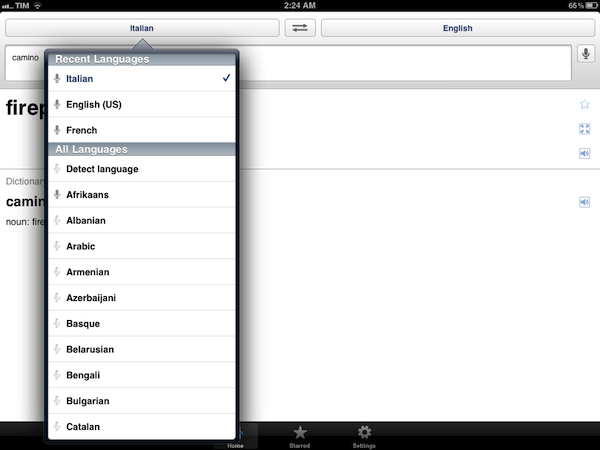
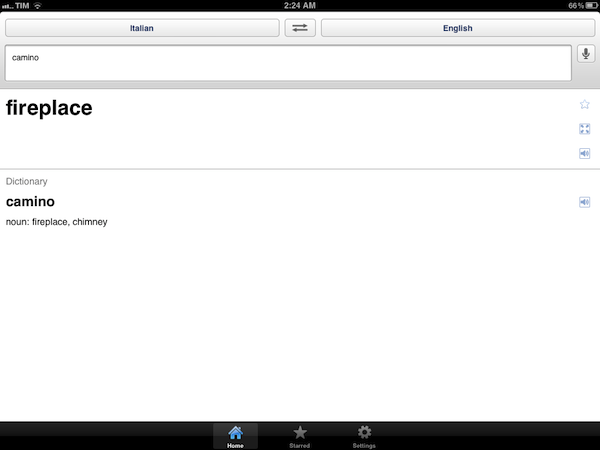
Previously available exclusively for iPhone and iPod touch owners, earlier today Google updated its official Google Translate iOS app to include a native interface for the iPad. The updated Google Translate, available here, heavily resembles its iPhone counterpart with larger interface elements ported to the iPad’s screen – there are three tabs at the bottom to switch between translations, favorite items and Settings, a microphone icon to speak directly into the device’s mic, and you can choose between multiple languages from a popover menu.

Unlike the surprisingly refreshing (for Google’s iOS standards) Google Search app, it appears Google Translate didn’t receive any particular iPad treatment in the conversion process.

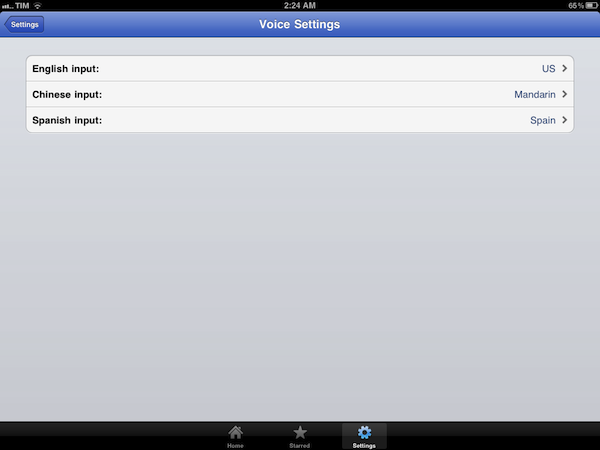
Among the lesser known features of the app, you can specify input for English, Chinese and Spanish languages, display translations in full-screen mode, and tap on results for text-to-speech.

Google Translate 1.3 (changelog simply reads “Added support for iPad”) is available for free on the App Store.


On Comments

There’s been a great discussion around comments and whether blogs should include or exclude them from their sites. A response by MG Siegler to Matt Gemmell has reignited the debate, and Siegler followed up with a thoughtful question that sums up the problem with comments in general.

If you’re saying something that you think is great, why would you want to do it as a comment on another site anyway?

I thought I’d add our own two cents to the discussion and let our readers know what side of the fence we’re on in the most transparent way possible.

When we’re not publishing, we’ve been behind the scenes planning the future of MacStories and we’re beginning to draft the next version of our website. We currently have several holes to patch up — mainly with the header, advertisements, and other loose ends — but one big decision we have to make is whether we should continue to allow comments on our site.

Comments are useful for one singular purpose: they allow readers to voice their opinions inline with the article (I don’t have to find your blog to see your opinion) and writers can quickly contribute to the discussion or defend their validity of ideas if challenged. Comments themselves usually aren’t a problem, and I don’t mind a strongly opinionated individual voicing their opinion as long as they aren’t rude, obnoxious, or unnecessarily double-post. Commenters keep us on our toes and aren’t afraid to call us out when we’ve strayed from the path. We currently have comments open because we like to give readers the option.

Disqus has made it easy for us to moderate comments, but the problem is with managing the amount of spam that gets thrown our way and moderating commenters who clearly don’t read the article and simply leave promotions to external websites that we can’t trust. We value the many opinions that end up on our site, but there’s a lot of noise and disruptive information that sometimes drowns out good feedback. We’re lucky — we don’t receive nearly as many comments as other sites. But take a look at your favorite big tech blogs and skim the comments sometime to notice just how much spam is unmoderated.

Too, maintaining comments means that we even have to look back at tutorials that were written on our site months ago, and respond or moderate comments that either aren’t relevant to today’s discussion or are obsolete thanks to some software update. I’d love to find time to help everyone configure an app or utility for their machine, but if we’re not returning to the comments at later dates, they’re clearly not worth having around — commenting becomes useless for the people who comment if the site’s editors don’t have time to continue following up.

It does upset us when someone simply slaps their hand on the keyboard and creates a fake username just to leave a trivial comment. Not only does “jhfle;af” (I call it Jiffle-Jaff) look ugly and ruin the visual medium, it means that you don’t even have any respect for leaving a thoughtful comment of your own. You don’t even care about how your opinion looks to others. And it’s the worst when that aimlessness is combined with unnecessary “bile.” If you voice your opinion, we at least want readers to abide by some moral or personal standard of an “honor-code” to leave something worth reading.

Comments are also difficult to maintain on the web front. A recent Disqus update broke our commenting style, and we’ve received numerous complaints from humans who’d prefer not to style their paragraphs with Markdown. Disqus itself (while an advantageous tool) is also one of the slower parts of our site behind advertisements, often displaying incorrectly on the iPad. We’re partly to blame for not doing a better job of keeping on top of this stuff, and we’re working hard to strengthen this weakness. Still, it’s a big time suck that prevents us from writing since we’re researching and learning new skills instead (which isn’t necessarily a bad thing!).

There are alternative commenting engines we can use. To solve the Jiffle-Jaff problem, we could use Facebook as one example, or we could even write our own commenting engine. While TechCrunch took a leap of faith in forcing commenters to use their real names in an attempt to avoid the merciless and degrading trolling that was happening on their site, commenters still aren’t afraid to write the “crapple suckz” and “mg is a fanboy” posts that don’t even bother to specifically debate what he or she took issue with. It’s certainly reduced, but comments still aren’t enjoyable to read.

In consideration of the reader, how we want the site to look, and due to the amount of time we can spend keeping an eye of this stuff, we will be removing comments from the next iteration of MacStories. And yes, it’s the nuclear option for keeping the site clean. Removing comments also means that we’re doing an incredible disservice for the readers who’ve already left great comments, and we hate having to remove those from the discussion. Decisions like this are tough because we have to do what’s best for us while minding our reader’s thoughts.

We’ve found that readers are more likely to engage with us on Twitter. If a typo escapes us or someone has something they want to share, our readers are intelligent and seek us out on Twitter to voice their opinions. Many of our readers enjoy engaging with the site’s founder, @viticci, and Twitter gives us a better medium to reply from our laptops, phones, or tablets. We love Twitter and like using that as the commenting medium for @macstoriesnet.

Commenting leaves a lot of baggage that we simply don’t have the time to maintain, and that’s not a good thing for us or our readers. Instead of putting readers in danger by failing to moderate a malicious link, or failing to moderate an offensive opinion, we’re simply going to remove comments and leave commenters the choice of using Twitter or their personal blogs to write informed and well spoken opinions that our comments section doesn’t provide room for. The answer isn’t as simple as, “We don’t like comments.” There are a lot of reasons behind why we’ve reached our decision, and we hope our contribution to the discussion provides an ample explanation for when we eventually remove the feature.

[MG Siegler via Ben Brooks]



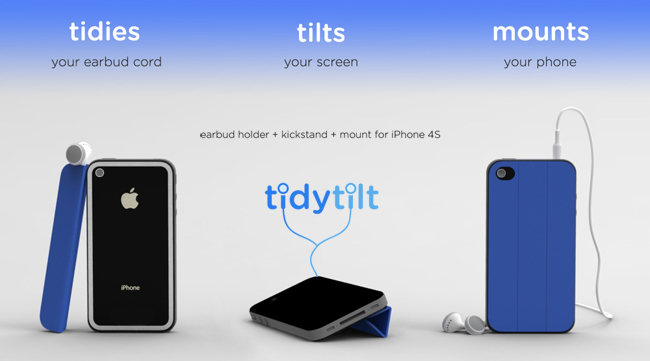
Kickstarter: TidyTilt, a Smart Cover Design with Smart Options for the iPhone

There are more manufacturers and designs for the iPhone than probably any other accessory in the market. Many look nice, others have gimmicks and some are just wrong. The TidyTilt is a new iPhone 4S accessory by Zahra Tashakorinia & Derek Tarnow, 2 students at the IIT Institute of Design in Chicago, that aims to be a unique multi-functional earbud holder, kickstand and mount for the iPhone 4 and 4S.

Video after the break. Read more


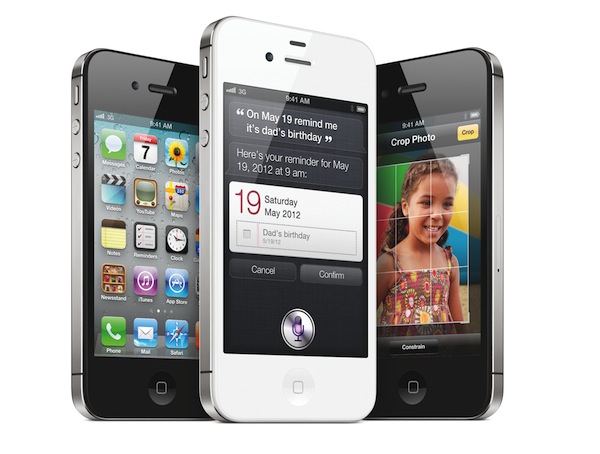
iPhone 4S Launches In China and 21 Additional Countries On January 13

With a press release, Apple announced that its latest iPhone model, the iPhone 4S, will be available in China and 21 additional countries on Friday, January 13. Making it the fastest iPhone rollout to date, the iPhone 4S will be available in over 90 countries by next week; Apple targeted a launch in 70 countries by the end of 2011.

Customer response to our products in China has been off the charts,” said Tim Cook, Apple’s CEO. “With the launch in China next week, iPhone 4S will be available in over 90 countries making this our fastest iPhone rollout ever.

On January 13, the iPhone 4S will become available in: Anguilla, Antigua and Barbuda, Bolivia, Botswana, British Virgin Islands, Cameroon, Cayman Islands, Central African Republic, China, Dominica, Dominican Republic, Ecuador, Grenada, Guam, Guinea Conakry, Ivory Coast, Jamaica, Kenya, Madagascar, Mali, Mauritius, Niger, Senegal, St. Vincent and The Grenadines, Trinidad and Tobago, Turks and Caicos and Uganda.

Since its introduction in October, the iPhone 4S has seen a steady rollout to meet Apple’s expectations of availability in 70 countries by the end of 2011. Just as U.S. carriers were reportedly struggling to meet the 4S’ demand and Apple launched an initiative to reserve a model for in-store pickup, the device launched in Hong Kong and South Korea, several countries in Europe and India. At the same time, Apple began selling unlocked iPhone 4S units in the United States, and confirmed they were “very pleased” with the initial demand for the device.

In October, it was reported the 4S sold 4 million units in its first weekend. Apple hasn’t disclosed new numbers since, but the company is expected to reveal financial results for the past quarter on January 24, where they’ll likely give out new pieces of information regarding the 4S’ performances in different markets. As a side note, Apple’s press release doesn’t include any details on the carrier(s) that will support the 4S in China, which has been an ongoing source of speculation among rumor sites and Apple watchers in the past few months due to China Unicom’s (the country’s second largest carrier) reported interest in the 4S.