Posts in Featured

Clear: An Interview With Impending’s Phill Ryu

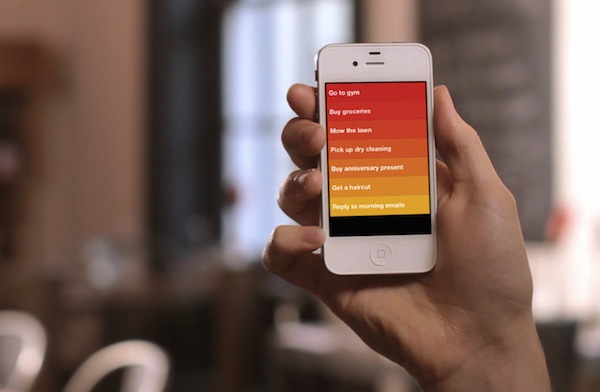
When Phill Ryu (MacHeist team member) emailed me a few days ago to give me a preview of his upcoming iPhone app, Clear, I immediately said “yes” and eagerly started waiting for a TestFlight email to hit my inbox. I know Phill: he has good taste in design, knows that I like great apps, and he’s an overall nice guy that I had gotten to work with multiple times in the past for MacHeist. Phill hinted at the particular nature of the app; yet when the beta came, I felt the kind of surprise and delight in using Clear I hadn’t experienced, I believe, since the original Tweetbot beta. Clear is one of those apps that redefine interaction schemes and navigation patterns: like Tweetie’s “pull-to-refresh” and Tweetbot’s “swipe-to-load” before it, I’m sure Clear’s gestures to move between lists and add new tasks will change the way developers imagine todo list apps.

Clear is a simple todo list app. Without spoiling too much now – you can check out the app’s webpage here, and promo video below – let me just say that the way Clear handles task creation, completion and list management has been uniquely and cleverly built around the iPhone’s screen and the way we can interact with our devices. In fact, I don’t think Clear would be possible on any other platform – when Clear comes out in the next few weeks, you’ll understand why you often hear of things such as “iPhone features the smoothest animations” or “fastest scrolling”. Everything in Clear is delightfully tappable, scrollable, responsive to your fingers with visual cues and sound effects. Yet it’s so simple. I’ll leave my thoughts about the app for a proper review.

What’s also intriguing about Clear, interface aside, is the team behind it. Take a look at the studio’s page: those who have been around long enough in the Apple Community will instantly recognize names like David Lanham and Dan Counsell; Impending’s webpage also reveals Ted Bradley, Jay Meistrich, Raphael Mun, Jeremy Grosser and Josh Mobley worked on Impending’s debut. Clear itself was co-created by Phill Ryu, Dan Counsell and Milen Dzhumerov. That was enough to trigger my curiosity radar, and ask Phill to sit down for a (virtual) coffee to discuss Impending and Clear.

Check out my interview with Phill Ryu and Clear’s promo video after the break. Read more

Access Extra Content and Perks

Founded in 2015, Club MacStories has delivered exclusive content every week for nearly a decade.

What started with weekly and monthly email newsletters has blossomed into a family of memberships designed for every MacStories fan.

Learn more here and from our Club FAQs.

Club MacStories: Weekly and monthly newsletters via email and the web that are brimming with apps, tips, automation workflows, longform writing, early access to the MacStories Unwind podcast, periodic giveaways, and more;

Club MacStories+: Everything that Club MacStories offers, plus an active Discord community, advanced search and custom RSS features for exploring the Club’s entire back catalog, bonus columns, and dozens of app discounts;

Club Premier: All of the above and AppStories+, an extended version of our flagship podcast that’s delivered early, ad-free, and in high-bitrate audio.

Learn more here and from our Club FAQs.


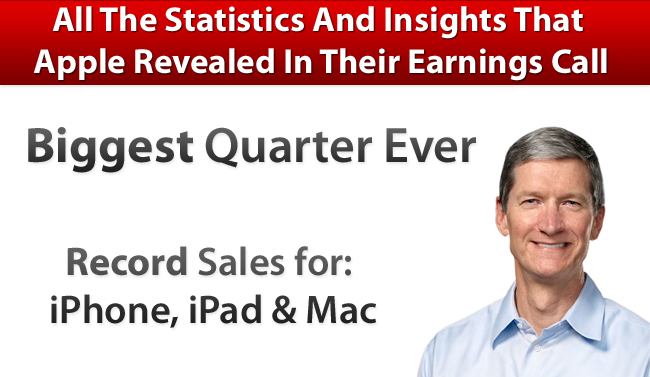
All The Statistics And Insights That Apple Revealed In Their Earnings Call

A few hours ago Apple released its Q1 2012 financial results and it saw Apple post its biggest quarter ever with revenue of $46.33 billion and see record sales of its Mac, iPhone and iPad product lines. We covered all the results in our Q1 2012 Results article earlier today so be sure to head over there if you haven’t already - it also includes a number of graphs that demonstrates Apple’s performance over the past 12 quarters and it paints a fascinating picture.

However, the earnings call itself is an interesting one hour, with Tim Cook (CEO) and Peter Oppenheimer (CFO) also answering a number of questions from select investors and analysts. In this Q&A section, a number of details are revealed - including additional statistics. We’ve re-listened to the call and have compiled the following post that highlights the more interesting aspects of this Q&A section and it is all below the break.

Further Reading:

MacStories: Apple Q1 2012 Results

MacStories: “Our Next Big Insight”

MacStories: More iPhones Than Babies Born Every Day

Apple’s Q1 FY12 Earnings Press Release

Audio Webcast of the Earnings Call

SeekingAlpha: Transcript of the Earnings Call

ReadWriteWeb: Apple’s Growth Rate Is Simply Incredible… And It’s Accelerating

Macworld: This is Tim: Apple’s CEO in his own words

Read more

Access Extra Content and Perks

Founded in 2015, Club MacStories has delivered exclusive content every week for nearly a decade.

What started with weekly and monthly email newsletters has blossomed into a family of memberships designed for every MacStories fan.

Learn more here and from our Club FAQs.

Club MacStories: Weekly and monthly newsletters via email and the web that are brimming with apps, tips, automation workflows, longform writing, early access to the MacStories Unwind podcast, periodic giveaways, and more;

Club MacStories+: Everything that Club MacStories offers, plus an active Discord community, advanced search and custom RSS features for exploring the Club’s entire back catalog, bonus columns, and dozens of app discounts;

Club Premier: All of the above and AppStories+, an extended version of our flagship podcast that’s delivered early, ad-free, and in high-bitrate audio.

Learn more here and from our Club FAQs.


“Our Next Big Insight”

From my iCloud overview in October, titled iCloud: The Future of Apple’s Ecosystem:

The problem Apple had to face in the past four years is that for millions of people iPhones and iPads have become substitutes to the PC. Over a third of iTunes Store content is now purchased on iOS devices, Apple’s Eddy Cue said at the Let’s talk iPhone media event last week. What started and was celebrated as the hub of the digital revolution became a burden for Apple as millions of customers began using iOS devices as their main devices. Apple was once again faced with a challenge: if people no longer want to use the hub and accept the trade-offs required to manage our digital lifestyle, where’s the new hub? And how will content be distributed in the ecosystem if there’s no visible hub to start with?

[…]

iCloud changes the way we interact with our devices. Ten years after the digital hub revolution led by the Mac and iPod, Apple’s ecosystem has evolved and turned into a variegate selection of notebooks, desktop computers, iPhones, iPods and iPads. iCloud goes beyond the simple function of a new digital hub: iCloud, built into iOS 5 and Lion, is the new soul of Apple’s hardware that unifies music, videos, photos, apps, books and documents. iCloud is a huge change for Apple’s ecosystem not just because of its new technology — it’s a new software paradigm that will deeply affect Apple’s devices and how we work with them in the next years. Ten years from now, when it’ll likely be time for another digital revolution, we’ll look back at 2011 and iCloud’s launch.

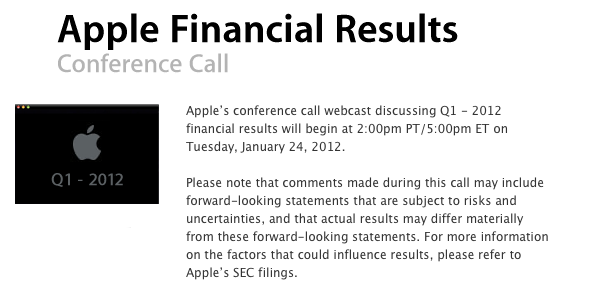
During today’s earnings call – in case you missed it, Apple today reported its biggest quarter to date – CEO Tim Cook seemed to agree with this vision. He said that ”iCloud is more than a product, it’s a strategy for the next decade.”

What strikes me as remarkable about this statement isn’t the simplicity of the message alone, it’s how well it plays with Steve Jobs’ original Digital Hub strategy in retrospect. The way I see it, today’s comments from Cook about iCloud declared the historic Digital Hub officially dead, yet sounded amusingly familiar at the same time. That Apple is a product company that also happens to do business with services isn’t new – but listening to Tim Cook and Peter Oppenheimer discussing the results, the future projections, the customer feedback and overall strategy in a single conference call is enlightening in a way it provides insight into Apple’s core values. Products matter, but what customers expect to find around a product is equally important – the ecosystem matters. Every recent move from Apple can be seen as part of the iCloud big picture: the 4S with an amazing camera that shoots photos that are backed up online; iTunes Match and its cloud-based music library; content deals for Apple TV; iBookstore and Textbooks that are backed up to your iCloud account. And when you think about it with today’s numbers in mind, it all starts to make sense not just from a conceptual standpoint, but from a business perspective as well.

Apple customers are willing to pay for a superior user experience through a solid ecosystem. And Apple is betting on that.

The “strategy for the next decade” that we’re covering today is what, I believe, the majority of users will see as the operating system in 10 years. And if you need a quick recap as to why Apple moved on from the Digital Hub, let Steve remind you.

“We’ve got a great solution for this problem. And we think this solution is our next big insight. Which is we’re going to demote the PC and the Mac to just be a device. Just like an iPhone, an iPad, or an iPod touch. And we’re going to move the Digital Hub – the center of your digital life – into the cloud.”

Access Extra Content and Perks

Founded in 2015, Club MacStories has delivered exclusive content every week for nearly a decade.

What started with weekly and monthly email newsletters has blossomed into a family of memberships designed for every MacStories fan.

Learn more here and from our Club FAQs.

Club MacStories: Weekly and monthly newsletters via email and the web that are brimming with apps, tips, automation workflows, longform writing, early access to the MacStories Unwind podcast, periodic giveaways, and more;

Club MacStories+: Everything that Club MacStories offers, plus an active Discord community, advanced search and custom RSS features for exploring the Club’s entire back catalog, bonus columns, and dozens of app discounts;

Club Premier: All of the above and AppStories+, an extended version of our flagship podcast that’s delivered early, ad-free, and in high-bitrate audio.

Learn more here and from our Club FAQs.


Apple Q1 2012 Results: $46.33 Billion Revenue, 37.04 Million iPhones, 15.43 Million iPads Sold

Apple has just posted their Q1 2012 financial results. The company posted record-breaking revenue of $46.33 billion, with 15.43 million iPads, 37.04 million iPhones and 5.2 million Macs sold. Apple sold 15.4 million iPods, a 21 percent unit decline from the year-ago quarter. The company posted quarterly net profit of $13.06 billion, or $13.87 per diluted share. iPhone represented a 128 percent unit growth over the year-ago quarter, while iPad reported a 111 percent unit increase over the year-ago quarter.

We’re thrilled with our outstanding results and record-breaking sales of iPhones, iPads and Macs,” said Tim Cook, Apple’s CEO. “Apple’s momentum is incredibly strong, and we have some amazing new products in the pipeline.”

“We are very happy to have generated over $17.5 billion in cash flow from operations during the December quarter,” said Peter Oppenheimer, Apple’s CFO. “Looking ahead to the second fiscal quarter of 2012, which will span 13 weeks, we expect revenue of about $32.5 billion and we expect diluted earnings per share of about $8.50.

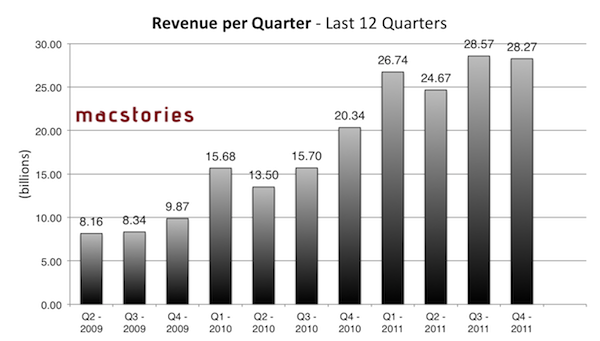
This is Apple’s best quarter ever. Until today, Apple’s most profitable quarter had been Q3 2011 with $28.57 billion revenue.

Estimates and Previous Quarters

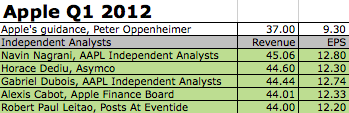
Wall Street consensus’ estimate was earnings of $10.08 per share and revenue of $38.85 billion; six institutional/independent analysts polled by Fortune expected earnings per share of $11.57 and $41.87 billion revenue. In Q4 2011, Apple said they expected revenue of about $37 billion and diluted earnings per share of around $9.30 in the first fiscal quarter of 2012.

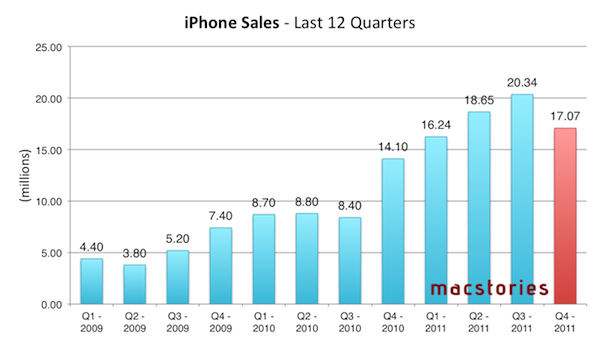
In Q4 2011, Apple posted revenue of $28.27 billion, with 11.12 million iPads, 17.07 million iPhones and 4.89 million Macs sold. The company posted quarterly net profit of $6.62 billion, or $7.05 per diluted share. iPhone represented a 21 percent unit growth over the year-ago quarter; iPod sales were down 27 percent from the year-ago quarter, and Apple reported the best iPad quarter to date with over 11 million units sold and a 166% increase over the year-ago quarter. In the year-go quarter, Apple posted revenue of $26.74 billion with 7.33 million iPads, 16.24 million iPhones and 4.13 million Macs sold.

Apple will provide a live audio feed of its Q1 2012 conference call at 2:00 PM Pacific, and we’ll update this story with the conference highlights. You can find the full press release and a graphical visualization of Apple’s Q1 2012 after the break. A recap of estimates and product releases happened during the quarter is available here. Read more

Access Extra Content and Perks

Founded in 2015, Club MacStories has delivered exclusive content every week for nearly a decade.

What started with weekly and monthly email newsletters has blossomed into a family of memberships designed for every MacStories fan.

Learn more here and from our Club FAQs.

Club MacStories: Weekly and monthly newsletters via email and the web that are brimming with apps, tips, automation workflows, longform writing, early access to the MacStories Unwind podcast, periodic giveaways, and more;

Club MacStories+: Everything that Club MacStories offers, plus an active Discord community, advanced search and custom RSS features for exploring the Club’s entire back catalog, bonus columns, and dozens of app discounts;

Club Premier: All of the above and AppStories+, an extended version of our flagship podcast that’s delivered early, ad-free, and in high-bitrate audio.

Learn more here and from our Club FAQs.


Apple’s Q1 2012: Quarter Recap and Estimates

At 2 PM PT, Apple is set to announce its financial results for the quarter that ended on December 24th, 2011. According to several analysts polled in the past weeks and Apple’s own guidance for the quarter, Q1 2012 is on track to become Apple’s biggest quarter to date both in terms of sales (with expected record iPhone and iPad sales) and revenue. Until today, Apple’s most profitable quarter has been Q3 2011 with $28.57 billion revenue. Below, we’ve compiled a breakdown of Q1 2012 estimates with a recap of what happened during the quarter.

Estimates and Previous Quarters

During last quarter’s earnings call, Apple said they were expecting $37 billion in revenue and diluted earnings per share of around $9.30 for this quarter. As Apple’s guidance for future quarters is historically low and conservative, the already high projection of $37 billion led bloggers to speculate Apple’s Q1 2012 would be a blowout quarter; some analysts, on the other hand, usually don’t pay attention to Apple’s guidance as the company lowballs expectations for the upcoming quarter.

Analysts and bloggers polled in the past few weeks had different takes on what Apple will report later today. Some of them, such as Robert Paul Leitao, Horace Dediu and Navin Nagrani projected revenue above $44 billion with iPhone sales of 34-35 million units and iPad sales in the range of 13 million units; as we reported three weeks ago, Asymco’s Horace Diedu estimates that Apple will report earnings of $12.3 on revenues of $44.6 billion, with the street price aiming at $9.75 EPS on $37.99 billion. As Philip Elmer-Dewitt also noted, analysts’ estimates need to be taken carefully, as several of them were released after the previous quarter’s results, and were never updated reflecting changes that took place through the quarter (such as fluctuating iPhone demand and international product launches).

Fortune’s comprehensive list of estimates for Q1 2012 is available here.

As far as iPhone sales are concerned (in Q4 2011, the device accounted for 47% of Apple’s revenue), this quarter will see Apple finally providing some actual insight into the iPhone 4S’ performance on the market. The device is well-regarded as a success on various international markets and the United States, but the only real numbers Apple posted referred to the opening weekend. Predictions for Q1 2012 go as high as 35 million units sold (those would indicate cumulative sales for iPhone 4, 4S and 3GS, not just the iPhone 4S), with an approximate figure of 30 million units sold being shared the majority of analysts and bloggers.

According to Nielsen, the launch of the iPhone 4S had an “enormous impact” on smartphone owners:

Among recent acquirers, meaning those who said they got a new device within the past three months, 44.5 percent of those surveyed in December said they chose an iPhone, compared to just 25.1 percent in October. Furthermore, 57 percent of new iPhone owners surveyed in December said they got an iPhone 4S.

This morning, Verizon Wireless reported 4.2 million iPhone activations. Reuters wrote Verizon’s ”business was hit by the high costs of sales of advanced phones such as the Apple Inc iPhone.”


In Q4 2011, Apple posted revenue of $28.27 billion, with 11.12 million iPads, 17.07 million iPhones and 4.89 million Macs sold. The company posted quarterly net profit of $6.62 billion, or $7.05 per diluted share. iPhone represented a 21 percent unit growth over the year-ago quarter; iPod sales were down 27 percent from the year-ago quarter, and Apple reported the best iPad quarter to date with over 11 million units sold and a 166% increase over the year-ago quarter. In the year-go quarter, Apple posted revenue of $26.74 billion with 7.33 million iPads, 16.24 million iPhones and 4.13 million Macs sold. Read more

Access Extra Content and Perks

Founded in 2015, Club MacStories has delivered exclusive content every week for nearly a decade.

What started with weekly and monthly email newsletters has blossomed into a family of memberships designed for every MacStories fan.

Learn more here and from our Club FAQs.

Club MacStories: Weekly and monthly newsletters via email and the web that are brimming with apps, tips, automation workflows, longform writing, early access to the MacStories Unwind podcast, periodic giveaways, and more;

Club MacStories+: Everything that Club MacStories offers, plus an active Discord community, advanced search and custom RSS features for exploring the Club’s entire back catalog, bonus columns, and dozens of app discounts;

Club Premier: All of the above and AppStories+, an extended version of our flagship podcast that’s delivered early, ad-free, and in high-bitrate audio.

Learn more here and from our Club FAQs.


Review: Logitech Tablet Keyboard for iPad

As I mentioned in my post about new apps and tools for 2012, I’ve been playing around with a Logitech Tablet Keyboard for iPad, which is available at $69 through Logitech’s website or $59 on Amazon. The Tablet Keyboard connects to the iPad (or any iOS device) wirelessly over Bluetooth, comes with built-in batteries, a carrying case that can be turned into a stand for the iPad, and media keys that trigger some of the tablet’s functions such as audio controls and Spotlight. Here are my impressions so far.

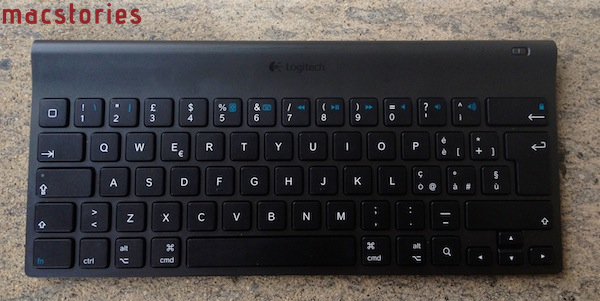
Normally, I wouldn’t have much to say about a keyboard except for “it’s comfortable” or “I can’t type anything on this”. Fortunately, the Logitech keyboard for iPad fits into the former category, with a sturdy plastic design that feels “premium” when compared to other keyboards available on the market, a good keyboard layout, and a carrying case that’s not as premium as the device but certainly gets its job done. Below, the Italian layout of my Logitech Tablet Keyboard:

As you can see, the keyboard isn’t necessarily “standard” as it’s been designed to include iOS-specific keys like shortcuts for Spotlight search, Home button, volume controls, slideshows, media playback and screen lock/unlock controls. The basic layout is the one of a Mac keyboard, and the function keys can be activated by holding fn. Obviously, this isn’t as intuitive as simply reaching out to the screen with your finger to adjust volume, but if you’re going to work with your iPad using the keyboard, you’ll want to know it’s possible to do more than just type.

Which brings me to this: why would you want a physical keyboard for your iPad when the system one is more than acceptable? I don’t know about you, but I’ve been working mainly from my iPad in the past month, and I found a physical keyboard to be a must-have if you’re serious about getting real, regular writing done in a text editor or word processor. iOS’ multitouch keyboard is fine to fire off quick email replies and tweets (and iOS 5’s new split keyboard helps a lot for “general typing” in every day usage), but I still can’t give up on the allure of plastic QWERTY for long-form content and serious email time. Logitech’s iPad offering fits nicely in my workflow (and Tom Bihn Ristretto Bag): I can get it out of its case, turn it on, wait a few seconds for the iPad to connect (once paired, the Bluetooth connection process is very fast on iPad 2) and start writing. Read more

Access Extra Content and Perks

Founded in 2015, Club MacStories has delivered exclusive content every week for nearly a decade.

What started with weekly and monthly email newsletters has blossomed into a family of memberships designed for every MacStories fan.

Learn more here and from our Club FAQs.

Club MacStories: Weekly and monthly newsletters via email and the web that are brimming with apps, tips, automation workflows, longform writing, early access to the MacStories Unwind podcast, periodic giveaways, and more;

Club MacStories+: Everything that Club MacStories offers, plus an active Discord community, advanced search and custom RSS features for exploring the Club’s entire back catalog, bonus columns, and dozens of app discounts;

Club Premier: All of the above and AppStories+, an extended version of our flagship podcast that’s delivered early, ad-free, and in high-bitrate audio.

Learn more here and from our Club FAQs.


MacStories Reading List: January 15 - January 22

At MacStories, we strive to produce great content every day. From news to stories and app reviews, we care about quality content to deliver to you, our readers, with insight and our personal analysis every day. But we can’t cover everything. And there’s some great writing on the Internet that we often can’t link to in our daily coverage, if only because there isn’t much we can add to an already excellent article.

Today we are introducing MacStories Reading List, a weekly selection of great stories from Authors that you should read. Every Sunday, we’ll publish a collection of links that we think you should read, such as the ones below. A very simple format for the great writing that is happening in the Apple community.

Even better, you can subscribe to the Reading List in your favorite RSS reader or Instapaper. We have created an Instapaper account dedicated to the Reading List, so head over this link to get the Instapaper feed for the links we’ll post here every week. You’ll also be able to able to find us in Instapaper if you’re already following @macstoriesnet and linked the service to your Twitter account.

On behalf of the entire MacStories team, I wish you a good reading. - Federico Viticci

World of Apple’s Alex Brooks reflects on his past few years of blogging, and ultimately decides that quality content, not the page views alone, is what matters. A must-read.

The site I want to read and will produce will post thoughtful commentary on Apple. The kind of commentary and prose that that’s sensible, articulate and adds value to a wider discussion happening across the internet. There are already a handful of sites just like this, authors who have in some cases taken grave risk to quit their day to day lives to produce content just like this. I value those sites, I enjoy reading their content.

Reflecting on Change, Alex Brooks (@alexbrooks)

Every month or so an analyst comes out and claims the iPad can’t be included in the same market share numbers of PCs, and vice versa. Asymco’s Horace Dediu collects actual numbers and puts things in perspective, revealing the true effect Android and iOS devices are having on the PC market.

This last view corresponds to the data in the first graph (line chart). If iOS and Android are added as potential substitutions for personal computing, the share of PCs suddenly collapses to less than 50%. It also suggests much more collapse to come.

How has the App Store third-party ecosystem evolved in the past four years? Is there still much of a difference between smaller developers who actually want to charge for their apps, and bigger studios that have adopted the “freemium” or in-app advertising models? App Cubby’s David Barnard has an insightful article from an indie developer’s perspective that’s worth reading and reflecting upon.

Ultimately, the users become the product, not the app. Selling users to advertisers and pushing in-app upgrades/consumables is a completely different game than carefully crafting apps to maximize user value/entertainment. It’d be a shame if the mobile software industry devolved into some horrific hybrid of Zynga and Facebook.

Free and Low-Cost Apps, David Barnard (@drbarnard)

Wandering Coder’s Pierre Lebeaupin makes an excellent case for iOS needing some sort of file management system at this point. You can disagree with him, but it’s undeniable the majority of users who want to use iPhones and iPads in a professional environment are still working with documents, and iOS doesn’t offer a native, integrated way for easily managing and searching them.

Let us contrast that with another situation. My father is a high school teacher; for the last 20+ years he has been working using computers, preparing teaching notes, transparent slides to project, diagrams, tests and their answers, student average note calculation documents, etc. on his Macs (and before that on an Apple ][e). He shares some of these with his colleagues (and back) and sometimes prints on school printers so it’s not like he is working in complete isolation, but he cannot rely on a supporting infrastructure and has to ensure and organize storage of these teaching material documents himself. He will often need to update these when it’s time to teach the same subject one year later, because the test needs to be changed so that it’s not the exact same as last year, because the curriculum is changing this year, because the actual class experience of using them the previous year led him to think of improvements to make the explanation clearer, because this year he’s teaching a class with a different option so they have less hours of his course (but the same curriculum…), etc. Can you imagine him using solely an iPad, or even solely an imaginary iOS 5 notebook, to do so? I can’t.

An amazingly detailed and in-depth overview of the iOS gaming scene with a series of post-mortems and sales figures for “blockbuster” and smaller iOS games. If you only read one article about mobile gaming this week, make it this one.

Eighteen months ago, when I left Ubisoft to start an independent game studio and focus on making my own games, I looked online a bit to get an idea of how much income I could expect to make as an indie. At Ubisoft I used to work on big AAA console games, and I had some figures in mind, but I knew they wouldn’t be relevant for my new life: $20M budgets, teams of 200 hundred people, 3 million sales at $70 per unit… I knew being an indie developer would be completely different, but I had very little information about how different it would be.

Angry Birds had taken off, Plants vs. Zombies was already a model, Doodle Jump was a good example of success, and soon after I started my “indie” life, Cut the Rope was selling a million copies a week. But except for what I call the “jackpots,” there were very few public stories or numbers on the web, and this meant we were a bit in the dark when we started SQUIDS. I have been tracking figures since then, and I’m writing this article to share what I’ve learned with my fellow indie dev buddies who might be in the same position I was, a year and a half ago.

Dov Frankel explains how the iPhone’s mute switch and audio controls really work.

On the last episode of The Talk Show, Gruber and Dan Benjamin discussed the design tradeoffs at length. During the discussion, they mentioned that you can set the iPad’s volume level to 0, but you can’t with the volume buttons on the iPhone. I understand the difference, and it’s something it took me a little while to figure out, way back in the early days of the first-generation iPhone.

Last week, Apple unveiled its iBooks Textbooks project as the result of deals with major US publishers that have agreed to release digital versions of their textbooks in a new iBooks format. Brian Lam has an interesting interview with former Apple intern Joseph Peters, who might have fueled Apple’s interest in textbooks back in 2008.

In 2008, Apple had its iContest in its Town Hall building. The iContest is sort of an American Idol for great ideas that gives interns a chance to present their best thoughts to executives. Here, Joseph Peters and some friends outlined the idea of bringing Textbooks to iTunes, before the iPad even existed to the rest of us. They won a set of Macbook Airs for their idea.

Much has been said and written about Apple’s decision to make iBooks Author a proprietary file format that only allows for selling eBooks into the iBookstore. Daring Fireball’s John Gruber looks at the “issue” from Apple’s perspective.

Glazman looks at these new iBooks books and sees a nonstandard proprietary format. Apple looks at these new iBooks and sees layouts and design features that no other e-book platform offers today. One man’s nonstandard is another man’s competitive differentiation.

Egg Freckles’ Thomas Brand looks back at Apple’s platform history and how the company has built its success on directly controlling the user experience in every possible way, from content sources to delivering software to the end user.

The iPhone may have been destined to become the world’s most popular smartphone due to the amazing multitouch technology it introduced, but Apple’s control over the iOS operating system, Xcode developer environment, and App Store distribution model have made the iPhone the central member of a new application ecosystem that can’t be beat.

Yesterday’s introduction of iBooks 2 and iBooks Author were significant announcements because they complete the platform pyramid Apple needs to enter the Textbook Market with the same control as its previous successes.

Macworld’s Serenity Caldwell follows up on Apple’s iBooks Author announcements and notes how authors welcome Apple’s entry in the digital publishing industry, but are still looking forward to a broader ePub-compatible publishing tool with advanced features, a polished interface, and Apple’s refined user experience.

It’s crazy that we have so few options after five years: The ebooks market is clearly making money. If Apple’s release of an authoring tool has shown anything, it’s that the demand is certainly out there. The publishing industry needs a Dreamweaver or Hype-type ePub application—one that won’t be limited by EULAs, or insistent on proprietary formats.

I’ve already written a wish-list for my perfect app; had I the talent, the skills, and the time to build it, I’d be half-tempted to try coding it myself. Silly, of course, but when it comes down to it, I just want to be able to make awesome ebooks. It shouldn’t take two weeks and six programs to create a book with images and interactive content.

Fraser Speirs, who knows a thing or two about iPad in schools, thinks that textbooks aren’t necessarily the future, but a way to get there.

Apple already revolutionized education when it invented the iPad. While iBooks textbooks are a bridge from the past to the future—and we do need a way to get to the future—they are not that future. If Henry Ford had been an educational publisher, his customers would have asked for electronic textbooks instead of faster horses.

How does Apple’s iBooks Textbooks initiative look from a teacher’s perspective? Kieran Healy’s post on the subject is insightful and detailed.

Apple’s proposed model would kill the used market, dead. The presentation emphasized that once you buy a book you always own it, and you can download it to any new devices you buy. But a corollary is that once you’re done with the book you can’t give or sell it to anyone else. So, at least initially, publishers can charge much less for their textbooks and make it up on volume. That’s fine by me if students end up paying less, though I immediately wonder whether the next step would be for publishers to modularize the books. Instead of your one giant Bio or Calc or Econ book for $14.99 rather than $129.99, you can have various shorter books available for the same price, but have to buy all of them over the course of a year or semester—like 19th century serial novels. This would likely be pitched to faculty as allowing for greater flexibility in curriculum construction, but again it’s the students who end up paying for the books.

Access Extra Content and Perks

Founded in 2015, Club MacStories has delivered exclusive content every week for nearly a decade.

What started with weekly and monthly email newsletters has blossomed into a family of memberships designed for every MacStories fan.

Learn more here and from our Club FAQs.

Club MacStories: Weekly and monthly newsletters via email and the web that are brimming with apps, tips, automation workflows, longform writing, early access to the MacStories Unwind podcast, periodic giveaways, and more;

Club MacStories+: Everything that Club MacStories offers, plus an active Discord community, advanced search and custom RSS features for exploring the Club’s entire back catalog, bonus columns, and dozens of app discounts;

Club Premier: All of the above and AppStories+, an extended version of our flagship podcast that’s delivered early, ad-free, and in high-bitrate audio.

Learn more here and from our Club FAQs.


#MacStoriesDeals - Friday

Here are today’s @MacStoriesDeals on iOS, Mac, and Mac App Store apps that are on sale for a limited time, so get them before they end!

Read more

Access Extra Content and Perks

Founded in 2015, Club MacStories has delivered exclusive content every week for nearly a decade.

What started with weekly and monthly email newsletters has blossomed into a family of memberships designed for every MacStories fan.

Learn more here and from our Club FAQs.

Club MacStories: Weekly and monthly newsletters via email and the web that are brimming with apps, tips, automation workflows, longform writing, early access to the MacStories Unwind podcast, periodic giveaways, and more;

Club MacStories+: Everything that Club MacStories offers, plus an active Discord community, advanced search and custom RSS features for exploring the Club’s entire back catalog, bonus columns, and dozens of app discounts;

Club Premier: All of the above and AppStories+, an extended version of our flagship podcast that’s delivered early, ad-free, and in high-bitrate audio.

Learn more here and from our Club FAQs.


iBooks Author From Apple’s Perspective

In following the interesting debate that has arisen with the release of iBooks 2.0, iBooks Author for Mac and a EULA that doesn’t allow authors to sell iBooks outside of the iBookstore, I’ve seen two kind of reactions: it’s either a draconian move or the “obvious choice” for Apple. I think the reasoning for Apple to release iBooks Author 1.0 today lies somewhere in the middle, so I’m trying to analyze this story from Apple’s perspective, if possible.

Earlier today I tweeted:

John Gruber posted similar thoughts on Daring Fireball:

Second, it’s about not wanting iBooks Author to serve as an authoring tool for competing bookstores like Amazon’s or Google’s. The output of iBooks Author is, as far as I can tell, HTML5 — pretty much ePub 3 with whatever nonstandard liberties Apple saw fit to take in order to achieve the results they wanted. It’s not a standard format in the sense of following a spec from a standards body like the W3C, but it’s just HTML5 rendered by WebKit — not a binary blob tied to iOS or Cocoa. It may not be easy, but I don’t think it would be that much work for anyone else with an ePub reader that’s based on WebKit to add support for these iBooks textbooks. Apple is saying, “Fuck that, unless you’re giving it away for free.

To recap: iBooks created with iBooks Author can be given away for free or sold through the iBookstore, where Apple takes a 30% cut. iBooks created with iBooks Author cannot be sold outside the iBookstore, as stated in the iBooks Author EULA

Now let’s consider the complicated scenario Apple must have faced when deciding as to whether iBooks Author 1.0 should have been a broader authoring tool, or a desktop editing suite for the iBookstore. Many devices nowadays are capable of displaying eBooks: smartphones, computers, tablets. There are several participants in the eBook race with the biggest player being Amazon, followed, I guess, by Apple with the iPad/iBookstore and many others including Barnes & Noble, Google, and so forth. eBooks are variegate: there are many file formats, different distribution networks with their own licenses and terms, different desktop editing programs that comply to a few standards, the most popular one being EPUB, which Apple also accepts for iBooks and the iBookstore. Apple is not alone in the eBook market.

Apple, however, doesn’t make much revenue off Internet services and the various Stores it operates. It’s a known fact iTunes and the App Store have been a break-even operation for many years, with the main goal of providing content and not making a serious profit. I assume the numbers for the iBookstore fall in line with iTunes and the App Store – Apple doesn’t make much money out of iBooks, nor did they ever plan to base their business on it. But: iBooks, apps and media are ways to get people to buy iOS hardware, which is where Apple makes money. Apple is a hardware company that produces fine software that helps them sell a lot of hardware. The iBookstore is, ultimately, a way for Apple to tell people that an amazing eBook reading experience is possible on iOS devices. iBooks is a brand that Apple should care to protect and maintain because it is associated with its main source of revenue – the hardware. Other companies, too, seem to understand that software and content drive hardware sales.

Because iBooks is Apple’s brand and platform now, Apple obviously wants to have some kind of control on the whole experience and distribution. And this is where things start to get tricky. On the App Store, apps have technical limitations that force them to go through the approval process before a user can install them. You can’t install apps in any other way, unless you’re willing to hack into your device’s operating system. Apps are made with Xcode and sold by developers enrolled in the iOS Developer Program. The setup is fairly similar with the iBookstore: iBooks are created in iBooks Author by writers/editors enrolled in the program, sold in the iBookstore so a user can download them. But there’s a big difference: we learn today that iBooks can be distributed for free elsewhere. This is not possible for iOS apps, and this is the reason I believe today’s announcement has been so controversial.

The problem, I think, is that allowing iBooks to be distributed for free anywhere but forcing authors to sell them only through Apple is seen as a pretentious move from a company that many were expecting to announce a grand plan to save the publishing industry today. It’s the sort of gray area that’s open to discussion and generally causes the sort of debates we’ve seen on the Internet. But, in fact, it is a move from a company that wants to make money: if you were to run a business you know it’s going to break even, giving away a great desktop application that costed thousands of dollars in research and development knowing that you’ll have to maintain it for years to come, wouldn’t you want to have products in your own Store and at least ask for a 30% cut?

Others say the main issue is not with the 30% cut itself – we’re used to it now – it’s with the requirement of having paid editions of iBooks only in the iBookstore. It’s not like it’s technically impossible to sell them elsewhere, right? It’s not like apps – and that is correct. In theory, Apple could allow .ibooks files to become just another file format that you can distribute digitally online, and even sell it for a price as several designers do, for instance, with .psd files. But the problem lies deeper, not in the revenue cut but in the locking-in philosophy that is leading some people to believe this is akin to banning free speech. So let’s look at this from a more conceptual standpoint.

I mentioned above iBooks is a brand that is functional to Apple’s primary way of making money. Imagine this: if Apple were to allow distribution of paid eBooks anywhere, nothing could stop an author from selling it on other channels – I’d say Google and Amazon but let’s assume “his website” for now. What would stop this author from selling his iBook at a lower price on his website, and at a 30% more on the iBookstore to make up for Apple’s cut? And now with the second scenario: imagine Google rolling out support for .ibooks files in the eBookstore. Why would Apple want Google, of all companies, to get to brag about .ibooks? And even if it’s not about the .ibooks published format (of limited use outside of iBooks 2.0), why wouldn’t Apple require a small kickback for the result of a desktop program they gave you for free?

Keeping a brand, lock-in, revenue cut: it’s all part of a bigger plan, which is selling hardware people want because of the experience it provides. This experience is provided by content. Again, ecosystem.

So, in a way, iBooks aren’t too different from apps. I could even argue that in Apple’s vision, everything that goes through iTunes has some sort of exclusivity attached to it. Yes, even music and movies: iTunes Extras and LPs aren’t as popular as apps and books, but they’re an example of the integrated media/platform experience that Apple sells.

From my perspective, of course I would have been more excited to see a broader authoring tool announced today with no licensing terms for paid eBooks and full EPUB support. But as I’ve stated in a Twitter conversation with Jason Snell, this is a 1.0 version of a tool that was clearly meant for textbook publishers, and released today for other authors as well. What I could really argue is that it’s not like Apple doesn’t have the resources to come up with a full-featured authoring tool on Day One, and it would have been much better to appeal to all kinds of authors and audiences starting today with a great format and a great app. But: not all apps are perfect on day one. Not even Apple’s. Political speculation aside, I wouldn’t be surprised to know they had to get this out of the door today in preparation of the big iPad 3 launch. We’ll never know why iBooks Author was released today and not in two months with more features, but we know that Apple is a company that in the past months hasn’t been afraid of reversing a couple of unpopular decisions.

As usual, we wait.

Access Extra Content and Perks

Founded in 2015, Club MacStories has delivered exclusive content every week for nearly a decade.

What started with weekly and monthly email newsletters has blossomed into a family of memberships designed for every MacStories fan.

Learn more here and from our Club FAQs.

Club MacStories: Weekly and monthly newsletters via email and the web that are brimming with apps, tips, automation workflows, longform writing, early access to the MacStories Unwind podcast, periodic giveaways, and more;

Club MacStories+: Everything that Club MacStories offers, plus an active Discord community, advanced search and custom RSS features for exploring the Club’s entire back catalog, bonus columns, and dozens of app discounts;

Club Premier: All of the above and AppStories+, an extended version of our flagship podcast that’s delivered early, ad-free, and in high-bitrate audio.

Learn more here and from our Club FAQs.