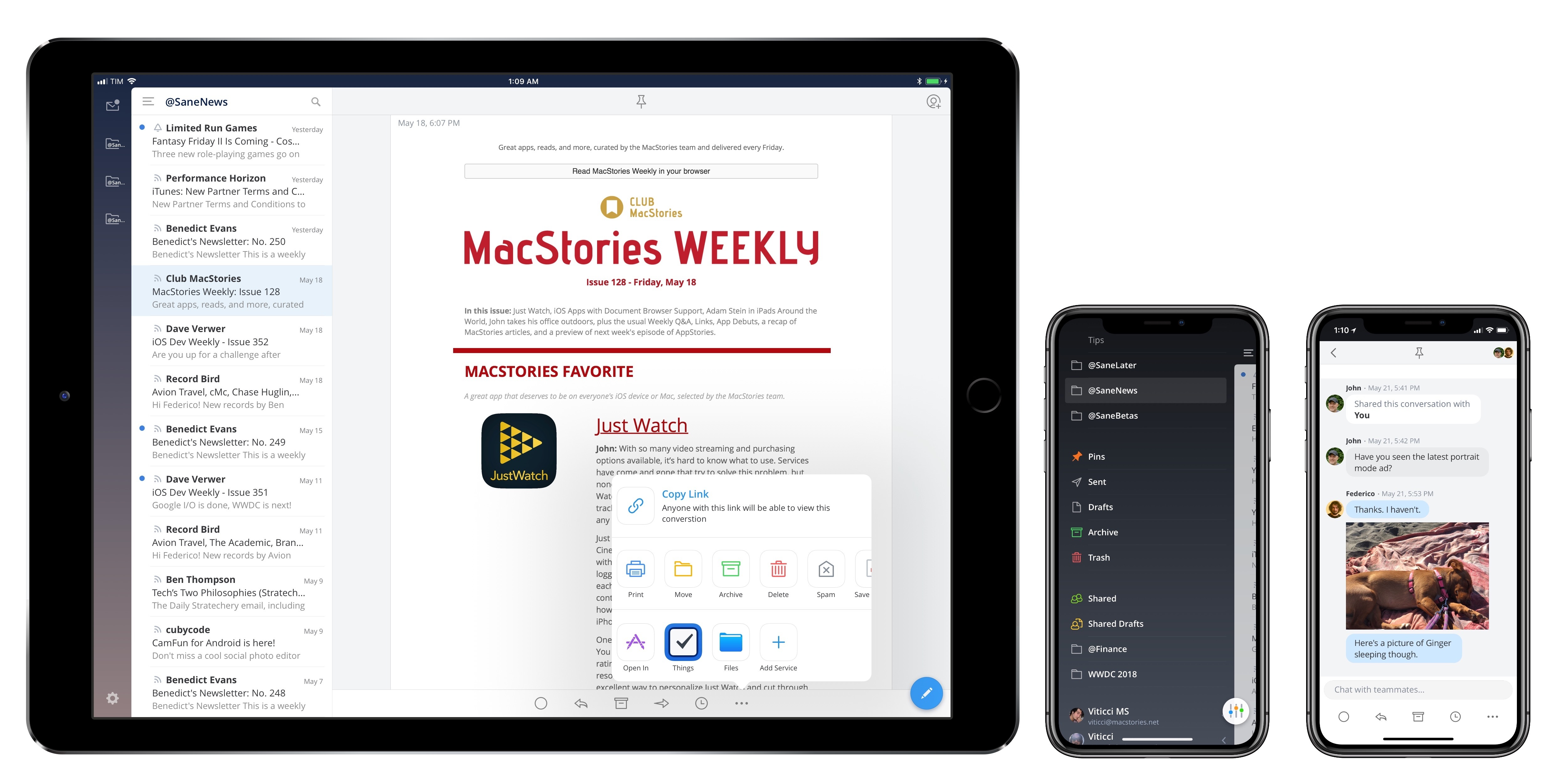
For the past several months, I’ve been refining a DEVONthink workflow I previously covered in a couple of issues of MacStories Weekly as well as MacStories. The workflow, which I called “DEVONmenu” then “DEVONmenu Plus”, was originally shared here and perfected in the Q&A section of MacStories Weekly #118. My DEVONmenu workflow was designed...
Connected, Episode 183: PodStorm→
Stephen’s family staged a HomePod intervention, Myke names his favorite Apple Watch apps, Apple kills off iTunes LP and Federico has some news.
We discussed a variety of fun and interesting topics on Connected this week, but MacStories readers shouldn’t miss the final part of the show. You can listen here.
Sponsored by:
HomePass Can Store All Your HomeKit Setup Codes
Developed by Aaron Pearce (the creator of Homecam, one of my favorite iOS apps this year), HomePass is a handy utility for iPhone and iPad to store HomeKit setup codes.
If you’ve been playing around with home automation on iOS, you know that managing accessory pairing codes isn’t exactly fun or convenient. While iOS 11 added support for QR codes and special NFC pairing tags, most accessory makers still stick basic alphanumeric codes on the back or at the bottom of accessories and essentially require you not to lose them. That’s not ideal. HomePass aims to be a single repository where you can easily keep track of all your setup codes, sync them across devices with iCloud, and even protect them with Face ID. Instead of taking pictures of your codes and storing them in Apple Notes (which is what I’ve been doing), you can collect every HomeKit code in HomePass, where they’ll be presented alongside device names, HomeKit rooms they belong to, and custom icons.
I’ve been testing HomePass for the past couple of weeks, and there are some nice touches I want to point out. First, if you grant the app access to your HomeKit data, it’ll be able to see existing accessories and allow you to simply enter the code without choosing a device name or icon (you can also create new accessories from scratch). In addition, the code displayed in the Code field of a device’s detail view is formatted with the same shape and font used on physical setup codes; this means you can open HomePass on your iPad and scan a code directly with the Home app on your iPhone. Lastly, you can add notes to your accessories and export everything as CSV if you prefer to have an additional backup of your accessory database.
One of the many shortcomings of Apple’s native Home app is the lack of deeper organizational tools for users who own dozens of HomeKit accessories and need a better way to store their codes. Ideally, such a feature shouldn’t be needed, but in my experience things sometimes go wrong and you may need to reset an accessory and add it to HomeKit again. When that happens, you don’t want to go hunting for the setup code on the back of a thermostat. I highly recommend using HomePass instead, which is available at $2.99 on the App Store.
Workflow 1.7.8 Adds ‘Mask Image’ Action, Things Automation Support, PDF Text Extraction, and More
In the first update since November 2017, Apple today released version 1.7.8 of Workflow, the powerful iOS automation app they acquired last year. The latest version, which is now available on the App Store, introduces a brand new Mask Image action, adds support for Things’ automation features, and improves the ability to extract text from PDFs using the company’s PDFKit framework, launched in iOS 11. While the unassuming version number may suggest a relatively minor update, Workflow 1.7.8 actually comes with a variety of noteworthy changes for heavy users of the app.
10 Years of iPhone SDK→
Whether you’re a developer who’s working on mobile apps, or just someone enjoying the millions of apps available for your phone, today is a very special day. It’s the ten year anniversary of the original iPhone SDK.
I don’t think it’s an understatement to say that this release changed a lot of people’s lives. I know it changed mine and had a fundamental impact on this company’s business. So let’s take a moment and look back on what happened a decade ago.
Craig Hockenberry published a fantastic retrospective on a decade of the iPhone SDK, which, after months of jailbreaking, allowed developers to start making real iPhone apps in 2008. It’s an excellent, well-researched story (with a lot of links, which you should open in new tabs; take your time to explore) that brings back a lot of memories. You should also check out the replies (standard and quoted) to Craig’s tweet for a lot more interesting stories.
It’s not an exaggeration to say that I wouldn’t be here, typing this post today, hadn’t Apple decided to open iPhone app development to third-party developers 10 years ago. I think many of us in this community of people who still care about this stuff at least partially owe our careers to the iPhone SDK. I’ve shared this story before, but in 2008 I dropped out of university, got a job at a physical “eBay store”, and later started blogging with a free WordPress website because I wanted to write about apps. But really, I wanted to write about iPhone apps and try as many as possible to share my thoughts with other people. That website eventually became MacStories and these words I’ve been putting out for almost 9 years now.
In hindsight, it feels strange that thousands of jobs around the world were created or inspired by a huge and sprawling corporation, but it didn’t feel that way back then. Even as a nobody watching and blogging (in poor English) from the sidelines of a burgeoning industry, that period between the spring of 2008 and early 2009 carried a palpable sense of discovery, surprise, and wild experimentation that I remember fondly. I saw app developers as pioneers charting a future we couldn’t even imagine. It was, in many ways, a different, ingenuous, more enthusiastic era – one that I hope to live through again someday.
Halide 1.7 Brings New Depth Photography and ARKit Features, Darkroom Integration
We first reviewed Halide, the powerful third-party camera app by Ben Sandofsky and Sebastiaan de With, when it debuted in the summer of 2017, providing a powerful and elegant alternative to Apple’s Camera app that fully embraced RAW photography and advanced controls in an intuitive interface. We later showcased Halide’s iPhone X update as one of the most thoughtful approaches to adapting for the device’s Super Retina Display; to this day, Halide is a shining example of how the iPhone X’s novel form factor can aid, instead of hindering, complex app UIs.
While Halide was already regarded as an appealing alternative to Apple’s stock app for professional photographers and RAW-curious iPhone users (something that designer de With covered in depth in his excellent guide), it was lacking a handful of key features of the modern iPhone photography experience. Sandofsky and de With want to eliminate some of these important gaps with today’s 1.7 update, which focuses on bringing the power of Portrait mode to Halide, supporting the iPhone X’s TrueDepth camera system, and extending the app’s integrations via a special ARKit mode, new export options, and native integration with the popular Darkroom photo editing tool.
An Interview with Harry Nesbitt and Ryan Cash About Alto’s Odyssey
AppStories Episode 45 - An Interview with Harry Nesbitt and Ryan Cash About Alto’s Odyssey
37:17
Federico and John interview two members of Team Alto, Harry Nesbitt and Ryan Cash, about Alto’s Adventure, the challenges they faced in following it up with Alto’s Odyssey, the creative process of making games, and the mobile game industry.
iPads Around the World
For the second installment of our iPads Around the World section, we’ve talked to Alexander Drechsel and Josh Goldsmith, two interpreters who, besides interpreting for the European Parliament and other large institutions, also train their colleagues on how to use iPads while interpreting. Alex and Josh were among the first Club members to get...
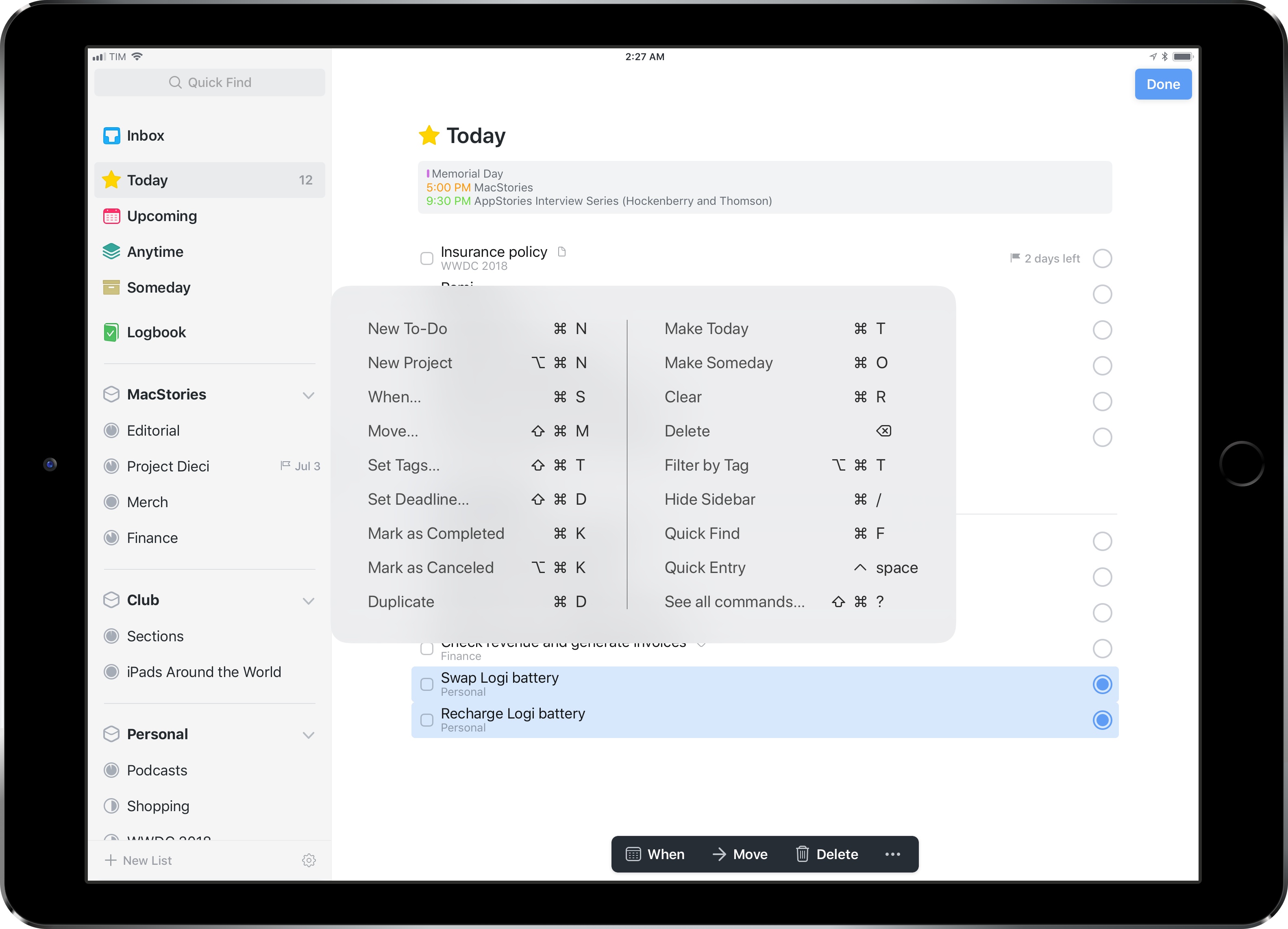
Things Automation: Building a “Natural Language” Parser in Workflow
One of the Todoist features I miss the most as a Things user is the service’s natural language parser. Available in the Quick Add field of Todoist for iOS, web, and macOS, this feature is, effectively, Fantastical for tasks. Instead of having to manually select task fields such as projects, tags, or dates, you can take advantage of an easy-to-remember syntax and quickly type them out. As you do that, Todoist will highlight the parts it understands in red, indicating that it knows how to parse them. I entered hundreds of tasks in Todoist using this system, and I think it’s an aspect of task creation that every other task manager should implement as well. It makes perfect sense, and it saves a lot of time.
Aside from a half-baked attempt at supporting natural language entry in its date assignment UI, Things doesn’t unfortunately offer a quick entry feature comparable to Todoist’s. So, of course, I set out to make my own using the app’s latest automation features.
Well, kind of. For starters, as much as I’d love to, automation doesn’t mean I can make my own interfaces in Things, supplementing the app with my custom UI to more easily create tasks. Things’ new URL scheme only lets us send data from other apps such as Workflow or Drafts. More importantly though, the workflow I’m sharing today isn’t based on a complex natural language engine such as the one used by Todoist or, say, the Chrono JS parser; I’m just using some special characters sprinkled with some delicious regex to make sure Workflow knows what constitutes a task title, a project, or a due date. Thus the quoted “natural language” in the headline of this story: it’s only natural as long as you don’t forego the special syntax required to make the workflow run.
That said, I’m quite happy with how this workflow lets me add multiple tasks to Things at once. I’ve been finding it especially useful at the end of the work day or during my weekly review, when I make a list of all the things I’m supposed to do next and want an easy way to add them all to Things. For this reason, rather than restricting this workflow to Club MacStories members, I thought every MacStories reader could benefit from it and modify it to their needs.
If you’re a Club member, you can still look forward to advanced Things workflows over the next few issues of MacStories Weekly; this one, however, has been too useful for me not to share with everyone.