Posts tagged with "developers"


Apple Seeds iWork for iOS Beta Apps With iCloud Support

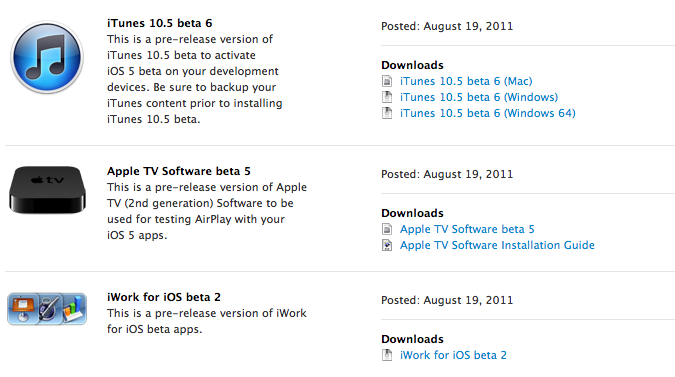
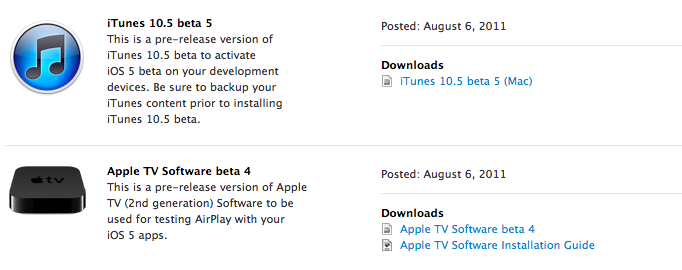
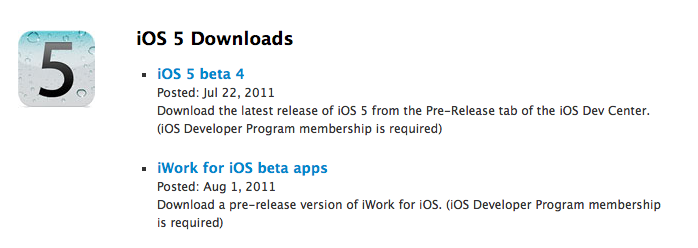
Following the launch of iCloud.com beta to developers, Apple updated its iCloud beta for Developers page including special versions of the iWork for iOS apps. Labelled “iWork for iOS beta apps” by Apple, the package includes new versions of Pages, Keynote and Numbers for iOS that will allow developers and testers of iCloud to start working on a new document on a device, and find it after a few seconds on another iCloud-connected device or the web counterpart, which also comes with web apps to edit documents.

The functionality was first demoed by Apple at the WWDC in June, and an iOS developer program membership is required to test the new iWork beta apps.


Face Detection Technology And APIs Make Their Way Into iOS 5

After doing some digging in iOS 5, 9to5 Mac today reported that Apple is planning to open up face detection APIs to developers. It appears from what they found that Apple will bring similar face detection techniques that Photo Booth on Lion currently employs to iOS and allow developers to build different apps that utilize the APIs.

These claims come after 9to5 Mac found the ‘CIFaceFeature’ and ‘CIDetector’ APIs within a recent beta build of iOS 5, which they say are “very advanced” APIs. The first of the two can be used by developers to locate where a person’s mouth and eyes are, whilst the latter is used when processing those images for face detection. Apple’s Developer Library online also already has some notes on the new APIs for developers to take advantage of.

Obviously at this point there is only speculation as to what these purported APIs could be used for – an obvious stretch is that the iPad version of Photo Booth may add the new effects added to the Lion version that take advantage of the information of where a person’s facial features are. It is also claimed that Polar Rose, a company that specialized in facial recognition software and was purchased by Apple last year, played a role in the development of these technologies within iOS and Lion.

[Via 9to5 Mac]


OS X Lion 10.7.2 Shows Up On Dev Center

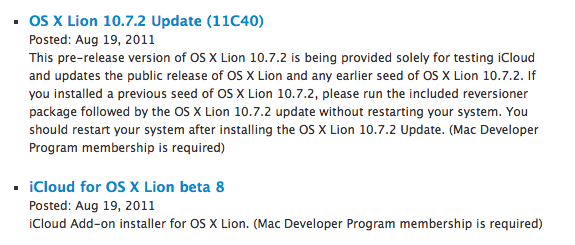
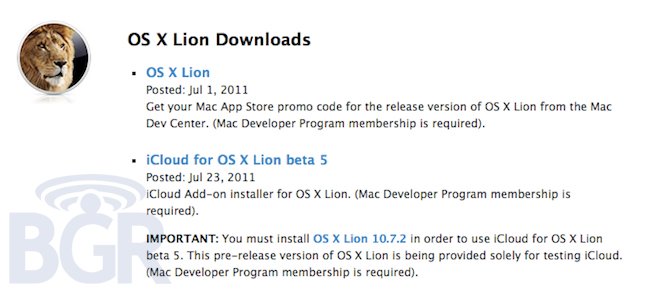
As first noted by BGR, a link to download OS X Lion version 10.7.2 has briefly appeared in the iCloud section of the Developer Center, which is unaccessible at the moment of writing this. However, a screen taken by BGR confirms that Apple – it’s not clear whether mistakenly or not – inserted a link to download a new developer seed of Lion, which was publicly released earlier this week on the Mac App Store.

According to Apple, this new version of Lion “is being provided solely for testing iCloud”, which has received an update to beta 5 today as a standalone control panel to install on OS X. iCloud is due this Fall as announced by Apple at WWDC in June. It is unclear whether this build of Lion for iCloud testing will be released alongside iCloud later this year, but considering Lion has yet to see a maintenance update to version 10.7.1, it wouldn’t be a surprise to see 10.7.2 scheduled for launch when iCloud is ready, too.

Since the launch of new hardware last Wednesday, it was noted the new MacBook Airs carried a different OS X Lion build number, version 11A2063.


Apple Releases iOS 5 Beta 4


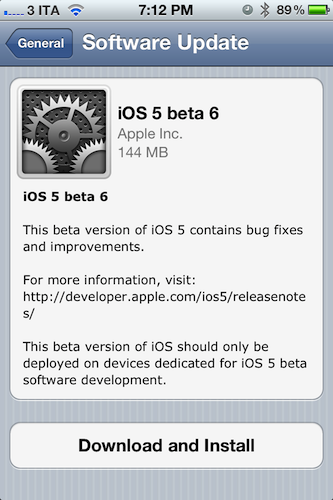
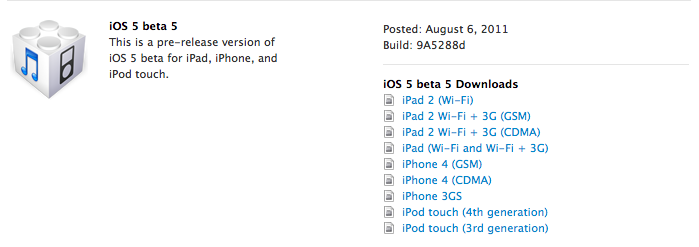
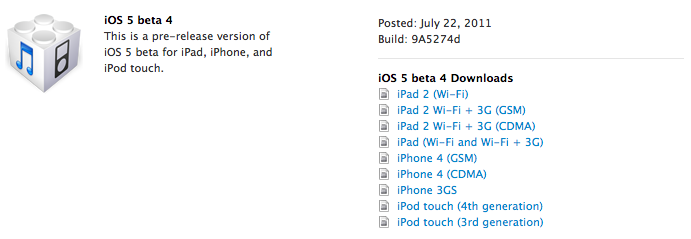
Apple just seeded iOS 5 beta 4 to developers. The new build, carrying number 9A5274d, is available now in the Dev Center. iOS 5 beta 3 was seeded to developers on July 11, introducing a series of tweaks to Location Services and several optimizations to the underlying code of the OS, which resulted much snappier and more responsive than previous betas. However, some developers reported that bugs with Notification Center found in iOS 5 beta 1 were still not fixed in beta 3. iOS 5 will ship in the fall, as announced by Apple at WWDC.

We’ll update this story with more information and details as they become available. Read more


Xcode 4.1 for Lion Released, Free On Mac App Store

Among all the various software updates released today, Apple also just flipped the switch on a new version of Xcode. Xcode 4.1, after several developer previews, is now available for free on the Mac App Store. From the changelog:

  • Includes SDKs for OS X Lion and iOS 4.3
  • Interface Builder support for Auto Layout and new Aqua controls such as NSPopover
  • Full screen support in workspace, project, and organizer windows
  • Project modernization to identify and resolve out of date build settings
  • Behaviors can be customized and assigned to unique key bindings
  • Source control enhancements to pushing, pulling, and management of remote servers
  • Assistant editor support for display of generated assembly and preprocessed output
  • Additional bug fixes and stability improvements

Mac OS X Lion is a requirement to download this new version of Xcode. The new 4.1 version, however, shows up as free on older Snow Leopard machines as well. Download here.


Patent Trolls Used To Be Easy to Ignore

Editor’s note: This is a guest post by Steve Streza, founder of Mustacheware and developer of Todolicious. Read more about him at his blog, and follow him on Twitter.

First Lodsys. Now Kootol. It seems the Pandora’s box has been opened on patent infringement lawsuits being levied against small-scale developers. What used to be a problem that only concerned large companies with massive legal teams and tons of cash to throw at patent discovery is now something that affects indies and small companies. The independent developer community has largely ignored software patents for ages, mostly because they didn’t ever get pressured by them. It was considered too small a target to go after by patent holders, considering how many bigger targets like Apple and Microsoft were often infringing the same patents. But now, with the kind of money being thrown around in the App Store (not just Apple’s, but Google’s Android Market as well), it almost seems too easy to pursue a lawsuit against a small vendor who can either kick you a few thousand bucks or spend hundreds of thousands on a patent lawsuit that will get them nothing in return.

US patent law surrounding patents has been vague and in flux for many years. In the US, Gottschalk v. Benson in 1972, it was decided that calculations (mathematical algorithms) were not patentable. In Diamond v. Diehr in 1981, a Supreme Court ruling set the precedent that computer algorithms which were parts of a larger process (in this case, making molded rubber using computer simulations) were patentable. It wasn’t until 1994 that the Federal Circuit ruled that algorithms and data structures interpreted by machines were patentable, which basically set up the current precedent that all processes interpreted by computers can be patented. This was reaffirmed in 1998 by a piece of financial software which pooled money and redistributed it; the reason this was declared patentable was because it produced something useful, and was something a human could not do manually. Compounding all of this are trade agreements between many nations (including the US) which respects patents from one country in another.

The courts have since started backtracking on this; a few rulings in the last few years may chip away at viability of some of these patents. But it doesn’t matter for already-granted patents; they can only be invalidated by time or a court, and getting it to a court is expensive and can take years. There’s an interesting thing that happens here. A patent holder risks the invalidation of their patent if they make it to trial, and the company that infringes on the patent risks having to pay damages (and possibly legal fees) if they lose. Both companies have an incentive to avoid court, so most patent lawsuits are settled out of court, preventing the viability of the patent from ever being challenged, and allowing the patent holder to continue suing other companies.

This cycle has led to the creation of the patent troll, a company with money, a legal team, a bunch of largely-obvious patents, and…well, that’s about it. These companies spend their time and resources filing for patents and pursuing companies who infringe upon them, while not doing anything of business significance with them.

Small companies have, until now, mostly ignored the threat of patent trolls, figuring that they would never go after such a small target. However, the threat has always been there. A patent is only valid if the idea has not been done before (a concept known as “prior art”), and if the patent holder actively pursues infringers. There are defenses against this (“these guys are so small, they didn’t even show up on our radar”), but generally you have to defend your patent or risk losing it. It was merely a matter of time before patent trolls began coming after the sea of cash flowing through software.

There is justified outrage at these companies for what they’re doing. Companies like Lodsys are taking advantage of patent law to harass small developers into paying up hush-money to keep from a time- and cash-consuming legal nightmares. However, it is worth noting that these patent trolls are legally operating under the rules of a broken system. It is the system surrounding patent law that must be reformed. Patent law was invented ages ago, when innovation was expensive and took a lot of time and energy. These days, any kid with a laptop can create the next huge app. The tech industry has largely figured out how to keep competitors from reverse-engineering trade secrets through a combination of mathematical and cryptographic tools. Don’t steal your way to a better product; compete your way there.

Whether Apple or Google figures out a way to shut Lodsys up is irrelevant. The patent troll hydra is out in the open; paying off one of them will cause every patent holder to consider pursuing developers with similar tenacity. With at least one indie developer withdrawing their apps from the US market so far, this spells a dark time for innovation. But only because we have been so willing to ignore the problem for so long.


Apple Approving Apps Updated for Lion

Earlier this week, Apple informed registered Mac developers that they could start submitting apps targeting the new features of OS X Lion – coming this month – such as full-screen mode, sandboxing, push notifications and new Aqua interface controls. In the email sent to developers, Apple wrote: ”OS X Lion, the eighth major release of the world’s most advanced operating system, will soon be available to millions of Mac users around the world. Submit your Lion apps for review now so they can be on the Mac App Store when Lion ships this month.” Whilst several rumors in the past had claimed Lion would be released today, July 14th, alongside new Mac hardware, such claims have failed to come true as the OS isn’t available to the general public yet. According to most recent speculation, minor issues with app resumes and restarts in Lion have forced Apple to “delay” the release – though it’s not clear how the company could delay something that was set for July, but wasn’t given a precise release date.

In the meantime, as first noted by OS X Daily, Apple has started approving apps updated for Lion. OS X Daily points out that Mac game WordCrasher was updated to support Lion’s full-screen mode and Resume; we’ve also found more Lion-ready app updates approved by Apple today. These updates either bring new features (as in the case of BusyCal) or minor bug fixes to ensure Lion compatibility.

WordCrasher

  • Full-screen. Use the full-screen button or press CONTROL + COMMAND + F to toggle fullscreen mode under OS X Lion.
  • Resume. Close WordCrasher at any time and resume your game right where you left it. Restart your Mac, and WordCrasher will resume straight away.

Harmony Worship

  • [Bugfix] Fix datamodel for OS X Lion
  • Include missing image in Mac App Store build

Shortcuts

  • System actions with CMD and ALT now work on Lion
  • User interface fixes

BusyCal

  • Lion compatibility.
  • Supports full screen mode on Lion.
  • Supports trackpad gestures on Lion.
  • Supports new scrollbars on Lion.
  • Supports Address Book yearless birthdays on Lion.

The four apps above were existing Mac App Store apps that have been updated to receive Lion fixes and support. The fact that all these updates were approved today leaves us wondering whether Apple wants to quickly get the Store ready for a Lion launch next week by approving apps that take advantage of the new OS – Lion will be exclusively distributed on the Mac App Store and, after it launches, new users may want to spend some extra money to get apps that work nicely with it. Since Apple began accepting Lion submissions this week many wondered whether the new OS could really come out today – if history is of any indication, it usually takes a week for Apple to begin accepting app updates and actually releasing a new major OS. According to a series of fresh claims, Lion is on schedule for a launch next week.


Apple To Developers: You Can Now Submit Lion Apps

Following the release of the Xcode 4.1 Golden Master seed and with OS X Lion rumored to be nearing its public release, Apple has just informed registered Mac developers that they can now submit apps built for Lion to the Mac App Store.

OS X Lion, the eighth major release of the world’s most advanced operating system, will soon be available to millions of Mac users around the world. Submit your Lion apps for review now so they can be on the Mac App Store when Lion ships this month.

In the past weeks, in spite of various developer previews of Xcode 4.1 for Lion available on the Dev Center, developers were unable to submit apps built specifically for the new OS. In OS X Lion, developers can take advantage of hundreds of new APIs to enable features like full-screen mode, push notifications for apps, new Aqua controls including iPad-inspired popovers, auto-save and versions, as well as sandboxing and multi-touch gestures.

Lion is rumored to hit this week, alongside new MacBook Airs with Sandy Bridge processors and Thunderbolt, and new Mac Pros. The GM build of Lion was seeded on July 1, leading to speculation that, after two weeks and with no major bugs found, the final version is ready to become available on the Mac App Store at $29 any day now. Several developers we polled in the past week told us they were ready to submit their new apps, but Apple (and Xcode) wouldn’t let them. With the release of Xcode 4.1 GM today, Apple flipped the switch on Lion submissions, but it’s unclear how many apps the Review Team could manage to approve before the rumored Lion launch. Clearly Apple wants some Lion-ready apps to be ready for Lion’s debut, so it’ll be interesting to see how this will play out in the next 48 hours.

Apple announced Lion would come out sometime in July as Mac App Store exclusive. In the past, Apple began accepting iOS 4 submissions on June 11 (roughly 10 days ahead of iOS 4’s release) and Mac App Store submissions in November, whilst the Mac App Store went public on January 6.