Review: Driver Feedback App Evaluates Your Driving Performances

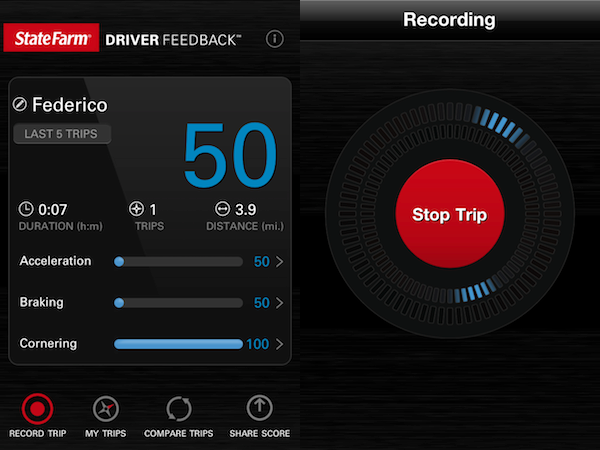
Following recent news of Apple building a crowdsourced traffic service to launch in the next few years, it’ll be interesting to see whether competitors and third-party developers will start playing around with more car-oriented and traffic-based services for iOS devices. Insurance company State Farm – which I had never heard of before, but it turns out they’re pretty huge in the United States – released a new iPhone app a few days ago that’s aimed at monitoring your driving performances and giving you a score based on various factors like braking, acceleration and cornering. The concept is really simple: the worse you drive (severe acceleration or braking, for example), the lower score you get at the end of the test. How does the app keep track of all this? Again, simple: it uses a mix of Google Maps, iPhone accelerometer and GPS data to see where you’re going, and how you’re driving. I took the app for a spin tonight to see whether or not it would really work with the awful road that connects San Martino al Cimino to my town, Viterbo.

The app starts up with a screen that asks you to create a new user profile, although everything stays locally and it’s not sent to State Farm’s servers. You can create as many profiles as you want for all members of your family who drive and would like to try Driver Feedback. Once a profile is ready, the app will also ask you to place the iPhone on a flat surface in your car but not on the dashboard, so you won’t be distracted and the iPhone’s accelerometer can work properly to register brakes and stops. Tonight I decided to drive a little faster than I usually do (75 km/h on average instead of the usual 60 km/h on the aforementioned terrible road) to see if Driver Feedback could really give me a bad score once I arrived at my destination. Once you’re ready to go, all you have to do in Driver Feedback is wait for a sound effect (a countdown related to the iPhone being placed on a flat surface, luckily I have one in my VW Polo) and start driving.

It usually takes me less than 10 minutes to drive from San Martino to Viterbo. As I decided to drive relatively worse tonight (of course, without putting anyone to risk) to evaluate the app’s functionalities, I didn’t consider that it was raining, badly. So it turned out to be a pretty awful 7-minute car trip that I honestly won’t repeat ever again. And the app did notice after I was done: I got a 50/100 score with multiple severe acceleration and braking points, and lots of suggestions to improve my driving in the future. Driver Feedback can even keep a log of all your trips and it allows you to check out data points on a Google Map, too. In the Alerts tab, the app explains what you did wrong and why you should improve your driving style, whilst the main screen offers an option to share scores via email or text. The UI is minimal, and elegant.

From what I’ve seen so far, Driver Feedback is a well-realized product that might really help you fine-tune the way you drive. I’d like to see more factors being considered in the future (such as traffic, or weather conditions), but as it stands now State Farm’s Driver Feedback is a cool app for drivers, and a useful product to remind everyone that good driving can save gas, and lives. Go download the app here. Read more

Company Promises To Automate Your Home Using iPads

How great would it be to control everything in our homes using only iOS devices? I’ve always dreamed to fire up my Espresso machine remotely using an iPhone app, or being able to close all my windows from an iPad with live webcam feeds. I know, crazy futuristic stuff that current home automation techniques haven’t fully addressed yet, especially when it comes to security concerns and reliability. But ask Solstice Multimedia about it: the Denver-based company with a decade-long experience in telecommunications and residential services thinks that turning your house into a full-featured iPad-controlled system is totally possible. They even promote a 3,400-square- foot model home with two iPads built-in at $718,000. Okay.

Price of the model home itself aside, the iOS-based system relies on a dual-iPad setup that will cost you roughly $5,000. Optional audio, video and security equipment will take the cost to $60,000 – that’s a whole lot of equipment, right? I assume so. Apparently the system’s “brain” is built into the home’s “mechanical room” with WiFi connection to the 2 iPads, but a third device can be used to control everything without having to touch a screen on your wall. So, basically, the iPad is the engine, and mechanical parts take care of lights, motorized blinds, cameras, and other stuff. The Denver Post reports:

A model home in the Overlook neighborhood in Lone Tree’s Heritage Hills is equipped with two built- in iPads that can control all of the electronic systems in the home, including lights, motorized shades, music and television systems, baby monitors and closed-circuit cameras.

“The iPad has brought the entry-level price point down significantly, because an 8-inch in-wall touch screen before cost upwards of $3,000 or more,” Deatherage said. “Now we can get a $500 iPad and still provide most of the functionality that an in-wall touch panel can give.

I’m pretty sure Apple won’t release an iHome anytime soon, so if you’re willing to automate your living room using iPhones and iPads this might be your best chance yet. Go take a look on Solstice Multimedia’s website. [via Cult of Mac]


Caffeinated RSS Reader for Mac Finally Out As Beta

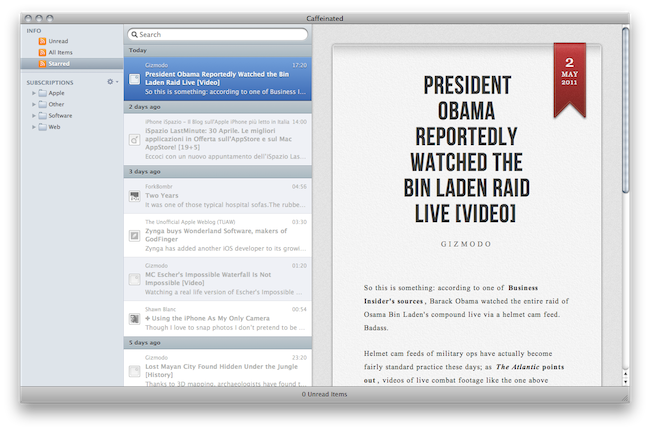
Back in December 2009, I was browsing Ember looking for some cool new apps to cover on MacStories. As I browsed the online gallery to find interesting projects worth a mention on the site, I stumbled upon the first screenshots of a new RSS reader for Mac, Caffeinated. The app looked elegant and super-slick, and as you may remember from my initial coverage of the private alpha version, it was also a fast way to access Google Reader from the desktop. But since then, the app disappeared from our radars and lots of things changed in RSS app landscape: Reeder for Mac was released as beta, Google Reader clients for iOS started proliferating implementing features that weren’t previously possible on the desktop. Caffeinated, however, wasn’t dead at all: it was being rebuilt from the ground up, and that was a long process looking back at my first article. As promised by the developer a few weeks ago, a first beta of Caffeinated is finally available today.

From a design perspective, not much has changed since my initial coverage. The app still looks as slick as ever with minimal sidebars and iOS-like scrolling and cells, but it’s the underlying engine that went under a massive re-construction. The app is way faster than I remembered, perhaps not as fast as the current Reeder for Mac beta but definitely snappy and promising. The app takes less than a second to start up with a neat opening animation, subscriptions can be manually refreshed with a keyboard shortcut but there’s no way to set automatic reload times yet. In fact, this first beta of Caffeinated is so limited there’s no access to the Preferences yet, and sharing options haven’t been implemented. As the developer writes:

Caffeinated was built for speed and customisability. The app is theme-able, the API exists but I have yet to write documentation or build in appropriate preferences, if you are interested in themeing with this beta, just give me a shout and I can walk you through it – its really not that difficult.

This is mainly a usable taster of what is to come…so be patient ( I know you have already! ) but it will be worth the wait in the end.

Overall, this first beta of Caffeinated – quite possibly one of the most anticipated Mac apps of 2010, before some users lost hope and began to think the project went the way of the dodo – is pretty buggy and clearly unfinished, but it’s a sign of interesting things to come in the (hopefully) near future. If you want to take Caffeinated for a spin, go download beta 1 here.


Kickstarter: Hive - An iPhone Amplifier + Screen Magnifier

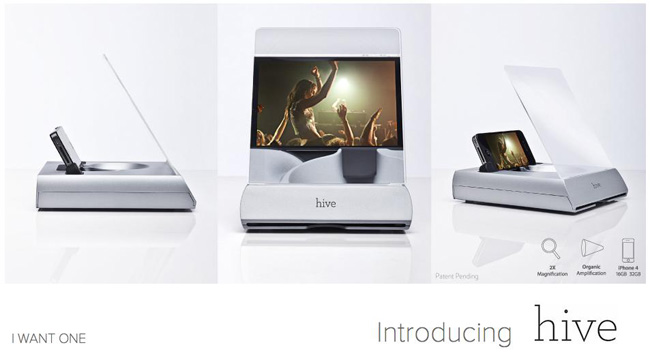
Mark this Kickstarter project as another original concept. The Hive, by Jake Waitzman of Screendoor Studio, requires no electronics or power, and amplifies the iPhone 4’s onboard speaker in both landscape and portrait orientation. It does this by channeling the sound into a concave chamber that projects upward and outward toward the listener’s ears (much like Griffin’s AirCurve). What makes it a lot different than the AirCurve and other docks is the fresnel lens. It stands parallel to the iPhone’s screen at a set distance of 4 inches, providing crystal clear 2X magnification.

Promo videos can be seen after the break. Read more


Things Cloud Sync Beta Goes Live

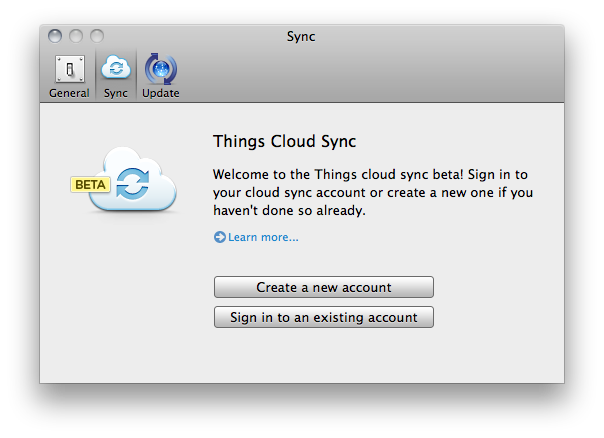
Years in the making, Cultured Code finally flipped the switch on the initial beta of Cloud Sync for Things, the popular GTD application for Mac, iPhone and iPad. Things, featured several times by Apple in the past and winner of a Design Award in 2009, was long criticized for the lack of over-the-air sync for tasks and projects across desktop and mobile devices, something that was implemented by other GTD-oriented applications like OmniFocus and Wunderlist with decent results in the past few years. Cultured Code, however, decided to wait before making a public announcement about their OTA sync plans; then, back in December, they revealed that, yes, they were working on a sync service for Things (which counts thousands of users worldwide), but it would take longer than expected due to the extremely unique nature of the product. And today, Cultured Code is letting registered beta users try the first version of Things Cloud Sync, although with some limitations.

We’re not able to test the actual implementation of sync right now, but details can be gathered from the developers’ blog and official sync page. This first version of cloud sync for Things will only work Mac-to-Mac, as the iOS clients haven’t been updated to test the functionality yet. The initial rollout of cloud sync is meant to test the reliability and scalability of the service, which, unlike most OTA sync tools out there, doesn’t want you to manually trigger a sync session but it’s aimed at constantly transmitting changes to the cloud – think of a continuous client for GTD. As Cultured Code explains, this is all based on a database system that makes sure current beta users can run the limited Things 1.5 version without corrupting their existing personal Things database. As explained in “State of Sync, Part III”:

Things will sync frequently. While there will be a way to initiate sync manually there should hardly be any reason for doing so. Every change you make is transmitted to the cloud almost instantly. No matter when you quit the app, your data is safe with the server already. Whenever you open Things, switch applications, or wake your computer from sleep, Things will check back with the server to see if there are any updates to pull.

Things will always connect to the server using an encrypted connection. Not only during log-in, as many web sites do, but for every connection. This means that your to-dos will never be sent in the clear.

The current beta of Things 1.5 can be downloaded here, but Cloud Sync is exclusive to users who signed up to Cultured Code’s list months ago and are receiving an activation email today. To stay up to date with Things sync development, follow Cultured Code’s blog here.


Fluid for Mac Goes 1.0, Introduces $4.99 Version for Extra Features

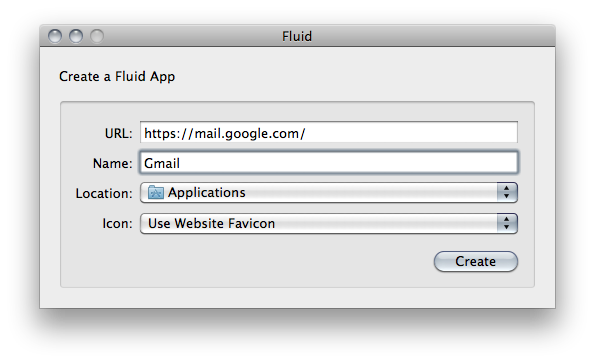
Fluid, the popular tool that allows you to turn websites into “native” Mac apps, was finally updated to version 1.0 yesterday after 3.5 years of development, bringing the app to “stable” status and introducing a new $4.99 price point that unlocks “extra features” – some of them previously available for free in the beta versions. For those who are not familiar with Fluid, it basically enables you to turn any website into a standalone desktop application that – technically speaking – is nothing but a Cocoa wrapper. By wrapping a website into its own desktop package, Fluid gives you the “illusion” of having a native Gmail or Facebook app while, in fact, you’re simply running a webpage into a separate window. Fluid, however, has got its very own perks, like the possibility to choose a custom Dock icon for a website, or displaying unread badges for new items and notifications – something that a browser normally doesn’t through tabs. In this way, Fluid becomes a pretty handy solution to put your Campfire chats in the Dock, or get Gmail out of the browser and into its own desktop window.

The new version 1.0, improvements and bug fixes aside, comes with an optional $4.99 purchase that will unlock three features: userscripts & userstyles, separate cookie storage, and possibility to “pin” apps to the OS X menubar. Whilst the first two features are self-explanatory (separate cookie storage is new to Fluid 1.0 though), “pin to status bar” is the big addition to this Fluid release. Much like Twitterrific and Twitter for Mac can be toggled by a menubar item to hide / show the main window, Fluid apps can now live in the menubar and get out of the way when you don’t need them. If you combine this with some clever mobile user agent tweaking, you end up with a sweet way to create useful iPhone-like desktop apps that don’t clutter your Mac’s screen, but they’re still there.

Fluid is not available in the Mac App Store, but you can download the free version here. A $4.99 license can also be purchased here with a Paypal payment.


Lima: Browser-based Cydia Alternative Demoed on Video

With 1.5 million users logging into the app every day and an estimated user base of 10 - 15 million iPhone, iPad and iPod touch users, Cydia has become the undiscussed leader of the jailbreak community thanks to the thousands of tweaks and utilities available for download and purchase. Developed as an alternative to the App Store to find a place for those apps that Apple would never approve, Cydia turned into a full-featured marketplace where users can go to find the latest modification to the iPhone’s graphic files, or hacks to enable functionalities that Apple left out in the last software update. Cydia is the single reason to jailbreak an iOS device, but some developers think there’s still room for healthy competition and fresh new concepts in the jailbreak scene.

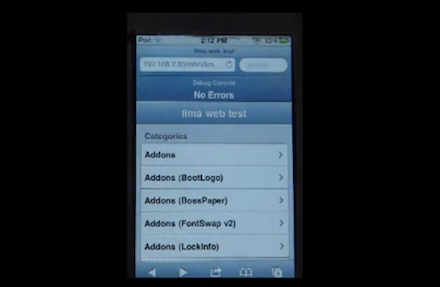
Lima, created by the same folks behind the Icy package installer, is a new browser-based Cydia alternative that’s still in the early stages of development but will be focused on speed, reliability and ease of use. Instead of building an app package, the devs of Lima opted for the browser option: Lima will likely gets its own homepage, and let users log in with their online accounts to download and install tweaks. It’s unclear whether Lima will allow users to add custom sources and how many developers will support the platform once it’s available, but devs weighing in iPhoneDownloadBlog’s original coverage seem to confirm that Lima will offer an option to manage repositories, as well as a backup system for installed packages.

You can follow the development of Lima on the Infini Dev Team’s blog, and check out the first demo video below. Read more


iOS 4.3.3 Coming Within Two Weeks

According to BGR, Apple is looking to roll out an iOS 4.3.3 update within two weeks and “possibly sooner” which, as previously announced, will improve the way iPhones and iPad 3G models handle the location database file required to quickly fetch nearby antenna and WiFi hotspot information.

We’ve been sent the OS and while we haven’t loaded it on our iPhone just yet, here is what we have been told it will address:

- The update will no longer back up the location database to iTunes.

- The size of the location database will be reduced.

- The location database will be deleted entirely when Location Services are turned off.

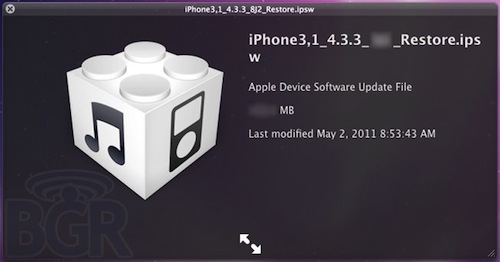
The website also reports iOS 4.3.3 will address battery life issues and introduce iPod bug fixes. On March 21st, BGR reported iOS 4.3.1 would be released within “one or two weeks” and they made a similar prediction for iOS 4.3.2, which came out on April 14th. Apple announced in its Location Tracking Q&A that an update coming out in the “next few weeks” would fix several bugs related to location tracking. With BGR posting a screenshot of the final firmware file, it’s very likely that Apple will release the update later this week.

Sometime in the next few weeks Apple will release a free iOS software update that:

- reduces the size of the crowd-sourced Wi-Fi hotspot and cell tower database cached on the iPhone,

- ceases backing up this cache, and

- deletes this cache entirely when Location Services is turned off.

In the next major iOS software release the cache will also be encrypted on the iPhone.

Update: as pointed out by one of our readers, the image above confirms build number of the new OS will be 8J2.