Did An Apple Investigator Pose as a Police Officer to Search for Missing iPhone Prototype?

On Wednesday, we reported a repeat of last year’s iPhone disaster - an iPhone prototype lost in a bar. According to the website, Apple never filed a police report based on such loss, likely from an employee field-testing the unit, although it “sparked a scramble by Apple security” in an effort to recover it quickly. The story just got one hundred times more interesting: the SF Weekly has followed up with a new report claiming that Apple security personnel may have posed as the police during the search of Sergio Calderón’s home. Impersonating a police officer is a criminal offense, even if you are a security guard. On the flip side, the police could’ve improperly assisted in the investigation without documenting their work corectly.

[Sergio] Calderón said that at about 6 p.m. six people – four men and two women – wearing badges of some kind showed up at his door. “They said, ‘Hey, Sergio, we’re from the San Francisco Police Department.’” He said they asked him whether he had been at Cava 22 over the weekend (he had) and told him that they had traced a lost iPhone to his home using GPS.

At no point, he said, did any of the visitors say they were working on behalf of Apple or say they were looking for an iPhone 5 prototype.

Calderón is claming that he allowed the team of investigators to search his home and automobile and even check his computer to see if a missing iPhone prototype had been synced with it. The investigators walked away empty handed but told Calderón they would give him $300 to return the phone or could offer information on the device’s whereabouts.

As the visitors left, one of them – a man named “Tony” – gave Calderón his phone number and asked him to call if he had further information about the lost phone. Calderón shared the man’s phone number with SF Weekly.

The phone was answered by Anthony Colon, who confirmed to us he is an employee of Apple but declined to comment further. According to a public profile on the website LinkedIn, Colon, a former San Jose Police sergeant, is employed as a “senior investigator” at Apple.

A spokesman for the SFPD is concerned about the supposed series of events and they will be investigating the incident. This story keeps getting more crazy by the day! What’s next, a movie deal? But in all seriousness, Apple is taking this very seriously.

UPDATE: Anthony Colon’s LinkedIn profile has been deleted but MacRumors saved a screenshot of it and we also have a link to the cached version of his LinkedIn profile page.

[via MacRumors]

Image via Taste Tequila



Report: Apple Considering USB 3.0 For Macs

According to VR-Zone Apple has been investigating third party USB 3.0 host controller chips and may be considering to add support for the latest USB standard in upcoming Macs. Many had presumed that with Thunderbolt Apple may not opt to support USB 3.0, but given that USB 3.0 chips have negligible cost (below $3) it may be seen that Apple embraces the standard as a complement to their Thunderbolt ports.

Intel has yet to add support for USB 3.0 on their chipsets and support is not expected until next Spring, which may explain why Apple is reportedly talking to other manufacturers. Compared to USB 3.0, Thunderbolt controllers are much more expensive at $10 to $15 per chip with corresponding chips on the device also required. This cost associated with Thunderbolt is an inherent limitation in the technology that could be compensated by supporting USB 3.0. As Electronista explains “USB 3.0 would, as a result, still be useful as a catch-all for faster devices that don’t need Thunderbolt in addition to the USB 2.0 devices it would inherently recognize.”

Apple may be aware of Thunderbolt’s current obstacles, the sources added. Apple is supposedly talking directly with some of its hardware partners, most likely early Thunderbolt supporters, to have them develop external drives more suited to the home or to small companies. [Electronista]

[VR-Zone via Electronista]


Apple Revamps ‘Student Jobs’ Page, Highlights Range Of Opportunities At Apple

Apple yesterday revamped their Student Jobs website that gives information about internships, retail positions and other career options at Apple that are open to current students and recent graduates. Current students have the opportunity to be an Apple Campus Representative, get an Internship or work in an Apple Retail Store. Whilst recent graduates similarly have the opportunity to work in an Apple Retail Store but could also participate in the Apple Leader Program or get a job in the Corporate section of Apple.

On the website Apple describes the Internships by saying:

At Apple, interns are an important part of the team. Whether you sign on for a summer internship or a co-op during the academic year, you’ll be working on critical projects. Better yet, you’ll be that much closer to landing a full-time job at Apple after graduation.

You might help engineer the next iPad, develop the next generation of Mac OS X, create the marketing materials for a top-secret product launch, manufacture the next new product, or travel internationally to help open a new store. We rely on interns in various corporate locations outside the United States too.

You can have a look for potential job opportunities yourself at Apple by visiting the new Student Jobs page here.

[Via The Next Web]


Final Cut Studio Back On Sale at $999

Following the controversial launch of Final Cut Pro X in June, Apple has put the former version of its video editing suite, Final Cut Studio, back on sale at $999 and $899 for educational customers, MacRumors reports. Final Cut Pro X is a complete rewrite of the application, rebuilt from the ground-up to take advantage of 64-bit architectures, featuring new video editing functionalities such as Magnetic Timeline, trackless canvas, and Content Auto-Analysis.

The app was first unveiled at the Supermeet during NAB Show in Las Vegas back in April, capturing the attention of video professionals thanks to its redesigned interface, dynamic editing UI, and improved rendering engine. However, when FCP X came out in June at $299, the lack of several features omitted from the first release caused a stir in the pro video community, forcing Apple to post a FAQ outlining the reasons behind the changes in Final Cut Pro X. Apple said they were committed to making Final Cut Pro X ”a breakthrough in nonlinear video editing”, although many suggested the company should put the old version back on sale to ease the transition process from FCP 7 to FCP X.

According to MacRumors:

We confirmed with an Apple telesales representative at 800-MY-APPLE that Final Cut Studio, part number MB642Z/A, is again available for $999 and $899 for educational customers. The product is only available through the 800-number and is not available in Apple Retail Stores or on the Apple Online Store.

Final Cut Studio includes Final Cut Pro 7, Motion 4, Soundtrack Pro 3, DVD Studio Pro 4, Color 1.5 and Compressor 3.5. The suite was discontinued with the launch of Final Cut Pro X, with Apple preferring a single-app model as Motion 5 and Compressor 4 also went on sale on June 21 on the Mac App Store.


“Enhanced for OS X Lion” Gets A Mac App Store Section

On August 16, we reported Apple had started promoting certain applications updated to take advantage of the new features introduced in OS X Lion with the “Enhanced for OS X Lion” tagline. Back then, the list included apps like Fantastical, Screenflow, and Touchgrind, but Apple wasn’t featuring those applications in a specific Mac App Store section, as they usually do with apps pertaining to a category or “theme”. We suspected Apple would introduce a standalone section as more customers upgraded to Lion and developers pushed Lion-specific app updates, and as reported by CNET that’s exactly what happened earlier today in the weekly App Store homepage refresh.

Apps Enhanced for OS X Lion is available here, and it showcases apps that have been recently updated to include features like multi-touch gestures, full-screen mode, Resume and Versions, or, in the case of Twitterrific, improved scrolling for Lion. The section aggregates more than 45 apps from a variety of categories, such as Social Networking, Productivity, Photography, and Music. As usual with Apple’s dedicated App Store sections, the company is likely to add more apps over time, and keep the section – admittedly one of the most “relevant” in the Mac App Store right now – featured on the Store’s homepage for several weeks.

Check out “Apps Enhanced for OS X Lion” on the Mac App Store.


Prowl 1.3 Adds iPad Support and “Do Not Disturb”

Back in July I decided to take a look at Prowl, an iOS app and web service that takes notifications from Growl, the popular app for the Mac soon to receive a major update, and transforms them into push notifications for your iPhone. So say you’ve left Transmission downloading a large torent at home, when the download is complete and Growl displays a desktop notification for that, Prowl will grab that message, push it up to the cloud, and back down to your iOS device when you’re on the go. Prowl works with any app that’s supported by Growl, and I was impressed by the quantity and quality of third party apps based on the Prowl API when I spent my first weekend with the app.

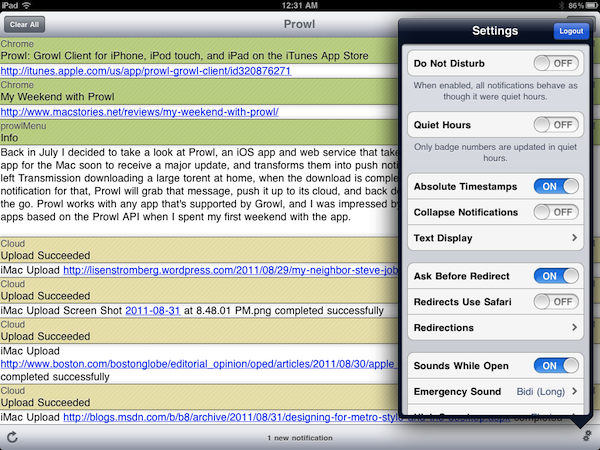
An update to Prowl for iOS was released today, and as the developers had previously teased this new version adds native iPad support and a “do not disturb” feature to force quiet hours when enabled. If you don’t want your devices to wake you in the middle of the night, that’s certainly welcome. And whilst the iPad app looks fairly similar to its iPhone counterpart in terms of design, the main notification list has been tweaked to be more refined and smaller in size. Notifications can be collapsed and expanded, and the settings have been moved to app’s toolbar.

This release also includes the following bug fixes:

  • Fixed quiet time setting the wrong time zone, thus being an hour off.
  • Fixed not leaving edit mode when removing the last entry.
  • Fixed some settings pages lacking titles.
  • Fixed cropping of Prowl app icon.
  • Fixed marking notifications as “new” even after backgrounding.
  • Fixed some description text sizing problems.

Prowl 1.3 retains its underlying simplicity in both design and function while adding some useful options to control how notifications are displayed. Get it here at $2.99.


MarkdownNote Brings Live Markdown Previews to OS X

Folks who enjoy writing in Markdown have already installed Brett Terpstra’s fantastic Marked for Mac, a nifty utility to generate HTML previews from Markdown documents written in any OS X application. You can read our review of version 1.2 here. Those who prefer a more cohesive writing environment with plain text/Markdown and HTML output living in the same application, however, might want to take a look at MarkdownNote, a new entry in the Markdown editing space that’s got some interesting features.

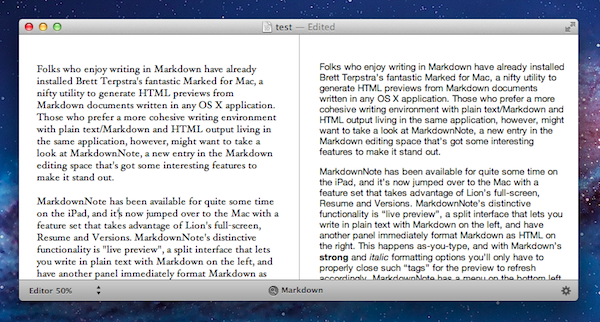
MarkdownNote has been available for quite some time on the iPad, and it’s now jumped over to the Mac with a feature set that takes advantage of Lion’s full-screen, Resume and Versions. MarkdownNote’s distinctive functionality is “live preview”, a split interface that lets you write in plain text with Markdown on the left, and have another panel immediately format Markdown as HTML on the right. This happens as-you-type, and with Markdown’s strong and italic formatting options you’ll only have to properly close such “tags” for the preview to refresh accordingly. MarkdownNote has a menu on the bottom left to resize the panels for Markdown and Live Preview, with options to set the editor and preview at 50, 70 or 100 percent.

MarkdownNote can save .txt files (everyone loves plain text, right?) , it lets you pick your own font and it’s got some further options to play with in the Preferences. When you’re done writing, you can copy the HTML and paste it somewhere else as usual. I’ve found MarkdownNote to be extremely useful in full-screen mode, as the split interface makes for a great alternative to having large borders around your text – with this app, you don’t waste space and you’ve got a live-updating preview at the same time.

MarkdownNote and Marked

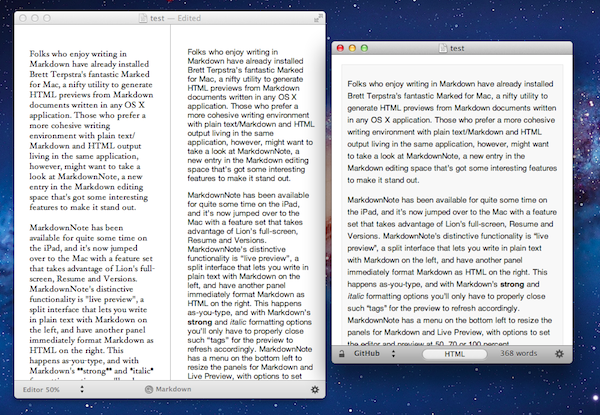
Best of all, MarkdownNote works great with Brett’s Marked, although you may wonder why would anyone use Marked when MarkdownNote has got a live preview. I think MarkdownNote is great at letting you write and quickly keep an eye on the correct visual output, but I still prefer Marked for editing – after I’ve written a long piece, I fire up Marked, choose my favorite style, see how many words I’ve typed, and I go through my Markdown. I love this combination of writing tools.

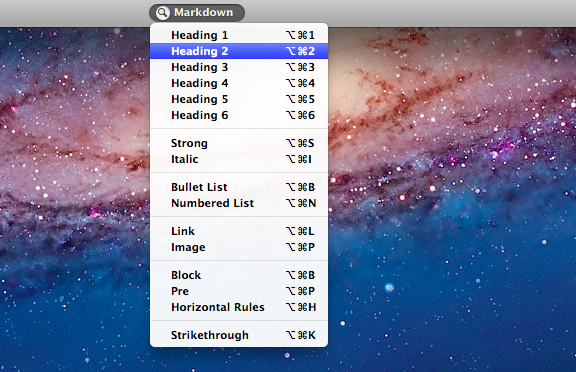
At $3.99 on the Mac App Store, MarkdownNote gives you an easy way to write in Markdown and instantly see how the words you typed will look like, and use keyboard shortcuts to facilitate the process of Markdown writing itself. MarkdownNote works really well in combination with Lion’s full-screen mode and Marked – if you’re a Markdown nerd, you should give this a try.