Posts in news


Apple Posts Mac OS X Lion Developer Preview 2

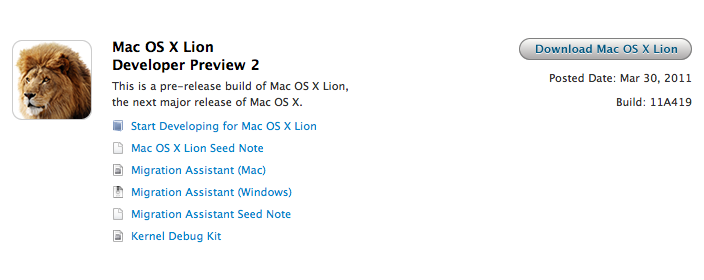
Following a brief fix in Software Update, here comes a new build of OS X Lion. It’s available now in the Mac Dev Center. Build number is 11A419. Once again, the new Developer Preview must be downloaded through the Mac App Store via a redeem code. It’s worth noting that OS X Lion Server has been posted as a separate build this time:

To install the Lion Developer Preview, you’ll need 10.6.7 or the previous developer preview which, again, needs to be updated in Software Update. For those who will need to pause their download from the Mac App Store and resume it, Apple says in the FAQ section:

If you need to interrupt your download for any reason, including changing the network you are connected to or traveling to a new location, ensure that you first Pause your download under the Purchases tab in Mac App Store. After you re-establish your connection, you may Resume your download under the Purchases tab.

While TechCrunch reported a few days ago that Apple would soon release a “GM” version of Lion to developers, it clearly appears that Lion still needs a few more updates before being ready for the golden master status. Several bloggers are speculating that a GM version will actually be released at the WWDC, which will kick off in San Francisco on June 6th.

Changes in the Lion Developer Preview 2 are still unknown. We’ll update this post as we gather more details.

TechCrunch now follows up to their previous report with details on today’s build:

More importantly, this is the build that Apple is considering to be a “GM1″ revision internally, we hear. And yes, it’s said to be much more stable and complete than the previous build.

Having said that, it’s unlikely that this will be the actual “Golden Master” copy. We’re still a solid two months away from Apple’s WWDC event where Lion will be a key area of focus. Apple may attempt to launch Lion there, but more likely is that the release candidates is handed out to developers there.


Photoshop For iPad To Be Updated With Support For Layers

Photography Bay got to go hands on with an updated Photoshop app for the iPad, which will bring support for layers and new features to compared original and edited photos. Recently, the Photoshop app was updated to its second version which included multitasking support and an update to utilize the Retina Display on the iPhone. Back in November, Adobe’s John Nack offered some insight as to what features would arrive in future app updates after a brief survey. Electronista notes that an updated Photoshop would, “help address the lack of content creation, one of the most commonly cited flaws of the platform.” Maybe the author hasn’t been paying attention, but while Adobe is updating Photoshop, many other photo editors such as Photogene, Masque, and PhotoForge have existed for a while. An update to Photoshop is still, however, a welcome addition to the iPad. While the Photography bay was able to snap some blurry demo photos and video, the video hasn’t been published online and has been noted to be published later tonight.

[Photography Bay via Electronista]


Apple Releases Lion Developer Preview Update 1

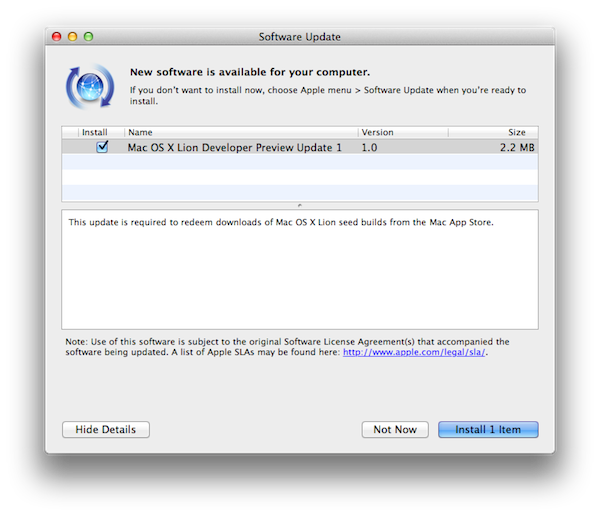
As noted by iClarified, Apple just released a first update for the OS X Lion developer preview in Software Update. A few days ago, TechCrunch reported Apple was getting ready to seed a GM build of Mac OS X Lion, and while this build isn’t touted as “golden master” to developers, it appears that the sources close to TechCrunch were right about Lion moving forward in the development stages.

The changelog indeed suggests this is only an update aimed at allowing developers to download new builds from the Mac App Store in the future:

This update is required to redeem downloads of Mac OS X Lion seed builds from the Mac App Store.

We’ll update this post with changes as more details come in.


Apple Releases 10.6.7 Supplemental Update For the 13” MacBook Air

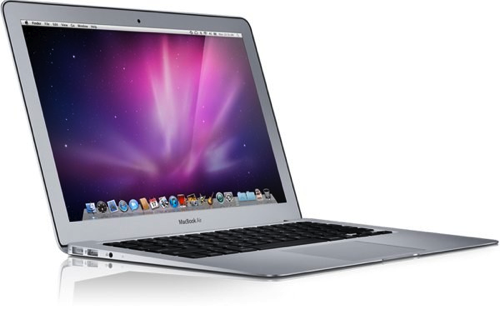
MacBooks have been getting their fair share of updates recently, and today Apple is providing a supplemental 10.6.7 update for the 13” MacBook Air (Late 2010) to resolve unresponsiveness when using iTunes. The previous 10.6.7 v1.0 (build 10J869) update must be installed in order to apply the supplemental update. If you have a 13” MacBook Air, check Software Update or download the 461 KB file from the posted support page below.

Supplemental 13” MacBook Air Update: DL1370


In Which We Apologize For The Downtime

Driving a decade old pickup, my first year of college was hampered with consistent issues revolving around anything and everything electrical, engine, axel, and the front arms even had to be replaced. I’ve had some terrible experiences when I purchased my first vehicle, including a scary engine misfire and a superheated rotor. At times I thought my truck would almost shake to pieces, but every time I managed to coast down that hill and limp the truck into the dealership. Often times when your vehicle breaks down or needs immediate maintenance, it comes at the inconvenience of others. Mechanics have to work late and adjust their schedules, friends are called to pick you up, and it ends up being a terrible hassle.

MacStories has had issues before, but today’s outage and downtime reminded me of all the issues I’ve had in my personal life, and it came at the inconvenience of our readers and advertisers. We apologize for the downtime, and thank you for your patience as we took the site offline, fixed what needed to be fixed, and brought the mothership back online. Needless to say that process didn’t go as smoothly as we had hoped, but now we’re running at full speed and believe our issue has been promptly resolved. We’ll be taking great care to prevent this kind of outage in the future. I want to thank everyone who offered help on Twitter, and a big thanks goes out to Alessandro Vendruscolo (@misterjack).

Now, let’s say we get some reviews out?

Yours truly,

The MacStories Team


With Apple’s New System, Popular Science Sells 10,000 iPad Subscriptions

Ever since Apple launched its new subscription system for “publishing apps” in February, there’s been a huge backlash over the implementation of the service itself, which requires publishers to give away 30% of the revenue to Apple (just like every “regular” App Store application) and allows consumers to opt-in for sharing personal data with the publisher. The new policy left many unhappy with Apple’s decision to protect the user’s privacy and ask for the same 30% cut on every subscription sold; plus, the notable rejection of the Readability app raised some questions and doubts over the whole idea of “publishing apps” and software that simply gives access to content published by others. Still, in spite of the debates and speculation, the first numbers are coming in, and they’re rather interesting.

Speaking with AdAge, VP-group publisher at the Bonnier Technology Group Gregg Hano confirmed the Popular Science iPad app sold 10,000 subscriptions since the update six weeks ago that enabled support for Apple’s new in-app subscription technology. And even if Popular Science has 1.2 million print subscribers and the iPad’s numbers are quite low right now, the publication is excited about the possibilities offered by Apple and the iTunes Store.

We really did not have any expectation of what would happen because we’re really pioneers.

We’ve been averaging 10,000 to 12,000 unit sales per month almost since the beginning,” Mr. Hano said. “Now we’re going to be above that in March. We’re inching up over that. And we look forward to continuing to see subscriptions grow. Hopefully people keep testing Popular Science on their tablets and then hopefully come back and subscribing.

The obvious downside, Hano confirms, is that they have so access to subscribers’ data:

We don’t have any information on where the subscribers are coming from or whether or not they are or are not print subscribers,” Mr. Hano said. “Nor do we at this time know the number of people who have opted in to share their data with us.

The Popular Science iPad app is available for free in the App Store and comes with in-app purchases for single issues ($2.99 for old ones, $4.99 for the latest issue) and a $14.99 annual digital subscription. A print subscription to the magazine costs $12.99 on Popular Science’s website. iPad magazines have been struggling with finding a loyal userbase mainly due to complicated subscription systems and clunky user interfaces, so an easy-to-use payment system based on the iTunes Store (Apple has 200 million credit cards on file thanks to iTunes) might really be the first step to get things started and change the way consumers think of digital publications for the iPad. [via The Loop]


Justin.tv iPhone App Adds AirPlay Support

Today an update to the Justin.tv iPhone app brings AirPlay functionality to the app, letting you stream one of the thousands live-streaming Justin.tv channels straight onto your big screen television via an Apple TV.If you aren’t familiar with Justin.tv, it is a similar service to Ustream, which gives users the power to create a live video stream and broadcast themselves to the world live.

The app update also fixes a couple of bugs that were causing some users to experience the app crashing on them. Also remember that some third-party apps let you use AirPlay to stream to other devices, helpful if you don’t have an Apple TV but want to stream it somewhere else.


iFixit Tears Down, Compares WiFi, GSM And CDMA iPad 2s

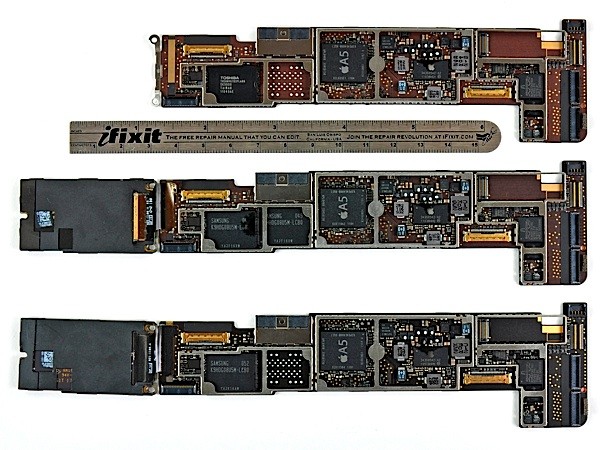
If you’ve been intrigued by what exactly is different between the WiFi, GSM (AT&T) and CDMA (Verizon) versions of the iPad 2, well iFixit has you covered yet again with some very nice comparisons of the internals of those three base models. The above photo shows you the logic board of the three (WiFi up top and 3G below the ruler) but iFixit also documents the other key vitals of the iPad 2 on their site from the various antennas, 3G chips and the headphone jack.

The key differences to note are that the CDMA model has an additional antenna compared to the GSM variety and it also uses a Qualcomm Gobi dual-mode radio with integrated GPS that actually supports both CDMA and GSM, but the GSM compatibility is unused by the iPad. As for the GSM models, they use an Infineon GSM chip and a Broadcom GPS chip. Interestingly the hardware for both the CDMA and GSM iPad 2 follows the iPhone 4, in which the GSM versions used that Infineon and Broadcom chips whilst the Verizon CDMA version used the single Qualcomm one.

Want to see more? Jump through to the iFixit site and don’t forget to have a look at the full iPad 2 teardown and Smart Cover teardown that they also did earlier this month.

[Via Engadget]