Posts in news

Wu: iPad Production Issues Have “Significantly Improved”

According to a new report by Sterne Agee analyst Shaw Wu relayed by Fortune, the production issues that were affecting the iPad 2 supply chain over the past months have “significantly improved”, with shipments approaching 3-4 million units per month as constraints ease on the suppliers’ end. Wu now estimates 6.8 million iPads for the quarter that ends on June 25 up from 5.9 million units, as well as 17 million iPhones and 3.9 million Macs. Wu notes how the release of the white iPhone marks a “continued strong adoption” of the product, also helped by the availability of the iPhone on Verizon in the United States.

The production problems that hurt iPad shipments last quarter have “significantly improved,” writes Wu, “with better yields and higher output due to successful retooling and conversion of more production lines to iPad 2.” This would appear to contradict recent reports of shortages of both components and labor.

The iPad “still has a ways” to go to hit what Wu says is Apple’s goal of 3-4 million units per month by the second half of 2011, but is “getting closer.”

Contradicting reports posted in the past weeks indicated Apple was still facing production issues with the iPad 2 because of the Japan earthquake and tsunami, alongside other problems encountered at Foxconn’s facilities, which led FBR analyst Craig Berger to believe Apple would be unable to meet the internal goal of 40-45 million iPads produced this year. Among the technical issues mentioned by separate reports recently, the iPad 2 shortages were linked to speaker and display production issues related to light leakage problems discovered in some LG screen units shipped last quarter.

iOS Devices Now Included In Amazon’s Trade-In Program

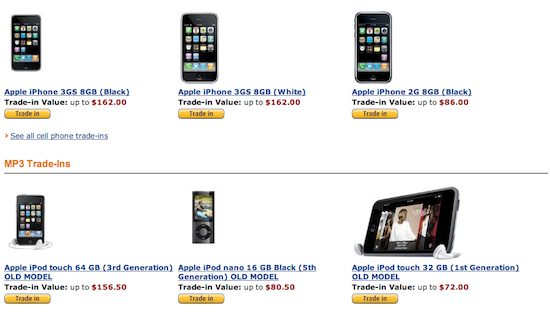
As noted by TUAW, online retailer Amazon has updated their electronics trade-in program to include Apple devices like older iPod touch and iPhone 3GS models, iPod Classics and original iPads. The webpage is available here, Amazon states it’s currently in “beta” status and items have to match several criteria to be eligible for the program. The devices have to be working units of course, must be in good hardware conditions, and mailing one back to Amazon (though a separate retailer handles the program, Amazon still provides the backend interface) will get you credits to spend on Amazon.com.

Prices seem to be pretty convenient, too: trading in a third-generation 64 GB iPod touch will result in $156 of credit, whilst an old 8 GB iPhone 3GS is priced at $162. A WiFi iPad 1st gen with 16 GB of storage has a trade-in value of $235, and a 16 GB iPad 2 (WiFi) is listed at $330.


Intel: Apple Transferring Thunderbolt Trademark To Us

In recent days there has been confusion over who exactly owns the trademark to the Thunderbolt brand – it had been revealed that Apple had sent trademark requests for the Thunderbolt name despite Intel developing most of the I/O technology. Intel had developed what was formally known as Light Peak, a technology that would allow high-speed connectivity of up to 100Gbps using an optical cable. Apple had then suggested to Intel in 2009 to add the capability of 10 Watts of power and construct the cable out of copper instead.

The fact that Intel did not have ownership of the Thunderbolt brand trademark caused confusion amongst many, as a result, Bright Side of the News contacted Intel and asked them about the situation. The Senior Communications Manager at Intel, Dave Salvator responded and said

As part of our collaboration with Apple, they did some of the initial trademark filings.  Intel has full rights to the Thunderbolt trademark now and into the future. The Thunderbolt name will be used going forward on all platforms, irrespective of operating system.

Effectively what this means is that Apple did the original trademark work but will be transferring it back to Intel. But Apple won’t be leaving empty handed, they get in return unrestricted use of the technology. Others, such as Sony, which are planning to implement the Thunderbolt technology into their own upcoming laptops (using a USB-style port) will still have to resolve trademark disputes with Intel. Salvator also provided some clarification on the future of Thunderbolt moving towards the originally planned optical technology. He said that Intel is working now on the design of the optical version and that

The (Thunderbolt optical) cable could carry power in the same cable (running next to optical part of cable), but exact product plans are still to be announced.

[Via Bright Side of the News]


Screenshots Reveal New “Daily Download” App for Apple Retail Employees

Following all the rumors posted in the past week surrounding Apple’s internal retail meetings set for May 22 and the alleged launch of a new retail store experience dubbed Apple Store 2.0, 9to5mac has managed to get their hands on one of those retail-specific iPads we previously reported on, grabbing some screenshots of the new “Daily Download” application for employees. As the website explains, the Daily Download used to be a web application where employees could get access to an internal “newspaper” with various material including news and product indexes.

9to5mac also says that private folder Apple employees were instructed to download from Apple’s servers with GBs of data inside contained disk images of Lion, which is going to be installed on some store machines. It’s unclear, however, how Apple managed to deploy a stable, final version of Lion for retail, when the consumer version is still stuck at beta 3 with several stability issues.

The “gigs of data” for sunday, as far as I can tell from the general consensus around the store and some of my contacts is that we will infact be downloading OS X Lion images and installing on all FOH machines for a Sunday launch. Nothing else fits since all other visual content has already been pulled from the apple servers that we gather content from. Lion is the mutual feeling around the store, even from managers. Speaking of managers, they have been given a general idea about what is happening, but full details will be revealed to them on friday evening.

We’ll know more for sure come Monday morning, May 22, and you can check out more screenshots of Daily Download here. Rumors have pointed to Apple organizing a product launch, a store re-organization and a 10th anniversary celebration for retail on May 22, though at this point an overhaul of some retail store operations seems more likely.


Second Build of Mac OS X 10.6.8 Seeded to Developers

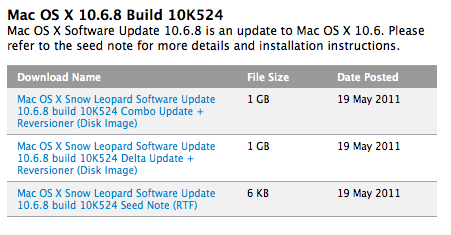
Last night, Apple seeded the second build of Mac OS X 10.6.8 to developers. The new build, weighing at around 1 GB, carries number 10K524 and it’s available now for download in the Mac Dev Center. According to people familiar with the new release, focus areas mentioned in the seed notes are still AirPort, Graphics Drivers, Mac App Store, Networking, QuickTime and VPN.

The first build of 10.6.8 was seeded last week on May 13, coming as a surprise for those who thought Mac OS X 10.6.7 would be the last Snow Leopard update. Apple is expected to unveil the final version of 10.7 Lion at the WWDC in June with a public release this summer, leading many to believe 10.6.8 will be the last maintenance update for machines running Snow Leopard.


Apple Reaches Deal with Sony Over Cloud Music

As work on the rumored cloud music service nears finalization for an official WWDC announcement, Bloomberg reported last night Apple has reached a deal with Sony Music Entertainment, following reports that the company managed to sign the Warner Music Group and EMI. This leaves Universal, the biggest label of all four in the United States, out of the equation, but according to the rumors Apple’s Eddy Cue is actively focused on closing all the remaining paperwork with music labels by next week.

Apple has reached licensing accords with Sony Corp. (6758)’s music division, EMI Group and Warner Music Group, the people said. Universal Music Group, the largest recording company, is close to a deal, another person said. The company also would need to reach agreements with music publishers, which control different rights than the labels.

Apple’s cloud music service is said to be part of a major MobileMe revamp the company has been working on for the past two years, which will include several new functionalities and a new price point with basic features offered for free. As for the music service, it’s unclear whether Apple will adopt an upload system like Google and Amazon or a subscription-based delivery with songs coming from the iTunes Store, but a patent surfaced yesterday seems to suggest Apple’s implementation will go as far as allowing users to upload their own songs, and stream others they don’t own from a larger “content source” like the iTunes Store.


DropDAV 2.0 Launches, Goes Paid at $5 Per Month

If you’re a heavy user of the iWork suite for iPad or the recently released OmniOutliner and have been looking for a way to easily keep documents in “sync” across machines, you’ve probably already heard of DropDAV. By providing a WebDAV interface to your existing Dropbox account, DropDAV allows you to export documents using iOS apps’ “save to WebDAV” function, and have your docs conveniently saved on the desktop. Because DropDAV simply gives Dropbox the capability of becoming a WeDAV server, you’re not really “syncing” documents when you use Pages or Number for iPad –rather, as these apps already use WebDAV, you’re given the option to at least save to Dropbox. That’s something.

The first version of DropDAV, launched a few months ago, became so popular that the developers had to rethink the service from the ground-up and rewrite the whole engine to support the latest WebDAV standards, offer more speed and reliability, and find a pricing model that would keep operations going. DropDAV 1.0, in fact, was free if you were connecting to a free 2 GB Dropbox account, and asked you to pay only if you had a paid Dropbox account. With version 2.0, officially announced two days ago, gone is the freemium model and the differentiation between free and paid Dropbox accounts: DropDAV now has a 14-day free trial, and after that it’s $5 per month. Simple. The developers explain they’ve completely rebuilt DropDAV to be faster, more compliant to standards and less prone to server-side errors; by integrating with the powerful Dropbox API, DropDAV still allows you to virtually export to WebDAV from any app that supports the protocol, and have documents actually offloaded to Dropbox. It works really, really well and, from what I can tell after a quick test (I’m a subscriber), it’s seriously faster and improved. From a technical standpoint, the devs write:

We identified inconsistencies in the way PHP and the OAuth Pear plugin worked with UTF-8 strings. We created a taxonomy of WebDAV clients, sorting out which ones behaved similarly. We integrated in support for WebDAV locking to comply with the Class 2 specifications.

In the end, we bridged our legacy implementations of WebDAV’s hairier functions (written in PHP) with the native UTF-8 support and better Dropbox client in Python. We settled on an implementation that includes extensible request parsing in PHP, communication with Dropbox in Python, then extensible response formatting back in PHP. It’s a lot cleaner than it sounds, and it works really, really well for the entire UTF-8 character set and XML Special characters.

Class 2 support is still a work in progress. In truth, it’s somewhat of a hack in that Dropbox doesn’t support locking, so we could only create the illusion of locking for our WebDAV clients. We think we’ve done that well enough to roll out and will continue improving it to eventually pass the Litmus test in the coming weeks.

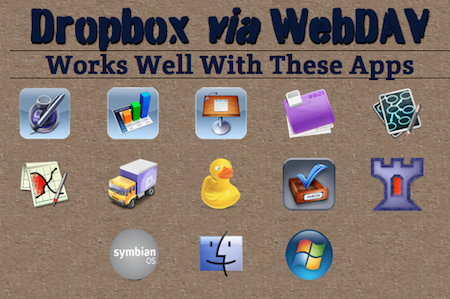
If you haven’t checked out DropDAV already, here’s your chance to start a free trial and connect the service to your Dropbox. It works great with the iWork suite, The Omni Group’s apps and a variety of file managers for OS X and iOS (such as iFiles), and it’s probably the best shot you have if you don’t want to go insane with Pages and exporting files in iTunes.


Apple “iTV” Prototype Shows Up on eBay

As noted by MacRumors, a prototype “iTV” of the device that eventually shipped as the first-generation Apple TV is now available on eBay for a “Buy Now” price of $350. The device, resembling the original Apple TV with only an Apple logo on top but lacking the “TV” branding, is still functional and also managed to receive Apple TV software updates throughout the years, in spite of its internal and not-for-release nature that would suggest the device is not capable of running the latest software. However, the iTV is apparently working correctly and showing the 3.0 software update from 2007. The seller on eBay claims the pictures are the best description he can provide, and admittedly the device seems in good conditions.

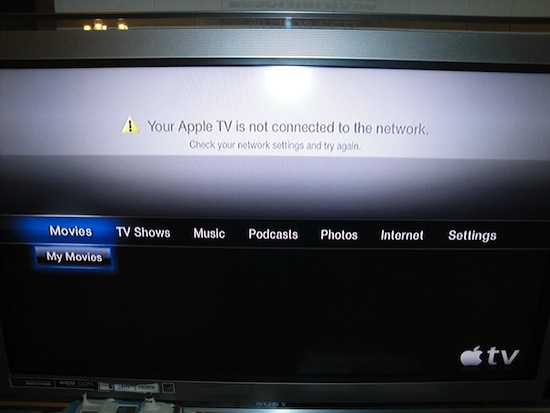
The photos also show the device booted up and displaying the stock photo screensaver, although it is not connected to the Internet and the item’s description indicates that it has not been fully tested for functionality.

The iTV also has a couple of labels on its back, depicting the DVT (device verification test) status and the “Apple Development Team” that originally owned it and somehow gave it to someone else. Overall, the device looks like a genuine hardware verification unit that eventually shipped with a different logo, but still retains all the functionalities of the original Apple TV. Check it out here before it’s too late.


Dual-Mode Verizon iPhone 4S to be Released With AT&T Version

Verizon has been a leaky faucet lately, with our first real bit of insight into Apple’s strategy coming in April where CFO Fran Shammo spoke about a global iPhone hitting shelves at the same time as their competitors. The idea of a dual-mode phone was “reiterated” again by Shammo at Reteurs’ technology summits: to be clear, the idea that Verizon would launch a dual-mode, GSM/CDMA capable model alongside AT&T would give it equal footing when customers decide on a carrier. Shammo offered further clarity that the iPhone probably won’t be an LTE device, noting, ”It’s a bigger issue for Apple than it is for us.” Apple is focused on providing an iPhone that works globally at the moment, rather than focusing on LTE technologies. Verizon themselves aren’t concerned about the lack of LTE on the next iPhone, given that they already have a slew of Android devices that offer their functionality if consumers desire it.

Along with iPhone plans, Shammo also said family plans would get shared data plans after the switch to tiered pricing. An end to unlimited on-device data plans was still on track for the summer, but he said it was sure Verizon would have “mega-plans” where a certain number of devices had a larger pool of data.

If you’re planning on getting an unlimited plan under Verizon, your switch from AT&T to the big red may not matter once Verizon adopts tiered pricing. Likely to be competitive with AT&T who’re currently offering 2GB of data for $25 a month, Verizon may also offer customers buying multiple phones a discount, and that mega-plans may offer incentives such as the ability to ‘borrow’ plans from other 3G devices (read: free tethering).

The next iPhone is rumored to be on track for an improved camera, bigger display, and an A5 processor. Apple should currently be in the process of ramping down iPhone 4 shipments (expecting to ship 2 million less in Q2) as the new batch of next generation iPhones are scheduled to begin production in August. The next iPhone will also likely feature an 8 MP Sony camera, as well as sporting a new design with relocated flash. All of us are going to be incredibly anxious as it’s unlikely Apple will launch a new iPhone in June or July, but I’m guessing September is looking like it’ll be bigger than we expected.

[Reuters via Electronista]