Posts in news

Instagram’s New Experiment: Open Up The API for Third-Party Uploads

Hipstamatic, a photo sharing app for the iPhone that allows users to apply vintage/analog effects and filters to their photos, has become the first app to directly integrate with Instagram. The popular iPhone-only sharing service, now boasting over 27 million users and on the verge of releasing an Android app, has so far allowed third-party developers to integrate their apps with the Instagram API to only visualize a user’s photos or feed. The API hasn’t allowed for the creation of real Instagram clients for other devices, in that uploading could be done exclusively using Instagram’s own app.

Today, however, an update to Hipstamatic and a collaboration between the two services first reported by Fast Company might signal an important change in Instagram’s direction and nature as a photo sharing service. The new Hipstamatic, available now on the App Store, comes with a redesigned “HipstaShare” system to send photos to various social networks including Facebook, Twitter, and Flickr. Among the supported services, a new Instagram option now enables you to log into your Instagram account, and upload photos directly within Hipstamatic, without leaving the app. There is no “forwarding” of files to the Instagram app, nor does Hipstamatic asks you to download the Instagram app from the App Store – this is true uploading to Instagram done by a third-party, via the API.

Unlike most photo sharing apps these days, Hipstamatic puts great focus on recreating the analog experience of shooting photos and carefully selecting the equipment you’d like to shoot with. With a somewhat accurate representation of vintage films, lenses, camera cases, and flash units, Hipstamatic wants to appeal to that kind of userbase that is not simply interested in capturing a fleeing moment and share it in seconds; rather, as famous appearances on publications like The New York Times confirm, the Hipstamatic crowd is more of a passionate gathering of 4 million users looking to spend minutes, if not hours, trying to achieve the perfect setup for each occasion, spending one dollar at a time on in-app purchases that unlock different filters and “parts” of the cameras supported in Hipstamatic. Unlike Instagram or, say, Camera+, Hipstamatic isn’t built to shoot & share; the ultimate goal is undoubtedly sharing, but it’d be more appropriate to describe Hipstamatic’s workflow as “set up, shoot, then share”.

Hipstamatic seems to have realized, however, that sharing can’t be relegated to a simple accessory  that has a second place behind the app’s custom effects and unlockable items. Whilst in-app purchases and fancy graphics may have played an important role in driving Hipstamatic’s success so far, apps can’t go without a strong sharing and social foundation nowadays, and since its launch two years ago, Instagram has seen tremendous growth for being only an iPhone app. With this update, Instagram and Hipstamatic are doing a favor to each other: Instagram gets to test the waters with an API that now allows for uploading through other clients that support similar feature sets; Hipstamatic maintains its existing functionalities, but it adds a new social layer that plugs natively into the world’s hottest photo sharing startup.
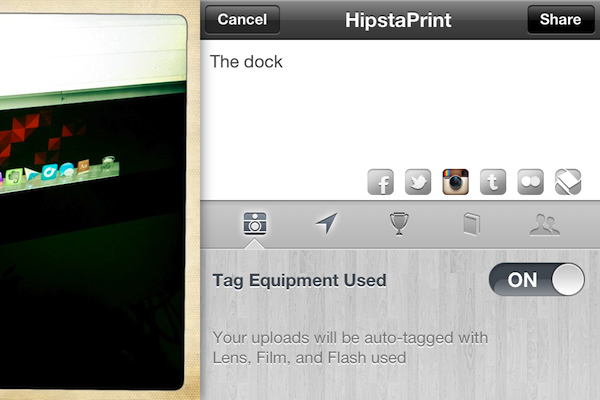
Looking at the terms of the “deal” (I don’t think any revenue sharing is taking place between the two parties), it appears both sides got the perks they wanted. This native integration comes with an Instagram icon in Hipstamatic’s new sharing menu, which, when tapped, will let you log into your account. Once active, each “Hipstaprint” (another fancy name for photos) can be shared on a variety of networks, with Facebook even supporting friend tagging. You can upload multiple photos at once if you want, too. In the sharing panel, you can optionally decide to activate “equipment tagging” – this option will, alongside the client’s information, include #hashtags for the lens, film and other equipment that you use in your Hipstamatic camera.

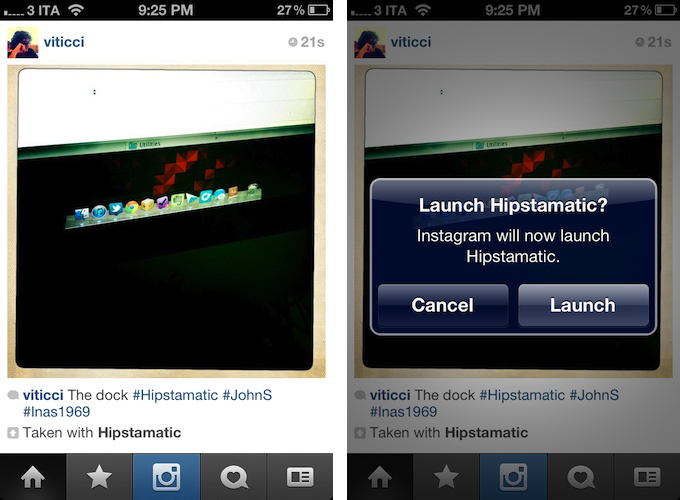
On the Instagram’s side, things get a little more interesting. Hipstamatic photos get uploaded respecting Instagram’s photo sizes, and they get a border around the image to, I guess, indicate their “print” nature. Together with the title, Instagram will display the aforementioned tags for equipment, and a “Taken with Hipstamatic” link that, when tapped, will ask you to launch Hipstamatic. If you don’t have Hipstamatic installed on your iPhone, this link will take you to the App Store page for the app.

Overall, what really intrigues me about this collaboration isn’t the Hipstamatic update per se – version “250” of the app is solid and well-built, but I don’t use Hipstamatic myself on a regular basis, as I prefer more direct tools like Instagram, Camera+, or even the Facebook app for iOS. What I really think could be huge, both for the companies involved and the users, is the API that Hipstamatic is leveraging here. Hipstamatic is doing the right thing: sharing has become a fundamental part of the mobile photo taking process, and it would be foolish to ignore Instagram’s popularity and come up with a whole new network.

Instagram, on the other hand, is taking an interesting path (no pun intended) that, sometime down the road, might turn what was once an iPhone app into a de-facto option for all future social sharing implementations. A few months from now, would it be crazy to think Camera+ could integrate with Instagram to offer antive uploads? Or to imagine built-in support for Instagram photo uploads in, say, iOS, Twitter clients, and other photo apps? I don’t think so. Just as “taken with Hipstamatic” stands out in today’s Instagram feeds, “Upload to Instagram” doesn’t sound too absurd at this point.

Ahead Of Angry Birds Space Launch Tomorrow, Rovio Releases Final Trailer

Rovio has released the final trailer for Angry Birds Space, the fourth game in the Angry Birds series (following the original, Seasons and Rio). The trailer introduces the space theme with an introduction scene showing the birds being flung into space. The rest of the trailer mixes quotes, shots of each of the birds (such as the one seen above) and some gameplay footage of the new levels.

Naturally the new game features some twists such as zero gravity and a “light speed destruction” feature. Angry Birds Space launches tomorrow, March 22nd on iOS, Android, Mac and PC. Jump the break for the full trailer, or watch it on YouTube.

Read more


Apple Confirms: Three Million iPads Sold In 4 Days

Apple just confirmed with a press release they have sold over 3 million iPads since the device’s debut on March 16.

The new iPad is a blockbuster with three million sold―the strongest iPad launch yet,” said Philip Schiller, Apple’s senior vice president of Worldwide Marketing. “Customers are loving the incredible new features of iPad, including the stunning Retina display, and we can’t wait to get it into the hands of even more customers around the world this Friday.

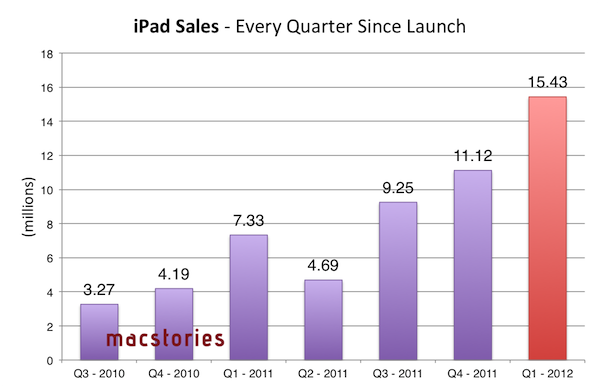
To put these numbers in perspective, let’s take a trip down Apple’s iPad memory lane again and remember how iPad sales evolved over time.

And then, of course, the company kept pushing the iPad quarter after quarter with new software, new apps, and a new version in March 2011, achieving these results:

It is worth noting, however, that the original iPad and iPad 2 went on sale exclusively in the United States on Day One, whilst today’s iPad numbers include sales and pre-orders for the United States and 9 more launch countries from March 16, 2012. This Friday (March 23), the device will go on sale in Austria, Belgium, Bulgaria, Czech Republic, Denmark, Finland, Greece, Hungary, Iceland, Ireland, Italy, Liechtenstein, Luxembourg, Macau, Mexico, The Netherlands, New Zealand, Norway, Poland, Portugal, Romania, Slovakia, Slovenia, Spain and Sweden.

For comparison, the new iPad has sold 3 million units in 4 days, while the iPhone 4S sold 4 million units in 3 days last October (the 4S went on sale in 7 countries on October 14, 2011). The iPhone 4S has been the Apple’s biggest success with the iPhone line so far, reporting over 37 million units sold in the last quarter. If these initial are of any indication, it seems like Apple’s strategy with multiple, international rollouts a week from each other may lead to the biggest iPad launch to date.

Earlier today, Apple CEO Tim Cook said the company saw “record” sales for the new iPad in its opening weekend. The new iPad launched to very positive reviews from the press (which mentioned the device’s Retina display, LTE, and battery life as great selling points) and long lines around the world.


Apple Adds “Answers from the community” Section To More Product Pages

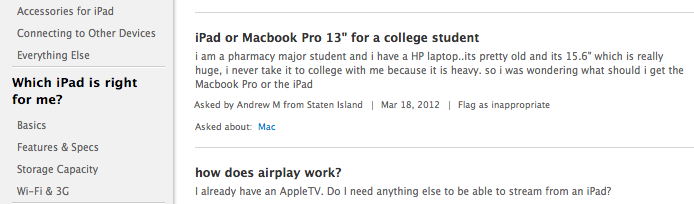
As noted by The Next Web, Apple has added a new “Answers from the community” section at the bottom of product pages accessed from the company’s online store, allowing users to read questions and answers submitted by the community, and reply to them by logging in with an Apple ID. Currently, a product page on Apple’s website doesn’t have this new section, but its dedicated retail store page does. Here’s an example of the iPad webpage, and its retail page. Furthermore, the section appears to have been enabled only for English-speaking countries: it is available on the US, UK, Canada and Australia Apple online stores, but it can’t be found in France or Italy.

In product pages, the new section is embedded at the bottom, displaying top questions from the community alongside “popular topics”. Single-product Q&A pages are available as well, with a sidebar on the left listing more popular topics and questions, and a link to visualize the most recent answers for a specific product. Questions include a variety of topics, such as, for the iPad, “which iPad is right for me?” and “what can I do with an iPad?”, alongside other discussions about apps, features, and “everything else”. Users can read questions without logging in, read all answers, browse similar questions, and submit an answer of their own through a dedicated form.

Separate from the Apple Support Communities that the company revamped last year, the “Answers from the community” section comes with a set of guidelines Apple is making publicly available. These guidelines have been online for quite some time – the possibility of leaving ratings, reviews, and questions has been a feature of the Apple online store, in one form or another, for years now – but the integration with product pages and overall graphical look are new.

It’s interesting to notice how, in the past months, Apple has been slightly tweaking the online Store to include social functionalities aimed at increasing options to share and discuss products. Last summer, Apple added Facebook and Twitter sharing to its online store, letting customers easily share links to a product with their friends and followers. Community answers are nothing new as a concept, but the way they are now prominently displayed on more product pages from the online Store signals a renewed focus on making the shopping experience more “personal” by enabling people to answer questions that, too often, an official FAQ section can only partially cover.


Apple Confirms Dividend and Share Repurchase Program

Apple just confirmed with a press release they are initiating a dividend and share repurchase program later this year. The company posted a press release yesterday, saying they would make an announcement related to their cash balance today.

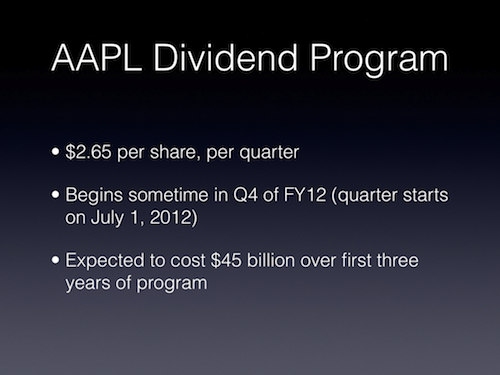
Subject to declaration by the Board of Directors, the Company plans to initiate a quarterly dividend of $2.65 per share sometime in the fourth quarter of its fiscal 2012, which begins on July 1, 2012.

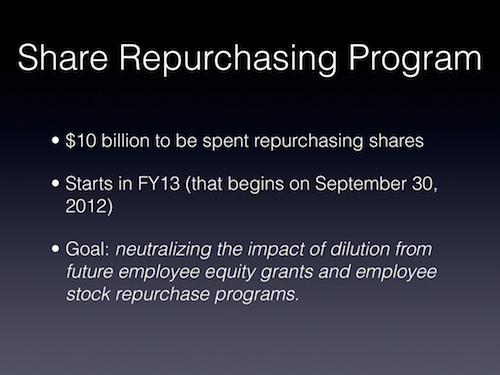
Additionally, the Company’s Board of Directors has authorized a $10 billion share repurchase program commencing in the Company’s fiscal 2013, which begins on September 30, 2012. The repurchase program is expected to be executed over three years, with the primary objective of neutralizing the impact of dilution from future employee equity grants and employee stock purchase programs.

Quoted in the press release, Apple CEO Tim Cook said the company has used its cash to make “great investments” with “increased research and development, acquisitions, new retail store openings, strategic prepayments and capital expenditures in our supply chain”. With “plenty of cash to run the business left”, Cook said to expect more of these from Apple in the future. Apple expects to utilize “approximately $45 billion of domestic cash in the first three years” for the programs.

Apple’s last dividend goes back to 1995, according to the company’s official Investor website. In 2010, Steve Jobs said he preferred the company to hold onto its cash, rather than paying a dividend to investors:

We know if we need to acquire something — a piece of the puzzle to make something big and bold — we can write a check for it and not borrow a lot of money and put our whole company at risk,” Jobs said today at Apple’s shareholder meeting. “The cash in the bank gives us tremendous security and flexibility.

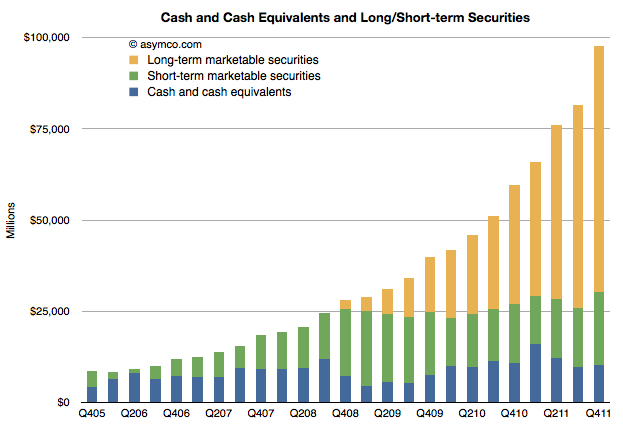
The direction, however, has been revised in the past years, with Cook and CFO Oppenheimer stating on multiple occasions Apple was in “active discussions” with the board in regards to its cash balance, now account for nearly $98 billion in cash ($97.6 billion in cash at end of December), cash equivalents, short-term marketable securities, and long term marketable securities.

Apple will provide a live stream of the conference call on its website starting at 9 AM EDT. Read more


Apple Schedules Conference Call To Announce Outcome of Cash Balance Discussions

Apple just issued a press release confirming a conference call scheduled for tomorrow, March 19th, to announce the outcome of discussions concerning the company’s cash balance.

Tim Cook, Apple’s CEO, and Peter Oppenheimer, Apple’s CFO, will host a conference call to announce the outcome of the Company’s discussions concerning its cash balance. Apple® will not be providing an update on the current quarter nor will any topics be discussed other than cash.

Apple will provide a live stream of the conference call on its website starting at 6 AM PDT (9 AM EDT). As noted in the press release, Apple won’t discuss any other details related to the ongoing quarter – as such, we shouldn’t expect any sales numbers related to the release of the new iPad during the conference call.

Apple, whose stock is currently trading at $585, has been rumored for years to be on the verge of announcing a dividend for its shareholders. In the past years, however, both CFO Oppenheimer as well as Tim Cook himself reiterated several times that Apple’s cash wasn’t “burning a hole in their pocket” – the company may have avoided discussions of a dividend, but as Tim Cook also recently noted, they haven’t been religious about holding or not holding cash. In the past year alone, Apple bought Israeli chip maker Anobit and App Store search and indexing service Chomp. Similarly, it was previously reported that $3.9 billion of Apple’s cash reserves may have gone into securing deals for LCD displays and other components in 2011.

At a shareholder meeting in 2010, Steve Jobs said he preferred the company to hold onto its cash for potential investments, rather than paying a dividend:

We know if we need to acquire something – a piece of the puzzle to make something big and bold – we can write a check for it and not borrow a lot of money and put our whole company at risk,” Jobs said today at Apple’s shareholder meeting. “The cash in the bank gives us tremendous security and flexibility.

During the Q4 2011 earnings call, Tim Cook, however, said:

To date we’ve wanted to have flexibility…. The cash isn’t burning a hole in our pockets and we’re not going to do silly things with it. We invest it conservatively….We’ve taken money and done things in Apple’s best interests, for example we’ve acquired several companies, some IP, we’ve invested in the supply chain and we use money to build out our stores and for new product tooling. So I believe what we’re doing with cash …that said, I’m not religious about holding cash or not holding it, I’m religious about of a lot of things, but that’s not one of them. We do what we believe is in Apple’s best interests …and we’ll continue to discuss it on the Apple board.

With just under $98 billion in cash and liquid investments ($97.6 billion in cash at end of December, compared to $81.6 billion at end of September with an increase in $16 billion), in February 2012 at the Goldman Sachs Technology Conference Cook said Apple has been “judicious” and “deliberate” with its cash.

Yes, we still have a lot. I would say we’re judicious and deliberate. We spend our money like it’s our last pennies. I think shareholders want us to do that. They don’t want us to act like we’re rich. We’ve never felt that way. It may sound bizarre but that’s the truth. In terms of our approach to cash, I’ve said since becoming CEO that I’m not religious about this. I’m not religious about holding it or not holding it. We’re in very active discussions at the board level on what we should do.

I think everyone would want us to be deliberate and really think it through. That’s what we’re doing. We’re not going to go have a toga party and do something outlandish. People don’t have to worry that it’s burning a hole in our pocket.

Via Asymco, an image showing the composition and scale of Apple’s cash holdings.

As Philip Elmer-DeWitt noted in February, there are some options Apple could consider with its cash. These options analysts and journalists have suggested include a one-time dividend, a stock split, a share repurchase plan, and an annual dividend. While there haven’t been any signs of the company effectively considering said options with for its cash holdings, Tim Cook publicly stated they were only asking “for a bit of patience” to make the “best decision for the shareholders”. He also went on the record saying Apple has “more cash than we need to run the business on a daily basis”.

We will post details of Apple’s announcement starting at 9 AM EDT tomorrow on MacStories’ homepage.


Apple Seeds OS X Lion 10.7.4 to Developers

Following the release of the second Developer Preview of Mountain Lion earlier today, Apple has also released a pre-release version of OS X Lion 10.7.4 to developers. Build 11E27 is available now for download in the Mac Dev Center to registered Mac developers. A Server build for 10.7.4 has also been seeded to developers.

The last public version of OS X Lion, 10.7.3, was released on February 1st, adding bug fixes and addressing compatibility issues with Windows file sharing. A “supplemental update” to 10.7.3 was released on March 5th to resolve an issue with Time Machine backups.


Apple Releases OS X Mountain Lion Developer Preview 2

Apple just released the second developer preview of the next major version of OS X – Mountain Lion. The new developer preview is available in the Mac Dev Center to registered Mac developers, and it carries build number 12A154q. As with the first developer preview, the build can be downloaded from the Mac App Store with a redemption code. The Next Web has a list of known issues with the latest build of 10.8.

Mountain Lion, officially announced on February 16th, will be released this summer, featuring a number of new functionalities, including standalone Notes and Reminders app, Notification Center, Gatekeeper, and more. Check out our Mountain Lion overview for a roundup of all the new features.


PayPal Announces “PayPal Here” Mobile Payment System

Long rumored to be working on a mobile payment system to take on Square, PayPal, the online payment company owned by eBay, officially announced today PayPal Here, a new mobile payment system that, through the combination of hardware and software, aims at helping small business owners complete transactions on the go.

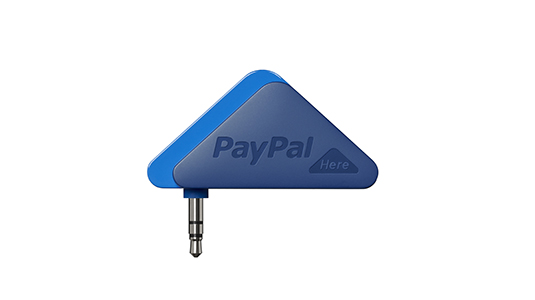
With a blue dongle that fits into the iPhone’s headphone jack port and an app in the works for iOS and Android devices, PayPal Here, similarly to how Square works, allows users to swipe their credit cards and confirm transactions on a mobile device’s touch screen. PayPal Here’s biggest advantage over the competition, as you can imagine, is the 100 million customers in 190 countries already using the service – Square, despite being the first company to really disrupt the mobile payment scene with its popular hardware accessory, can’t boast the same numbers of PayPal, which is still the leading online payment solution worldwide. With this in mind, PayPal has created a system that accepts credit and debit cards, PayPal, and checks; the company is collaborating with VISA, American Express, Discover and MasterCard to provide support for credit and debit cards, whilst also enabling users to invoice from the app, and track cash payments.

While taking checks and issuing invoices are free of charge, all card swipes that will happen through PayPal Here will have a 2.7% rate with “no hidden fee or commitments”. This is very similar to Square’s standard 2.75% commission, but being new to this market, PayPal still doesn’t have all the options for merchants that Square is offering. Recently, Square set out to reinvent old POS systems with the iPad, revamped its iOS app completely, and launched a brand new Card Case app to facilitate virtual transactions for its users.

PayPal Here looks very straightforward for now, albeit it wouldn’t be a surprise to see the company rolling out new functionalities quickly now that the product has been unveiled. The free, encrypted card reader can accept cards, and users can also rely on a phone’s camera to scan checks and process cards. The app, demoed today and shown in a promo video, uses a typical grid interface to choose between various payment methods, and enables customers to sign digitally using their fingers. The app can deliver receipts wirelessly, and it appears it will also let merchants set up various items in their database for quick access when entering a new transaction. Funds are “instantly available” in a PayPal account, and there’s also a map to show where a transaction was completed.

In another promo video that we have embedded after the break, PayPal is obviously touting the new service as the only one that accepts the most payment systems with the convenience of something that’s portable and secure. Admittedly, the fact that PayPal already has millions of users and that is a well-established brand in several countries will help in making Here gain traction among consumers and business owners. On the other hand, though, Square has been making some terrific innovations in the mobile payment space lately, and although still limited to the US, it comes with a richer catalog of apps and tools to help consumers and business owners tailor their digital transactions (and wallets) to their needs. It will be interesting to see how this industry will evolve now that the biggest player has decided to come up with a solution that, while very similar to Square, has a chance to raise general awareness and curiosity among users.

More information about PayPal Here can be found on the official website. PayPal Here is available today for select merchants in the United States, Canada, Australia and Hong Kong. More merchants will be added next month, and the service will launch in more countries soon. Read more