Posts in news

ustwo Announces Monument Valley Release Date, Posts “Behind the Scenes” Video

Monument Valley, the highly-anticipated game by London-based development studio ustwo, is launching on April 3 at $3.99 for iPad and iPhone, the company confirmed today.

Monument Valley, originally teased in November 2013, is a mobile-only puzzle game influenced by the drawings of Dutch artist M.C. Escher: with a mix of impossible perspectives and its own set of physics, in Monument Valley players will have to guide main character Ida through a series of stages that challenge the rules of geometry and spatiality and that are beautifully realized and animated.

Monument Valley, which was originally meant to be an iPad-only game, has been designed to let any kind of player finish the game; according to ustwo, each level is intended to be a work of art that can be hung on a wall (the game will feature a special screenshot button to capture completed levels as images). Monument Valley, which has been in development for over 10 months, is ustwo’s next major game to land on the App Store – the company’s previous hit, Whale Trail, generated over 5 million downloads to date.

In an interview with TechCrunch, ustwo’s Ken Wong shared some of the details behind the design and development of Monument Valley, citing Valve’s Portal and Brian Eno’s music as sources of inspiration for the game. Created specifically for mobile devices, Monument Valley will only run in portrait mode due to the verticality of its structures. In February, ustwo’s Ken Wong wrote that his hope for Monument Valley “is that it might contribute to the argument that the medium of entertainment we call video games is in fact art”.

Ahead of the game’s public launch next week, ustwo has published a Behind the Scenes video, embedded above. You can check out more Monument Valley teasers at the game’s official website.


Twitterrific Goes Freemium

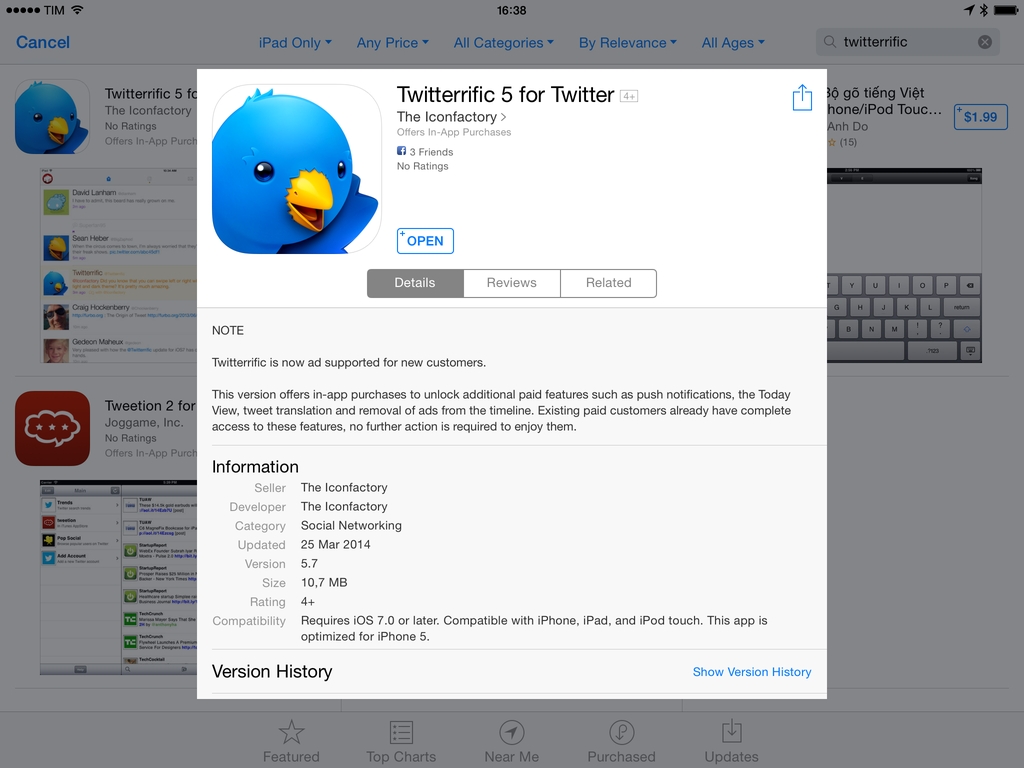
With the latest 5.7 update released today, Twitterrific for iOS, The Iconfactory’s popular Twitter client, has gone freemium: the app is now free to download with In-App Purchases to unlock more features and remove ads from the app. For those who have been around to witness Twitterrific’s evolution through the years, this move actually marks the return of The Iconfactory’s client to a freemium business model with ads.

From the company’s official blog post:

Twitterrific has been available in the App Store since day one and we’ve experimented with different revenue models in the past, including the one we’re returning to today. Our hope is that this helps get Twitterrific into more people’s hands than ever before so they can enjoy the simple beauty of reading and posting tweets once again. The update also includes some improvements including upping the number of tweets the timeline can hold to 500, something users have been requesting more and more.

The Iconfactory’s Gedeon Maheux published his thoughts on the new strategy in a separate blog post:

There are lots of risks with moving to this type of revenue model, but version 4 of Twitterrific was by far our most successful and that version was supported by ad revenue from The Deck. No doubt levels of support will increase dramatically for us but that’s part of the trade-off of having successful, thriving software. I’m also personally curious to see if moving to the free model and increasing the app’s downloads by at least 1 or 2 orders of magnitude will improve Twitterrific’s search results in the App Store.

For existing customers who bought Twitterrific 5.0 when it launched in December 2012, all features will be automatically unlocked by default. Twitterrific’s renewed freemium approach comes at an interesting time: Apple is testing a feature to enable customers to find more specific, relevant apps in search results (whose ranking is affected by the number of downloads, which a freemium strategy can facilitate), and Twitter is still enforcing a token limit on third-party clients. While news of third-party Twitter apps exceeding their token limits aren’t new on other platforms, popular clients for iOS such as Tweetbot and Twitterrific have so far managed to always accommodate new users without issues.

It’ll be interesting to see how going freemium will affect Twitterrific’s popularity and relevance in search results; in the past months, the app received several enhancements such as live streaming and background refresh. Features that are now part of the In-App Purchase include tweet translation, Today view, and push notifications, which are automatically unlocked using iOS 7’s receipt validation for existing customers.

Twitterrific 5.7 is available on the App Store.


Apple Testing Related Search Suggestions On The App Store

As first noted by developer Olga Osadcha, Apple is testing a related search suggestion feature on the App Store, which started rolling out earlier today for iPhone users on iOS 7.

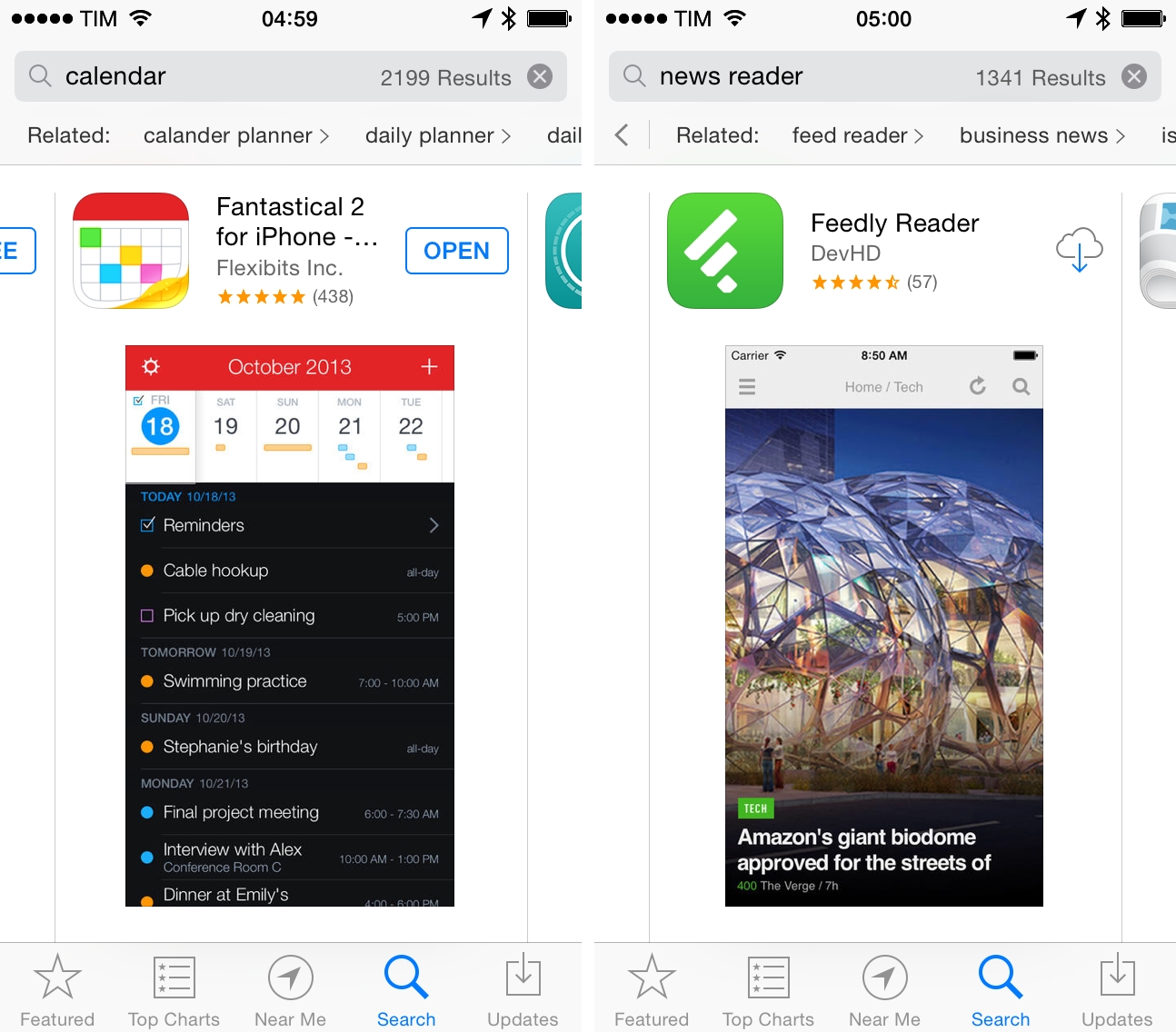
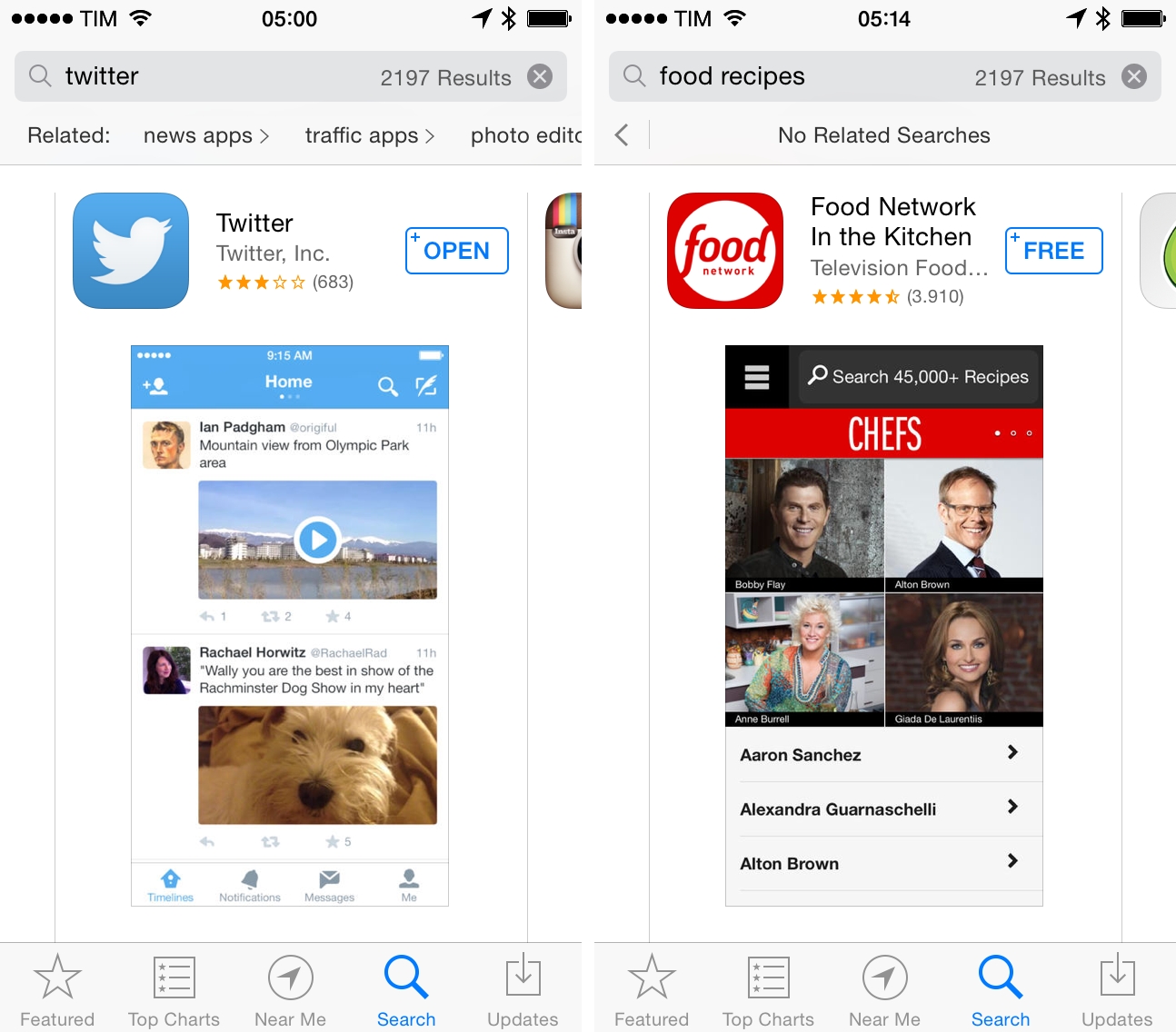
The new menu, a scrollable bar with suggestions for searches related to the current search, allows users to discover more apps in search by tapping on suggestions, receiving a fresh set of results. Multiple suggestions can be selected in a single session: searching for “indie games”, for instance, displays suggestions for “action games”, which include “action RPG” into their own suggestions. The new suggestion bar doesn’t alter the way search results are displayed – Apple is still using a cards layout on the iPhone – and, for now, the feature doesn’t appear to be available on the App Store for iPad and desktop computers.

The new related search suggestions mark one of Apple’s first attempts to augment App Store search results with visual semantics for apps. In testing the feature, I was able to get suggestions for specific sub-categories such as “business news” and “video game news”, “writing” and “story ideas”, or “healthy cooking” and “food recipes”; each set of related searches included new results that were more specific and relevant to the suggested search. A suggested search can branch out to more sub-suggestions (that was the case with the aforementioned games example), but I also noticed related searches that had no additional searches inside them. Aside from the additional bar for suggestions, results were displayed as normal cards with no additional changes.

It’s unclear whether this new feature could be based on Apple’s curation efforts with custom sections, keywords chosen by developers for their apps, popular searches on the App Store, or a combination of all these existing pieces of metadata. Over the past few years, Apple has built a large catalogue of curated sections (called Collections), which, however, don’t appear to be the primary source of search suggestions. Related searches ranged from generic terms and phrases like “writing” and “news” to mixes of company and product names such as “word excel” and “game loft”, suggesting that Apple may indeed still be testing and tweaking the feature before a wider rollout.

With over a million apps on the App Store, search has often been mentioned as one of the areas where Apple could make significant improvements to enable customers to discover relevant apps more easily. Two years ago, Apple acquired App Store search engine Chomp in a move that was believed to bring new user features for App Store search and recommendations, which, however, didn’t materialize with iOS 6 and iOS 7.

While the company introduced a feature to discover apps popular nearby last year, the new search suggestions could provide a general layer of filtering that is independent from geographical location. At this point, it’s not clear whether Apple may be optimizing search suggestions based on user taste and purchase history – first tests suggest that related searches are simply based on app category rather than user personalization; right now, it’s hard to tell whether some search suggestions may have been manually curated by Apple or not.

In the past year, App Store optimization (or “ASO”) has become a common practice for third-party developers willing to ensure their apps would rank highly in Apple’s search algorithm – which the company also tweaked multiple times. With more specific searches directly suggested to users when searching, Apple could alleviate the problem of good results being buried below worse results with higher ASO values, giving users more relevant and specific apps in an increasingly crowded marketplace.


Apple Adds NPR News Channel To iTunes Radio

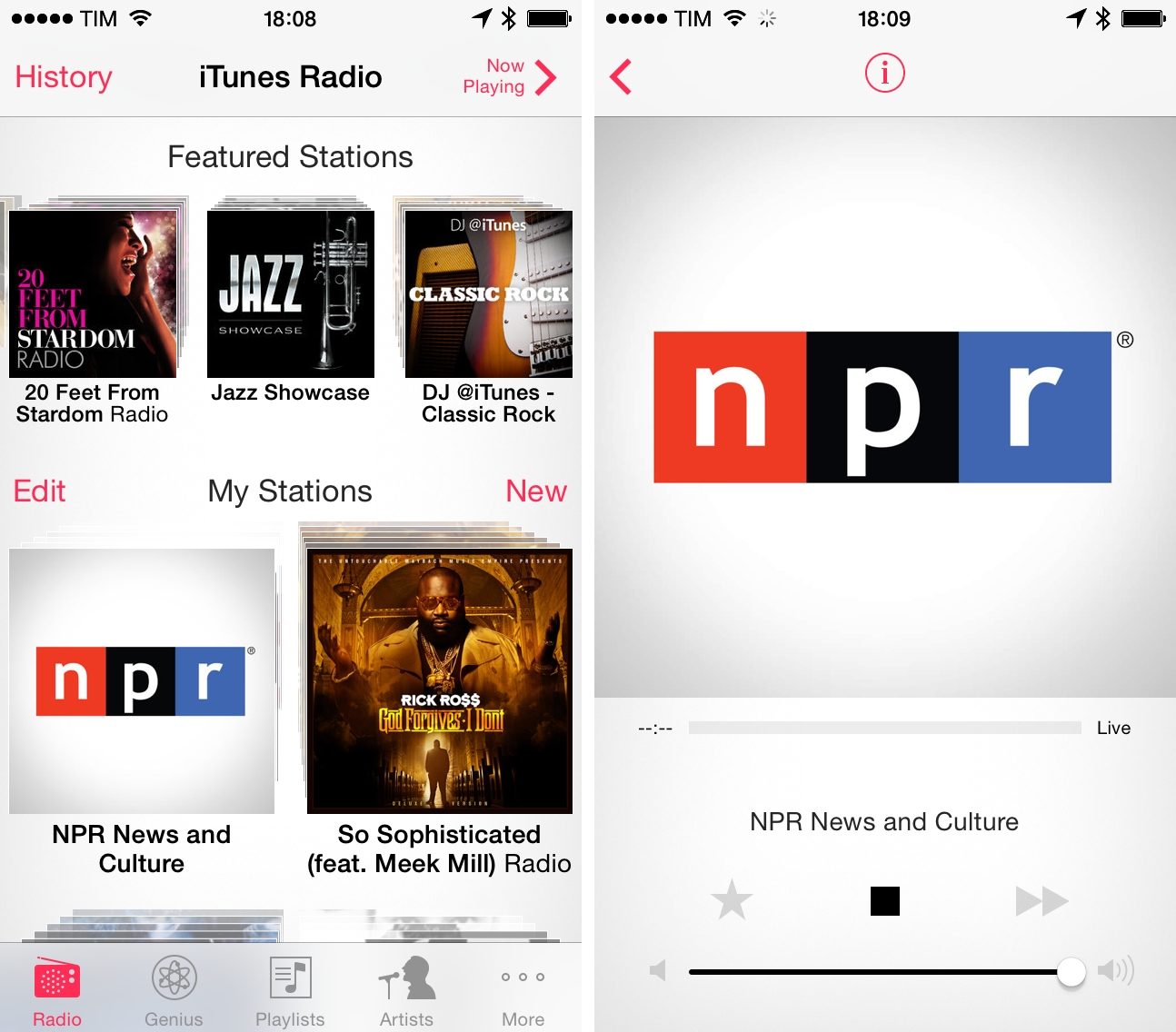
Apple’s iTunes Radio has gained a news channel today with the addition of NPR, as first reported by re/code and confirmed on NPR’s All Tech Considered blog.

Digital streams of Morning Edition, All Things Considered and hourly newscasts will be available on a new 24-hour streaming NPR channel on iTunes Radio.

“What you hear today is just the start of what’s to come,” said Zach Brand, NPR’s vice president of digital media. Later this spring, the channel will expand to include streams of our member stations from across the country.

iTunes Radio, launched alongside iOS 7 in September, allows users to listen to free, ad-supported streams of songs that are automatically suggested by the service or collected in stations curated by music experts and artists. The new channel, available for streaming on iTunes Radio for iOS 7 devices and computers running iTunes, marks an important milestone for Apple in diversifying the offer of its iTunes Radio service, thus far focused on promoting music content with direct integration with the iTunes Store for purchases – iTunes Radio is built into Apple’s Music and iTunes apps, which have buttons to quickly purchase a song from a stream.

NPR will offer both pre-programmed and live shows; at the moment, it’s displayed as a station in iTunes Radio next to music stations created by customers or curated by Apple. Since the launch in September, Apple has been trying various experiments with iTunes Radio for music content: the company regularly hosts “First Play” stations with previews of upcoming albums from popular artists, and it recently launched a special station with audio streams of iTunes Festival at SXSW.

Apple is believed to be considering a dedicated app for iTunes Radio in a future version of iOS, which could give the company more flexibility for separating user-made stations and curated sections, or music content from news, interviews, and other audio content. Currently, the entire iTunes Radio service lives in a dedicated page of the existing Music app for iOS.

Apple’s expansion of iTunes Radio could also be particularly interesting for CarPlay, the company’s initiative to bring iOS apps and services to car infotainment systems with a dedicated interface and iPhone integration. In initial demos, Apple showed how CarPlay could stream songs off iTunes Radio through an iPhone, but news channels and other audio content could easily fit into the same vision with the unified iTunes Radio service.

NPR’s new iTunes Radio channel is available here.


Slow Feeds Updated for iOS 7, Adds Background Fetch and Subscription Management

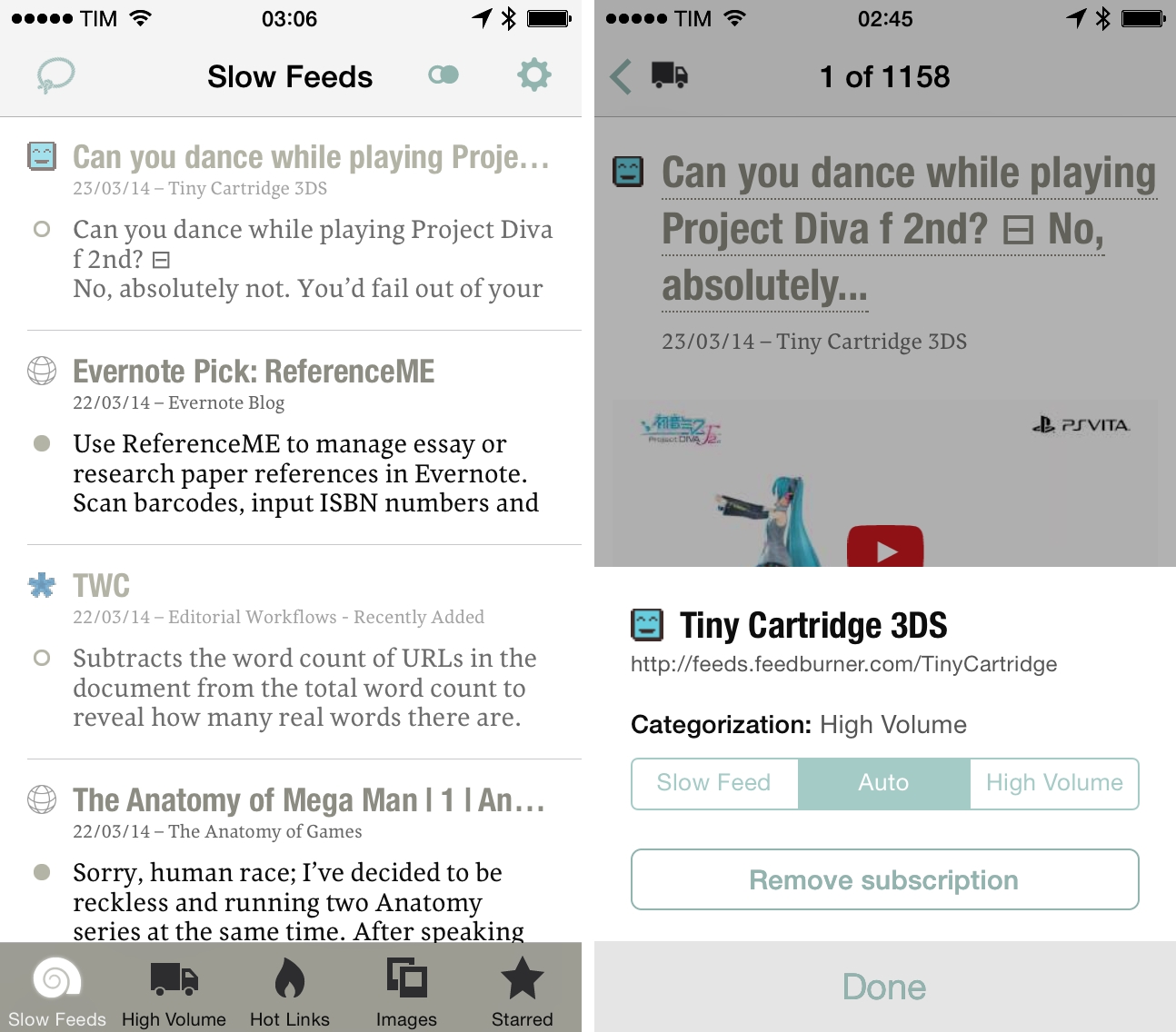
Unlike most RSS clients for iOS and OS X, Slow Feeds doesn’t prioritize the latest items from feeds you’re subscribed to – instead, it highlights feeds that don’t post several items a day, called the “slow” ones. We first covered Slow Feeds in May 2012, and followed its progress as it added Hot Links and more RSS services.

Earlier this week, Slow Feeds gained proper support for iOS 7, receiving a refreshed design and new subscription options that allow for better organization of feeds.

Read more


Command-C Updated with Clipboard History, Mac to Mac Sharing, Connection Improvements

Command-C

Command-C

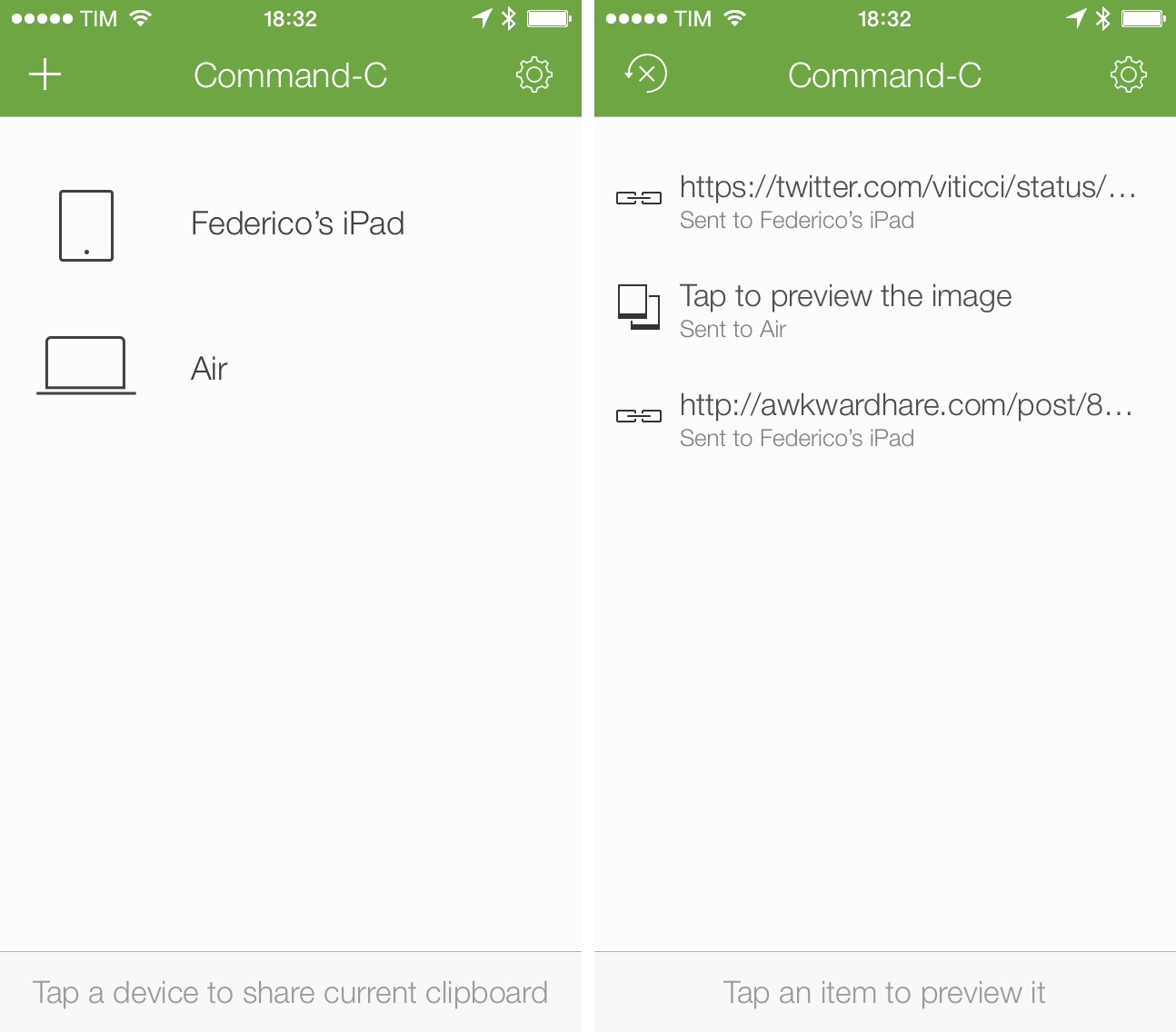
Danilo Torrisi’s Command-C, my favorite utility to share the contents of the clipboard across Mac and iOS devices, has been updated today with reliability improvements for Bonjour connections, a new clipboard history view, Mac to Mac sharing, and several other tweaks and fixes to the app that was first released in January.

From my original review:

Command-C brings back the old concept of local clipboard sharing, with some unique twists. Thanks to iOS 7, Command-C on an iPhone or iPad (the app is Universal) can always be available as a receiver in the background, using notifications to alert you when the clipboard has been received from another device. Communication between devices (which includes a dedicated menubar app for the Mac) happens on a local WiFi network, it’s encrypted, and no data is sent over the Internet; though the app works with a “one tap” approach to send your current clipboard to another device, there are some fantastic tools for power users who want to do more with keyboard shortcuts, URL schemes, and bookmarklets. Command-C is a clipboard sharing tool for the modern age, built with iOS 7 (and a new set of limitations that the current OS entails) and multiple iOS devices in mind.

I use Command-C on a daily basis to share text, URLs, and pictures between my iPhone, iPad, and Mac, and the improvements to local connections have been noticeable in my tests. Command-C uses the Bonjour technology to handle communications between devices, and, according to Torrisi, the core of the app has been rewritten from the ground up in version 1.1. In trying the update before today’s release, I noticed that the app would keep running in the background more reliably under iOS 7.1, resulting in fewer disconnections (which used to force me to manually open the app to receive the clipboard) and speedier clipboard transfers. The setup process was faster in version 1.1, and adding multiple devices to the app showed no errors or slow loading times, a problem that occurred for multiple users in previous versions of the app. Read more


Tweetbot for Mac Updated with Large Thumbnails Option, Three-Finger Gesture Fix

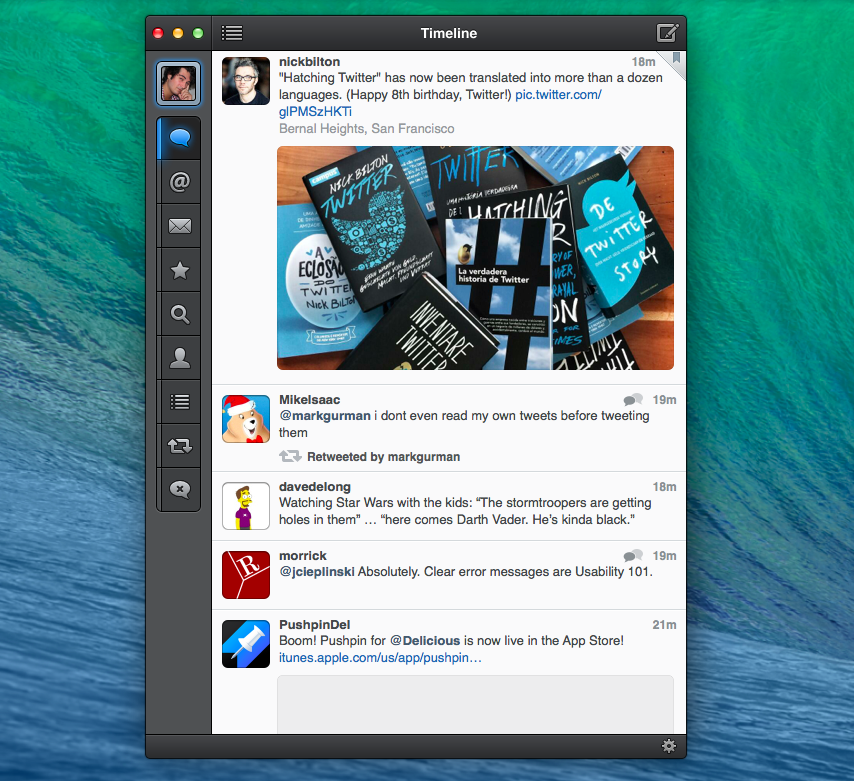
Tweetbot for Mac, Tapbots’ desktop version of its popular Twitter client, was updated last night with support for a new large thumbnail option in the timeline, a refreshed design of inline image previews, and a fix for three-finger gestures.

Following Tweetbot 3.3 for iPhone, Tweetbot 1.5 for Mac adds large thumbnails as an option in the app’s Preferences. Large thumbnails retain the capability of being right-clicked to access a contextual menu, and they bring a slightly redesigned preview in the tweet detail view as well. In my tests, loading large thumbnails with proper resolution required deleting Tweetbot’s account cache under Preferences > Account.

For users who enabled three-finger navigation gestures on their Macs, Tweetbot will now respect that setting and allow to swipe with three fingers to navigate back and forth between tweets, timelines, and other views of the app.

Tweetbot for Mac is available at $19.99 on the Mac App Store. You can read our original review here.


Apple Highlights Indie Games In “Indie Game Showcase” Section

Following a weekly refresh of the App Store’s featured content, Apple has started highlighting indie games in a section called “Indie Game Showcase” today, presented on the App Store’s homepage.

The new section, available on iTunes here, will presumably highlight indie developers on a regular basis, featuring a selected game from the development studio and offering a glimpse into the favorite games of an indie development’s team. This week, Apple started by featuring Simogo, the independent, award-winning studio behind Year Walk, Beat Sneak Bandit, and the widely acclaimed Device 6.

From Apple’s Indie Game Showcase page:

Often made up of just a few dedicated members, independent studios prove that what really matters is the size of your dream. In each Indie Game Showcase, we celebrate a popular game and its creative team, highlighting the developer’s titles along with their favorite games from other studios.

In featuring Simogo’s Device 6, Apple notes that the experience was “tailor-fit for iPad, iPhone, and iPod touch”, resulting in a game that was included in the list of runner-ups for the App Store’s Game of the Year collection in 2013 from a company that has made “outstanding games exclusively for the App Store”.

Apple’s Indie Game Showcase comes at the end of the Game Developers Conference, which saw an increased interest in indie productions by larger companies. Among various announcements, Sony unveiled improved development tools for indie developers on PS4, Microsoft showcased games part of the initial rollout of the ID@XBOX program, Nintendo showed the capabilities of its Web Framework, while both Epic and Crytek announced subscription services for their game engines, a move likely aimed at smaller, independent developers.

Alongside the Indie Game Showcase, Apple also featured its “10 Essential Indie Games” section on the App Store’s Games category page again, including recent releases such as Nyamyam’s Tengami and Sirvo’s Threes.


Apple Launches 8GB iPhone 5c, Replaces iPad 2 with Updated iPad 4

Following speculation from earlier this week, Apple has today launched updated versions of its iPhone 5c and fourth-generation iPad, the latter previously discontinued in October 2013 for the iPad Air.

The return of the 16 GB iPad 4 marks the company’s official discontinuation of the iPad 2, first introduced in March 2011 and sold until today as the most affordable iPad in Apple’s line-up. The relaunched iPad 4 is the same device that Apple unveiled in October 2012 – it comes with an A6X processor, FaceTime camera, and LTE support, but it replaces the iPad 2’s 30-pin connector with Lightning, making it consistent with the rest of Apple’s iPad family.

Now for $399 customers can get iPad with a stunning 9.7-inch Retina display, fast A6X chip, and 5MP iSight camera, offering a dramatic upgrade in power, performance and value compared to the iPad 2 it replaces,” said Philip Schiller, Apple’s senior vice president of Worldwide Marketing. “The iPad line sets the gold-standard in mobile computing and all iPads have access to the largest and best ecosystem of more than 500,000 iPad optimized apps from the App Store.

The 16 GB iPad 4 is available at $399 for the WiFi model and $529 for the WiFi + Cellular version, and it’s shown on Apple’s website as “iPad with Retina display”.

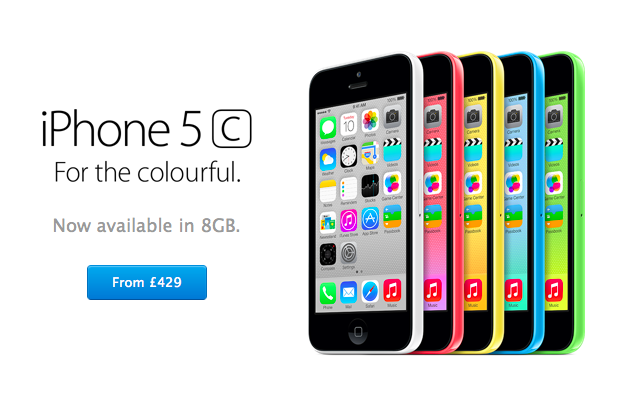
The iPhone 5c has received a new 8 GB storage option today, currently available in Apple’s European stores but expected to become available in the US later today. The new model is £40 cheaper than the 16 GB iPhone 5c in the UK, and it starts at £429, fully unlocked. The 8 GB iPhone 5c hasn’t replaced the 8 GB iPhone 4s, which is still available on Apple’s website.

The iPhone 5c was introduced in September with multiple color options as a slightly upgraded version of the iPhone 5, but its sales have been below Apple’s expectations, as also confirmed by CEO Tim Cook in January.