Federico Viticci

10876 posts on MacStories since April 2009

Federico is the founder and Editor-in-Chief of MacStories, where he writes about Apple with a focus on apps, developers, iPad, and iOS productivity. He founded MacStories in April 2009 and has been writing about Apple since. Federico is also the co-host of AppStories, a weekly podcast exploring the world of apps, Unwind, a fun exploration of media and more, and NPC: Next Portable Console, a show about portable gaming and the handheld revolution.

This Week's Sponsor:

Inoreader

Build your own newsfeed and cut through the noise


Jailbreaking iPhones Made This Student $50,000

Can jailbreaking iOS devices become a real business with an actual annual profit? Apparently, yes. And even if we wouldn’t recommend basing your monthly income entirely on the process of hacking phones and installing apps Apple doesn’t approve, $50,000 a year doesn’t sound that bad.

The Washington Post published a piece yesterday profiling Kevin Lee, a George Mason University senior that has managed to earn $50,000 a year by jailbreaking and unlocking iPhones. What started as a hobby to help out friends and relatives eventually evolved into a “real business” with 30-40 clients per week asking for jailbreak, Cydia installations, graphical customizations and “unlocks” to use the iPhone on wireless carriers otherwise unsupported by Apple. The procedure of unlocking iPhones has in fact turned out to be quite lucrative for Lee, thanks to international customers buying an iPhone in the United States, and looking for a way to use the device overseas. Lee says he recently unlocked an iPhone for a member of the Mongolian embassy who was about to go back to Ulaanbaatar (Mongolia’s capital) and needed to have a device compatible with his local carrier.

But how did a student get a massive traction for a business that – let’s face it – can be easily achieved with a computer and a couple of tutorials? With a Craigslist ad, that’s how. By posting a “Get Your iPhone Jailbroken Today” ad on the popular online community, Lee got hundreds of requests from people who didn’t have the knowledge, or simply didn’t have time to mess with redsn0w, Geohot’s tools, or Cydia itself.

Personally, I wouldn’t run a business that’s clearly going against Apple’s rules (even though the Library of Congress ruled last year jailbreaking a phone in the US is legal) and requires my friends to pay actual money for something that can be done for free in 2 minutes. Curiously enough The Washington Post reports the Craigslist ad has been taken offline since the original article. [via iPhoneDownloadBlog]

The New York Times Brings Paywall To iPad App

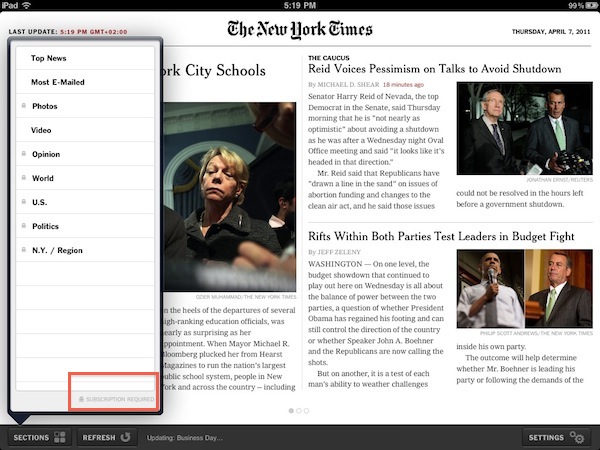
The official New York Times app for the iPad was updated a few minutes ago to include the new subscription system the publication first announced in March. The latest 2.0.5 version, bug fixes and performance enhancements aside, introduces the so-called paywall that restricts access to several sections of the app and only enables you to check out the Top News and Video section. You can find the updated version in the App Store here.

What’s interesting is that The New York Times still isn’t using Apple’s iOS subscription system to sell digital access to the newspaper. The app still relies on an embedded browser login to unlock all the features or sign up for a new subscription plan, and we guess it’s because developers of existing App Store apps can wait until June before being forced to update their software to include the iTunes subscriptions. From the app’s Settings, in fact, there’s no way to easily purchase a subscription like in The Daily with your iTunes account – you’ll have to manually log in The New York Times’ website from a popup window. We assume an upcoming update to the iPhone app (recently updated to version 3.0) will also activate the NYT’s paywall for sections.

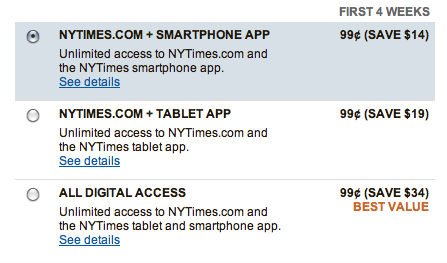
On March 17th, the New York Times announced they will offer three different packages for unlimited digital access:

  • NYTimes + smartphone app: $15 per month
  • NYTimes + tablet app: $20 per month
  • NYTimes full access: $35 per month

At the moment of writing this, however, it appears that The New York Times is running a promotion with discounted access for early subscribers:

The New York Times has also started offering 1 year of full digital access to long-time subscribers of the print edition. Check out more screenshots of The New York Times iPad app below. Read more


Here’s A Digital Whiteboard Running On 40 iPads Simultaneously

Back in January Cody reviewed SyncPad, a collaborative online whiteboard with web, iPhone and iPad applications that allow people to collaborate on sketches, wireframes or PDFs in real-time. SyncPad is a very powerful app, as it lets you create multiple rooms, work locally or over the Internet, share with Dropbox and even import PDFs in seconds to quickly mark up a document and show it to your colleagues. From the review:

As soon as you open SyncPad, you’re asked to enter a room name. You can make up anything, and a URL will be spit out enabling you to share that room with collaborators. With no sign-up required, collaborators can simply plug the URL into a web browser to watch you markup content in realtime. There may be a slight delay between what someone will see in a room as you draw on the screen, but it’s rather minor and personally unimportant. The WOW! factor is immediate as the simplicity behind SyncPad is astounding, and it’s an easy way to impress others on the other end. They’ll tell you, “it’s the future,” and I’m not exaggerating - SyncPad is a great way to share content with others because it’s such a fascinating little tool.

The “WOW” factor Cody mentioned is indeed well visible in the video shared by the developers, in which 40 iPads are running the same whiteboard simultaneously. The devices are on the same local WiFi network (they’re not connected over the air from different countries in the world – like Cody and I did in our tests), but the tech is still impressive. The animations are smooth, everything happens in real-time, and we can only imagine the possibilities offered by SyncPad during, say, meetings or conferences where all attendees have an iPad with the aforementioned app installed.

Check out the video below. Read more


iOS 4.3.2 Coming In Two Weeks?

BGR reports this morning that Apple is looking to launch another version of iOS 4.3 within two weeks. The update, labelled iOS 4.3.2, should contain various fixes and enhancements, address security issues (quite possibly a jailbreak fix) and it “will also fix several bugs that have affected users.”

On March 21st, BGR reported iOS 4.3.1 would be released within “one or two weeks”, and the OS was released on Friday, March 25th. If BGR’s track record is of any indication, there is the small chance to see iOS 4.3.2 becoming available next week if Apple really wants to close security holes and fix bugs quickly. In the past weeks, several users running iOS 4.3.1 reported bugs in the FaceTime application for iPad and iPhone, WiFi connectivity issues after the 4.3.1 upgrade and other minor glitches in the Camera app.


FileBrowser for iPad Lets You Access Computers, Network Drives, Shared Folders

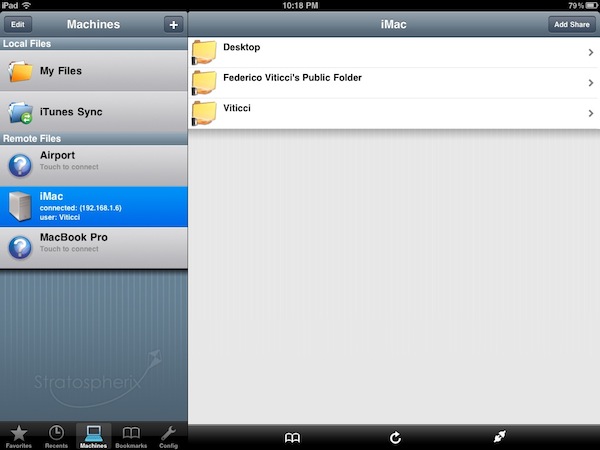
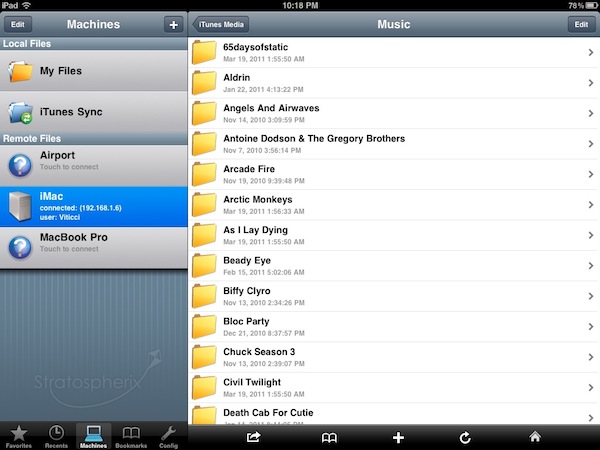
Earlier today I mentioned (again) Cloud Connect Pro, a universal $24.99 app that enables you to access online services like iDisk and Dropbox, local and remote computers, AirPort Disks and much more. Cloud Connect is a pricey app, but it also packs a whole screensharing app, runs on iPhone and iPads and it’s got the possibility to navigate a computer’s filesystem with a Finder-like interface. For quite some time, however, I’ve been using a cheaper alternative to Cloud Connect called FileBrowser that runs only on the iPad, it doesn’t have screensharing functionalities or Dropbox / iDisk / Google Docs integration but enables you to connect to your computers, shared folders and network drives just fine.

FileBrowser uses the CIFS and SMB protocols to connect to Windows and Mac computers, and NAS drives. Linux is also partially supported but you can’t connect using Apple File Sharing (AFP) or FTP. Once File Sharing is enabled on your Mac, FileBrowser should be able to see your machine on a local network. There’s no support for automatic computer discovery, but you can easily add a new computer by typing “username.local” in the “Name or Address” field – where “username” is the actual name you chose for your Mac’s Home folder. With the same .local domain, FileBrowser can connect to an AirPort Extreme station (and thus open the contents of a shared drive) or recognize the folders you’ve decided to share (besides Home) in your Mac’s System Preferences. This app is quite powerful in the way it lets you remotely connect to a machine using a DynDns hostname, enter username and password in the Settings (to avoid being asked every time), or tweak the Advanced Settings to change the SMB port number and pipelining.

FileBrowser can also open and preview a variety of file types, including music files and video formats supported by the iPad (no, it won’t do live conversion for your AVIs like Air Video). Songs can play in the background and be shared through AirPlay, but the app goes fullscreen when playing them and there’s no way to keep browsing or creating a queue. I’m okay with having videos in fullscreen, but the developers should find another implementation for music playback. The app can load images and documents like PDFs too, plus every file can be saved as a “bookmark” for quick access or emailed as an attachment. Again, these files come from your computer and network drives, not the iPad itself. There’s a temporary file cache that you can “purge” from the Settings, alongside many other options to enable admin shares or change the remote permissions for file creation / deletion, for example. There’s a lot of stuff to play with to turn FileBrowser into a powerful app, finely tuned to connect to your computers and network drives. FileBrowser doesn’t have the best interface the iPad has ever seen, but as far as functionality is concerned we have a great piece of software here. Fast, stable, feature-rich and being actively developed by Stratospherix.

At $3.99 in the App Store, FileBrowser gives you the tools you need to access and browse computers and drives from your iPad. Make sure to also check out NetPortal for iPhone, from the same developers, which brings most of the functionalities of FileBrowser to the iPhone.

Read more


Atari Introduces “Greatest Hits” App with 100 Retro Games

If you love retro gaming as much as I do, Atari’s latest app for the iPhone and iPad (which will launch in the US App Store later today) might as well be a dream come true: with Atari’s Greatest Hits, you’ll have access to 100 old Atari games from a single app that presents them in a beautiful interface with arcade cabinets and original box arts. That’s right, 100 games in a single universal app. Where’s the catch? The app is free and comes bundled with PONG, but if you want to download the other included games you’ll have to choose between some in-app purchases options. The huge deal is the following: games have been organized in 25 game packs; each game pack will cost you $0.99 via in-app purchase. Alternatively, you can buy all the packs (and thus 100 games) together with a single purchase at $14.99. Which brings us to: 15 bucks for 100 old Atari games, on the iPhone. Some of them have even been updated to include local Bluetooth multiplayer. I won’t be missing this offer as soon as the app goes live, for sure.

The app is available now in the New Zealand store and will go live at this link in the US tonight. Full list of included games after the break. [via Touch Arcade] Read more


iAd Gallery Violates Apple’s Own Guidelines

iAd Gallery, a free iPhone app Apple released yesterday in the App Store, has generated several debates on the Internet about its rather “limited” feature set: the app, good-looking and responsive, does only one thing: it’s a collection of advertisements you can browse and “love.” By aggregating the best campaigns recently launched on the iAd network, iAd Gallery only lets users interact with a spinning wheel featuring ads from different brands, view information and “launch” them to experience the rich functionalities of iAds. Basically, it’s a free ad collector for iPhone. Not exactly the kind of “productive” (or at least entertaining) software most users would expect from Apple.

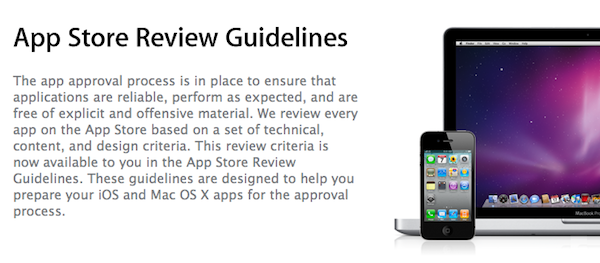
As noted by Dan Frommer at Silicon Alley Insider, it is kind of ironic that iAd Gallery may be violating Apple’s own Review Guidelines for iOS apps and should have been rejected by Apple itself. In the 2.13 section of the Guidelines, the company explains:

Apps that are primarily marketing materials or advertisements will be rejected

iAd Gallery indeed is based on marketing materials and doesn’t do anything but enabling you to browse various ad campaigns. Sure, you can read details about a specific campaign and learn more about the agency behind it, but that’s not really a “functionality” in our opinion. The app also lets you get in touch with the iAd team with a Contact button: perhaps the App Review Team at Cupertino thought that was enough to let the app through the App Store gates.

The truth is, of course Apple won’t reject its own app because it violates one of the Guidelines. They manage and have the ultimate word on the App Store, and they can release whatever they want under the Apple, Inc. name. But looking at the big picture, it is kind of funny that Apple is distributing an app that would have been rejected if it came from someone else.


Apple Orders 12 Petabytes (That’s 12 Million Gigabytes) For iTunes Store Video

After all the theories surrounding Apple’s new data center in North Carolina, and the rumors surfaced in the past months pinpointing a complete revamp of iOS and MobileMe with extensive cloud features, here comes an interesting tidbit suggesting that Apple is looking to improve capacity of the iTunes Store by ordering 12 petabytes of storage from Isilon Systems. As reported by AppleInsider, the additional storage will be used for hosting video content on the iTunes Store – although it is not clear whether this storage will also be dedicated to video streaming, future iOS or MobileMe functionalities, or just downloads for the existing iTunes Store. Currently, the iTunes Store hosts thousands of movies, TV shows and video podcasts that are available both in standard and high definition, can be streamed to an Apple TV or downloaded locally on Windows PCs and Macs. Read more


Camera+ Goes Social With User Pages, Comments, Mobile View

Camera+ for iPhone is one of our favorite photography apps here at MacStories: version 2.0 brought lots of new features and optimizations to an already great piece of software, and another update released last week introduced a brand new “Clarity” effect that’s a serious competitor to Apple’s own HDR processing. Camera+ is packed with features, has a beautiful user interface and powerful sharing options. It doesn’t come as a surprise that the app sold more than 2 million copies in a few months. Camera+, according to many, is the photography app for iPhone Apple should have bundled into iOS in the first place.

Today the tap tap tap developers are taking a leap forward by completely revamping the social aspect of Camera+ – the campl.us website that allows you to upload photos (even multiple pics at once) directly to app’s servers and then share a link on Twitter, Facebook or other social networks. The new Camera+ website now supports comments, has got user pages to quickly browse all the images posted by your friends, and – finally – has also a mobile view optimized for the iPhone and iPod touch. You can see a photo of mine here, and my user page here. You can comment either as a Guest or by logging in with Twitter and Facebook (with optional comment sharing as well); photo pages sport the usual view count and image info; the mobile web view perfectly fits the iPhone’s screen and you can also swipe through photos at the bottom to quickly switch between them.

The developers write on the company’s blog:

For a long time we were hesitant about doing mobile optimized versions of our sharing pages because we still wanted to support the zooming into pictures that our desktop pages allowed. We’ve finally come up with a solution that makes everything easier to read and browse while still supporting high quality photos that can be pinched in to see more detail. We really wanted to make our mobile pages “feel” exactly like their desktop counterparts, all the information on them makes its way over, just organized and designed for a smaller screen. We also support the same commenting via mobile as on the full desktop website.

We really like the new social features of Camera+ on the web, and we look forward to more functionalities (such as albums, they would be great) hopefully coming soon. If you still haven’t downloaded Camera+, go get it here. Check out more screenshots below. Read more