Posts tagged with "apple"

Wired Implements Apple’s In-App Subscriptions

With an update to the Wired app today, it becomes the latest iPad magazine from Conde Nast to utilize Apple’s in-app subscription service after they began implementing it in all their magazine apps earlier this month. Wired now offers users four ways to consume the Wired magazine on the iPad, they can continue to purchase individual issues for $3.99, pay $1.99 for a monthly subscription, $19.99 for a yearly subscription or if they are already a print subscriber, access the app for free.

The subscription offerings will allow users to access the monthly editions until the subscription runs out. Opting to purchase individual issues will mean users get to permanently purchase that issue and re-read it at a later time without a subscription.

Today’s update follows last month’s update that brought enhanced sharing and shopping features to the app, and to celebrate they made the issue available for free. According to Howard Mittman on Twitter, that proved successful because the issue has become the most downloaded, beating the record set by the first iPad edition of Wired, which had over 100,000 downloads.


App Store Hits Milestone Of 500,000 Approved Apps

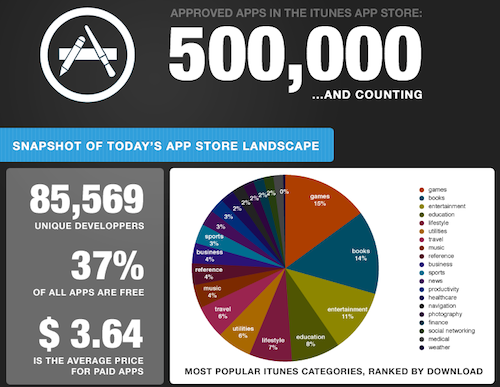
Just after midnight this morning, the iTunes App Store approval team pushed through a batch of app submissions, making the total number of submissions exceed 500,000 apps. It means that in the 34 months since the App Store opened in July 2008, there have been just over half a million apps published to the App Store.

To celebrate the event, Chillingo (developer), 148apps (mobile app blog) and Chomp (search company) created an epic infographic. It’s full of a tonne of interesting factoids such as: Angry Birds stayed at number 1 on the paid apps list for 275 days, the App Store launched with 500 apps, each developer submits an average of 4.6 apps and so on.

The actual number of apps available for download is currently closer to the 400,000 mark because of various replacement and withdrawals of the past 34 months. We also know that at least 75,000 of the apps are for the iPad – a figure revealed in late March. To see the full infographic jump over to the 500K Facebook page put together by Chillingo, Chomp and 148apps.

[Via Fortune]


Chengdu Plant Shut Down May Reduce iPad 2 Production By 500,000 Units

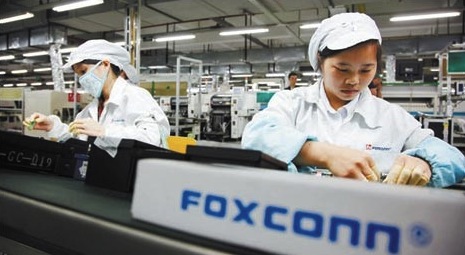
Last week’s explosion at the Chengdu Foxconn plant may in fact lead to a loss in production of 500,000 iPads, despite contrary reports from yesterday. The figures come from IHS iSuppli, which did note the exact figure will depend on how long the plant remains closed.

Yesterday’s report, from China Times, reported that production would unlikely be impacted because the Shenzhen Foxconn plant would pick up any drop in production from the Chengdu plant. IHS however says that Shenzhen will struggle to make up for all of the lost output. It may even result in Apple missing the 7.4 million iPad 2 shipments that IHS iSuppli has forecast.

The Chengdu plant is said to produce 30% of all iPad 2s and some, including Mike Abramsky of RBC Capital Markets last week speculated that the impact could even be as large as a loss of production between 1.8 million and 2.8 million iPads. Whilst others such as Shaw Wu of Sterne Agee doesn’t believe the Chengdu shut down will have much of an impact at all on iPad 2 production, with other plants picking up the slack.

The explosion at the Chengdu Foxconn plant last week took 3 lives and injured 15 people, nine of which are still hospitalised. The exact cause of the explosion is still unknown but early signs point to inadequate venting leading to a build-up of highly explosive aluminium dust that combusted.

[Via Bloomberg Businessweek]


Analysis of Apple’s Letter To Lodsys

Analysis of Apple’s Letter To Lodsys

Florian Mueller at FOSS Patents breaks down today’s letter from Apple to Lodsys CEO Mark Small, detailing a possible scenario iOS developers might soon find themselves into:

App developers have to understand that Lodsys can still sue them. Apple’s letter does not prevent Lodsys from doing that, and it would be a way for Lodsys to pursue its agenda. It wouldn’t make economic sense for Lodsys to sue a few little app developers based on the damage awards or settlements Lodsys might get out of such a lawsuit. However, for Lodsys it would still be worth it if this resulted in a lucrative settlement with Apple, or if it (alternatively) scared potentially thousands of app developers so much that they would pay. Lodsys would sue some app devs only to set an example, and for the ones to whom it happens, that would be an unpleasant situation.

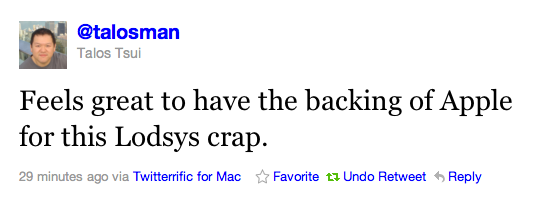
As other bloggers have already written and tweeted, Apple’s letter might be heartwarming for developers, but the story is far from over. Apple is stepping up to defend its developers and that is great news for sure (see developers’ reactions here), but in case of Lodsys deciding to sue anyway to set a precedent, these indie developers would still have to deal with actual court duties, lawyers, and the fact that they’d need to directly ask Apple to back them up. Apple hasn’t explicitly stated they would pay for every legal expense in today’s letter (unless the emails sent to developers, and not Mark Small, have additional details we’re not aware of), though Mueller believes that sending a copy of the letter to Mark Small to developers is a good sign of the company taking things seriously and considering paying for any kind of expense if Lodsys sues.

Again, it’s not over yet, but the general consensus seems to be that this is a great first step to defend the App Store, Apple’s own ecosystem and in-app purchases, and independent developers.

Permalink

Apple Officially Responds To iOS Devs Hit By Lodsys Patent Claims [Updated]

According to a number of tweets from iOS developers hit by Lodsys’ patent infringement claims in regards to in-app purchases and upgrade buttons, Apple has started sending out emails earlier today with legal documentation about Lodsys’ claims. While the contents of the entire email and letter haven’t been posted yet, the first details have started making the rounds of Twitter as Apple is apparently offering support to iOS developers by helping them defending against Lodsys patent infringement claims.

The first paragraph of the email has been posted by Craig Grannel at Revert To Saved:

There is no basis for Lodsys’ infringement allegations against Apple’s App Makers. Apple intends to share this letter and the information set out herein with its App Makers and is fully prepared to defend Apple’s license rights.

The Loop has posted another paragraph of the email, with more coming soon:

Apple is undisputedly licensed to these patents and the App Makers are protected by that license,” wrote Bruce Sewell, Apple Senior Vice President and General Counsel.

From what we can gather so far, it appears Apple is asking Lodsys, and CEO Mark Small, to withdraw letters sent to developers as they’re already covered by Apple. We’ll update this story with more details as they become available.

Another excerpt from Apple’s email confirms that the company believes developers shouldn’t pay any licensing fee because Apple’s already licensed to use Lodsys’ patent and offer the technology to third-party App Store developers through software development kits and  APIs:

Thus the technology that is targeted in your notice letters is technology that Apple is expressly licensed under the Lodsys patents to offer to Apple’s App Makers. These licensed products and services enable Apple’s App Makers to communicate with end users through the use of Apple’s own licensed hardware, software, APIs, memory, servers, and interfaces, including Apple’s App Store. Because Apple is licensed under Lodsys’ patents to offer such technology to its App Makers, the App Makers are entitled to use this technology free from any infringement claims by Lodsys.

Update: full text of the letter sent by Apple to Lodsys’ CEO Mark Small has been posted by Macworld. A few notable excerpts:

Because I believe that your letters are based on a fundamental misapprehension regarding Apple’s license and the way Apple’s products work, I expect that the additional information set out below will be sufficient for you to withdraw your outstanding threats to the App Makers and cease and desist from any further threats to Apple’s customers and partners.

First, Apple is licensed to all four of the patents in the Lodsys portfolio. As Lodsys itself advertises on its website, “Apple is licensed for its nameplate products and services.” See http://www.lodsys.com/blog.html (emphasis in original). Under its license, Apple is entitled to offer these licensed products and services to its customers and business partners, who, in turn, have the right to use them.

Through its threatened infringement claims against users of Apple’s licensed technology, Lodsys is invoking patent law to control the post-sale use of these licensed products and methods. Because Lodsys’s threats are based on the purchase or use of Apple products and services licensed under the Agreement, and because those Apple products and services, under the reading articulated in your letters, entirely or substantially embody each of Lodsys’s patents, Lodsys’s threatened claims are barred by the doctrines of patent exhaustion and first sale.

The conclusion of the letter:

Therefore, Apple requests that Lodsys immediately withdraw all notice letters sent to Apple App Makers and cease its false assertions that the App Makers’ use of licensed Apple products and services in any way constitute infringement of any Lodsys patent.

Contrarily to speculation and rumors posted in the past week, Apple isn’t avoiding the situation and is now actively taking part in backing independent developers hit by Lodsys claims of patent infringement in applications that use Apple’s own iOS SDK. By reassuring that developers shouldn’t pay any licensing fee because Apple is already licensed to offer the technology behind the App Store and in-app purchases, the company is taking a firm position in defending its ecosystem and “app makers.” Several bloggers and patent experts tried to analyze the patent claims over the past two weeks, with the EFF even coming out and saying Apple should have stepped in and started defending its iOS devs right away. As usual Apple has taken its time to study the issue and come up with facts, and is now simply asking Lodsys to withdraw every notice letter and infringement claim sent out to developers.



Scott Forstall Places Second In Most Creative Business People Award

Fast Company has placed Scott Forstall as second in their 2011 ‘Most Creative People in Business’ awards. Forstall, who is VP of iPhone software, received the award for leading the development on iOS, with Fast Company noting that “the popularity of that tap, pinch, and swipe interface has sent Cupertino’s earnings rocketing”.

Jonathan Ive’s slick designs may grab the headlines whenever Steve Jobs introduces a new product, but it’s Scott Forstall’s smart software that fills Apple’s coffers.

Meanwhile, Wadah Khanfar took out top honors for his work as Director General of the Al Jazeera network – which has seen recent surge in popularity for its extensive coverage of the uprisings in the Arab world, notably for its coverage in Egypt and more recently, Syria. In its entirety, the list featured a variety of people that exhibited creativity in business from Arianna Huffington of the Huffington Post (10th) to Oprah Winfrey (12th) to the singer Bruno Mars (58th).

However of most interest to us at MacStories are those which have heavily utilized iOS as part of their business strategy – in some cases even dedicating their entire business to the success of iOS. Jack Dorsey of Square and Twitter made the list at number 4, whilst Marcos Weskamp of Flipboard made the list at number 42. Others included Aaron Levie of Box.net (59), Kevin Systrom of Instagram (66), Dong Minghzhu of Gree (71) and Mikael Hed of Rovio, who rounded out the list at number 100. [via Setteb.it]


Reports Of A Grand Central Apple Store Resurface

The Wall Street Journal has today revived suggestions that Apple is looking to open an Apple Store in the New York Grand Central Terminal. Back in early February there had been reports from the New York Observer that Apple was planning to open their largest store at the terminal. Those rumors were then squashed in early March after reports surfaced that negotiations had fallen through.

Todays report from the WSJ claims that the Metropolitan Transportation Authority (MTA) is looking for new tenants and that Apple has expressed interest in establishing a retail presence within Grand Central. The space on offer is large, but not large enough to be the world’s largest Apple Store – which is currently the Regent Street (London) store which is 25,000 square feet.

The agency is looking for a single renter for two adjacent balconies on the north and east sides of the terminal. It will issue a request for proposals Monday.

A spokesman for the MTA told the WSJ that the agency dealing with the space has spoken to Apple and is hopeful that they bid on the space. Their report also suggests that the MTA may even be working specifically to find space for Apple, offering two adjacent spaces for rent, even though one is still occupied by a tenant. That tenant, who operates the Metrazur restaurant, would likely receive a hefty buyout from whoever purchases the space.

If Apple is interested in renting the space they will have to do so publicly – with all retail space within Grand Central awarded through an open bidding process. Jump the break for a plan of the retail space on offer – highlighted in red on the right hand side, labelled “East Balcony”.

Read more


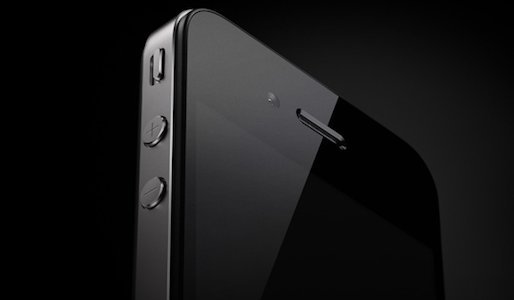
iPhone 5 To Feature Curved Glass Screen?

According to DigiTimes, the latest rumor going around the Taiwan supply chain is that the next iPhone (whether it be the 4S or 5) will feature a curved cover glass for the display. It would see the next iPhone resemble aspects of Google’s Nexus S phone which had the glass curved into a concave, or perhaps like the older model iPod Nano which had convex glass.

In the past, manufacturers of the glass for smartphone displays had been reluctant to commit to the investment in appropriate glass cutting equipment because of the high capital costs associated with producing them. However, Apple is said to have purchased between 200 and 300 glass-cutting machines for the glass manufacturers according to DigiTimes’ sources.

Prior reports put the production of the next iPhone as beginning in August this year, but today’s DigiTimes report notes that there is no firm timetable yet for the beginning of production. Apple is supposedly still involved in working with suppliers for cover glass, glass cutting, lamination and touch sensors to improve yield rates before production begins.

[Via DigiTimes]


Explosion Tragedy at Foxconn Plant Claims Third Life

Today some more details have emerged over the explosion and subsequent fire that occurred at a Foxconn manufacturing plant in the city of Chengdu, China. The sad news is that a third life has since been lost and 9 people (of the 15 that were injured in the incident) remain in hospital as a result of various injuries.

The Chinese paper, Commercial Times is reporting that the explosion took place around the location of a building that houses coating lines and other various chemical materials. An investigation is currently ongoing, but early signs point to “an explosion of combustible dust in a duct” within one of the polishing workshops. On a related note, the SACOM watchdog group had published a report two weeks ago that criticized several aspects of the Chengdu plant, including insufficient venting of the polishing department, where it was said that there was large amounts of (highly explosive) aluminium dust.

Foxconn rejected the report when it was released, and although early signs do point to a dust explosion, it must be noted that the investigation is still in the very early stages to say with certainty that this was the cause. Meanwhile it has been reported in the Commercial Times and China Times that Foxconn, in efforts to quell investor concerns, will be increasing production of the iPad 2 at their Shenzen plant (which already produces most iPad 2s) to offset any loss in output at their Chengdu plant whilst it is being repaired and investigated.

[Via Engadget and DigiTimes]