New Rumor Claims Apple Is Considering AMOLED For iPad 3

According to a report by The Korea Herald, in a recent visit to South Korea Apple COO (and temporary CEO) Tim Cook has discussed with Samsung the possibility of implementing AMOLED displays in the next-generation iPad, dubbed iPad 3. The “industry sources” cited by The Korea Herald claim that Apple would be interested in the technology for an “upgraded version” of the iPad 2, with the website also relaying an old rumor that suggested Apple could release another iPad model later this year.

Apple wants to tap into Samsung’s AMOLED technology for an upgraded version of the iPad 2, considered as many by the iPad 3 that is likely to be launched toward the end of this year,” a source told The Korea Herald on Wednesday on condition of anonymity.

Tim Cook is not only the COO, but also acting CEO of Apple. During Cook’s trip last week, Apple seems to have offered Samsung an advance for the AMOLED displays, the source said.

Apple’s rumor timeline in regards to AMOLED displays produced by Samsung goes a long way back to 2009: various reports from last year indicated the company had considered AMOLED screens for the iPhone 3GS, but couldn’t implement them due to production capacity issues, high costs and the PenTile technology used by Samsung at the time.  Also last year, when Apple was rumored to be working on a new iPad, speculation surrounding the supply chain in Asia claimed Apple was negotiating with Samsung over the usage of AMOLED displays, which didn’t happen as the company preferred standard LCDs with IPS technology produced by LG, among others. Manufacturing issues with LG displays that allegedly caused problems with iPad 2 shipments in the last quarter might lead the company to choose another supplier for the next-generation iPad, though The Korea Herald is also claiming Apple is considering a major shift in the technology being used and an early launch later this year.

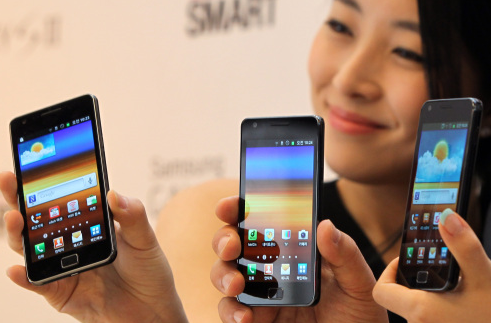
Samsung’s AMOLED technology is said to have dramatically improved over the past months to be suitable for tablets, sport brighter colors and deeper blacks, better behavior in direct sunlight and low power consumption. Samsung is currently using AMOLED in its Galaxy S smartphones, and it’s also rumored to use the displays in future tablets running Android. Samsung is currently facing a lawsuit from Apple, whose claims of patent infringement for the design of the iPhone and iOS copied by Samsung’s Galaxy devices and TouchWiz UI have led the tech press to believe future collaborations between the two companies may not go as smoothly as before. [The Korea Herald via 9to5mac]

Miro 4.0 Available Now, Miro For iPad Coming Soon

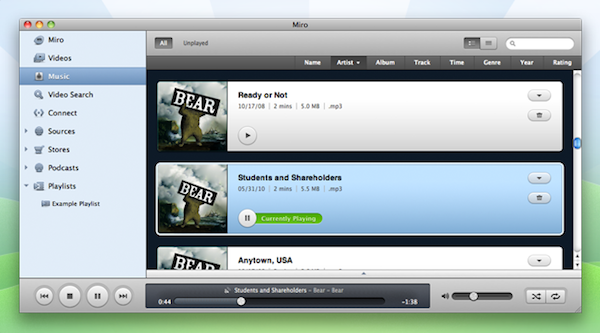
Miro, the open source media player and organiser, was today updated to version 4 and it heralds in some significant improvements and feature additions. Most notably it has taken on the role of being iTunes for Android devices, challenging others such as DoubleTwist with its media syncing capabilities.

It allows Android users sync the typical music, movies and podcasts but will even allow them to download Android apps from either the Google Android Market or from Amazon’s Android app store. The other significant addition is a home sharing feature for content stored in Miro. Using the iTunes DAAP protocol, it lets users stream their Miro Library to any other DAAP or vice versa, letting you play content from other DAAP clients, even a NAS drive on your network.

The New York Times is also reporting that the Miro developers, the non-profit group The Participatory Culture Foundation, have also been hard at work developing a Miro app for the iPad, which will launch within three weeks. The app will likely support the streaming features introduced in Miro 4.0 as well as focusing on podcasts, which was the original appeal for Miro.

[Via The New York Times]


New Apple Stores Set To Open In Florence and Madrid

The trusted source on new Apple Store openings, ifoAppleStore, is today reporting on two new Apple stores in Spain and Italy that are currently undergoing construction. The new Italy store is expected to be opened in the I Gigli suburban shopping center in Florence, located on the ground floor and facing a large circular courtyard. Based on documents that were posted on the traditional black barricade, the stores construction will be completed in August, suggesting an early September opening.

The third Apple store in Spain, is set to be a spectacle, occupying all seven levels of the historic building at #1 Puerta del Sol in Madrid, overlooking the large city plaza (pictured above). The historic 1863 building is currently being restored and renovated. The retail store is then expected to operate on at least two levels and the basement. As for the other levels, ifoAppleStore speculates that they may be used as administrative offices for Apple, meeting rooms or training space. Madrid’s mayor revealed the plans last week when he confirmed to reporters that Apple was leasing the entire building. The building, which has an iconic “Tio Pepe” electronic sign will be returned to the building after renovations are complete. The store will most likely open early next year, with significant construction work still to be completed.


Pioneer Introduces AppRadio with Powerful iOS Integration

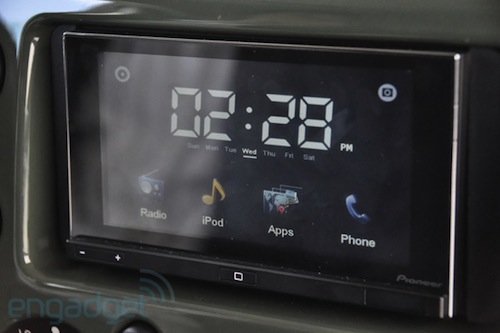
Initially surfaced last month through some FCC filings and rumored to be the first in-car radio to sport full iOS integration with iPhone apps and iPod out music controls, Pioneer officially announced the AppRadio today, with a dedicated iPhone app already available on the App Store for free. With a 800 x 400 6.1-inch multitouch capacitive display, Bluetooth connectivity and possibility to plug directly into an iPhone or iPod touch 4th gen running Pioneer’s software, the AppRadio will not only get usual access to your music library with album artwork and song information visualized on screen (BMW apparently already does that), it will also be capable of letting you interact with iOS calendars, maps, contacts and photos using the touchscreen device. It seems like Pioneer went all out to enable deep iOS integration, so much that certain applications available on the App Store, like Pandora and Rdio, have already announced AppRadio-specific versions with controls meant for the bigger display. On top of that, the AppRadio features a nice digital clock, an on-screen week calendar, a mic, external GPS antenna and a price tag below $500 when it goes on sale at the end of June.

From the press release:

Pioneer is rethinking connectivity by tapping into the power of the smartphone, while simultaneously providing a solution that safely merges the consumer’s connected lifestyle into the vehicle,” said Ted Cardenas, director of marketing for the car electronics division of Pioneer Electronics (USA) Inc. “AppRadio fully embraces the iPhone, which has become the window to our mobile connectivity and provides a comprehensive and safer way to use apps in the car.

There’s more: the AppRadio recognizes multitouch gestures like swipes, pinch and zoom, and the companion iPhone app will alert you of new AppRadio-compatible 3rd party apps as they’re released. iOS 4.2 or later will be required for the AppRadio to work with an iPhone or iPod touch. [via Engadget]


Sparrow 1.2 Now Available

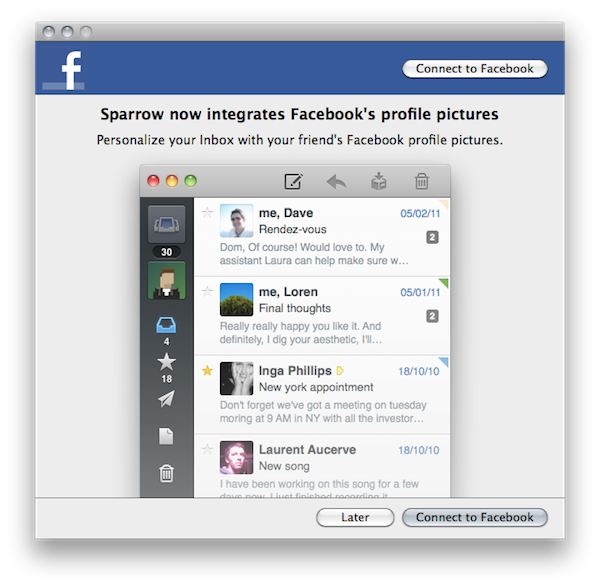
Teased earlier today at TechCrunch Disrupt in New York City, Sparrow 1.2 is now available for download on the Mac App Store. As previously reported, the new version adds a number of bug fixes and improvements, most notably enabling Facebook integration through Facebook Connect to automatically add profile pictures to contacts found in your social graph. Facebook support in Sparrow 1.2 is very straightforward: upon first run, you’ll be asked to connect with your Facebook account so Sparrow will be able to fetch your friends’ profile photos; according to the release notes, Sparrow 1.2 is also capable of letting you add new friends within the application, though I haven’t been able to test the new feature just yet. In the Settings, a new Facebook panel will allow you to disconnect from the service at any time and see friends that are also using the app.

Sparrow 1.2 brings many other functionalities such as a revamped dock icon that lets you write a new message with a right-click, new font options in the compose window and an overall interface refresh that’s quite welcome. Taking clues from Lion and other Mac apps like Twitter, Sparrow sports iOS-like scrollbars and free resizing on the message list. As I mentioned today, there’s a new Unified Inbox option that, just like iOS, allows you to see all your incoming messages from all accounts in a single tab; if you’re accustomed to this feature on your iPhone or iPad, you’ll feel right at home using Sparrow 1.2. Alongside these new options, bug fixes and localization in 8 more languages, Sparrow 1.2 brings the following changes as well:

  • Gravatar support
  • Threading by subject
  • Preference to hide Inbox selection bar
  • Account names appear faster on hover

With Twitter and LinkedIn support coming in the near future and new email functionalities likely in the works, Sparrow is shaping up to be a very interesting client for OS X that has a chance deeply change the way we think of social communication on our desktops. Go download the update here.


iPad 2 To Launch In Russia, Ukraine, Brazil This Friday [Update: Chile and Argentina, Too]

Just as Apple is allegedly considering opening its first retail store in Russia, 9to5mac reports Apple will officially roll out the iPad 2 to authorized resellers in Russia and Ukraine this Friday, May 27. That’s the same day carrier Aircel will start offering the iPhone 4 in India, in what it looks like a day focused around international releases ahead of the WWDC, where the company will sure give much importance to the availability of its devices in several countries. The Russian iPad 2 sales will begin this Friday through retail chain Re:Store, with MediaMarkt, Beliy Veter Cifrovoi, ION, Technosila and Eldorado also looking to jump on board for the May 27 rollout. Retailers are expecting “unprecedented demand” for the iPad 2, which doesn’t surprise considering the device’s popularity and the lack of Apple’s retail presence in Russia. As for the prices, Re:Store writes in their PR statement:

We are happy to be among the first to satisfy the incredible demand of our customers for the second generation of iPad featuring 16 GB, 32 GB of built in memory offered either with 3G or Wi-Fi or both features. The starting price for iPad2 is 18.990 roubles which is less than the price of previous generation iPad. The full pack supplied with both internet features equipped with 64 gb memory will be offered for 30.990 roubles. Following unprecedented demand from customers in Germany, Denmark and Norway, where the first batch of iPad 2 was sold inside three days, we are expecting all iPad 2’s to be sold even faster in Russia. We have offered our customers the opportunity to place pre-orders since April and have already received more requests than for first iPad when it came out on the market. I think there will be a deficit, assuming strong demand and problems with spare parts supply from Japan and China.

As usual with international launches, the price will be higher than the US suggested price tag, but this shouldn’t keep people from buying the iPad 2 anyway as, according to the same retailers, the first-generation iPad has got users accustomed to the concept of the tablet, and the iPad 2’s new features should make for incredibly fast sold-outs. As for Ukraine, website UkranianiPhone reports [Google Translation] the device will be available on Friday at selected retailers starting 1 PM with prices ranging from $670 for the 16 GB WiFi model to $1100 for the 64 GB WiFi + 3G iPad 2.

The long-awaited gadget will hit iStore, MOYO, Comfy and Foxtrot. The question may arise: why only in these stores? After the official Apple dealers in Ukraine, much more?

It turns out the whole thing in international politics Apple - iPhone and iPad have the right to sell only partners with the status of APR (Apple Premium Reseller) and major retail chains. Other authorized partners, for example. AAR (Apple Authorized Reseller) or ASE (Apple Sales Expert), unfortunately, have no such right.

Apple’s latest major iPad 2 rollout happened in late April, with twelve countries receiving the device on Friday, April 29.

Update: the iPad 2 is also launching in Brazil this Friday. MacMagazine reports [Google Translation] it will be available through Americanas.com, Fast Shop, Scott and Walmart alongside accessories like Smart Covers, docks and power adapters. [Thanks, Lucas]

Update #2: 9to5mac also reports Argentina and Chile will get the device this week as well.


Behind The Scenes of Verizon iPhone: Special PIN Security Protocol, “ACME” Code Name

In a lengthy report published earlier today, TechnoBuffalo shares some of the interesting details behind the launch of the Verizon iPhone 4, which went on sale in the United States in February. In the months leading to the launch of the CDMA device, speculation was running wild on the Internet as to whether Apple was really ending AT&T exclusivity to release an updated version of the iPhone to support Verizon Wireless’ CDMA infrastructure; citing a source “close to the action”, TechnoBuffalo says only top executives at Verizon knew about the device, which internally used to be mentioned as “ACME device” to avoid other employees would hear the “iPhone” name and leak information outside of the company. Public testing of the CDMA iPhone 4 began at Apple Stores (and obviously, Apple’s own campus, where Steve Jobs said they had installed Verizon and AT&T towers) six months ahead of the official launch, meaning in summer 2010 shortly after the release of the AT&T iPhone.

Though key employees and executives were in the loop, everyone else at the carrier knew little more than the rest of the public. And it would seem the higher ups wanted to keep it that way. No one talked about the Apple smartphone externally, and even internally, it was still a hush-hush operation. In fact, says the source, the word “iPhone” was never uttered; only its codename was referenced: It was called the “ACME” device.

Between NDAs to sign, corporate secrets and internal discussions about field-testing and cooperation with Apple, the most interesting tidbit details how, rather than installing geo-location software (like Find my iPhone) on the prototypes to make sure they wouldn’t end up in the wrong hands (as the AT&T iPhone 4 did), Verizon testers were required to text a PIN code every 12 hours as a confirmation the device was being used internally for testing purposes only.

Our source describes a unique protocol requiring staffers to text a secret PIN code to a dedicated phone number every 12 hours. This served as ongoing confirmation that the handset was still in the proper hands. So no PIN code, no functionality.

Unlike the original iPhone 4, Apple managed to keep the Verizon iPhone closely under wraps until the official announcement, not even allowing Verizon to tease anything at CES 2011 in Las Vegas a few weeks before. The security measures taken by Apple to ensure devices were only used internally are particularly interesting, and a sign Apple must have reconsidered its testing process after the AT&T iPhone got leaked to Gizmodo.com in Spring 2010, months before the WWDC announcement.


Sparrow Unveils Unified Inbox and Facebook Integration in Version 1.2

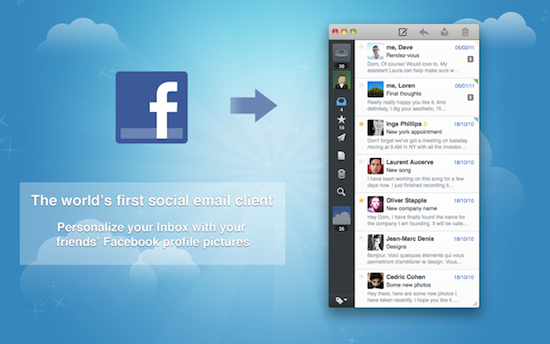
Sparrow, the minimal email client for the Mac that was born as a mix between Mail.app and Tweetie for Gmail and eventually evolved into a full-featured IMAP email application, has just announced version 1.2 at TechCrunch Disrupt, which will add a number of new features including the long-awaited unified inbox and a new social layer for your contacts. Since the app was first revealed as beta in October, Sparrow saw a terrific rise in popularity throughout the release of the various betas, and especially after the launch of a Mac App Store version and lite edition, Sparrow has quickly become many people’s favorite way to access Gmail and any other email provider with a convenient, simple interface that follows the latest trends set by apps like Twitter and Reeder for Mac. With the 1.1 update, the developers added IMAP support and integration with Google’s Priority Inbox, thus turning Sparrow from a lightweight client into a serious alternative to more complex apps like Mail and Postbox. The 1.2 update will bring the possibility to see all email messages in a single inbox without switching between accounts, as well as Facebook Connect integration to automatically add profile pictures to contacts. It’s not clear now if this new Facebook feature will also add photos to people that have emailed you using standard IMAP and Gmail accounts, but CEO Dom Leca says they’re “not adding social layers mail for the sake of it”, and Facebook Connect will let you add people as Facebook friends within the app.

Victor Ageda, Jr. from TUAW further reports Sparrow 1.2 will also add some kind of Tumblr integration. The Sparrow team has raised $250,000 in funding over the last months (funders include Twitter’s Loren Brichter), and the developers are looking forward to bring Twitter and LinkedIn support to Sparrow in future versions, turning an email client into a complete social messaging experience like no other on the Mac. The idea of grouping all kinds of social communication into a single app has always attracted users and developers, but no one really quite nailed it. Hopefully Sparrow will manage to blend it all together, yet retaining its nature of simple and powerful email client.

Sparrow 1.2 should be available later today or tomorrow on the Mac App Store at the regular price of $9.99. We’re looking forward to the update and the full list of changes in version 1.2.