Daisey’s Lies Take Us Two Steps Backwards

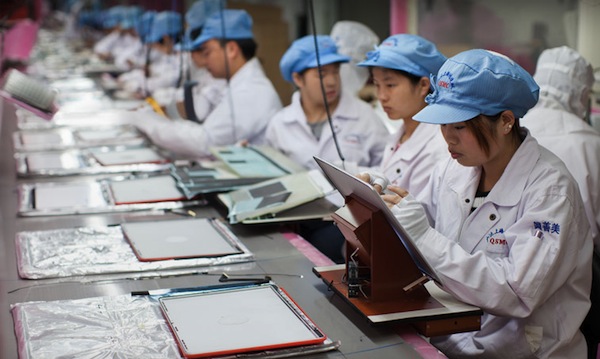
Taking a noble cause one step forward, and then two steps back. That’s what I think Mike Daisey has done with his spinning of the truth and lying in creating his monologue ‘The Agony and Ecstasy of Steve Jobs’. I have no doubt that a significant part of Daisey’s intentions were noble in creating the show, particularly when he was starting — but all that was wasted, when, in the pursuit of a perfectly dramatic story, he started to make things up. His play was meant to be a serious, considered, sobering look at the ugly, hidden side of how our Apple devices are made. But because he made details, people and stories out of thin air – particularly the ones that plucked the hardest on our hearts – he has ultimately trivialised the real human suffering that does exist in the factories of a developing country. And the worst atrocity was Daisey hiding these stories and instead calling them as facts — because now that the truth has been revealed, the play (and the original This American Life podcast, where he adapted the show into an hour long episode) has been discredited severely.

Most of all, I feel anger and frustration towards Daisey. After initially deciding to tackle a serious humanitarian issue, he surrendered to greed, using dramatic licence to sensationalise the story. His greed has likely set action on the humanitarian issue backwards, not forwards as I think he did set out to do.

With this retraction so heavily publicised, many may be under the impression that there are no under-age workers, that there aren’t people poisoned by chemicals, or that there aren’t terrible living conditions in dorms at Foxconn. Daisey created stories and people that personified these facts, to advance his story in a dramatic way. But whilst those individual stories might not be true, those circumstances, those injuries, that mistreatment of workers is unfortunately still a fundamental truth that exists. Now that the story is all about Daisey’s lies, the ugly truth that Daisey had initially tried to shine a light on has been relegated to insignificance again.

Max Fisher over at The Atlantic epitomises my fears surrounding this pretty much perfectly in this paragraph (though his whole article is also worth a read):

How receptive will they be the next time a reporter writes about how Chinese laborers are forced to stand for so long they struggle to walk, or that some workers weren’t even given gloves to handle poisonous chemicals? Will they believe the reports that say Chinese manufacturers could fix a number of these problems simply by rotating shifts or allowing workers to organize to ask for gloves, neither of which would cost them (or American consumers) anything? Will they bother to listen to the human rights NGOs who say that American consumers can help fix the problem simply by choosing to buy products that are manufactured under better conditions? Or will they think back to Mike Daisey, and wonder who else might be lying to them?

The Truth of the Situation

So what is the truth of the situation? This is an important question given the retraction and media circus surrounding Daisey’s lies. The answer is one we should keep reminding ourselves of, because the truth of the matter is that, whilst Apple is ahead of its competitors in working conditions, safety and anti-discrimination, they are still well behind what is considered acceptable in developed countries. Here are some statistics, lifted directly off Apples own Supplier Responsibility Progress Report from earlier this year:

  • 24 facilities conducted pregnancy tests, and 56 facilities did not have policies and procedures that prohibit discriminatory practices based on pregnancy.
  • 93 facilities had records that indicated more than 50 percent of their workers exceeded weekly working hour limits of 60 in at least 1 week out of the 12 sample period.
  • 67 facilities used deductions from wages as a disciplinary measure.
  • A total of 6 active and 13 historical cases of underage labor were discovered at 5 facilities.
  • 78 facilities had at least one instance where a workstation or a machine was missing the appropriate safety device such as a gear guard, pulley guard, or interlock.
  • 99 facilities had noncompliance in some aspect of their fire prevention, preparedness, and response, such as unmarked fire extinguishers and insufficient fire drills.

I also highly recommend listening to Act 3 of This American Life’s Retraction episode, which further delves into what the truth of the situation really is.

Let’s be Realistic

China is still a developing nation and as is mentioned in Act 3 of This American Life, it would be unrealistic to expect equal standards of a Foxconn factory and one in the US. But we are still a long way off from that threshold of what is an unrealistic expectation of Foxconn and other Apple suppliers - and of Apple itself. They may be doing more than most companies, and we should congratulate them for that, but also stress it is not yet enough. There are still unacceptable breaches of supplier responsibility, as Apple has set out themselves in their reports. Apple, like it does in its products, should always strive upwards to improve its record on the issue.

We should also be putting pressure on other consumer brands to step up to the level of transparency that Apple offers with its supplier responsibility reports and encourage them to do better than Apple at improving standards. Finally, we should be educating each other on the issues, whether it be pointing out what is fact and what is fiction from Daisey’s monologue or discouraging pointless arguments for Apple to move its entire manufacturing base to the US (also see Act 3 of This American Life for a great explanation).

The revelation of Daisey’s lies should not be a cause for relief or celebration. It’s a sad revelation that a man had to further dramatise the sufferings of other human beings in order to get the rest of us to listen and feel sympathy. It’s time we pay attention to the facts ourselves, and make sure we don’t just ignore them.


Apple Adds “Answers from the community” Section To More Product Pages

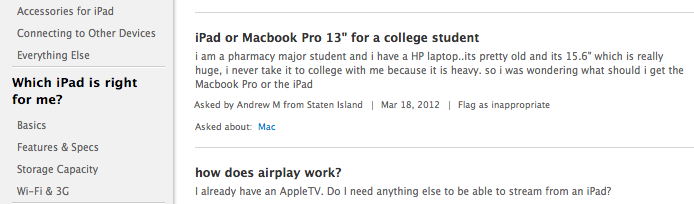
As noted by The Next Web, Apple has added a new “Answers from the community” section at the bottom of product pages accessed from the company’s online store, allowing users to read questions and answers submitted by the community, and reply to them by logging in with an Apple ID. Currently, a product page on Apple’s website doesn’t have this new section, but its dedicated retail store page does. Here’s an example of the iPad webpage, and its retail page. Furthermore, the section appears to have been enabled only for English-speaking countries: it is available on the US, UK, Canada and Australia Apple online stores, but it can’t be found in France or Italy.

In product pages, the new section is embedded at the bottom, displaying top questions from the community alongside “popular topics”. Single-product Q&A pages are available as well, with a sidebar on the left listing more popular topics and questions, and a link to visualize the most recent answers for a specific product. Questions include a variety of topics, such as, for the iPad, “which iPad is right for me?” and “what can I do with an iPad?”, alongside other discussions about apps, features, and “everything else”. Users can read questions without logging in, read all answers, browse similar questions, and submit an answer of their own through a dedicated form.

Separate from the Apple Support Communities that the company revamped last year, the “Answers from the community” section comes with a set of guidelines Apple is making publicly available. These guidelines have been online for quite some time – the possibility of leaving ratings, reviews, and questions has been a feature of the Apple online store, in one form or another, for years now – but the integration with product pages and overall graphical look are new.

It’s interesting to notice how, in the past months, Apple has been slightly tweaking the online Store to include social functionalities aimed at increasing options to share and discuss products. Last summer, Apple added Facebook and Twitter sharing to its online store, letting customers easily share links to a product with their friends and followers. Community answers are nothing new as a concept, but the way they are now prominently displayed on more product pages from the online Store signals a renewed focus on making the shopping experience more “personal” by enabling people to answer questions that, too often, an official FAQ section can only partially cover.


Apple Confirms Dividend and Share Repurchase Program

Apple just confirmed with a press release they are initiating a dividend and share repurchase program later this year. The company posted a press release yesterday, saying they would make an announcement related to their cash balance today.

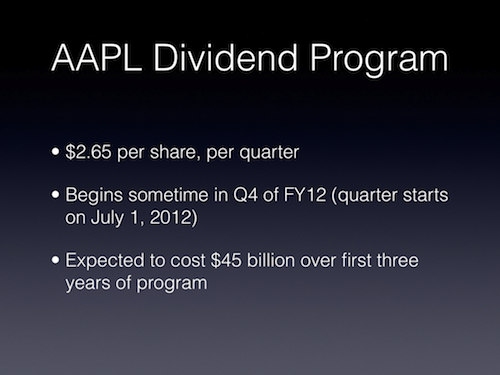
Subject to declaration by the Board of Directors, the Company plans to initiate a quarterly dividend of $2.65 per share sometime in the fourth quarter of its fiscal 2012, which begins on July 1, 2012.

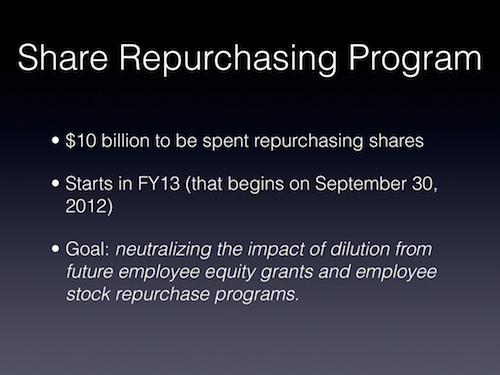
Additionally, the Company’s Board of Directors has authorized a $10 billion share repurchase program commencing in the Company’s fiscal 2013, which begins on September 30, 2012. The repurchase program is expected to be executed over three years, with the primary objective of neutralizing the impact of dilution from future employee equity grants and employee stock purchase programs.

Quoted in the press release, Apple CEO Tim Cook said the company has used its cash to make “great investments” with “increased research and development, acquisitions, new retail store openings, strategic prepayments and capital expenditures in our supply chain”. With “plenty of cash to run the business left”, Cook said to expect more of these from Apple in the future. Apple expects to utilize “approximately $45 billion of domestic cash in the first three years” for the programs.

Apple’s last dividend goes back to 1995, according to the company’s official Investor website. In 2010, Steve Jobs said he preferred the company to hold onto its cash, rather than paying a dividend to investors:

We know if we need to acquire something — a piece of the puzzle to make something big and bold — we can write a check for it and not borrow a lot of money and put our whole company at risk,” Jobs said today at Apple’s shareholder meeting. “The cash in the bank gives us tremendous security and flexibility.

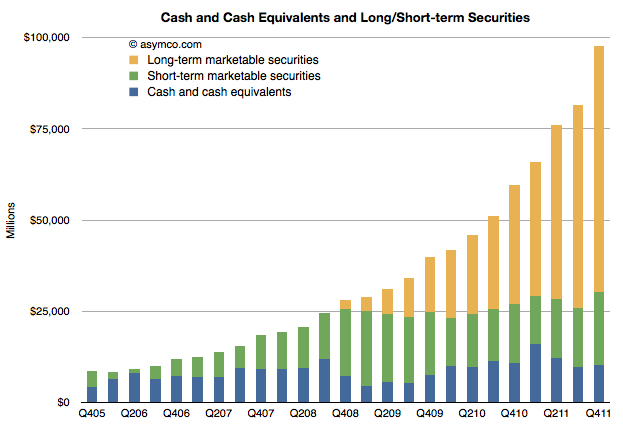
The direction, however, has been revised in the past years, with Cook and CFO Oppenheimer stating on multiple occasions Apple was in “active discussions” with the board in regards to its cash balance, now account for nearly $98 billion in cash ($97.6 billion in cash at end of December), cash equivalents, short-term marketable securities, and long term marketable securities.

Apple will provide a live stream of the conference call on its website starting at 9 AM EDT. Read more


Apple Schedules Conference Call To Announce Outcome of Cash Balance Discussions

Apple just issued a press release confirming a conference call scheduled for tomorrow, March 19th, to announce the outcome of discussions concerning the company’s cash balance.

Tim Cook, Apple’s CEO, and Peter Oppenheimer, Apple’s CFO, will host a conference call to announce the outcome of the Company’s discussions concerning its cash balance. Apple® will not be providing an update on the current quarter nor will any topics be discussed other than cash.

Apple will provide a live stream of the conference call on its website starting at 6 AM PDT (9 AM EDT). As noted in the press release, Apple won’t discuss any other details related to the ongoing quarter – as such, we shouldn’t expect any sales numbers related to the release of the new iPad during the conference call.

Apple, whose stock is currently trading at $585, has been rumored for years to be on the verge of announcing a dividend for its shareholders. In the past years, however, both CFO Oppenheimer as well as Tim Cook himself reiterated several times that Apple’s cash wasn’t “burning a hole in their pocket” – the company may have avoided discussions of a dividend, but as Tim Cook also recently noted, they haven’t been religious about holding or not holding cash. In the past year alone, Apple bought Israeli chip maker Anobit and App Store search and indexing service Chomp. Similarly, it was previously reported that $3.9 billion of Apple’s cash reserves may have gone into securing deals for LCD displays and other components in 2011.

At a shareholder meeting in 2010, Steve Jobs said he preferred the company to hold onto its cash for potential investments, rather than paying a dividend:

We know if we need to acquire something – a piece of the puzzle to make something big and bold – we can write a check for it and not borrow a lot of money and put our whole company at risk,” Jobs said today at Apple’s shareholder meeting. “The cash in the bank gives us tremendous security and flexibility.

During the Q4 2011 earnings call, Tim Cook, however, said:

To date we’ve wanted to have flexibility…. The cash isn’t burning a hole in our pockets and we’re not going to do silly things with it. We invest it conservatively….We’ve taken money and done things in Apple’s best interests, for example we’ve acquired several companies, some IP, we’ve invested in the supply chain and we use money to build out our stores and for new product tooling. So I believe what we’re doing with cash …that said, I’m not religious about holding cash or not holding it, I’m religious about of a lot of things, but that’s not one of them. We do what we believe is in Apple’s best interests …and we’ll continue to discuss it on the Apple board.

With just under $98 billion in cash and liquid investments ($97.6 billion in cash at end of December, compared to $81.6 billion at end of September with an increase in $16 billion), in February 2012 at the Goldman Sachs Technology Conference Cook said Apple has been “judicious” and “deliberate” with its cash.

Yes, we still have a lot. I would say we’re judicious and deliberate. We spend our money like it’s our last pennies. I think shareholders want us to do that. They don’t want us to act like we’re rich. We’ve never felt that way. It may sound bizarre but that’s the truth. In terms of our approach to cash, I’ve said since becoming CEO that I’m not religious about this. I’m not religious about holding it or not holding it. We’re in very active discussions at the board level on what we should do.

I think everyone would want us to be deliberate and really think it through. That’s what we’re doing. We’re not going to go have a toga party and do something outlandish. People don’t have to worry that it’s burning a hole in our pocket.

Via Asymco, an image showing the composition and scale of Apple’s cash holdings.

As Philip Elmer-DeWitt noted in February, there are some options Apple could consider with its cash. These options analysts and journalists have suggested include a one-time dividend, a stock split, a share repurchase plan, and an annual dividend. While there haven’t been any signs of the company effectively considering said options with for its cash holdings, Tim Cook publicly stated they were only asking “for a bit of patience” to make the “best decision for the shareholders”. He also went on the record saying Apple has “more cash than we need to run the business on a daily basis”.

We will post details of Apple’s announcement starting at 9 AM EDT tomorrow on MacStories’ homepage.


Instapaper 4.1

In my review of Readability for iOS, I wrote:

I think there are various important points to stress: the Instapaper app has been around for years now, and with the recent 4.0 update it solidified the strong feature set offered by Arment which, quite honestly, is still unsurpassed. Put simply: you can’t do all the things you’re able to do in Instapaper with the new Readability app. So, if you’re really used to Instapaper’s pagination settings, Friends discovery, sharing options and app integrations, you might want to consider staying with Instapaper.

I am one of those users that, for a number of reasons, are glad to stay with Instapaper. When it comes to my reading list, I invested too much time in building a personal archive of articles I enjoyed that I feel uncomfortable switching, after years of usage, to another service. That was the most difficult part of writing my Readability review: to be able to take an objective and balanced look at the app – which, again, I believe is a very good one – while knowing that I would stick with Instapaper. But it’s okay: unlike some people, I don’t see competitors as “enemies”, and healthy competition ultimately leads to more innovation. Omitting the inelegant words of other people that only show a lack of grace when it comes to respecting your competitors, I think Readability and Instapaper can coexist. And as I wrote, I do hope that Readability can figure out a better way to manage its payment platform for publishers. I like and use Instapaper, and in my perfect vision of the software scene everyone would just work hard silently and strive to one-up a competitor, with class.

Last night, Marco Arment released a 4.1 update to Instapaper. You can find it on the App Store, and the app also comes with Retina assets for the new iPad, if you got one yesterday. Perhaps more importantly, at least for me, Instapaper 4.1 adds a series of improvements and design refinements that only make an already fantastic 4.0 version even better. Read more


Comparing My Favorite iOS Text Editors

Earlier this year, I promised myself that I would get more work done using the iPad. The plan was an ambitious one: after three years of writing, researching, and online communication done exclusively using my MacBook (and, perhaps to an extent, my iPhone) switching to the iPad as my main work machine did indeed seem like a daunting task at first. Yet the more I thought about it, the more I realized the long-term benefits of giving the iPad a fair chance as a full-time writing tool would outnumber the perks of using a device I am accustomed to. With a mature ecosystem of apps that sees great new software coming out every week and a Retina display on the horizon, starting to use the iPad as my main computer was an investment.

The experiment has been a success so far. I use my iPad a lot more, I enjoy it, and, more importantly, the device is helping me work smarter because it lets me focus more on what I do for a living: writing.

If anything, the only negative note is that the iPad has given too much choice when it comes to picking a single writing tool. See, on the Mac, when I need a text editor, I usually fire up Text Edit (rigorously set in plain text mode) and forget about it. But there is no Text Edit for iPad. And all those text editors on the App Store look so tempting.

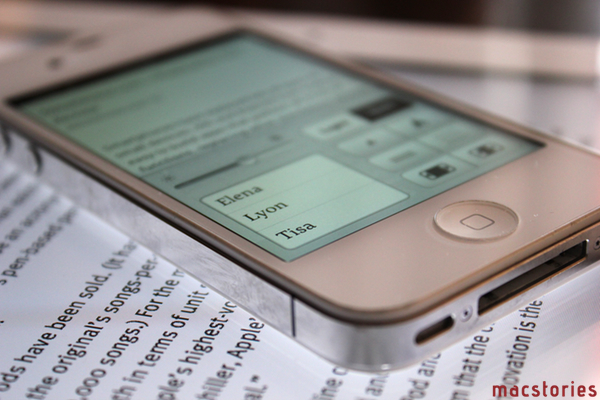
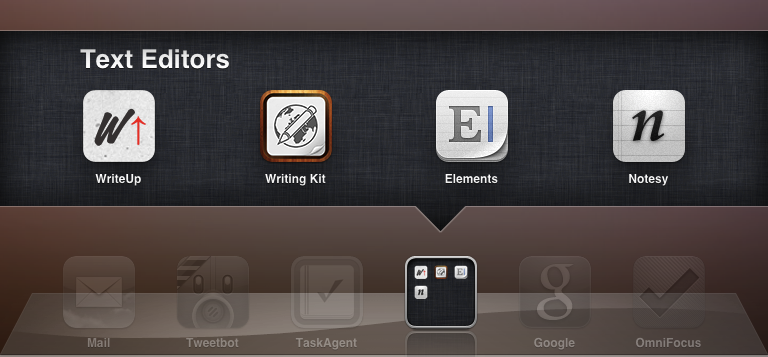
What follows is an overview of the four text editors (for writing, not coding) that I have preferred using in the past three months. Like TJ Luoma, I have bought many of them. Almost too many, to the point where I needed to stop fiddling already, and get the writing done. Because while I’m one for supporting developers and buying apps and paying for the tools I use, there is a line between “trying software” and “using software to work better”, and I had crossed that line with my curiosity for text editors. So I took all of them, tested them, and deleted the ones I didn’t like. I kept the ones with Markdown formatting and Dropbox sync. I didn’t include recent additions to the ecosystem like iA Writer (for iPhone) and Byword, as I need to test them more accurately. Eventually, I picked four apps.

Some smart folks have already written about the note-taking apps/text editors they like and use. Mine doesn’t want to be a comprehensive comparison that takes into account all the possible options from the App Store. It will likely lack the app you like, and yes, it’s also very likely that it’s not here for a reason. In this article, I am just comparing four apps that, taken singularly, allow me to write for the site; these four apps can stand on their own. However, they have their differences, which is why I am, ultimately, going to choose one and stick with it. The apps are universal, and while I am primarily looking at their iPad versions, almost all of the features I mention are also available on the iPhone.

I have no doubt new iOS text editors will come out, activating my curiosity trigger again. Until then, these are the four text editors I was most impressed with. Read more


Apple Seeds OS X Lion 10.7.4 to Developers

Following the release of the second Developer Preview of Mountain Lion earlier today, Apple has also released a pre-release version of OS X Lion 10.7.4 to developers. Build 11E27 is available now for download in the Mac Dev Center to registered Mac developers. A Server build for 10.7.4 has also been seeded to developers.

The last public version of OS X Lion, 10.7.3, was released on February 1st, adding bug fixes and addressing compatibility issues with Windows file sharing. A “supplemental update” to 10.7.3 was released on March 5th to resolve an issue with Time Machine backups.


Apple Releases OS X Mountain Lion Developer Preview 2

Apple just released the second developer preview of the next major version of OS X – Mountain Lion. The new developer preview is available in the Mac Dev Center to registered Mac developers, and it carries build number 12A154q. As with the first developer preview, the build can be downloaded from the Mac App Store with a redemption code. The Next Web has a list of known issues with the latest build of 10.8.

Mountain Lion, officially announced on February 16th, will be released this summer, featuring a number of new functionalities, including standalone Notes and Reminders app, Notification Center, Gatekeeper, and more. Check out our Mountain Lion overview for a roundup of all the new features.


PayPal Announces “PayPal Here” Mobile Payment System

Long rumored to be working on a mobile payment system to take on Square, PayPal, the online payment company owned by eBay, officially announced today PayPal Here, a new mobile payment system that, through the combination of hardware and software, aims at helping small business owners complete transactions on the go.

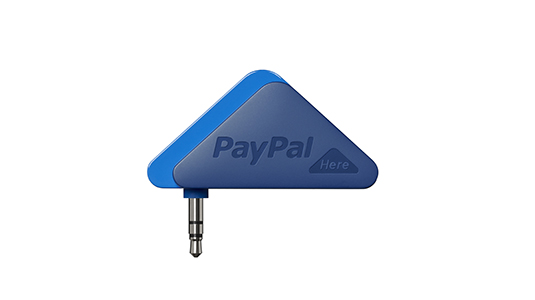
With a blue dongle that fits into the iPhone’s headphone jack port and an app in the works for iOS and Android devices, PayPal Here, similarly to how Square works, allows users to swipe their credit cards and confirm transactions on a mobile device’s touch screen. PayPal Here’s biggest advantage over the competition, as you can imagine, is the 100 million customers in 190 countries already using the service – Square, despite being the first company to really disrupt the mobile payment scene with its popular hardware accessory, can’t boast the same numbers of PayPal, which is still the leading online payment solution worldwide. With this in mind, PayPal has created a system that accepts credit and debit cards, PayPal, and checks; the company is collaborating with VISA, American Express, Discover and MasterCard to provide support for credit and debit cards, whilst also enabling users to invoice from the app, and track cash payments.

While taking checks and issuing invoices are free of charge, all card swipes that will happen through PayPal Here will have a 2.7% rate with “no hidden fee or commitments”. This is very similar to Square’s standard 2.75% commission, but being new to this market, PayPal still doesn’t have all the options for merchants that Square is offering. Recently, Square set out to reinvent old POS systems with the iPad, revamped its iOS app completely, and launched a brand new Card Case app to facilitate virtual transactions for its users.

PayPal Here looks very straightforward for now, albeit it wouldn’t be a surprise to see the company rolling out new functionalities quickly now that the product has been unveiled. The free, encrypted card reader can accept cards, and users can also rely on a phone’s camera to scan checks and process cards. The app, demoed today and shown in a promo video, uses a typical grid interface to choose between various payment methods, and enables customers to sign digitally using their fingers. The app can deliver receipts wirelessly, and it appears it will also let merchants set up various items in their database for quick access when entering a new transaction. Funds are “instantly available” in a PayPal account, and there’s also a map to show where a transaction was completed.

In another promo video that we have embedded after the break, PayPal is obviously touting the new service as the only one that accepts the most payment systems with the convenience of something that’s portable and secure. Admittedly, the fact that PayPal already has millions of users and that is a well-established brand in several countries will help in making Here gain traction among consumers and business owners. On the other hand, though, Square has been making some terrific innovations in the mobile payment space lately, and although still limited to the US, it comes with a richer catalog of apps and tools to help consumers and business owners tailor their digital transactions (and wallets) to their needs. It will be interesting to see how this industry will evolve now that the biggest player has decided to come up with a solution that, while very similar to Square, has a chance to raise general awareness and curiosity among users.

More information about PayPal Here can be found on the official website. PayPal Here is available today for select merchants in the United States, Canada, Australia and Hong Kong. More merchants will be added next month, and the service will launch in more countries soon. Read more