

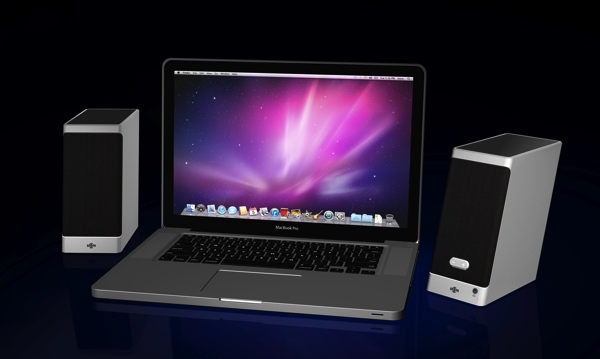
Your next pair of speakers should be as beautiful and innovative as the MacBook on your desk. Ditch those internal speakers for a pair of Stem Innovation’s Tandem high performance speakers, featuring a channel swap technology that enables the main unit to switch from the right to left channel depending on how you’d like to orient the speakers.
Posts in news
Stem Innovation Tandem Switches Channels, Compliments Macs and MacBooks
Pixelfari: It’s Safari, In 8-bit. And It’s Totally Awesome.
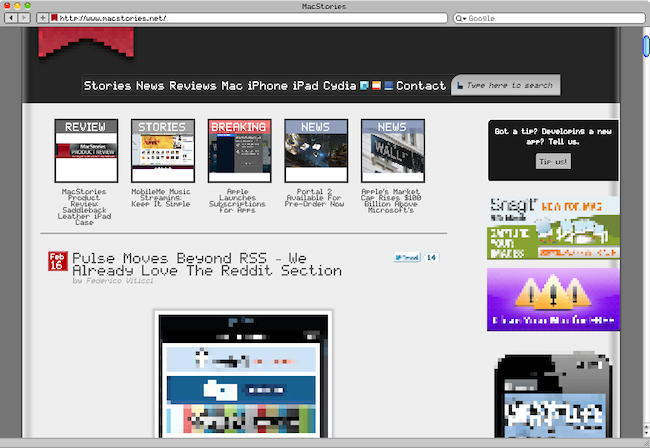
Pixelfari by Neven Mrgan is the coolest Safari mod I’ve ever seen. The app, very buggy and released as an experiment by Mrgan, is basically a skin for Apple’s browser completely realized in 8-bit style. Like those old Nintendo games, or The Incident from Mrgan himself. It’s pixel art applied to a browser: toolbars, fonts, menus, preferences – everything. It’s unreadable as hell. But at the same time, my beloved geeks, it’s kind of a dream come true: Nintendo from the 80s meets Apple. Mrgan writes:
Ladies and gents, fellow humans — presenting Pixelfari, a pixely, 8-bitty version of everyone’s favorite browser. Enjoy chunky fonts, blocky graphics, and a general sense of giddy inefficiency. Spearheaded by yours truly and developed by a very clever friend.
Maybe we’re all getting excited about this because it’s a neat hack no one ever did before. Still, you can’t take the 8-bit love away from me. So go download the app here , right now. Enjoy. Read more
Pulse Moves Beyond RSS - We Already Love The Reddit Section
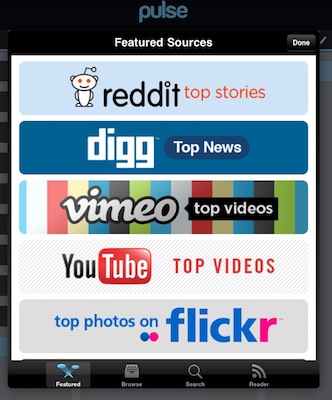
A few days after an update that brought proper Google Reader sync and faster loading times, the developers of Pulse News Reader for iPad issued a small update on their online backend (it means you don’t need to check for updates in iTunes) to bring extensive support for a series of APIs. What Alphonso Labs is doing is very simple: they’re slowly moving beyond RSS. And with this move, they have embraced APIs as the new way to fetch content from various services like Reddit, Vimeo, Youtube and Digg.
RSS, as many have noted, sounds very geeky - something we find impossible to explain to our mothers. RSS provides the plumbing to visualize a variety of news sources, but it is never mentioned in the app. We added a layer of usability that really resonated with our mainstream users.
For a lot of our users, Pulse has now become their go-to “browser” for consuming content. And this content does not have to be restricted to RSS feeds. Today, we’re adding SIX brand new sources to Pulse.
Warner Bros’ Ingenious Move: Sell Movies As Apps
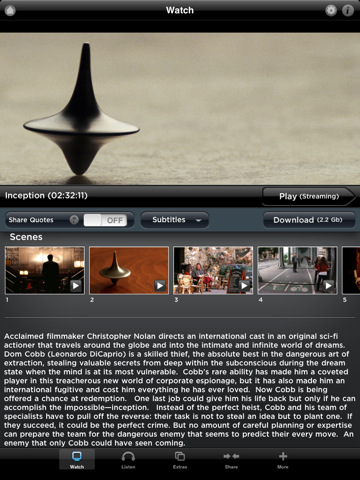
A day after the release of the updated iOS App Store Review Guidelines, it appears that Warner Bros. has already figured out a better way to avoid the iTunes Movie Store’s country limitations and offer content for all mobile devices and users: they are selling movies as apps. The apps, Inception: App Edition and The Dark Night: App Edition, are actually quite interesting as they pack a lot of extras like interactive video trivia, soundboard, ringtones and art galleries, thus seemingly respecting Apple’s new rule on songs, movies and books sold as applications:
2.21
Apps that are simply a song or movie should be submitted to the iTunes store. Apps that are simply a book should be submitted to the iBookstore.
These are not “simply a movie”. Warner Bros. has built two apps that offer a native interface for iPhone and iPad, they are available for free in the App Store and allow you to stream a movie or download it for $11.99 and $9.99, respectively. The Inception app, for instance, even comes with movie posters,” behind the scenes” content and music by Hans Zimmer that you can stream via AirPlay. No details on resolution / quality, but it appears that everything can be streamed on 3G as well – perhaps the apps adjust quality automatically basing on your connection’s speed.
This is interesting, as Warner Bros. has cleverly implemented in-app purchases and the features offered by building a native app to bypass Apple’s guidelines and, overall, provide a great experience to customers. We would like to see more of these experiments in the future. [Inception, The Dark Knight via 9to5mac]
Verizon iPhone Sales Low, Under Apple’s Expectations?
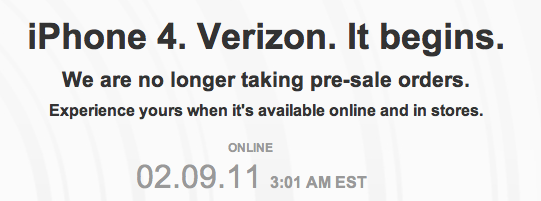
BGR is reporting numbers shared by one of their Apple sources about sales and pre-orders of the Verizon iPhone which apparently are “performing a little under what Apple and Verizon anticipated”. BGR has posted the following numbers from 5 Apple Stores combined, including “two very, very prominent stores”:
- Thursday: Verizon = 909, AT&T = 539
- Friday: Verizon = 916, AT&T = 680
- Saturday: Verizon = 660, AT&T = 471
- Sunday: Verizon = 796, AT&T = 701
- Monday: Verizon = 711, AT&T = 618
These numbers refer to first five days of availability of the device in 5 different Apple retail stores. BGR also reports pre-orders amounted to 550,000 units. As for who’s buying the Verizon iPhone:
We also have some statistics on who’s buying Verizon iPhones to share with you: 30% of people buying Verizon iPhones were Android users, just over 25% of people buying iPhone 4 were BlackBerry users, and only 14% of people buying the Verizon iPhone were AT&T iPhone owners. The remaining percent didn’t want to say, didn’t have a smartphone, or didn’t have a phone prior to making their iPhone 4 purchases last week.
As of today, Apple hasn’t announced how many Verizon iPhones were sold or pre-ordered. We do know, however, that the iPhone 4 broke Verizon’s sales record in two hours. Also, looking at the numbers posted by BGR, it’s clear that Verizon is selling more phones than AT&T anyway – we’d be curious to know how many Apple planned to sell in the first week.
To sum up, Verizon is already outselling AT&T (in “prominent stores”) with a 8-month old device, yet it’s not meeting Apple’s expectations. Interesting.
iPhone Nano Concept: Squeeze To Close Apps
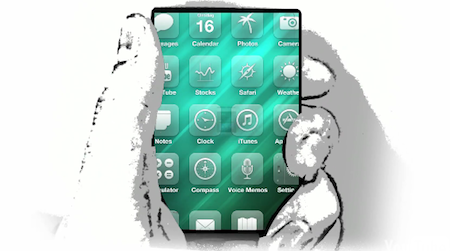
Max Rudberg of Max Themes has tried to imagine a smaller iPhone with, as according to recent speculation, an “edge-to-edge” screen. While the WSJ report doesn’t give many details about the nature of such a screen (is it “edge-to-edge” vertically, or horizontally?), it admittedly plays very well with previous rumors of future iPhones lacking a home button. So what Max did, and you can check out in the video below, is think about a phone that’s really just a screen, but that you can “squeeze” to close apps and go back to the Springboard.
A more intuitive way could be to equip the phone with a pressure-sensitive body. The phone could then be squeezed and the current app would shrink and return the user to the Home screen.
This could be a real wow effect. Seeing how the phone reacts to your grip and then having the app vanish in the palm of your hand.
To avoid ‘squeeze to go Home’ from happening by accident, a visual cue could show that pressure is being applied. In this concept, the app begins to shrink to reflect the pressure that is being applied. When the pressure goes over a defined threshold, the user is returned to the Home screen.
It sounds very futuristic, we know, but it could be a good idea for when the iPhone will eventually lose the Home button. What do you think? Read more
People Spend 200 Million Minutes Playing Angry Birds. Every Day.

Okay, we know Angry Birds has become a social phenomenon like no one ever did before, but the latest numbers shared by Rovio’s “mighty eagle” Peter Vesterbacka are just impressive. Absurd, if you think about it. Here’s the revelation: people spend 200 million minutes every day playing Angry Birds on the platform the game is available. 200 million minutes means every week 1,400,000,000 minutes are spent killing the infamous pigs that made this game famous. That’s over the billion, and I don’t even want to do the math for all the months Angry Birds has been available.
Of course, I assume other popular PC and console games have impressive numbers as well, but this is insane for mobile gaming – a market that four years ago was basically non-existent, or at least dreaming of reaching such a level of popularity. Remember when we used to play Snake on our Nokia cellphones? That’s exactly what I mean. Think about those days, and look at Angry Birds’ success now. The change in less than a decade is incredible.
You can listen to Rovio CEO talk about the proliferation of the birds below. With a new version coming out in March and a sequel likely to debut in 2011, I would buy some Rovio stock if it was available right now. Read more
A Week After Verizon iPhone Launch, AT&T CEO Is Unhappy About The App Store
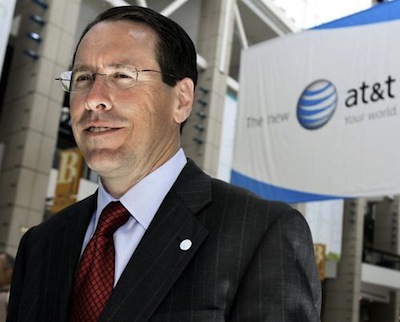
AT&T CEO Randall Stephenson doesn’t think the App Store model is what consumers want. In fact, a week after the public release of the Verizon iPhone (AT&T has been the iPhone’s exclusive carrier in the US since 2007), he thinks carriers (surprise) should sell apps to consumers as HTML5 pieces of software available through the “Wholesale Applications Community” – an app store set up by carriers.
Stephenson doesn’t explicitly mention Apple, but the statement speaks for itself:
You purchase an app for one operating system, and if you want it on another device or platform, you have to buy it again,” Stephenson said in a keynote speech at the world’s largest mobile-phone trade show in Barcelona, Spain. “That’s not how our customers expect to experience this environment.
The move to universal webapps that run on any environment is great, we just think the timing of this statement is quite interesting. After all, AT&T isn’t happy about losing exclusivity of the iPhone in the United States. And the commercials prove that, in a weekly effort to convince consumers that their network is better, while just about any review of the Verizon iPhone confirmed that Big Red’s network is more reliable, although slower with data transfers.
Still, AT&T, Sprint, Verizon and T-Mobile have all teamed up to sell HTML5 apps in the Wholesale Applications Community. I wonder if this app store will come with an iPhone-optimized mobile interface. [via The Loop]
Analyst: iPhone Nano Could Expand Apple’s Market By 6x
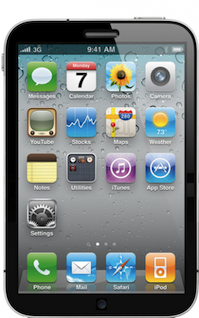
With recent rumors about a smaller, cheaper, streaming-only iPhone, it’s no surprise analysts are weighing in to offer their take on the subject. After the predictions of Apple’s promising 2011, a new iPhone model targeting “the masses” with a lower price point and possibility to run off-contract surely could deeply affect Apple’s market worldwide.
As reported by Forbes, analyst Toni Sacconaghi of Bernstein Research believes the so-called “iPhone nano” (or “iPhone mini”) could expand Apple’s addressable market by six times in terms of units:
Sacconaghi says his analysis suggests a lower price phone could expand Apple’s addressable market by 6x in terms of units and 2.5x in revenue. Based on the expected size of the 2011 market, and assuming the company captured 5% of the expanded market, he calculates that Apple would get an annual profit boost of $4.50 a share.