

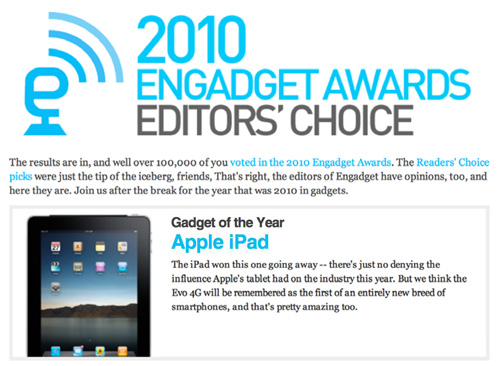
Does it really surprise anyone that Apple’s iPad keeps winning awards? No, not really but it means Apple really knows how to make great products. Today, Engadget announced the winners of their 2010 Editors’ Choice Awards. Just a few days ago, Engadget posted their Reader’s Awards and the iPad also won ‘Gadget of the Year’ there too. Readers’ opinions are just as important as editors’ ones but it’s the editors’ decisions that more people see. Engadget is one of the most popular tech sites out there, besides us, so it’s cool to see the iPad standout from the crowd there as well. Read more
Posts in news
Engadget Awards iPad ‘Gadget of the Year’
Consumer Reports Can’t Recommend the Verizon iPhone

In spite of earlier reports that suggested ratings and reviews publication Consumer Reports would give a thumbs up to the Verizon iPhone (and debates on its testing methods), this is clearly not happening. For the second time since Consumer Reports smacked the AT&T iPhone 4 in July due to signal degradation issues (and eventually confirmed they could be easily fixed with duct tape, a free bumper or a better holding of the phone), the iPhone 4 can’t be recommended.
The Verizon iPhone 4 has a problem that could cause the phone to drop calls, or be unable to place calls, in weak signal conditions, Consumer Reports engineers have found in lab tests.
The problem is similar to the one we confirmed in July with the AT&T version of Apple’s newest smart phone. It can occur when you hold either version of the phone in a specific but quite natural way in which a gap in the phone’s external casing is covered. The phone performs superbly in most other respects, and using the iPhone 4 with a case can alleviate the problem.
Consumer Reports has performed its usual set of tests to determine whether or not the iPhone 4 on Verizon could be inserted into the list of recommended products. The iPhone 4 is among Consumer Reports’ highest rated smartphones, but can’t be recommended by Consumer Reports itself. Verizon, on the other hand, is widely recognized as America’s most reliable and recommended network. The Verizon iPhone has collected very positive reviews from all around the web.
With the iPhone 4, we placed a finger in contact with the lower-left-side gap. Reception typically dropped notably within 15 seconds or so of the gap being bridged. The iPhone eventually dropped calls when touched at very low signal strength—that is, at levels of around one bar in the phone’s signal-strength meter.
For those interested, video is embedded below. For those running a Verizon iPhone: sorry it can’t be recommended, but enjoy your phone.
Apple Internal Document Confirms MobileMe Available Online Only
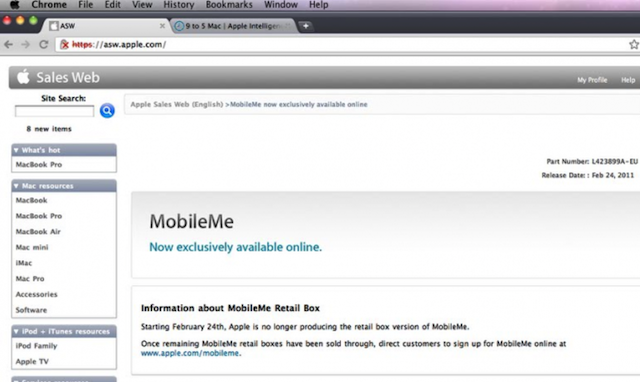
Apple has notified its retail staff that it will no longer be producing the physical MobileMe boxes and moving sales of the product solely online. This has all but confirmed what was was reported yesterday with customers to be directed to apple.com/mobileme to purchase the product once all existing stocks of the MobileMe boxes are sold.
The question still remains whether MobileMe will soon get a major revamp and possibly become a free product.
[Via 9to5 Mac]
Apple Prepares For Retina Monitors With HiDPI Mode in OS X Lion
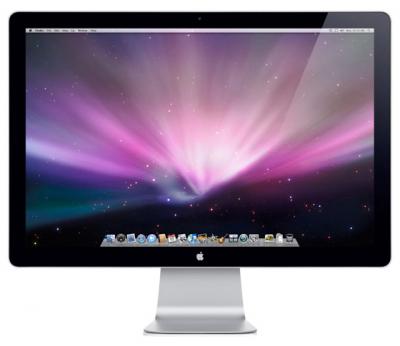
Digging through the build of Mac OS X Lion that was seeded to developers yesterday, MacRumors discovered the presence of “HiDPI display modes” which suggests that Apple is planning for the possibility of Mac displays running something similar to a Retina display sometime in the near future.
Developers would, as they have done on the iPhone, provide each UI element in two sizes, one in the size they currently are and then one at twice the resolution. It would work virtually identically to how Apple implemented the Retina display for the iPhone, with the high-resolution displays using the double sized UI elements so that physically the size of the elements would stay the same.
MacRumors gives the example of a 15” MacBook Pro that has a resolution of 1440x900 that could be doubled to 2880x1800 and then use an app’s UI 2X elements and which would leave the application’s UI elements the same physical size, but with much greater detail. Apple had previously dabbled in the notion of creating OS X a resolution independent OS through a number of methods from using vector graphics to providing bitmaps for multiple screen resolutions, but none had previously eventuated.
The HiDPI mode is not turned on by default and must be done so through Lion’s Quartz debug in Xcode.
[Via MacRumors]
Sparrow Lite Available in the Mac App Store

Sparrow, one of our favorite mail clients for the Mac, has just realeased Sparrow Lite via the Mac App Store. The Lite version integrates all the features of Sparrow but you can only use one Gmail mail account, it has ads by Carbon (very nice by the way), and your signature adds ‘Sent with Sparrow’ after your name.
Sparrow Lite is a great way to give it a try before deciding if you are interested in buying the full version for $9.99. Sparrow Lite is FREE and is now available in the Mac App Store.
OS X Lion Adds TRIM Support for SSDs
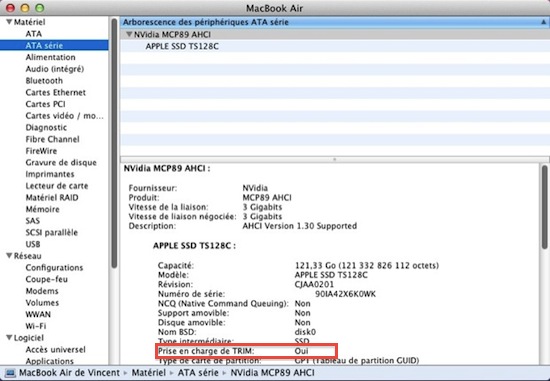
Here’s some great news for SSD owners like me (on a 2008 unibody MacBook Pro) or people that bought a new shiny MacBook Air with integrated Flash storage earlier this year: the developer beta of Mac OS X Lion adds support for the TRIM command on SSD. As you can see in the screenshot above captured by MacGeneration, there’s a “Oui” (yes) next to TRIM command info.
What’s the big deal with TRIM support? To put it simply, operating systems like Snow Leopard that don’t have TRIM support will treat solid state drives as regular, spinning drives when writing and deleting blocks of data. Snow Leopard doesn’t exactly know it’s dealing with an SSD, and while you’ll notice incredible performance improvements in daily usage, the same performances will slowly degrade over time without TRIM support. TRIM correctly tells the operating system which blocks of data are no longer in use in the solid state unit, and the OS passes the information along to the SSD controller so it can wipe blocks internally.
Basically: this is great news for SSD aficionados and, looking forward, a smart move from Apple as the move to solid state drives in all Mac computers seems inevitable.
iFixit Tears Down 2011 MacBook Pro
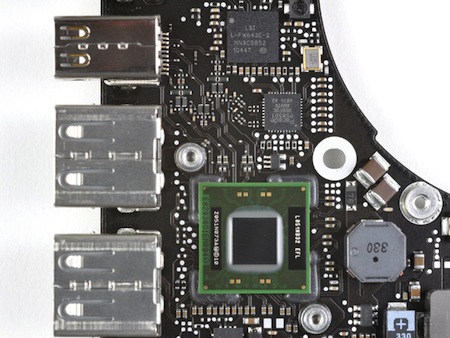
iFixit didin’t waste any time and, shortly after the release of the new MacBook Pros, tore down a 15” model to see the changes performed by Apple in this revision. It turns out, not much. Most changes are visible in the logic board (quad-core processor, AMD GPU, Thunderbolt chip) and in the way the battery is attached to the laptop.
A few notes from the teardown below.
Battery life decreased from previous generations, as Apple is performing more accurate tests with more realistic estimates (their tests include Flash installed while browsing the web):
No pentalobe screws;
iFixit thinks Apple made some improvements to wireless performance under the hood;
Broadcom BCM4331 chip.
The RAM in this machine is PC3-10600 RAM. That’s the same RAM used in the 2010 revision of the 21.5” and 27” iMacs, but different from earlier Apple laptops. PC3-10600 RAM is backwards compatible with the PC3-8500 RAM in older MacBook Pro Unibody machines, but you can’t use PC3-8500 RAM in this machine
The wireless card bracket is aluminum, rather than the plastic in previous revisions. Perhaps this change was made for thermal reasons, as a visible pink thermal pad is used to transfer heat from the board to its aluminum bracket.
Holy thermal paste! Time will tell if the gobs of thermal paste applied to the CPU and GPU will cause overheating issues down the road.
Rumor: iTunes In The Cloud Will Let You Backup Your Music Collection, Stream It

At a shareholders meeting yesterday, Apple clarified its position on the massive data center they’ve been building in Maiden, North Carolina confirming that launch is set for a Spring 2011 and it will to host the iTunes and MobileMe services. Many, however, have speculated in the past months whether the move of iTunes to the cloud would bring a new way of streaming songs and albums sold in the iTunes Store through a monthly subscription, or an easy-to-use way of uploading your personal media to the cloud.
According to a new report by the Financial Times, the iTunes online service will simply function as a backup solution for your music collection, which will be available over the internet on all Apple devices.
Apple, which rocked digital music services such as Pandora, Rdio and MOG last week by announcing plans to keep 30 per cent of all revenues from subscriptions taken out through its App Store, has clarified its plans for using remote storage, known as the cloud, according to several music industry executives.
More than a year after buying Lala, a cloud-based digital music service, Apple is now looking to use the cloud mainly to allow users of its iTunes store to back up their collections and access them from any Apple device.
One person with knowledge of Apple’s plans said the company did not want to undermine the market that it dominates for paid downloads, likening its plans for the cloud to “insurance”.
Rumors surfaced in the past weeks suggested Apple was working on a new version of MobileMe that would work as a “locker” for your personal media, stored in the cloud and accessible from all your Mac and iOS devices. Such a system would not compromise Apple’s lead in the digital music distribution market, but would let users upload their music to an online service always available. In the meantime, Google is rumored to be finalizing the details of its Google Music service for Android devices, and European company Spotify is reportedly nearing a U.S. launch after closing deals with major music labels. Spotify lets you stream any song available in the service’s online library through a monthly Premium subscription; it appears at this point that Apple is building the exact opposite, a cloud service that will let you backup / stream the songs and albums you already own.
References of a “MediaStream” service found in the iOS 4.3 SDK suggested Apple might be working on a new platform to allow users to stream their media from the cloud to iOS.
Milestones

Today is Thursday, February 24, 2011. Today has been full of Apple news everywhere, especially here at MacStories. Today Federico, Cody, Graham and myself have been chugging hard on rumors, announcements, first looks, previews, etc. You name it, we’ve probably done it. With that said, lets talk about today some more.

Milestones, what are they and what do they mean to us? Well, to MacStories it means forward progress, growth and evolving. We are celebrating 5000 posts as I write this now. It also means birthdays and achievements. Today is Steve Jobs’ 56th birthday and look at what he has accomplished in his lifetime.