Posts in news

Report: TSMC Begins A6 Chip Trials, Won’t Be Ready For Any iPad HD This Fall

Last month a flurry of reports suggested that Apple might release a new model of the iPad that would be targeted at ‘Pro’ users and featuring a Retina display - many dubbed it the iPad HD. That suggestion (or at least the schedule) seems less reliable today with Taiwan Economic News citing sources within the chipmaking industry that claim the A6 processor won’t be available until at least the second quarter of next year with trials of the A6 only just beginning in earnest now.

Taiwan Semiconductor Manufacturing Co., Ltd. (TSMC), the world’s largest semiconductor foundry by market shares now, has allegedly started trial production of the A6 processor in cooperation with Apple Inc., with the production design to be taped out in the first quarter of next year and scheduled to be publicly unveiled in the second quarter at the earliest, according to industry sources

As previous reports have noted, Taiwan Semiconductor Manufacturing (TSMC) is producing the A6 chip, which would be the central component of the iPad ‘Pro’. The chip is said to be extremely-low powered whilst far exceeding the processing capabilities of the A4 and A5 chips because of a new 28-nanometer process and 3D stacking technologies. Darrell Etherington of GigaOm explains that this differs from the previous layered designs because “the 3D stacking tech will allow layers to be integrated vertically and horizontally into one single circuit”.

[Via GigaOm]


Apple’s Fall Media Event Scheduled For September 7?

For months there has been discussion of a Fall media event for Apple to reveal the iPhone 5 and according to a report by Kodawarisan Apple has scheduled the event for Wednesday, September 7th. The date falls in line with previous years in which the traditional iPod event was held on September 1st in 2010 and September 9th in 2009 and 2008.

MacRumors clarified with Kodawarisan that the September 7th date was not a “product of guesswork, but came from a source in the know”. They also note that Kodawarisan has had a long history of rumors (nearly a decade) but had recently been pretty quiet - with the last “sucessful” rumor arising in 2009 in whcih they correctly predicted the Mac Mini launch date.

If this date does come true and the event includes the announcement of the iPhone 5, it would differ from reports earlier this month in which AllThingsD claimed an “October surprise” for the iPhone 5 launch.

[Via MacRumors]


Apple’s Andromeda Galaxy is Missing A Few Stars

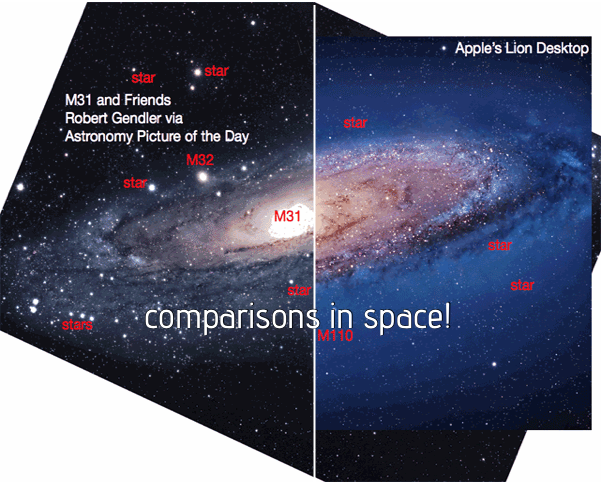
Boing Boing’s Maggie Koerth-Baker made a great comparison today between the actual Andromeda Galaxy (which is 2.5 million years away from Earth), and the Andromeda Galaxy representation that ships as the default wallpaper in OS X Lion. Thanks to a reader of the site (David Kaplan, assistant professor of physics at the University of Milwaukee), a GIF shows a comparison between what’s actually in the sky and what Apple shows you — Apple’s representation has of course been photoshopped. With the removal of stars and galaxies, the professor points out that one of Andromeda’s big satellites (M110 for those keeping track) is completely missing.

Apple has once again altered the Universe according to their whim. They moved/removed many stars, and got rid of a whole galaxy. This is M110, which is one of M31’s [Andromeda’s] satellites. The other big satellite, M32, is still there.

Okay, it is purposely done for the sake of art and keeping things pretty, but what I like about Boing Boing’s piece is that it actually gets people to see and learn about one of our galaxies. And normally I wouldn’t plug apps in a post like this, but this would be a good time to check out the Andromeda Galaxy via Qwiki (it’s an audio link). Cool right? See the side by side by comparison at Boing Boing.


Apple Updates Migration Assistant for Lion

If you still haven’t upgraded to Lion, Apple is continuing to improve how you migrate information from Leopard onto the new OS. In an update posted this afternoon, Apple cites the following changes.

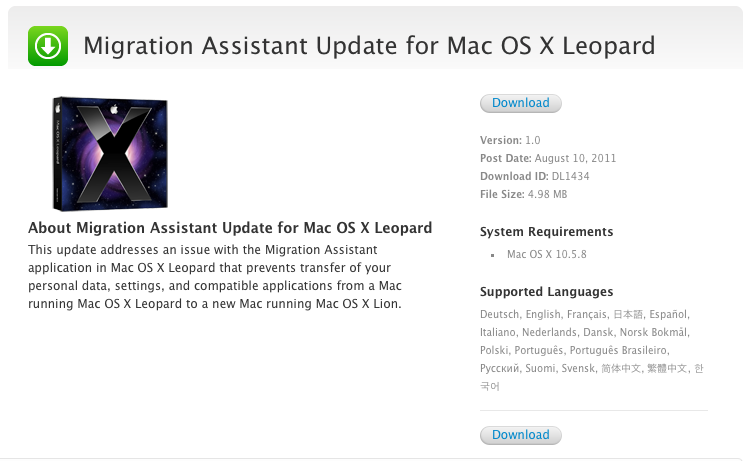
This update addresses an issue with the Migration Assistant application in Mac OS X Leopard that prevents transfer of your personal data, settings, and compatible applications from a Mac running Mac OS X Leopard to a new Mac running Mac OS X Lion.

What’s the issue? The Next Web pinpoints that the updated Migration Assistant will warn users that their Rosetta based applications (designed for older generation macs PowerPC Macs) won’t be available on Lion, which culled Rosetta support in the transition to support 64-bit Intel applications. Rosetta apps, no longer available in Lion, will have to be updated (or you’ll need to find alternatives) for the apps to work. It’s a small change, but one that should help make aware that the applications you rely on may be broken.

Download the Migration Assistant Update for OS X Leopard.

[via The Next Web]


Apple Targets Motorola’s Xoom Tablet Design in EU

Just after we reported on Samsung’s injunction in the European Union, FOSS Patents has dug up some hidden information pertaining to Apple’s patent battle (currently over 40+ patents are in dispute) with Motorola. In Apple’s complaint against Samsung, Apple details that prior to (or simultaneously) filing for the preliminary injunction against Samsung, Apple filed a similar complaint against the design of the Motorola Xoom. The passage uncovered by Florian Mueller doesn’t explicitly state whether Apple filed for a preliminary injunction against Motorola, although he assumes the complaint would be EU-wide.

A preliminary injunction, however, has been obtained by Apple against another company named JAY-tech for a tablet (the operating system was unspecified, but Mueller assumes it was Android).

Apple’s dispute with Motorola began in October 2010, but so far it was not known that it has also branched out to Europe – just like Apple’s disputes with Samsung and HTC. In the U.S., an ITC hearing was due later this month on Motorola’s complaint against Apple, but due to the retirement of Chief Administrative Law Judge Paul Luckern it was postponed.

Apple might not be able to file a preliminary injunction against Motorola in this case as the German courts frown upon cases where the rights holder has been aware of the infringement for a long time (over a month for example). The Xoom, released in the Spring, would have been on Apple’s radar long enough for them to be unable to seek a preliminary injunction since there’s no sense of “urgency”.

[FOSS Patents via The Next Web]


MacRumors Mocks up the iPhone 5 Based on Design Specifications

Just about everyone is talking about the iPhone 5, and while I remain skeptical of most rumors, I have to give MacRumors some props for commissioning CiccareseDesign to create a mockup based on a leak of the phone’s design specifications. Before we dig into the MacRumors’ render, I’m going to put my thoughts on the table (might as well at this point — all the cool kids are doing it). We don’t talk about these iPhone 5 rumors too often.

When This Is My Next published a crude mockup of the iPhone 5, Joshua Topolsky introduced his take on a tapered design — that the next iPhone would have a shape similar to the MacBook Air with a fat top which tapers down to a smaller edge at the bottom of the phone. But I think the tapered design means this: that the next iPhone is going to follow the iPod touch 4th gen’s design in that the buttons are going to be hidden underneath the display along the curved edges. Apple re-used the iPod touch’s 4th generation design with the iPad 2, and I see them continuing this design ethos with iPhone. When you look at the front of the phone, I do think Apple only wants you to see the display. Apple wants the lines of the phone to be very clean. I also agree with the idea that Apple will move away from the glass backing since it’s fragile and easily cracks when dropped — Apple doesn’t want damaged phones in the press or in Flickr photos online.

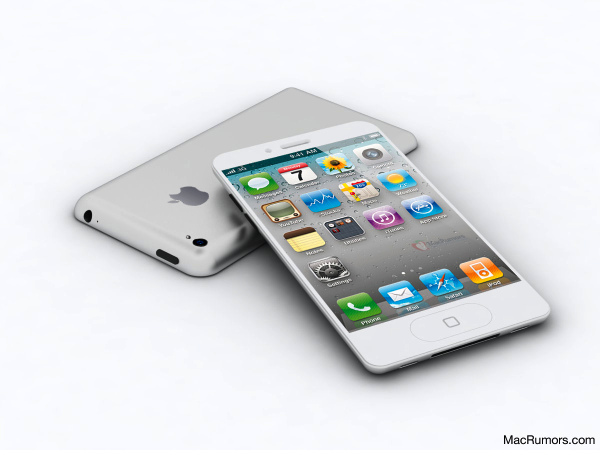
MacRumors’ “take-it-to-the-max” mockup of the iPhone 5 is interesting simply because it matches my idea of what Apple will do with the next iPhone. It nicely takes most of the rumors we’ve heard about for the last months and wraps it one nice package that looks believeable: you’ve got your oval home button (which could very well be a gesture area for flicking between apps as suggested by Gruber on The Talk Show), your edge-to-edge display (although MacRumors shows a 4” display — I think it’ll be smaller), and tapered edges which hide the volume buttons underneath the glass of the phone.

The final dimensions of the new design are calculated to be: 4.33” x 2.36” and .27” thickness at the top and .21” at the bottom In comparison, the iPhone 4 dimensions are: 4.5” x 2.31” x .37”. So the new design is actually shorter than the existing iPhone 4, but slightly wider and thinner.

I think MacRumors’ mockup captures the idea that the next iPhone will be thin, a little wider, and more comfortable in the hand. The phone can’t be too thin — battery technology is still going to be a concern with iOS 5 between the Notification Center and new uses for location based data. We’re at point now with these rumors where we’ve gotten the general idea of what the iPhone will look like, and a lot of sites have shifted focus to release dates instead of speculating on features. Federico and I have been very careful not to spew a lot of these rumors onto the site (they’re not interesting enough most of the time), but MacRumors took a lot of these bits and pieces and actually did something very cool with it.

My concern — as always with rumors — is that it sets us up for a lot of false hope. “Man this iPhone looks so good I hope it looks just like this!” Then when the iPhone comes out, people are disappointed when a site’s mockup doesn’t turn out to be the real thing that they wanted. My suggestion is to look at the MacRumors’ mockup as the summary (but not the conclusion) of where we are with rumors and speculation on the iPhone. They’re confident that their rendering is very close to the final product, but I think seeing the final product will ultimately be more impressive.

[via MacRumors]


VUDU Brings Its Video-On-Demand Service To The iPad Via A Web App

Amazon wasn’t the only content provider to launch an iPad web app today, with VUDU also bringing its video-on-demand service to the iPad via a web app. VUDU, which is owned by Walmart and claims to be “a leading subscription-free, video-on-demand movie service” chose to optimise the site for the iPad and now streams videos in h.264 - although unfortunately the videos are only in standard definition due to licensing restrictions (some Disney films are also missing from the catalogue).

VUDU, a leading subscription-free, video-on-demand movie service and wholly owned subsidiary of Walmart stores, has optimized the navigation experience of VUDU.com to enable millions of iPad owners to rent or buy entertainment content and then stream it easily through any iPad browser.

Edward Lichty, General Manager of VUDU, said of the iPad launch that it “plays into that vision as we’re committed to offering the VUDU experience on as many devices as possible so customers can shop for and access their favorite movies and TV shows however they want, whenever they want”. What this means in part is that any movie rented or purchased on the iPad VUDU website is also viewable on any other device that supports VUDU - which Walmart claims is more than 300 consumer electronic devices. According to Engadget, you can watch VUDU on the iPhone through this same web app despite the UI not yet being optimized for it - but don’t be disappointed if this doesn’t work well or if VUDU stops this soon.

Just head to the VUDU website on your iPad and follow the prompts to start using the VUDU iPad interface.

[Via Engadget]


Amazon Releases Impressive Kindle Cloud Reader Web App, Sidesteps In-App Purchase Rules

Over the past six months there has been a (fairly) quiet tussle between Apple and various publishers and other content suppliers over the issue of In-App Purchases and Subscriptions. At the beginning of the year Apple had demanded that by July, all content available within an app must be available for purchase within the app through In-App Purchasing, for the same price as it was available on the publishers website (say the Kindle online store) and that the app did not link to the website for purchases but used the In-App Purchase system. Apple reversed their policy in May, removing the first two restrictions — but still denied publishers from including a ‘Buy’ link that went to a website and then finally late last month various publishers began to abide by these rules, including the Wall Street Journal, Kobo and the Kindle apps.

This obviously isn’t the best situation for consumers and as many have noted, including Dan Frommer of SplatF, it has made purchasing Kindle books more difficult for the user - despite the premise of In-App Purchases aiming to simplify purchases. Consequently, Amazon today released the Kindle Cloud Reader, a web app for Chrome, Safari and the iPad - with support for other browsers and devices promised soon.

The desktop version of the Kindle Cloud Reader is nice, but it is the iPad version that is most intriguing and impressive. It is a web app but it does an excellent job at masquerading as a native app — particularly features such as offline support and menus that hide/reappear when you tap the screen. It starts from when you first load the Kindle Cloud Reader and it asks permission to reserve 50 MB on your device so that it can store all the necessary elements of the ‘app’ and your books to ensure that when you have no 3G or Wi-Fi connectivity, everything continues to work. To really see how well it does at pretending to be a native app, try it yourself or jump the break for more screenshot’s of the Kindle Cloud Reader — pinning it to the Home Screen as a web app (which it dutifully suggests you do) in particular just amplifies the native app feel by removing the browser chrome.

What Amazon has done by creating this web app reminds me of the Financial Times, which also created a web app for delivering their content to users and subscribers after they also felt Apple’s terms were too restrictive and negative. Unlike the Financial Times, Amazon has not removed their iOS app from the App Store — it remains, albeit hampered by the lack of easy access to the Kindle Store. On the Kindle Cloud Reader however, the Kindle Store works great with a link in the top-right corner and it is made better by the fact that the store has also received an iPad-enhanced design and works much better whilst also looking great.

You can access the Kindle Cloud Reader now, simply by logging in to your Amazon account - all your purchased books will already be there.

[Via TechCrunch]

Read more