Federico Viticci

10765 posts on MacStories since April 2009

Federico is the founder and Editor-in-Chief of MacStories, where he writes about Apple with a focus on apps, developers, iPad, and iOS productivity. He founded MacStories in April 2009 and has been writing about Apple since. Federico is also the co-host of AppStories, a weekly podcast exploring the world of apps, Unwind, a fun exploration of media and more, and NPC: Next Portable Console, a show about portable gaming and the handheld revolution.

Rdio Launching In “All Countries” in Europe “Within The Next Few Months”

According to an interview published  by paidContent, music streaming service Rdio will soon expand in “all countries” in Europe, making its digital music catalog available to more users outside the US, Canada, Germany, Brazil, Portugal, Spain, Australia, New Zealand, and Denmark, where it is currently available.

There are some major competitors in Europe,” Rdio’s partnerships and internationalisation VP Scott Bagby tells paidContent. “We are a couple of years behind others in terms of expansion there.

“But Europe is an immediate focus. We’ll be expanding in all countries in Europe - within the next few months, you’ll see several pop up.

Like competitors Spotify, MOG, and Deezer (the latter very popular in Europe), Rdio allows users to pay a monthly fee to gain unlimited access to a vast library of songs and albums by artists whose labels and publishers have agreed to make music available for streaming. That isn’t always the case, as some notable exceptions have showed in the past, but new data from the US music industry suggests that music subscriptions are growing, proving to be a viable alternative to standard digital downloads. Rdio, however, puts greater focus on the social aspect of music discovery and collection, allowing its users to “follow” other Rdio subscribers and build playlists they can share and collaborate directly on the site, or using the native apps the service has developed for iOS, Android, and OS X. With the recent launch of New Rdio, the company has set out to fundamentally rebuild the way users interact with the service, making it easier to access playlists, recommendations from the network, and people to follow.

Like with most streaming services founded in the US, Rdio hasn’t been able to obtain rights to launch internationally since Day One, preferring to stagger launches in other countries throughout the past year. According to VP Scott Bagby, no timeframe has been set, but Asia will be another focus for the company after a wider European rollout.


Apple Releases iTunes 10.6.1

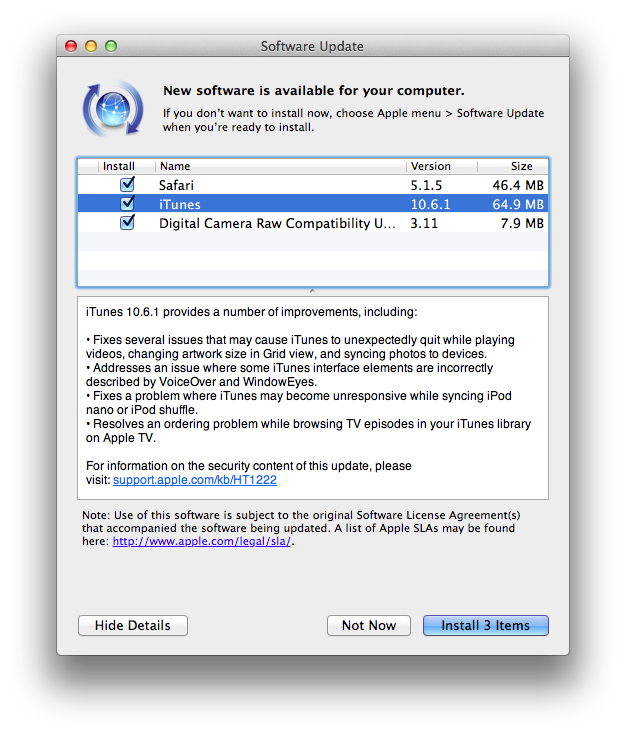
A few minutes ago Apple released iTunes 10.6.1, adding a number of bug fixes that were reported in previous versions of the software (iTunes 10.6 was released on March 7). From the changelog:

  • Fixes several issues that may cause iTunes to unexpectedly quit while playing videos, changing artwork size in Grid view, and syncing photos to devices.
  • Addresses an issue where some iTunes interface elements are incorrectly described by VoiceOver and WindowEyes.
  • Fixes a problem where iTunes may become unresponsive while syncing iPod nano or iPod shuffle.
  • Resolves an ordering problem while browsing TV episodes in your iTunes library on Apple TV.

iTunes 10.6.1 is showing up now in Software Update, and should be available on Apple’s Downloads website shortly.


A Series of Clicks

“Every once in a while a revolutionary product comes along that changes everything.” - Steve Jobs, Macworld 2007

Often, new technologies come along and they immediately show us the future. That something new is possible, right now, today, and that we should pursue innovation along that path. But other times – most of the times I’d argue – new products and technologies simply “click” in our brains, telling us that, yes, that looks like the future, but that we should also wait for a proper and concrete realization of that vision.

In the past 18 years, I have been fortunate enough to play around with gadgets and technologies that had a profound impact on my personal and professional life.

It was sometime around 2003 when a friend of mine showed me the first Nokia phone with a camera. The 7650, revolutionary to me at the time, had a poor display compared to today’s standards and it ran Symbian. But it took pictures. Coming from old StarTACs and other Nokia phones, I can’t really express how that lens embedded in a mobile “smartphone” seemed ground-breaking to me. I mean, there you had a phone – the thing you were already using to make phone calls and send short messages – capable of shooting stills and saving them into its onboard memory for future perusal and consumption. Back then I couldn’t afford that phone; I started saving money, and eventually got another Nokia phone, with a camera that, however, was quickly surpassed by the pace of innovation in that area. Click.

Around that time I also used to travel a lot with my parents, usually by car. When we did, I made sure my dad would tune in the car’s FM radio to my favorite station…which would promptly lose its signal inside tunnels. So I convinced my parents that I needed one of those things – a portable CD player. My parents weren’t – they still aren’t – exactly “tech savvy”, and they hadn’t considered upgrading their music library from cassette tapes to the higher-quality CDs. We had a lot of music tapes in our house – remember how you had to switch sides in LPs, or use a pencil to manually rewind the tape? So I got a portable CD player – an Amstrad model – and boy was I late to the party. All my friends from school already had one, making mixes with the latest hits and exchanging ripped albums like there was no tomorrow. I remember getting my own portable CD player was some sort of a revolution for my music listening habits. Not only did I get to enjoy music with higher fidelity that didn’t “lose the signal” while in the car, I could also listen to something different than my parents. I loved that CD player. In fact, when it eventually broke down, instead of getting a new one I decided to take it to my local gadget shop and have it fixed. They fixed it. And I kept collecting CDs from my favorite artists and I made sure that, on every new trip, the Amstrad was right there in my backpack.

Of course, eventually, something new came along and showed me yet another taste of the future. New solutions always create new problems. With the CD player, it was the CDs. All those CDs! I think by the time I was into my second year of portable CD player usage, I had bought around five of those things to carry around compact discs. And sure enough, a new standard had come around, a digital format called MP3 that promised to bring CD-like quality with the convenience of your music being available digitally. On a computer, with files you could manually manage, download, and delete at any time. So I bought a new “MP3 player” – it was an Acer one – one of those with a spinning hard drive you could hear when you were navigating your music library through a terrible display. The MP3 player was an even bigger revolution for my music habits. It allowed me to rip my own music, transfer it on a computer, manage it there, and if I still wasn’t happy, look it up on the Internet to get something else. And I didn’t have to carry around CDs. I filled my MP3 player with gigabytes worth of music and those random bootlegs found on the Internet I still cherish today. Because new technologies often “click” somewhere in our brains and tell us to wait for the complete realization of that product a few years down the road, it was no surprise when that MP3 broke and I decided to get an iPod. Classic white one, bought in 2007. That iPod got me started with iTunes, the Apple ecosystem, and gave me a better interface for the CDs I had ripped, which hopefully in a few months will be available for a digital upgrade through iTunes Match. Those are the same files I converted over a decade ago.

Progress and innovation have a funny way of changing our lives. Sometimes, they do so abruptly, seemingly without following a constant line of changes throughout the years. Other times, it’s just a series of clicks. The music tapes became CDs, which convinced me to get a portable player, which turned into an MP3 that, because of the pace of innovation in the digital era, led me to buying an iPod years later. That iPod allowed me to create the iTunes account I still use today for my iPhone. The MP3 files have become a monthly subscription to Rdio. You can count the clicks.

It’s not just about music and gadgets. In reminiscing products and ideas that have been truly transformative in the way I think about the broad subject of “technology”, I can’t avoid mentioning videogames. I have been a gamer since my earliest memories, and even if I’m playing less today, I still try to be in the loop of what’s happening in the community. My parents bought me the original Game Boy and SNES when I was around 6, yet the more I think about “click” moments in regards to gaming, the more I keep coming back to the Game Boy Advance. The GBA, and in particular its SP revision, showed me that SNES-quality portable gaming by Nintendo was possible, with decent battery life and original games, too, not just ports. Years later, I got a call from my friend Marco, who owns a videogame store here in Viterbo, to come try “something cool” he just got from Japan. It was a Saturday afternoon in late November. Today, every time I go visit Marco, usually over the weekend, I still remember that Saturday afternoon of 2004, when I first tried the original Nintendo DS, controlling Mario in a 3D environment with a stylus on a touch screen. Back then, I couldn’t believe what I was looking at - “you really can control Mario with your touch”, I think I said. Touch screens were nothing new; yet that implementation paved the way – or at least my perspective – for touch-based interactions in the future, leading all the way up to today’s Angry Birds. Click.

The sense of discovery in The Legend of Zelda: The Wind Waker. Liberty City Stories, flexing the original PSP’ hardware muscles for the first time. The PSP homebrew community – back in high school, I spent hours browsing PSPUpdates.com (now available here), learning the latest tricks to run perfect emulators of – guess what – my old SNES and GBA games. The day my friends and I figured we could send photos during class to each other over Bluetooth, rather than MMS, with our Nokia phones, also in high school. Or that morning when Marco from the videogame store called us – we were at school – because he had the Wii in stock on Day One. We left school, got the Wii, and spent all day wondering if, someday, all game interactions would be based on motion controls. Click, and click.

In the recent years, several innovations occurred in other areas: the App Store in 2008; the solid-state drive, forever changing the way I think of “responsiveness” on a laptop; Twitter, the tool I use every day to get in touch with people from around the world. Just two years ago, in 2010, I gazed upon the iPhone 4’s Retina display for the first time, thinking that such image quality, such crispness, such detail couldn’t be possible. But they were possible. Nokia 7650 be damned.

In connecting the dots and “counting the clicks”, I remembered ideas and products that I was able to try out when they were first released, and then I look at my new iPad, which is the culmination of these technologies that have so amazingly evolved over the past 10 years. For better or worse, in one way or another, all those innovations that were so incredible when I first tried them are now coexisting in a single device that’s even more incredible and enjoyable because of the very sum of its parts.

Technological innovations are objective, factual, but how we remember them – the way we connect them to today’s products – is deeply personal. So while my series of clicks and dots may be best exemplified by the iPad in 2012, waiting for “the next big thing” to happen, perhaps yours is still developing, with the iPad being just another “click”. Either way, there’s only to be excited about the future.

Click.


The Apple Community, Part II

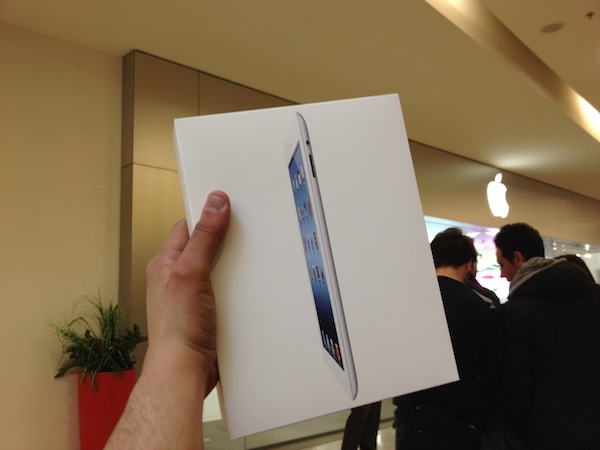
A few hours ago, I came back from the Apple Store at Roma Est driving all the way back home after a 19-hour wait for the new iPad. Tired – exhausted, my head exploding for the absurd coffee intake I forced my body into, but happy, smiling because I knew that what I had imagined all along didn’t turn to be true – it was better.

Until yesterday, I had never waited in line for an Apple product before. I always preferred driving to the store myself after a few days, or simply asking one of my US friends to ship me an iPhone or iPad without waiting for the Italian launch. A lot of people told me “I was missing out” – that for an Apple fan, getting in line to wait for a new product isn’t just about waiting, which is boring per se, it’s about knowing the people that share your same passion, not giving a damn about spending 20 hours of their lives to get “a device”. Today I can say buying an iPad was just the tip of the iceberg for what has been an incredible experience – something that I look forward to for the next big Apple launch.

I know I am late to the party. I’m fairly certain you all know what a “Day One” looks and feels like. Long lines, security staff, Apple employees, the cheering and the clapping before and during the launch. All that felt new to me. Unexpected and familiar at the same time, as if I was getting to know for the first time a family that, however, I had always known somehow.

It’s no exaggeration to call the people I got to meet in real life last night an extended family. I wrote about the Apple Community before, but actually meeting the people I mention so often is different. I shook hands and made bad jokes 5 minutes after arriving at the line. I talked to folks I only “knew” through Twitter and Facebook, and got a chance to really know them from a much more rewarding perspective. I talked to the founder of another blog and spent two hours discussing the future, where we see things going for our sites, and the state of Italian Apple reporting in general. I introduced myself to Apple PR, finally giving a face and a smile to the people that keep in the loop about news and announcements. I shared meals, coffee – and lots of it – and exchanged phone numbers and Twitter handles. Because whilst I may have known some of those folks already, clicking on usernames and friend request buttons after knowing them felt more real. Necessary. Natural. An obvious consequence.

It was surreal. I mean, we’re talking about a bunch of people – from any kind of social extraction – waiting in line and sitting on the ground to buy a gadget. We are talking about employees of a big corporation, all dressed up in blue and clapping and shaking your hands because you are giving them money. Because you are the customer. And it was surreal, because it felt like you were there as a friend. As my girlfriend put it - “they make paying more pleasant, as if you are glad you are giving them money”. I don’t know if I’m “glad” I spent 700 Euros today. But I sure am happy to have paid for this product in that way.

On the other hand, it felt real. Surprisingly so. You are meeting up with these people you only know from profile pictures and wall posts, and you realize these are real people that have their history, their flaws, their bad jokes about food and sports, and all those traits that turn flaws into the thing we love the most about human beings: that we’re different. That we all have problems and may argue about politics and Android. But that, in the end, if 20 hours spent in line to get an iPad can make us laugh, we should celebrate those 20 hours. Appreciate them. Treasure them.

The more cynical of you might dismiss my words as the usual excitement of a nerd who is happy about paying for Apple products because it is this company’s big, evil plan to make us think we have a choice. You are free to think whatever you want. Maybe it is Apple’s grand scheme to get rich by providing a friendly customer experience. But we do have a choice, and we have chosen to make the most out of it. Those people, those stories – heck, those 13 espressos were real. There is no corporate strategy that will take that away from us. There is no exclusive or breaking news that can beat the fact that some of my readers can also be my friends.

In our review of the new iPad, Cody wrote “you won’t believe it until you see it”. I agree. The device is fantastic. But I ’ll add this: the greatest thing about Apple isn’t the product line itself. It’s the community. It’s the users and the developers and the journalists. It is you, reading this on an Apple device. It’s the Apple community using Apple products. And you won’t believe it until you experience it.


Angry Birds Space Now Available

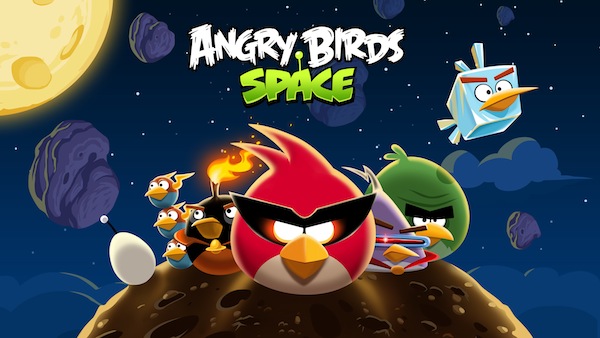
Angry Birds Space, the first new game from Rovio in over a year, is now available on the App Store. Officially announced back in February, Angry Birds Space takes a radically new approach to the series by setting the war against the pigs in outer space, thus bringing completely re-imagined dynamics and physics to the franchise.

From our previous coverage:

Based in a weightless environment, the basic gist of the game seems to be that in such conditions, trajectories are affected by gravity, and objects end up following curves, rather than straight lines. Using a “galactic slingshot” in footage shot on-location at the International Space Station, NASA’s Don Pettit explains how astronauts and scientists have to consider these changes in physics and gravity when they are in outer space; apparently, this mechanic will be brought to Angry Birds Space in a fairly accurate representation.

Angry Birds Space, unlike the Rio and Seasons spin-offs, brings a new gameplay that has allowed Rovio to design a whole set of different birds, levels, and in-app purchases. Angry Birds Space comes with 60 levels, new superpowers, hidden bonus levels, and a zero-gravity mechanic that, for those who have played with the Nintendo Wii in the past, somewhat resembles Mario Galaxy’s unique approach to planets and interstellar jumps.

Early coverage of the new game positively remarked how Angry Birds Space will feel familiar to the franchise’s veterans, while still adding a new way of thinking and constructing trajectories on screen. Angry Birds Space is now available on the App Store, both in iPhone and iPad editions. You can check out the game’s trailers and first hands-on videos after the break.


Instagram’s New Experiment: Open Up The API for Third-Party Uploads

Hipstamatic, a photo sharing app for the iPhone that allows users to apply vintage/analog effects and filters to their photos, has become the first app to directly integrate with Instagram. The popular iPhone-only sharing service, now boasting over 27 million users and on the verge of releasing an Android app, has so far allowed third-party developers to integrate their apps with the Instagram API to only visualize a user’s photos or feed. The API hasn’t allowed for the creation of real Instagram clients for other devices, in that uploading could be done exclusively using Instagram’s own app.

Today, however, an update to Hipstamatic and a collaboration between the two services first reported by Fast Company might signal an important change in Instagram’s direction and nature as a photo sharing service. The new Hipstamatic, available now on the App Store, comes with a redesigned “HipstaShare” system to send photos to various social networks including Facebook, Twitter, and Flickr. Among the supported services, a new Instagram option now enables you to log into your Instagram account, and upload photos directly within Hipstamatic, without leaving the app. There is no “forwarding” of files to the Instagram app, nor does Hipstamatic asks you to download the Instagram app from the App Store – this is true uploading to Instagram done by a third-party, via the API.

Unlike most photo sharing apps these days, Hipstamatic puts great focus on recreating the analog experience of shooting photos and carefully selecting the equipment you’d like to shoot with. With a somewhat accurate representation of vintage films, lenses, camera cases, and flash units, Hipstamatic wants to appeal to that kind of userbase that is not simply interested in capturing a fleeing moment and share it in seconds; rather, as famous appearances on publications like The New York Times confirm, the Hipstamatic crowd is more of a passionate gathering of 4 million users looking to spend minutes, if not hours, trying to achieve the perfect setup for each occasion, spending one dollar at a time on in-app purchases that unlock different filters and “parts” of the cameras supported in Hipstamatic. Unlike Instagram or, say, Camera+, Hipstamatic isn’t built to shoot & share; the ultimate goal is undoubtedly sharing, but it’d be more appropriate to describe Hipstamatic’s workflow as “set up, shoot, then share”.

Hipstamatic seems to have realized, however, that sharing can’t be relegated to a simple accessory  that has a second place behind the app’s custom effects and unlockable items. Whilst in-app purchases and fancy graphics may have played an important role in driving Hipstamatic’s success so far, apps can’t go without a strong sharing and social foundation nowadays, and since its launch two years ago, Instagram has seen tremendous growth for being only an iPhone app. With this update, Instagram and Hipstamatic are doing a favor to each other: Instagram gets to test the waters with an API that now allows for uploading through other clients that support similar feature sets; Hipstamatic maintains its existing functionalities, but it adds a new social layer that plugs natively into the world’s hottest photo sharing startup.

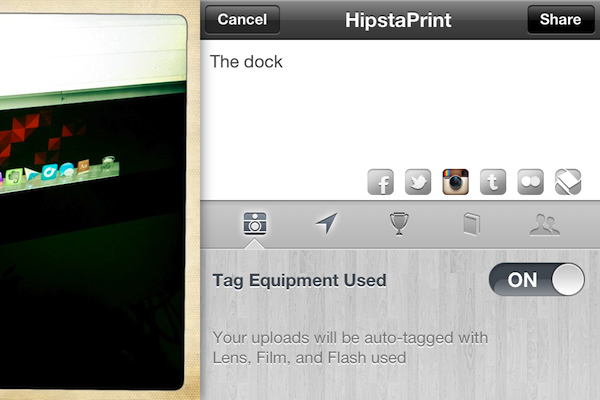
Looking at the terms of the “deal” (I don’t think any revenue sharing is taking place between the two parties), it appears both sides got the perks they wanted. This native integration comes with an Instagram icon in Hipstamatic’s new sharing menu, which, when tapped, will let you log into your account. Once active, each “Hipstaprint” (another fancy name for photos) can be shared on a variety of networks, with Facebook even supporting friend tagging. You can upload multiple photos at once if you want, too. In the sharing panel, you can optionally decide to activate “equipment tagging” – this option will, alongside the client’s information, include #hashtags for the lens, film and other equipment that you use in your Hipstamatic camera.

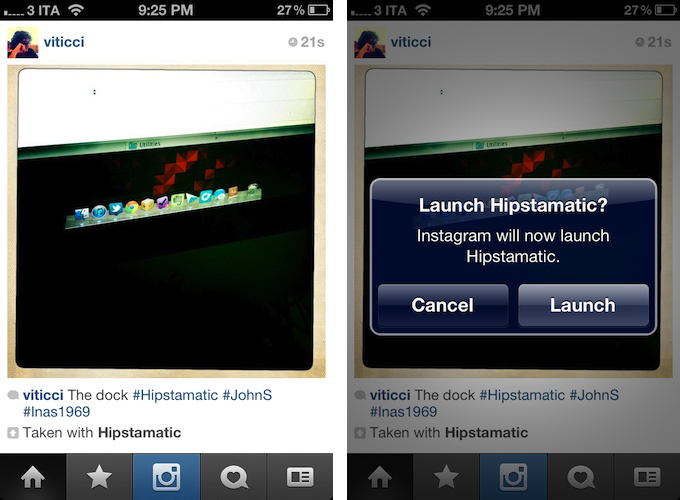
On the Instagram’s side, things get a little more interesting. Hipstamatic photos get uploaded respecting Instagram’s photo sizes, and they get a border around the image to, I guess, indicate their “print” nature. Together with the title, Instagram will display the aforementioned tags for equipment, and a “Taken with Hipstamatic” link that, when tapped, will ask you to launch Hipstamatic. If you don’t have Hipstamatic installed on your iPhone, this link will take you to the App Store page for the app.

Overall, what really intrigues me about this collaboration isn’t the Hipstamatic update per se – version “250” of the app is solid and well-built, but I don’t use Hipstamatic myself on a regular basis, as I prefer more direct tools like Instagram, Camera+, or even the Facebook app for iOS. What I really think could be huge, both for the companies involved and the users, is the API that Hipstamatic is leveraging here. Hipstamatic is doing the right thing: sharing has become a fundamental part of the mobile photo taking process, and it would be foolish to ignore Instagram’s popularity and come up with a whole new network.

Instagram, on the other hand, is taking an interesting path (no pun intended) that, sometime down the road, might turn what was once an iPhone app into a de-facto option for all future social sharing implementations. A few months from now, would it be crazy to think Camera+ could integrate with Instagram to offer antive uploads? Or to imagine built-in support for Instagram photo uploads in, say, iOS, Twitter clients, and other photo apps? I don’t think so. Just as “taken with Hipstamatic” stands out in today’s Instagram feeds, “Upload to Instagram” doesn’t sound too absurd at this point.


Basil Review

In there’s one thing (among others) that I have noticed while using the iPad extensively over the past five months, is that it makes for an excellent “kitchen screen” while cooking. Whether it’s for browsing recipes or keeping an eye on what the final results should look like, the iPad’s form factor and wide array of apps, coupled with the excellent Safari and Facebook apps, allow for a fantastic experience when browsing recipes, checking out friends’ recommendations, and saving instructions and photos for future usage.

It was with particular interest that I tested Kyle Baxter’s new iPad app, Basil. Available today on the App Store, Basil is a fresh take on “smart recipe books” that lets you to keep your recipes neatly organized in a clean interface that gets out of the way, but it’s also smart enough to facilitate the process of cooking better.

A recipe app should have a clean interface with text on a white background, large buttons you can easily tap, search features, and timers. Basil does this by leveraging the inner strengths of iOS, and it adds its own implementation of bookmarklet/parser to make the process of saving recipes from the web effortless and intuitive. Read more


Apple Confirms: Three Million iPads Sold In 4 Days

Apple just confirmed with a press release they have sold over 3 million iPads since the device’s debut on March 16.

The new iPad is a blockbuster with three million sold―the strongest iPad launch yet,” said Philip Schiller, Apple’s senior vice president of Worldwide Marketing. “Customers are loving the incredible new features of iPad, including the stunning Retina display, and we can’t wait to get it into the hands of even more customers around the world this Friday.

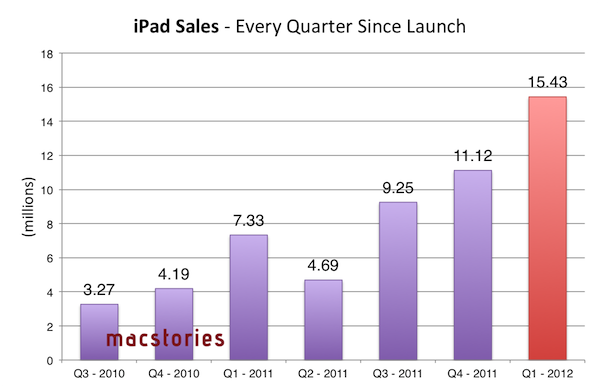
To put these numbers in perspective, let’s take a trip down Apple’s iPad memory lane again and remember how iPad sales evolved over time.

And then, of course, the company kept pushing the iPad quarter after quarter with new software, new apps, and a new version in March 2011, achieving these results:

It is worth noting, however, that the original iPad and iPad 2 went on sale exclusively in the United States on Day One, whilst today’s iPad numbers include sales and pre-orders for the United States and 9 more launch countries from March 16, 2012. This Friday (March 23), the device will go on sale in Austria, Belgium, Bulgaria, Czech Republic, Denmark, Finland, Greece, Hungary, Iceland, Ireland, Italy, Liechtenstein, Luxembourg, Macau, Mexico, The Netherlands, New Zealand, Norway, Poland, Portugal, Romania, Slovakia, Slovenia, Spain and Sweden.

For comparison, the new iPad has sold 3 million units in 4 days, while the iPhone 4S sold 4 million units in 3 days last October (the 4S went on sale in 7 countries on October 14, 2011). The iPhone 4S has been the Apple’s biggest success with the iPhone line so far, reporting over 37 million units sold in the last quarter. If these initial are of any indication, it seems like Apple’s strategy with multiple, international rollouts a week from each other may lead to the biggest iPad launch to date.

Earlier today, Apple CEO Tim Cook said the company saw “record” sales for the new iPad in its opening weekend. The new iPad launched to very positive reviews from the press (which mentioned the device’s Retina display, LTE, and battery life as great selling points) and long lines around the world.


Apple Adds “Answers from the community” Section To More Product Pages

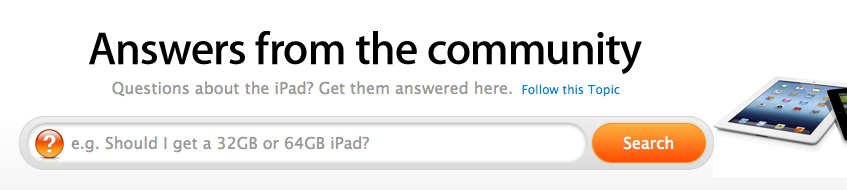
As noted by The Next Web, Apple has added a new “Answers from the community” section at the bottom of product pages accessed from the company’s online store, allowing users to read questions and answers submitted by the community, and reply to them by logging in with an Apple ID. Currently, a product page on Apple’s website doesn’t have this new section, but its dedicated retail store page does. Here’s an example of the iPad webpage, and its retail page. Furthermore, the section appears to have been enabled only for English-speaking countries: it is available on the US, UK, Canada and Australia Apple online stores, but it can’t be found in France or Italy.

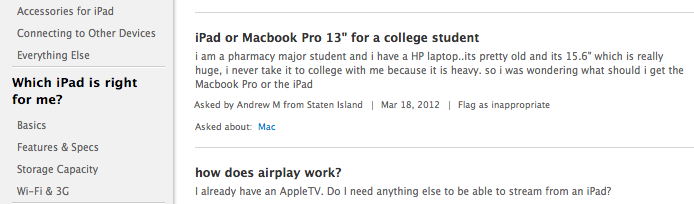
In product pages, the new section is embedded at the bottom, displaying top questions from the community alongside “popular topics”. Single-product Q&A pages are available as well, with a sidebar on the left listing more popular topics and questions, and a link to visualize the most recent answers for a specific product. Questions include a variety of topics, such as, for the iPad, “which iPad is right for me?” and “what can I do with an iPad?”, alongside other discussions about apps, features, and “everything else”. Users can read questions without logging in, read all answers, browse similar questions, and submit an answer of their own through a dedicated form.

Separate from the Apple Support Communities that the company revamped last year, the “Answers from the community” section comes with a set of guidelines Apple is making publicly available. These guidelines have been online for quite some time – the possibility of leaving ratings, reviews, and questions has been a feature of the Apple online store, in one form or another, for years now – but the integration with product pages and overall graphical look are new.

It’s interesting to notice how, in the past months, Apple has been slightly tweaking the online Store to include social functionalities aimed at increasing options to share and discuss products. Last summer, Apple added Facebook and Twitter sharing to its online store, letting customers easily share links to a product with their friends and followers. Community answers are nothing new as a concept, but the way they are now prominently displayed on more product pages from the online Store signals a renewed focus on making the shopping experience more “personal” by enabling people to answer questions that, too often, an official FAQ section can only partially cover.