



Brightcove today unveiled their ‘App Cloud Dual-Screen Solution for Apple TV’ which is effectively a development kit that allows developers and media publishers to easily create “dual-screen” apps that utilise AirPlay. It enables an Apple TV to effectively become a second screen in which different content can be showed, but synchronised to what is shown on the iPad or iPhone. As highlighted in the demonstration video below, this tool could be used to create interactive quiz games or perhaps an app that plays a video on a TV and display additional information on the iPad or iPhone.
Read more
Court Approves Fine Against Apple For Misleading Australian Consumers With “4G” Claim
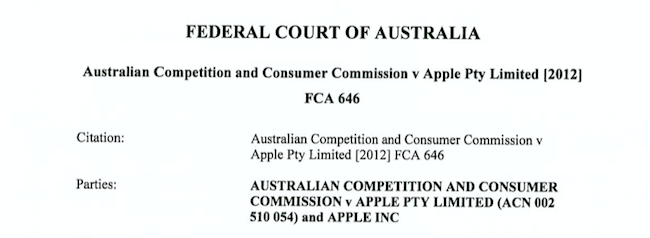
Apple will pay the AU$2.25 million fine for misleading Australian consumers by marketing the new iPad as “WiFi + 4G” after the Federal Court this morning approved the settlement that Apple reached with the ACCC on June 7th. Although Apple and the ACCC came to the agreement (which also requires Apple to pay AU$300,000 in court costs for the ACCC), approval was required from the Federal Court. In coming to the decision, Justice Mordecai Bromberg requested various sales, refund and other information from Apple to assess whether the fine was appropriate.
Although the exact numbers remain confidential, in his judgement, Justice Bromberg notes that the “number of new iPad cellular model devices sold by Apple in the relevant period was very substantial”. As for the number of consumers who took up Apple’s offer for a refund, he notes that “only a very small percentage of them took up the opportunity of a refund” - although this is tempered by a preceding paragraph in his judgement:
“Cant tell with any certainty how many consumers were mislead, nor is it possible to discern the level of disappointment (as distinct from proven loss or damage) involved for those consumers who were misled… many purchasers will have felt decidedly short-changed…”
Apple Pty Ltd (Apple Australia) Dominated by Apple Inc (Parent Company)
In what is largely unsurprising for those who are observers of Apple, the Australian arm had little control over the marketing message of the iPad. All marketing materials were provided to Apple (Australia) by Apple Inc and then passed on by Apple (Australia) to the “some one hundred and fifty resellers”. Justice Bromberg says “the same campaign was used worldwide by the Apple group of companies”.
“The most concerning aspect of Apple’s contravention of s 33, is the deliberate nature of its conduct. Apple does not seek to deny the deliberateness of its conduct and there are no facts before me which seek to excuse or explain the conduct, other than that the conduct occurred at the behest of Apple’s parent company, the second respondent (“Apple Inc”).”
This control by Apple Inc is further exemplified by the fact that Apple (Australia) became aware of the cellular iPad’s incompatibility with Telstra’s LTE network as early as 8 March, (the first day of pre-orders). “The controlling hand of Apple Inc” can be seen in that Apple “did not desist in its use of “iPad with WiFi + 4G” until 12 May 2012, when the product designator was changed globally.”
“Those who design global campaigns, and those in Australia who adopt them, need to be attuned to the understandings and perceptions of Australian consumers and ensure that representations made by such campaigns will not serve to mislead.”
The Factors Assessing The Appropriateness of the Penalty
There were a number of factors that led Justice Bromberg to accept the AU$2.25 million fine, starting with the fact that Apple did later clarify the incompatibility with Telstra’s LTE network and the fact that the whole spectacle had quite significant media attention in Australia. These two factors are likely to have substantially diminished the potential for consumers to be mislead by the product designator of “WiFi + 4G”. However beyond that, there were also some other factors including:
- Senior management was involved
- Education programs and disciplinary measures taken by Apple
- Apple has never before engaged in conduct similar to this (significant weight attatched)
- Gave credit to Apple for their cooperation with the ACCC
- Apple acknowledged its liability
- Media attention
- Absence of loss or damage
In conclusion, Justice Bromberg said that the “proposed penalty is neither manifestly inadequate nor manifestly excessive”.
“I harbour a concern that the size and financial strength of Apple diminishes the meaningfulness of the penalty proposed. However, I do not perceive any further transgressions by Apple to be likely. The fact of the litigation and the media attention which it has drawn, will no doubt be a somber reminder to Apple, and others who rely on their brand image that, as well as a penalty, there will likely be an intangible cost involved in a contravention of the ACL.”
A Refresher on What Exactly Apple Did Wrong
Below are some key quotes I’ve pulled from the judgment that help explain why the ACCC went after Apple and why Apple ultimately acknowledged and accepted liability:
“No Australian carrier uses the term “4G” to describe any network which operates on HSPA, HSPA+ or DC-HSDPA networks. Those networks have always been referred to by Australian carriers as “3G” networks. Apple has also referred to those networks as “3G”.
“During the relevant period, Apple used the product designator “iPad with WiFi + 4G”, in relation to a device which could not directly connect with the only commercially available LTE network understood by Australian consumers to be a “4G” network.”
“Apple admits that by its use of the product designator “iPad with WiFi + 4G” during the relevant period, in trade or commerce, it impliedly represented that the new iPad cellular model could connect directly to the Telstra LTE mobile data network in Australia. Apple admits that by doing so, its conduct was liable to mislead consumers in relation to a characteristic of the new iPad cellular model, namely, its ability to connect to the Telstra LTE mobile data network. It is that representation about that characteristic, which resulted in the admitted contraventions of s 33 of the ACL.”
“The most concerning aspect of Apple’s contravention of s 33, is the deliberate nature of its conduct. Apple does not seek to deny the deliberateness of its conduct and there are no facts before me which seek to excuse or explain the conduct, other than that the conduct occurred at the behest of Apple’s parent company, the second respondent (“Apple Inc”).”
A Timeline of Events
- On March 27th the ACCC announced it would initiate legal action against Apple for making misleading 4G claims in its marketing of the new iPad in Australia. The issue arose because although the new iPad supports US and Canadian 4G networks, the hardware in the new iPad does not support any of the Australian 4G networks.
- Across Europe a few countries began to keep an eye on the issue and consider investigations into the issue after fielding complaints from consumers.
- On March 30th, Apple clarified its iPad marketing in Australia by explicitly noting that “it is not compatible with current Australian 4G LTE networks and WiMAX networks.
- On April 5th, Apple gave Australian customers the ability to get a full refund of the new iPad if they purchased it under the assumption of it supporting Australian 4G networks up until the 25th of April. They also informed Australian resellers to update marketing to explicitly mention the incompatibility with Australian 4G networks.
- On May 12th Apple decided to rename the WiFi + 4G model to WiFi + Cellular - across the whole world (including the US and Canada), eliminating the confusion over whether the iPad supported 4G in a particular country like Australia, where it did not.
[via itnews]
You can read the entire judgment here, uploaded by itnews.
Apple Agrees It Misled Consumers With “WiFi + 4G” And Accepts AU$2.25M Penalty, Judge Yet To Approve Settlement
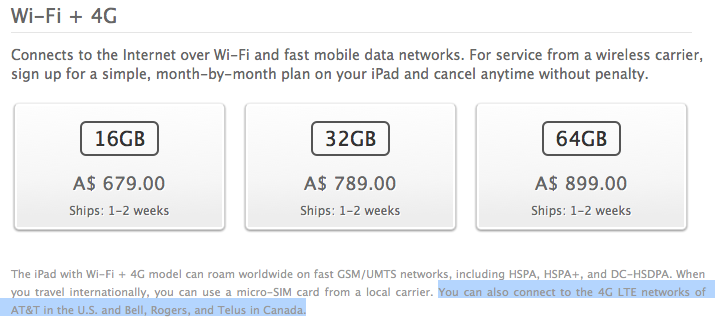
UPDATE: The Court has been adjourned and Justice Bromberg will receive confidential information from Apple (currently unclear what that will include, but presumably some sales and/or refund numbers) by next Wednesday. A decision about whether or not the penalty is appropriate can then be made.
In Australian Federal Court today, Apple has told the court it is willing to accept a AU$2.25 million penalty after agreeing it misled consumers by initially marketing the new iPad’s cellular capabilities as “with WiFi + 4G” in Australia. Apple accepted the penalty that the ACCC proposed which also requires Apple to contribute $300,000 to the ACCC’s legal fees. Colin Galvan, who is representing the ACCC noted that the “substantial” penalty would amount to a warning to the computer industry that “such conduct will not be condoned”.
Although both Apple and the ACCC have now agreed on a proposed settlement, Judge Mordy Bromberg must yet approve the deal. Judge Bromberg has said that he wants more information about the extent of misleading advertising after Apple has so far refused to provide any information about how many iPads have been sold, returned and how much revenue and profit Apple has earnt.
“I have some concern… that the agreed facts might be a little thin to allow me to do what I need to do and that is determine whether the proposed penalty is appropriate,”
Timeline of Events
- On March 27th the ACCC announced it would initiate legal action against Apple for making misleading 4G claims in its marketing of the new iPad in Australia. The issue arose because although the new iPad supports US and Canadian 4G networks, the hardware in the new iPad does not support any of the Australian 4G networks.
- Across Europe a few countries began to keep an eye on the issue and consider investigations into the issue after fielding complaints from consumers.
- On March 30th, Apple clarified its iPad marketing in Australia by explicitly noting that “it is not compatible with current Australian 4G LTE networks and WiMAX networks.
- On April 5th, Apple gave Australian customers the ability to get a full refund of the new iPad if they purchased it under the assumption of it supporting Australian 4G networks up until the 25th of April. They also informed Australian resellers to update marketing to explicitly mention the incompatibility with Australian 4G networks.
- On May 12th Apple decided to rename the WiFi + 4G model to WiFi + Cellular - across the whole world (including the US and Canada), eliminating the confusion over whether the iPad supported 4G in a particular country like Australia, where it did not.
[Information via @NorrieRoss, @LucyBattersby, @_kate_osborn and The Australian]
May 2012 In Review

May was a huge month for new apps and app updates with everything from Spotify for iPad, Diet Coda and TouchArcade launching to Flipboard, Sparrow and Tweetbot seeing sweet updates - and that’s only scratching the surface, there was a lot more. As for news, we saw another Siri ad (this time with John Malkovich), confirmation of the Mac App Store sandboxing deadline of June 1st, WWDC Keynote announcement and Rovio had two big pieces of news. Finally, we had some great stories go up in May and Lukas keeps writing awesome app reviews in his Inspiring UIs series. So without further ado, jump the break and enjoy the recap of May and sorry we’re a few days late this month!
Game In-App Purchases: A Conflict Between Developer Economics & Goodwill

In-App Purchases for iOS games. It’s a bit of a sensitive topic really, not many people like them at all, and quite a few people hate them and the impact they have had on the iOS games market. But today I want to explore the reason for their prevalence and explain why it has become an important part of the market for developers. I also want to reframe the discussion from one of “In-App Purchases are a problem” to one where we consider how they are being used and what developers could do to improve their implementation.
Below the break is Part 1: The Economics, in which I tackle the reason for their prevalence and importance in the iOS games market. Following that is Part 2: “Developers and Goodwill To Customers” in which I discuss how they are being used and perhaps what might be some best practices.
Apple Posts Initial WWDC 2012 Schedule, Releases Official App
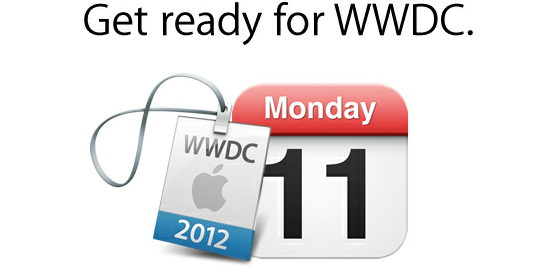
With less than two weeks to go until WWDC 2012 kicks off, Apple has this morning released the conference schedule as well as the official iOS app and some guides for the conference goers. Developers who were lucky enough to snag tickets to WWDC ‘12 can access the schedule here. There are over 100 sessions and labs that have been categorised into six technical tracks covering:
- Essentials
- App Services
- Developer Tools
- Graphics, Media and Games
- Safari and Web
- Core OS
One interesting change is that the Apple Design Awards will this year be held on Monday at 3:45 PM - usually the event was held later in the event and during the evening.
The official WWDC app is also live now, featuring a detailed schedule, daily news and photos, a map of Moscone West and the ability to plan your week by favoriting sessions and detecting session conflicts. For those who might be new to the WWDC experience, Apple has also created a handy ‘Attendee Guide’ for WWDC that you can access here - it’s nothing huge but does have handy links to other resources that will likely be useful to new attendees. Lastly, there is guide to the WWDC labs including what they will cover, when and where they run and which require a reservation.
Review: MoneyWiz For Mac
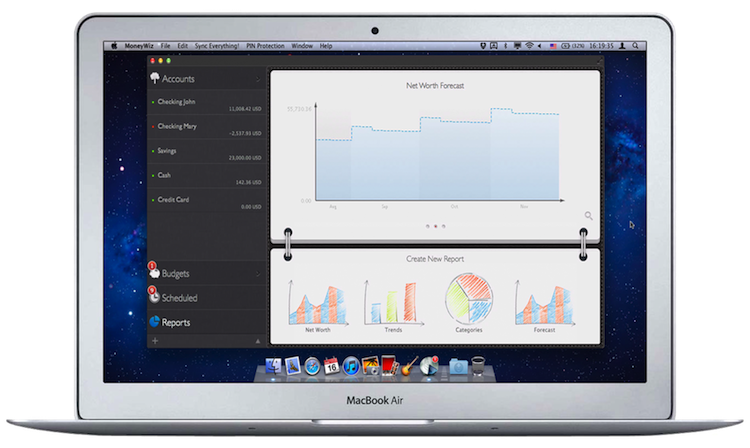
I reviewed MoneyWiz for iPad back in late February and found it to be a really great personal finance app for the iPad. Today I’m back to have a look at the recently launched Mac version of MoneyWiz. In many ways, the Mac app is identical to the iPad app, so this won’t be an in-depth review of the Mac app — rather it’ll be an overview of the MoneyWiz app and then some discussion on specifically the Mac App as well as the ‘Reports’ and the Sync service.
Read more
Say Hello To Amazing Alex, The Next Game From The Makers Of Angry Birds

Rovio’s CEO today revealed on Finnish TV that the next Rovio game will be called Amazing Alex and will launch within two months. Rovio will be reworking the game a little and it will center around Alex (the main character) who is a “curious young boy who loves to build things”.
“The quality pressure is high. We want to maintain the high standard Angry Birds fans have come to enjoy,” Hed said.
It’ll be based off of Casey’s Contraptions (see above image) which Rovio yesterday acquired to, from developers Snappy Touch and Mystery Coconut. On that acquisition, Rovio’s VP of franchise development, Ville Heijari, said yesterday that “The gameplay is a perfect fit in our arsenal with its approachable, fun and highly addictive take on the physics puzzler genre”. He also noted that Rovio was “reworking the title to enhance it”, so that it was in the Rovio style of “expect the unexpected”.
The Next Web points out that Rovio already owns the domain amazingalex.com as WHOIS records show. Today’s news comes after a stunning week for Rovio, hitting 1 billion Angry Birds downloads and revealing first-quarter revenues of 75.4 million euros (roughly US$106.3 M).
[yle, via The Next Web]
Why My iPad Is Not My Laptop→
Why My iPad Is Not My Laptop


John Carey, who you might know from all the excellent photographs he posts on his (equally awesome) fiftyfoodshadows blog, today wrote a piece entitled “Why My iPad Is Not My Laptop”. It’s effectively a counter-argument from Carey on why the iPad just isn’t a laptop replacement for many people, particularly those in the professional creative community - yet.
I would say a good 90 percent of the debate on the iPads usefulness as a computer is coming from writers and casual users and this is where I find the debate getting a little one sided. Of course a writer would like the iPad. The tools most needed to get their work done are right there for the taking, you can hunt and gather all day long and it does make a fantastic, distraction free space to write in.
Carey doesn’t dispute that the iPad is a ‘personal computer’ - in fact he asks “what is there to even to debate” on that question and he says it’s all about the software, not the input device. For creatives, he says there are a number of nice apps for sketching, image editing and so on, but they don’t have anywhere near the “horsepower or precision that it takes to complete a finished product” - likewise for others such as web designers, coders, industrial designers and so on.
When it comes to many jobs within the professional creative community the iPad is still more or less incapable of handling any honest workload. At least as far as things stand at this point in time. There are no designers that I am aware of using it to create much outside of concepts.
Some might question Carey’s premise, is the iPad ever meant to replace a laptop for such professional tasks? Perhaps that is why the laptops (or trucks as you may call them) are going to stick around for the key purpose of satisfying these people. But I’m not so sure, I think the iPad can evolve to be a suitable PC for most of these tasks undertaken by creative professionals - I don’t think it will completely replace the need for a laptop or desktop, but I think it will eventually replace the laptops of these professionals. As Carey said, it’s all about the software and whilst we have made giant leaps and bounds in just over two years — we have a long way to go.
But when it comes to honest creative work I can not help but find the iPad as little more than a sidekick. I can say with certainty though, that this is far from the last word on this. I can clearly see a future where touch screen devices such as the iPad become more and more viable for the kind of things I have discussed here today. It is still new territory being explored and I for one can not wait to see where it takes us.
One particular point that Carey talks about quite a bit in his piece is about the filesystem - or rather lack thereof in iOS. His arguments resonate with me, particularly surrounding photo management on iOS which in some ways has gotten worse with iPhoto - “a black hole within a hole where edited photos from your “camera roll” somehow end up in limbo within the app and you have to send edited versions back to the photo roll to do anything else with them”.
For such a supposedly simple to use device the iPad it sure makes it complicated to move files around. In this case, Apple is entirely responsible with their rebellious idea to avoid traditional file structures. I can not fathom why it would be so difficult to have a system level file management area that is as convenient to use as the notification system they have so diligently been working on. Something which is not so flawed and cumbersome as the hidden data that lives within each app.
You may not agree with everything Carey says, but I encourage you to read his full article, I think he makes some very good points and the personal examples of where he has tried to use the iPad as a laptop are an excellent addition.