Graham Spencer

997 posts on MacStories since January 2011

Former MacStories contributor.

Mapping The International Availability of Entertainment Services

It is 2014 and we live in a rapidly globalizing world. Unfortunately, that is not always apparent from the technology press, which focuses primarily on developments in the US. That is not meant as a slight against others who write about technology – it is just the reality. But thanks to our global and interconnected world, companies increasingly need to be able to do well in more than just one geographical market to succeed and grow. Additionally, customers outside the US are more aware than ever (thanks to the Internet and technology press) of new products available in the US and will place loyalty in the companies that bring those products to their country too.

It was this train of thought that led me to write a trilogy of so-called ‘Mapping’ posts in 2012 which covered three main topics: the availability of entertainment services across the world, the expansion of Apple Stores internationally and the rollout of various iPhones and iPads after their US launch. All are still available to be viewed, but as significant time has passed, please bear in mind that they are no longer current.

Today I am back to revisit the topic of entertainment services. The purpose, as was the case last time, is to see the international availability of entertainment services from Apple, Google, Microsoft and Amazon. Not only have we updated the information on all of these, but we have also added data about the availability of Rdio, Spotify, Deezer, Netflix, Hulu, Kobo, and Nook. Hopefully, with the aid of new maps and graphs included, you will get a better picture of how these entertainment services fare in catering to today’s global market of consumers.

Technical notes on the interactive content

This article is a bit different to most others we run on MacStories as it includes interactive graphs and maps. Most importantly, if you are reading this from an RSS reader or read-it-later service such as Pocket or Instapaper, we would suggest you read this article in a web browser as those interactive elements form a big part of this article and will unfortunately not be visible in those services. If you are on an iPhone or iPad, don’t worry, we have made sure they work and look perfectly fine on those devices as well.

When you come across the interactive maps, there are a few things to be aware of. Firstly, they are interactive in the sense that you can zoom in (pinch to zoom on iOS, buttons in the top-left for Macs/PCs) and take the map full screen (button in the top-right corner). In order to compare the worldwide availability of various services, you simply need to click or tap on the service names that are listed directly below the map and the map will update with relevant countries shaded to indicate availability.

Read more


Apple Refreshes MacBook Air With Faster Processor, Cuts Prices In Some Countries

Apple this morning refreshed their MacBook Air models with the latest generation of Intel’s Haswell processors. The new processors give the MacBook Air a slight speed bump, taking them from 1.3GHz to 1.4GHz (and Turbo Boost from 2.6GHz to 2.7GHz). The refreshed models are otherwise the same, offering 128GB or 256GB storage, 4GB of RAM and Intel HD Graphics 5000. Built to order machine options are also unchanged, with upgrades of 8GB of RAM, 512GB storage and a 1.5GHz i7 Processor available.

“With MacBook Air starting at $899, there’s no reason to settle for anything less than a Mac,” said Philip Schiller, Apple’s senior vice president of Worldwide Marketing. “Macs have never been more popular, and today we’ve boosted the performance and lowered the price of MacBook Air so even more people can experience the perfect everyday notebook.”

The four preconfigured models have all taken a $100 price cut in the United States - but those price cuts have not translated to every region, with Australia being one region where the prices of the models stay the same. But that can be explained by the recent weakness in the Australian dollar. The below graph illustrates the comparison between US prices and Australian prices, after converting the Australian prices to a 2014 average of the US Dollar and removing GST (which are included in the Australian prices).

The new MacBook Air models are available for purchase now. You can read Apple’s press release here.


Visualizing The Addition Of Apple TV Channels Over Time

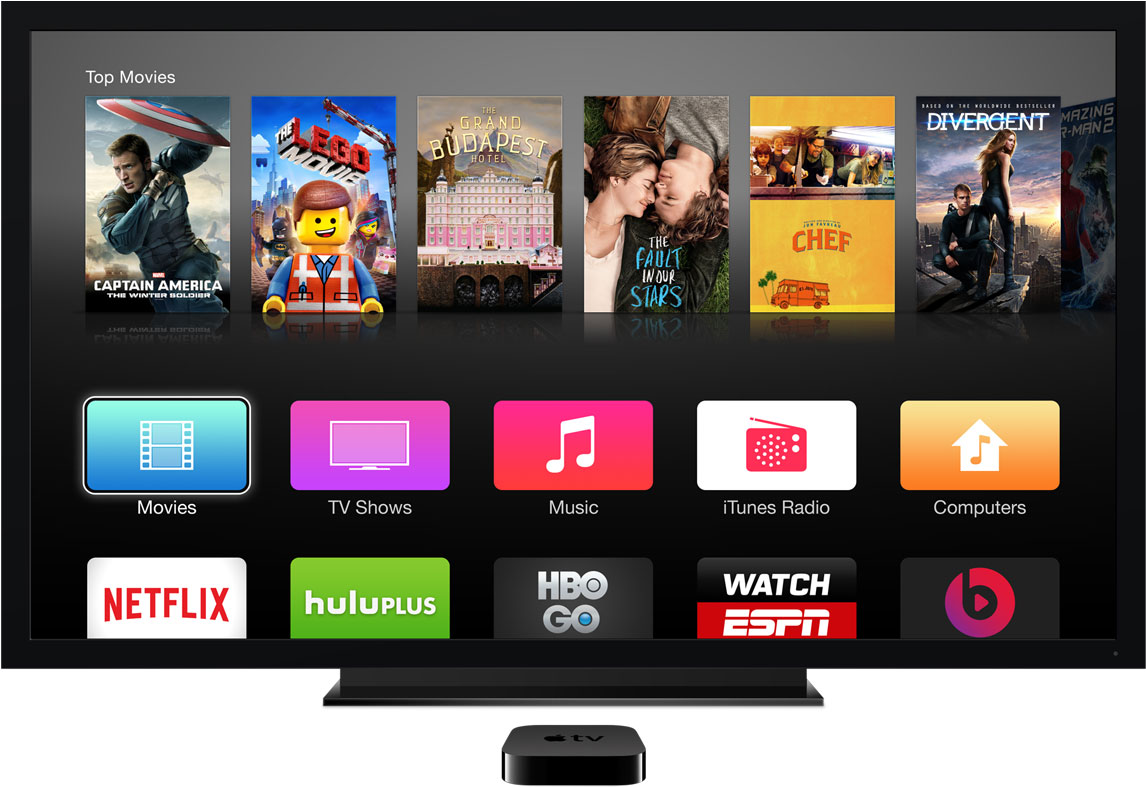
The Apple TV is a curious product. It has been called a hobby product by Apple; rumors constantly suggest a ‘groundbreaking’ new Apple TV is imminent, and Apple has chosen to add features to it on a more frequent, but irregular, schedule than their other products. What I mean by this last point is that unlike other products and services such as iOS, iCloud and even Apple Maps, Apple has not seen the need to wait for a keynote to update the Apple TV with new services.

In fact, since the Apple TV (second generation) was released in 2010, Apple has added new ‘channels’ to the Apple TV on 18 seperate occasions. Excluding Apple’s own channels, the Apple TV now has 33 third party channels in the US, with a handful of other channels only available in countries outside the US. Even more interesting is the fact that in the last 12 months Apple has rapidly increased their pace of adding new channels, with 26 being added in that time period.

I did this research after noticing a more frequent and steady stream of news about new channels being added to the Apple TV. I don’t have any explanations or theories for this recent acceleration of channel additions, but am curious as to where the next few months will take us. Will the pace continue, will Apple slow down, or will they eventually open the Apple TV up with an App Store? Of course, the even bigger question is whether the Apple TV will ever really become more than an accessory to your TV or iOS device and become a so-called “revolutionary” device that challenges ‘the status quo’. Only time will tell.

Read more


Apple Q2 2014 Results: $45.6 Billion Revenue, 43.7 Million iPhones, 16.4 Million iPads Sold

Apple has published their Q2 2014 financial results for the quarter that ended on March 29, 2014. The company posted revenue of $45.6 billion. The company sold 16.4 million iPads, 43.7 million iPhones, and 4.1 million Macs, earning a quarterly net profit of $10.2 billion.

“We’re very proud of our quarterly results, especially our strong iPhone sales and record revenue from services,” said Tim Cook, Apple’s CEO. “We’re eagerly looking forward to introducing more new products and services that only Apple could bring to market.”

We’ve been a bit busy today with the launch of MacStories 4.0 so we weren’t able to do our usual ‘notes from the call’. But we do have our usual graphs below, so that you can quickly digest this quarter’s earnings results.

Read more


Apple Debuts New ‘Powerful’ iPhone 5s Advert

Apple last night debuted a new advert for the iPhone 5s on US television networks and YouTube. Dubbed ‘Powerful’, the advert features the song Gigantic by the Pixies amongst a montage of scenes that shows the iPhone 5s accomplishing a myriad of tasks. There is no narration in this advert, but it does end with the slogan “You’re more powerful than you think”, which aptly sums up many of the more unique uses of the iPhone 5s that are shown. For example, the iPhone is used as a heart rate monitor, a remote to launch miniature rockets, as well as both an instrument and aid to an instrument, amongst other uses in the 90 second advert.

Update: As discovered by MacRumors, Apple has today launched a new section on their website that is dedicated to this advert and it highlights the apps that are featured in the spot.

You can watch the full advert below, or on Apple’s YouTube channel.

Read more


Apple Tries to Clean Up Its Carbon-Spewing Ways With New Data Centers

It’s an unusual trip in that its point is to give a reporter exposure to the way Apple works, a departure from the company’s usual maniacal secrecy. But when it comes to the environment, Apple consciously carves out an exception to its standard opacity. Part of the motive, of course, is generating a halo effect from good works. But Apple also hopes to inspire other companies and organizations to embark on similar ecologically helpful enterprises. Though it may not have always been the case, Apple has a good Earth Day story to tell.

Here’s that story: Apple is close to its goal of powering all its facilities 100 percent by renewable energy. Its corporate campuses and data centers are now at 94 percent renewable and rising. (In 2010 it was 35 percent.) The next step is to extend the efforts to its retail stores.

A fascinating insight into Apple’s environmental efforts from Stephen Levy at Wired, who was given the opportunity to tour an Apple solar plant and data center in Nevada with Apple’s senior vice president of environmental initiatives, Lisa Jackson. It’s no surprise that the tour given to Levy is a good news story for Apple, but equally interesting are the things that Jackson notes Apple has yet to achieve - in particular converting their retail stores to renewable energy (which is this year’s goal).

Also interesting (but not surprising), Levy was allowed to report on anything he saw, except “the manufacturer of the servers” in the Reno data center.

Permalink

What Fruit Is Left Hanging For iOS In Education?

There are very legitimate uses of IAP that make sense from both a developer and customer standpoint, but it’s not usable in education deployments. When my art teacher saw Paper by FiftyThree, she immediately wanted it. The problem is that it’s a free app and you can unlock needed extras by using IAP. If you are using either Managed Distribution or redeemable spreadsheets from the VPP store, there is simply no way to deploy these upgrades using MDM or Apple Configurator. I’ve e-mailed a couple of developers asking them to release paid versions of their apps as education editions, but haven’t had much luck.

Bradley Chambers provides seven great suggestions about how Apple could improve the functionality and usability of iOS in the educational field. What makes them particularly interesting is that these suggestions from Chambers have clearly come out of his experience of deploying iOS in an education setting. As a result, I was oblivious to a lot of the issues that he raises, and his suggestions make a lot of sense.

Hopefully Apple has been listening to people like Chambers who are on the front line of deploying iOS devices in educational settings and have some improvements to announce at WWDC in a few weeks time. And I think I speak for a lot of people when I say I really hope Chambers’ final suggestion became a reality.

Permalink

Pioneer To Add CarPlay To Five Of Their Existing Aftermarket Consoles

Update [April 17]: 9to5Mac has noticed that Apple has updated their CarPlay website with a section highlighting that Pioneer and Alpine will also support CarPlay. This confirms previous reports that Alpine will also begin selling a CarPlay compatible console later this year.

Pioneer has announced that it will bring Apple’s CarPlay to five of its existing aftermarket dash consoles via a firmware update. The update will be available early this summer, making Pioneer the first manufacturer to offer CarPlay on an aftermarket console system.

Pioneer’s years of expertise integrating smartphone connectivity into the automotive environment has provided us the opportunity to be among the first to offer CarPlay to drivers,” said Ted Cardenas, vice president of marketing for the Car Electronics Division of Pioneer Electronics (USA) Inc. “By providing an aftermarket option, Pioneer’s 2014 in-dash multimedia systems give many iPhone owners the ability to add CarPlay to their current vehicles.”

The Pioneer consoles that will support the CarPlay firmware update include the AVIC-8000NEX ($1400 SRP), AVIC-7000NEX ($1200 SRP), AVIC-6000NEX ($900 SRP), AVIC-5000NEX ($750 SRP) and AVH-4000NEX ($700 SRP), all of which are currently available from retailers today. Reports from Nikkei earlier this week suggest that Alpine Electronics will follow suit by launching their own CarPlay-compatible console in the Fall, with an expected price between $500 and $700.

CarPlay, which was formally announced last month after an initial introduction at WWDC last year, is an infotainment system designed so that cars can integrate with iOS devices and allow drivers to reply to messages, answer phone calls, listen to music, and more. Although CarPlay comes with support for touchscreens and control knobs featured in most cars, Apple has also placed focus on CarPlay’s Siri support. Drivers can use Apple’s voice assistant to control music playback and ask for directions with Maps, compose new text messages, make calls – all while staying focused on the road as much as possible.

[Nikkei, via MacRumors]


Use The Power of IFTTT To Customize Your Apple TV Screen Saver

It’s a fairly hidden feature that not many people seem to know about, but the Apple TV has some pretty great options for customizing its screen saver. There are a few default sources of photos you can choose from, including National Geographic (probably what you are using now), Animals, Flowers, Trailers (which shows movie posters of films on the iTunes Trailers website) and iCloud Photos (Photostream and iCloud albums).

But more interesting is the option to use Flickr. That may sound odd, but the reason I say it is because when you combine it with the awesome power of IFTTT, you can create some really unique screen saver options. For example, for the last few months I’ve been using a combination of Flickr, IFTTT and Instagram to create an Apple TV screen saver that cycles through images that I have liked on Instagram and it is far better than seeing the same old National Geographic photos (as great as they are) over and over again.

Read more