


I have had my eye on smart thermostats ever since the Nest was released in 2011. I came very close to purchasing one over the years, but something always held me back. Between the price, concerns that installation could be a hassle or require someone else to install it, the lack of simple integrated control systems, and not wanting to complicate something that was already simple, I never bought one. That changed about a month ago when I purchased two ecobee3 smart thermostats for my home. I couldn’t be happier with the simplicity, level of control, and automation that the ecobee3 delivers.
ecobee3 Smart Thermostat Review
Australian Banks Ask Competition Regulator to Allow Collective Boycott of Apple Pay

In a rather extraordinary move, four of Australia’s largest banks have written to Australia’s competition regulator requesting permission to join together in a collective boycott whilst they negotiate with third-party mobile wallet services including Apple Pay, Android Pay and Samsung Pay. The banks seeking permission include 3 of the ‘Big 4’ banks in Australia, being the Commonwealth Bank of Australia, National Australia Bank, and Westpac Banking Corporation, but it also includes Bendigo and Adelaide Bank. Notably, the fourth bank in the ‘Big 4’ absent from this request is ANZ which reached an agreement with Apple earlier this year to launch Apple Pay for its customers.
In a lengthy, 121-page submission, the four banks have written to the Australian Competition and Consumer Commission (ACCC) requesting such permission for a period of three years. The banks also flag the possibility that the arrangement could be extended to other card issuers in Australia who wish to participate in the collective negotiation and boycott. The banks argue that the collective negotiations will be limited so as to encourage the introduction of mobile wallet and mobile payment services in Australia that best promotes competition, best practice standards, and efficiency and transparency.
At the heart of their request is the claim that third party wallet providers have the power to “impose highly restrictive terms and conditions”. The banks point out that 90% of smartphones sold in Australia run iOS or Android, and Samsung is the leading manufacturer of Android phones. Therefore, they claim, Google has significant bargaining power over Android, Samsung over Galaxy phones, and Apple over iPhones. But it is Apple that the banks say “has particularly significant bargaining power in negotiations relating to Apple Pay due to its control of both a key operating system and key mobile hardware”. They point out that in Australia the iPhone has a share of 41.2% of the market and Apple sells the two most popular phones on the market.
The banks also make the argument that Apple has refused to permit third-party apps from accessing the NFC functionality contained in recent iPhones, unlike other manufacturers. They argue that it is inconsistent with other hardware and software features Apple has introduced such as the iPhone camera, accelerometer, and Touch ID sensor which are available to third-parties. Unfortunately, the banks also cite concerns over high rates of fraud which have since been debunked as spurious and unrelated to Apple Pay. The final key arguments from the banks relate to regulatory asymmetry - the fact that banks are faced with regulatory obligations in relation to fees and charges, but third-party wallet providers are not.
The objective of the banks here is to reach a deal with Apple that would allow them to use their own mobile payment solution on top of the NFC technology in iPhones and other smartphones. That seems to me to be highly unlikely given Apple’s desire to control its platform, grow its services revenue and protect the privacy of its users. Besides, Apple has already been willing to negotiate for nearly 2 years since Apple Pay launched, it seems likely that they are content with playing the long game. Nonetheless, this submission from the Australian banks will likely concern Apple if it is approved as it may inspire banks in other regions to undertake similar actions.
You can read the banks’ full submission to the ACCC here.
[via @TapDownUnder]
Apple Music Buys ‘Carpool Karaoke’ TV Series→
Cynthia Littleton writing for Variety:
Apple has emerged as the surprise buyer of the unscripted TV series based on the “Carpool Karaoke” segment of CBS’ “The Late Late Show with James Corden.”
The tech giant’s Apple Music service will distribute the series to its members in 100 countries worldwide. Apple sees the show as a natural vehicle to drive online activity for its streaming-music venture.
This is not Apple’s first foray into original video content, and at this point it is quite clear that Apple is actively exploring the idea. For now at least, most of the focus (including today’s announcement of Carpool Karaoke) has been on video content that can be part of Apple Music, but if these early projects go well it’s likely that we’ll see Apple’s video ambitions expand in scope and scale. In the last year Apple has reportedly approved a scripted series from Dr. Dre, launched a music docu-series from Vice, partnered to produce the ‘Planet of the Apps’ reality competition series, and exclusively streamed a Taylor Swift concert from her 1989 world tour.
“We love music, and ‘Carpool Karaoke’ celebrates it in a fun and unique way that is a hit with audiences of all ages,” said Eddy Cue, Apple’s senior vice president of Internet software and services. “It’s a perfect fit for Apple Music — bringing subscribers exclusive access to their favorite artists and celebrities who come along for the ride.”
It should be noted that James Corden, who has hosted the Carpool Karaoke segments as part of ‘The Late Late Show’ will not be hosting these standalone episodes of Carpool Karaoke for Apple - though he will be an executive producer. The new host and premiere date has not yet been announced, but Variety reports that production is expected to begin soon. Apple has licensed 16 episodes of Carpool Karaoke and they will air the episodes weekly to members of Apple Music in over 100 countries.
Connected, Episode 101: Best Represent Pineapple→
In a stunning break with tradition, Connected tackles the multi-iPad lifestyle and photo management in this week’s episode.
On this week’s Connected, more on Apple’s intelligence-based features in iOS 10, with a focus on Memories in Photos. You can listen here.
Sponsored by:
- Textexpander, from Smile: Simply indispensable.
Apple Q3 2016 Results: $42.4 Billion Revenue, 40 Million iPhones, 10 Million iPads Sold

Apple has just published their financial results for Q3 2016, which covered the three months from April to June 2015. The company posted revenue of $42.4 billion. The company sold 10 million iPads, 40 million iPhones, and 4 million Macs, earning a quarterly net profit of $7.8 billion.
“We are pleased to report third quarter results that reflect stronger customer demand and business performance than we anticipated at the start of the quarter,” said Tim Cook, Apple’s CEO. “We had a very successful launch of iPhone SE and we’re thrilled by customers’ and developers’ response to software and services we previewed at WWDC in June.”
“Our Services business grew 19 percent year-over-year and App Store revenue was the highest ever, as our installed base continued to grow and transacting customers hit an all-time record,” said Luca Maestri, Apple’s CFO. “We returned over $13 billion to investors through share repurchases and dividends, and we have now completed almost $177 billion of our $250 billion capital return program.”
Google Tweaks the Design of Maps and Adds Areas of Interest→

Google Maps is on the move. Just last week, Google added enhanced crowdsourcing features to Google Maps making it easier for users to edit map locations and add richer information about them. Now, Google has updated the design of its iOS, Android, and web apps to make them easier to explore visually too.
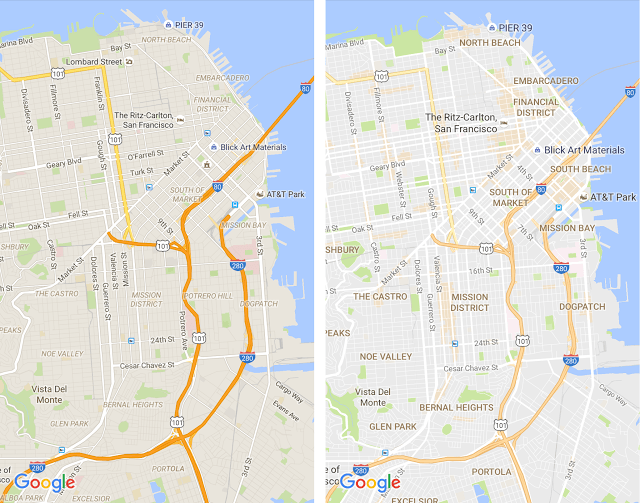
The goal of the Google Maps update was to create a less cluttered look:
… as part of this update, we’ve removed elements that aren’t absolutely required (like road outlines). The result is a cleaner look that makes it easier to see helpful and actionable information like traffic and transit.
Google also modified the typography and color scheme of Maps to make it easier to identify different map elements.
The update to Google Maps includes an all-new feature as well – areas of interest, which are shaded orange. The shading, which is determined algorithmically and by humans makes it easy to spot areas where you may want to zoom in to browse points of interest.
I like the design changes that Google has made. In the before and after screenshots of downtown San Francisco above, the neighborhood names and other points of interest are much more legible than they were previously, which should make it easier to use Google Maps to explore and navigate new places.
New Video Policies for iOS→
Jer Noble on the WebKit blog:
Since before your sun burned hot in space and before your race was born, Safari on iOS has required a user gesture to play media in a
<video>or<audio>element. When Safari first supported<video>in iPhoneOS 3, media data loaded only when the user interacted with the page. But with the goal of returning more control over media playback to web developers, we relaxed this restriction in iOS 8: Safari began honoring thepreload="metadata"attribute, allowing<video>and<audio>elements to load enough media data to determine that media’s size, duration, and available tracks. For Safari in iOS 10, we are further relaxing this user gesture requirement for silent<video>elements.
There are a few new <video> policies in iOS 10, and the WebKit blog goes into great technical detail about what they all are. But for most users, there will be two main changes that you’ll notice in iOS 10. The first is that iOS 10 will now support the ability to play videos automatically if they are silent. For example, some websites have a silent video background (e.g. The Life of Pi movie website), and others use it as an alternative to displaying GIFs. In iOS 10 these will be able to play automatically without a user interacting with it. It is important to note that this feature of automatic playback will only be triggered if a video has no audio tracks or is muted.
The second change is that on the iPhone, user-triggered video will not automatically enter full screen mode. Instead, videos will play inline, just as they do currently on the iPad and on Android. Full screen mode is still available, but a user will have to trigger that manually.
These may seem like small tweaks, but they are notable improvements to the video experience on Safari for iOS. The first brings the iPad and iPhone one step closer to the Mac/PC web experience, whilst the second is a recognition that iPhones have become large enough and powerful enough that it is entirely feasible that users may wish to view videos inline and continue browsing the webpage that has embedded the video.
Teeter Review: A Beautiful, Challenging Momentum Puzzler
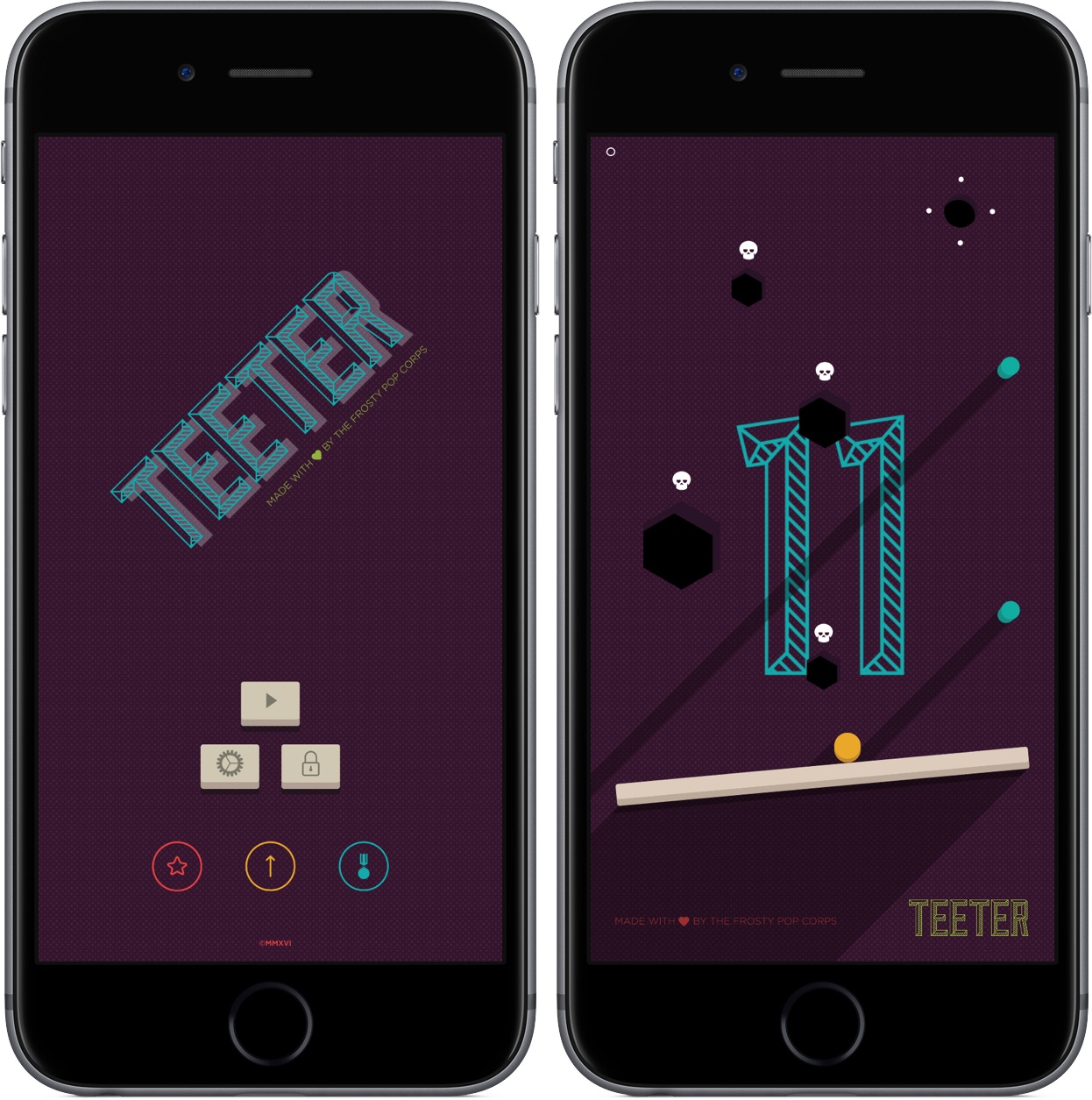
In the broadest sense, I feel like there are two categories of games: quick fixes and time sinks. The former, built on the foundation of quick-to-play casual hits like Paper Toss and Angry Birds, dominate the market. With the latter, including games like Infinity Blade or Bastion, the time it requires to complete the story lends itself to a more tradional gaming market. Both have their place, of course, but short, level-based games often translate into a more universal and better mobile experience.
A quick game of Teeter can be about as short as they come. If you play the game right, you’ll get through a level in a couple of seconds. The problem, however, is that each of Teeter’s levels is immensely challenging, which makes it really difficult to advance. Despite failing levels hundreds of times, I’ve stuck with Teeter for its whimsy, level design, and overall gameplay.
Game Day: Nanuleu
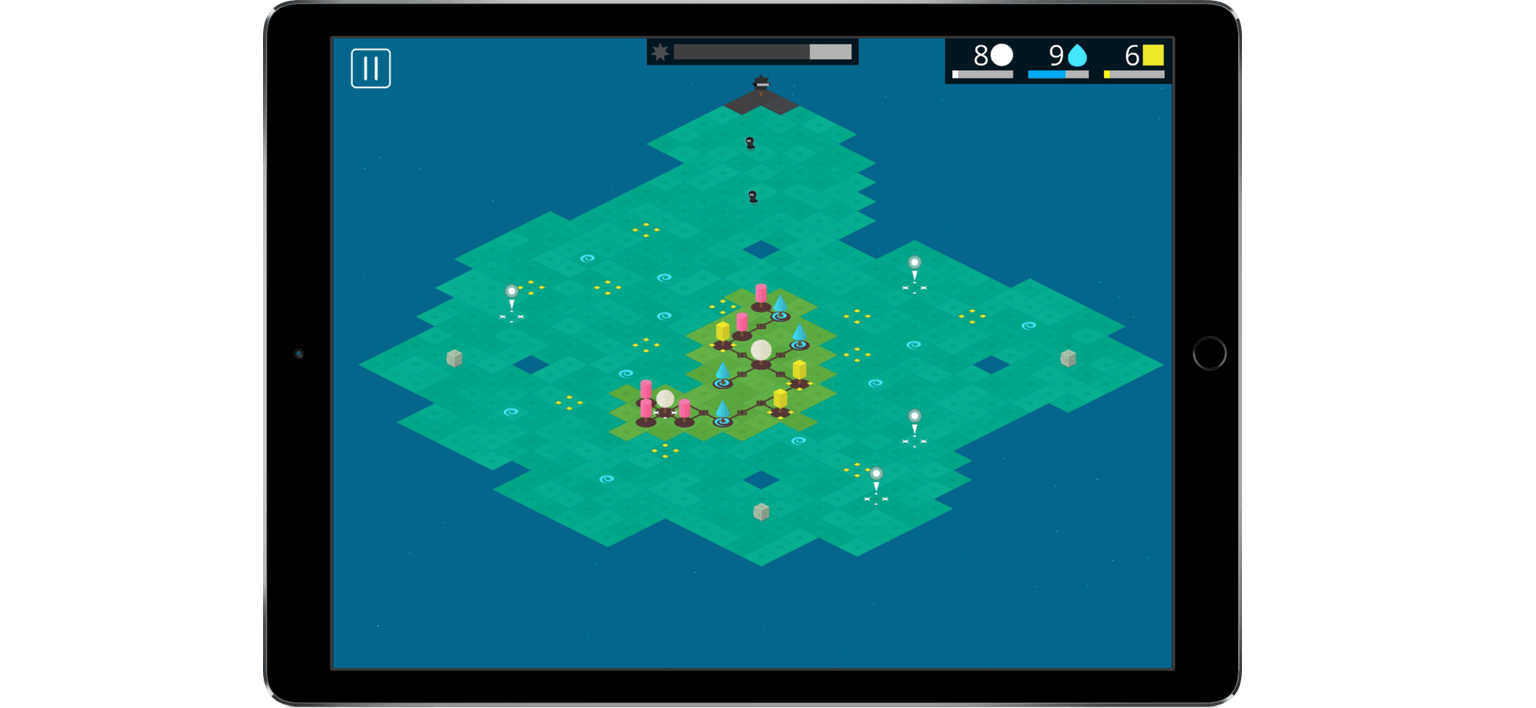
Nanuleu by Selva Interactive is an excellent new tower-defense strategy game reminiscent of Rymdkapsel. I’ve been a fan of tower-defense games since the original Fieldrunners game launched on iOS just a couple months after the App Store opened. Nanuleu is a less frenetic, more laid-back take on that classic style with many of its own distinctive elements.
Nanuleu is played from an isometric perspective on a procedurally generated map that makes each game you play unique. There are three modes, Apprentice, Warrior, and Sage, each of which is progressively more difficult to complete.

You start each game with a life tree at the center of the map and resources that you can spend to expand your territory across the map. Tapping on the squares on the map that are adjacent to territory you already control gives you the option to plant certain types of trees or simply expand your network of roots. Water, mineral, and life trees can only be planted on squares with corresponding colored symbols and require more resources than simply laying down roots.
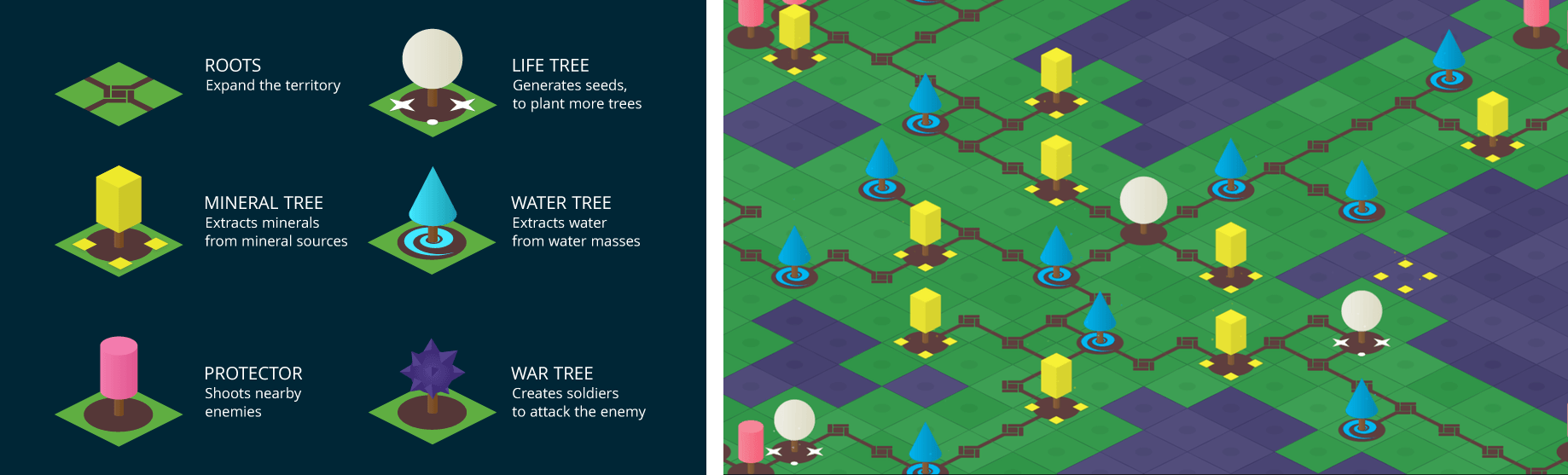
After a while, enemies start attacking from different spots along the edges of the map. Planting protector, and later, war trees helps defend your trees against the enemy. As you expand your network of water, mineral, and life trees, resources accumulate faster, but you need to spend your resources carefully to defend your territory. If the enemies start taking out trees, especially those that produce resources, your territory begins to shrink. Vanquish all the enemies and you win the round. If the enemies get the upper hand and overtake your last life tree, you lose.
It’s easy to understand why Nanuleu won an award at the 2015 Indie Game Maker Contest and has already made a best of 2016 list just over a week since its release. The game combines great visuals and sound with simple, but challenging, gameplay. Nanuleu games are not short. Most of the games I’ve played have lasted 20-30 minutes, but time flies because it’s easy to get absorbed in the action. If you enjoy tower defense and real-time strategy games, Nanuleu is worth checking out.
Nanuleu is available on the App Store for $2.99.