Reading Manga On The Retina iPad

Last month, I asked on Twitter if there was an easy and legal way to purchase manga digitally on the iPad. Unfortunately, while American comics are seeing a nice digital resurgence thanks to apps like Comixology, the situation is profoundly different and inherently worse with Japanese manga. There is no Comixology for manga – where by manga I basically mean Shonen Jump content – and the few services that do have some manga available (like VIZ) have terrible apps that don’t take advantage of the latest iOS technologies and come with risible offers on multi-volume purchases.

I have no idea why Shonen or its international publishers – like Panini Comics and Star Comics in Italy – aren’t realizing the huge potential for legal, convenient, digital editions of their manga on mobile devices. It is kind of ironic that, as of today, pirating manga you already own physically gets you better, higher quality results from some shady Internet forum than going the proper, legitimate way. Because that way doesn’t exist. It’s the same problem of old media all over again.

As I was listening to T.Rex on Spotify yesterday for my review of the app, I connected Marc Bolan’s song to Naoki Urasawa’s 20th Century Boys, and I felt the need of finding a solution to begin reading the series again. It turns out, provided you have scans for your manga ready to go (I prefer PDF and CBR, but there are several options out there), there are two interesting options right now on iOS.

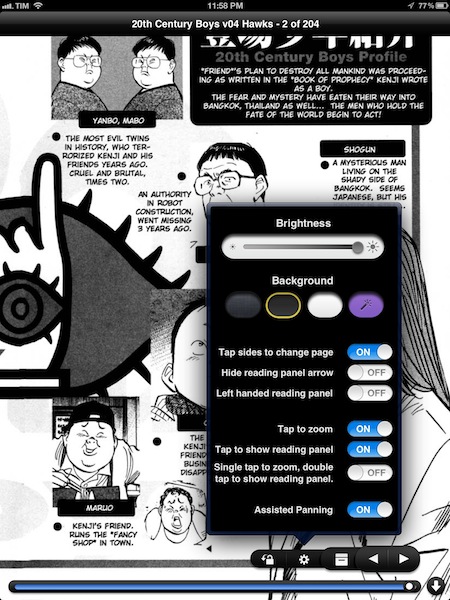
Assuming you want to read manga on your iPad, Bookman is a $2.99 iPad app that’s been updated for the Retina display and that comes with fast caching of pages, great performance, and a good selection of browsing and optimization settings. Its rendering has been very good for my copies of 20th Century Boys, and I like how you can easily import content through a built-in FTP server (I transfer files with Transmit) or Dropbox. You can organize manga in bookshelves, and the app comes with various settings for tap areas, thumbnail previews, appearance, and zoom. It’s even got page resume and multiple page turning effects. $1.99 on the App Store gets you the separate iPhone app (I wish they were universal). Right now, I’m reading manga with Bookman.

The other option is Comic Zeal, which is universal, but that I haven’t tried yet as it doesn’t have support for the Retina iPad. Technically, the app displays manga in Retina resolution if higher-res images are available, but interface elements haven’t been updated for the new display. According to the developers, an update with new graphics and “other goodies” has been submitted to Apple. Comic Zeal is $4.99 on the App Store.

Here’s to hoping publishers will consider the market for digital manga someday.


iCloud and iOS Games

iCloud and iOS Games

TouchArcade’s Brad Nicholson asked some indie iOS game developers about iCloud and support for syncing save states across devices:

It’s also obvious to us that iCloud and the implementation of it needs to be easier, and the service itself needs to be more reliable. Almost every studio we talked to had some trepidations or a horror story to share. Browse our message board, and you’ll find even more from users receiving the bad end of an iCloud problem.

That’s not to say iCloud isn’t awesome. It is. Games that use it, like Infinity Blade 2, are better for the implementation. iCloud could also be used for stuff beyond saves, so there’s promise of what’s to come. We simply want to see more of it.

In the case of smaller, independent developers of games for the iPhone and iPad, money is the main reason why iCloud often gets cut off from the list of features to implement at the last minute. For as much as we like to think of indie games as modern versions of DOS games programmed in a garage with virtually zero costs and lots of caffeine (and weird haircuts), the reality is that creating the latest $0.99 hit for iPhone is based off real business rules with real associated costs. As TouchArcade quoted a developer saying, “keep making games” is just as important as “making games”. The business side of things needs to be taken care of; when time is running out, iCloud typically gets sacrificed for the greater good – shipping the game.

I believe, however, that there is a deeper reason as to why developers are choosing to think about iCloud at the last minute. Why aren’t developers considering native iCloud integration from the get-go? And why is that only bigger, triple-A titles have been able to successfully use and ship with iCloud integration so far?

When I talked to developers about the first six months of iCloud, the reaction was the same: iCloud is great when it works, but there’s a need for better documentation and debugging tools. iCloud requires a lot of technical work to be implemented and customer support once it’s made available; not all developers are willing to go through this effort right now, and, unsurprisingly, only bigger development studios with consequently bigger budgets and support staff are pursuing iCloud sync for games.

With the WWDC approaching, here’s to hoping Apple will incentivize developers to consider iCloud integration as the foundation for apps and games. Third-party software is better with iCloud, iOS is better because of iCloud, but the platform for the next decade needs to find its early adopters in the people that will ultimately improve the platform going forward: iOS developers.

Permalink

Rare Video Of Steve Jobs as Franklin Delano Roosevelt Surfaces

Rare Video Of Steve Jobs as Franklin Delano Roosevelt Surfaces

Network World (via MacRumors) managed to obtain a copy of an old internal inspirational video for Apple employees titled “1944”, starring Steve Jobs as U.S. President Franklin Delano Roosevelt. Serving as an in-house alternate version of Apple’s iconic 1984 commercial, “1944” was allegedly aimed at rallying Apple’s sales troops against IBM.

Set as a World War II tale of good vs. IBM, it is a broadcast-quality production (said to have cost $50,000) that was designed to fire up Apple’s international sales force at a 1984 meeting in Hawaii. A copy of “1944” was provided to me by one-time Apple employee Craig Elliott, now CEO of Pertino Networks, a cloud-computing startup located two blocks from Apple in Cupertino.

Make sure to check out the full video, backstory, and transcript of the entire video at Network World.

Permalink

MacStories Interviews: Manton Reece

In our ongoing series of interviews with developers and creators in the Apple community, I recently had the chance to talk with Manton Reece, the founder of Riverfold Software and developer of Wii Transfer, Tweet Library, and Tweet Marker. When he’s not developing new features for his apps, Manton writes at manton.org. You can follow him on Twitter as @manton.

The interview below was conducted between January 18 and May 2, 2012.

MacStories: Hey Manton! Could you introduce yourself to the readers who haven’t heard about you or haven’t tried any of your apps before?

Manton Reece: Sure, my name is Manton Reece and I’m a Mac and iOS developer from Austin, Texas. I build e-textbook software for VitalSource and in 2006 I founded Riverfold Software with my first indie Mac app, Wii Transfer. My two main products are Clipstart, for managing videos on the Mac, and Tweet Library, an iOS app for archiving and collecting tweets. Most recently I launched Tweet Marker, a syncing web service for Twitter apps.

MCSTR: What are the circumstances that led you to start your own company? When, and how, did you decide you wanted to become an independent developer?

MR: It was almost an accident that I started Riverfold. I’ve always worked on side projects, though often it’s just to build something I need for myself, or a small tool released as freeware. But in 2006 the Nintendo Wii had just been released, and over a few weekends I built this app to make it easier to convert movies to a format that could play on the new console. At the last minute, I decided to charge for it, and I reused the domain name from a previous, unfinished web project of mine.

People bought the app, but the most surprising thing to me – and what really opened my eyes about the business of software development – is that sales were fairly consistent over those first few months. I could tell that the Mac had a very healthy software market for independent developers.

And there’s nothing like feedback from paying customers to get you excited about building and improving apps. I don’t think I would have been nearly as inspired to do anything after that if I hadn’t decided to make it a paid app at that initial release. Read more


QuickShot 2.0

QuickShot 2.0

I don’t only store text in Dropbox. Sometimes, I like to quickly send photos or videos shot with my iPhone or iPad to my Dropbox account – either into the standard Photos directory, or to a folder I’m sharing with the MacStories team. Previously covered on MacStories, QuickShot recently got an upgrade to version 2.0, adding a number of new features and optimizations to improve the way the app uploads photos and videos to Dropbox as soon as they are shot.

QuickShot is a standalone camera app that uploads media to any Dropbox folder. In version 2.0, the developer added support for specifying your own Dropbox path from a built-in browser. Similarly, you can now set custom file names for files that get uploaded – with default shortcuts for timestamps – opening the door for some interesting automation possibilities (imagine mixing up filename recognition with Hazel, or custom folders with IFTTT to save, say, receipts into Evernote). Custom path and file names definitely help in personalizing QuickShot even more (the app already allowed you to set custom file sizes for faster uploads).

The most notable feature of version 2.0, however, is “Capture Profiles” – a way to switch between different output settings for multiple scenarios.

The second goal was to transform QuickShot from a single-purpose app to one that could be easily integrated into powerful workflows. A single new feature called “Capture Profiles” you to go from shooting HD video of your kids and sharing it with the world through a shared folder to capturing business receipts and sending to Evernote using if this then that without the need for changing a bunch of settings. The app ships with a few great profiles by default but its really easy to create and customize them to suit your needs.

I am using QuickShot for photos and videos that I want to end up on Dropbox instantly, and I like the improvements of version 2.0. The app is $1.99 on the App Store.

Permalink

Create Multiple Mail Signatures On Your iPhone with Signatures

When it comes to mail conversations, it’s often difficult to find the right signature for the mail you’re about to send. You obviously cannot send a mail to your grandma ending up with “Kindest Regards, Lukas Hermann – Staff writer for MacStories.net”. I mean, of course you can, but she may misconceive that a bit. To avoid uncomfortable answers or telephone calls from her, mail apps for the Mac most of the time offer the ability to create several signatures and add them to a mail with a single click. On the iPhone, you can only create one signature, it completely lacks of this ability although it’s Mac companion has this feature. Signatures from Crowded Road fills this gap of functionality with a great UI and many useful features. Read more


Spotify for iPad: A UI Analysis with A Rdio Perspective

Spotify for iPad, released this morning, is a beautiful app. It’s solid, providing fast and reliable access to Spotify’s huge catalogue of songs and artists, and it presents content inside a great-looking package that, as I’ve already written, reminds me of Reeder’s sepia tones.

What follows is a brief examination of the app’s interface and functionalities. I have been using Rdio to completely fill my music listening needs for the past six months, but I was looking forward to trying Spotify for iPad to give it a fair shot. Read more


Spotify for iPad Now Available

After years of speculations and subtle hints, music streaming service Spotify is today unveiling its official app for the iPad. The Next Web has the first details on the app; you can find Spotify for iPad on the App Store.

Fully optimized for the Retina display and taking advantage of Apple’s AirPlay technology to stream audio to other sources, the official Spotify app has been completely re-imagined to use the device’s larger screen, and give users more space to browse music, access their playlists, and inbox. The app uses a Twitter-like panel navigation to load playlists and artists, with music controls available at the bottom alongside an option to enlarge the album view. Relying on linen and sepia tones reminiscent of apps like Reeder, Spotify for iPad doesn’t simply look like a bigger version of its iPhone version – something the company is even joking about in the promo video. For instance, the larger screen has allowed Spotify to introduce features like instant, unified search for artists, albums, and playlists, or a full-screen cover art view that users can swipe on to change songs.

Spotify for iPad requires a Premium subscription. We will update this post with more information and our first impressions during the day, as the app is propagating now in iTunes. In the meantime, you can find more screenshots and a video after the break.

Update: Here’s our look at Spotify for iPad.

Read more


11.13 and The Dropbox SDK

Apparently, Apple has been rejecting some iOS apps with Dropbox integration lately (at least during the past week) for linking to the Dropbox website through the login/sign up process. The Next Web has a rundown of the “issue”.

Apps that integrate with Dropbox, in fact, can either authenticate through the installed Dropbox app, or, if not installed, open a web view to let users log in with the browser. The alleged problem with Apple is that the Dropbox mobile login page contains a link to go back to Dropbox’s main website/account creation page, and possibly purchase a subscription bypassing Apple’s App Store (and thus 70/30 revenue split).

Of course, this isn’t new. In its App Store Review Guidelines, Apple has been enforcing for years a policy that doesn’t allow developers to visibly link to external websites that contain links to subscriptions sold outside of iTunes

Apps that link to external mechanisms for purchases or subscriptions to be used in the app, such as a “buy” button that goes to a web site to purchase a digital book, will be rejected.

In the past, a number of developers and services that included buttons/links to external websites containing subscription options were forced to update their apps to remove such functionalities. The most notable example to date has probably been the official Kindle app, which removed a button that linked to Amazon’s Kindle Store (where books can be purchased with an Amazon login, and saved into Amazon’s cloud locker). The list goes on, and the core issue at hand seems to be just how visibly developers are linking to external websites featuring ”external mechanisms for purchases or subscriptions”. There doesn’t seem to be a “visible” link to purchase additional Drive storage on Google.com, but you get the possible irony of this scenario. In the past few days, if these forum posters are to be believed, Apple decided to reject some apps that offered “an external link to Safari to create a Dropbox account”.

Before we march to Infinite Loop with our community pitchforks and torches, there are some necessary notes to be made about these rejections. First, the latest public version of the Dropbox iOS SDK is 1.2.1, available here, and I know at least two apps – Ultimate Password Manager and Drafts – that use it, and were approved today. Dropbox integration isn’t a central feature in these two apps, but they do have the Dropbox SDK built-in. On the forums – thus, not on the public developer page – the Dropbox team has already released a “beta” version of the 1.2.2 SDK, which removes the option to create an account on Dropbox.com. The beta SDK was seeded a few hours ago, and there’s the possibility Apple will reverse its decision on those rejections once they see the removal of the incriminated links. Right now, we don’t know.

Perhaps more interestingly, Dustin Curtis notes how some developers had also trouble linking to Rdio content inside their apps. It’s interesting, because Rdio came up with its own way to comply with Apple’s terms without losing money: they are offering subscriptions at a higher price through in-app purchase. But then again, the issue isn’t that Rdio does offer IAPs in its iOS app (the restriction on different prices was relaxed last year): it’s that the Rdio website still displays links to subscriptions users may potentially purchase through Safari (or any iOS web view).

As iOS apps become increasingly connected with third-party services and APIs, it’s going to be difficult for developers to keep track of websites and login pages that may or may not contain purchase mechanisms Apple doesn’t like. Sometimes, these mechanisms go unnoticed for months; other times, Apple decides to take action, such as in the (reportedly few) cases of Dropbox rejections this week.

Does this signal a change in Apple’s stance on Dropbox-enabled apps? We don’t know, though developers are naturally asking for clarifications and expressing their doubts. It may well be that Apple decided to simply start enforcing its old existing rule, and that they will be perfectly fine with the new SDK for newly-submitted apps. More importantly, while these few rejections are being talked about now, it’s important to note how, this week, other apps with the old Dropbox SDK have been approved.

Apple’s 11.13 rule isn’t new, and before we dabble in speculation about Apple wanting to “kill Dropbox”, I suggest we wait.