Posts in news

Could Aperture Be Coming to iOS?

This would be a photographers dream come true wouldn’t it? Even if you prefer Adobe’s Lightroom to Apple’s Aperture, I’d love to have the iPad play a larger role in field editing for photographers. The Photos app included on the iPad isn’t exactly prime for professional work (it’s great for displaying and browsing the end result), but Aperture on the iPad would give photographers an intuitive touch interface to edit photos in a library that’s perhaps separate from Photo’s library. Patently Apple reports that Aperture could well be on its way towards touchscreen devices such as the iPad (and maybe that touchscreen iMac we’ve heard about).

It’s the latter that’s interesting in light of Apple’s latest patent revelation that Aperture is coming to touch displays including handhelds like the iPad. It may even come to future desktops and laptops that offer touch displays, according to Apple. An advanced graphics pen would be great for fast photo touch-ups and appreciated by photographers using Aperture on-the-go.

The patent covers various means of interacting with Aperture, from touch input to pen input, and the descriptions of various GUI elements that can provide authors with an easy toolset at the ready for image editing. The authors are intrigued with the idea that Apple may be moving towards various forms of alternate input, such a smart light pen, that could aid future Apple device owners in precision editing.

[via Patently Apple]

Internal AppleCare Document Directs Employees Not To Help With Malware Removal

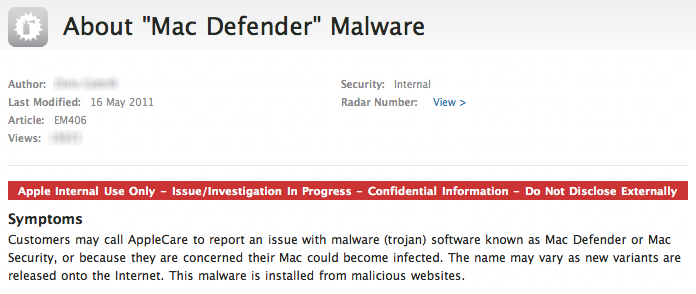
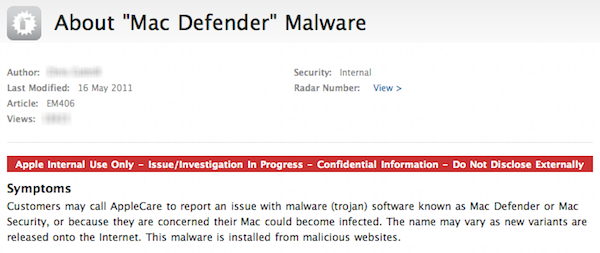
An internal AppleCare document posted earlier this week reveals that Apple is investigating ‘Mac Defender’ – a recently unleashed malicious application that pretends to be an anti-virus application when users download it. The document, which Apple clearly notes is for internal use only, tells its employees not to confirm or deny whether the application has been installed on a users computer, not to attempt to remove it or escalate the issue.

The bizarre document, which is posted in full after the break, seems to be instructing Apple employees to take no part in resolving malware issues on a users computer.

AppleCare does not provide support for removal of the malware. You should not confirm or deny whether the customer’s Mac is infected or not.

However, the document does tell employees to instruct customers that if the Mac Defender installer pops up on their screen, to cancel the installer and delete the installer immediately. Whilst if the application is already installed they are told to tell the customer to make sure all security updates have been installed with Software Update and then direct them to the “What is Malware?” document. But the document is clear in saying that Apple doesn’t deal with malware – even recommending anti-virus software in the Mac App Store.

Explain that Apple does not make recommendations for specific software to assist in removing malware. The customer can be directed to the Apple Online Store and the Mac App Store for antivirus software options.

[Via ZDNet]

Read more


Patent Reveals How Apple’s New Music Service Could Work

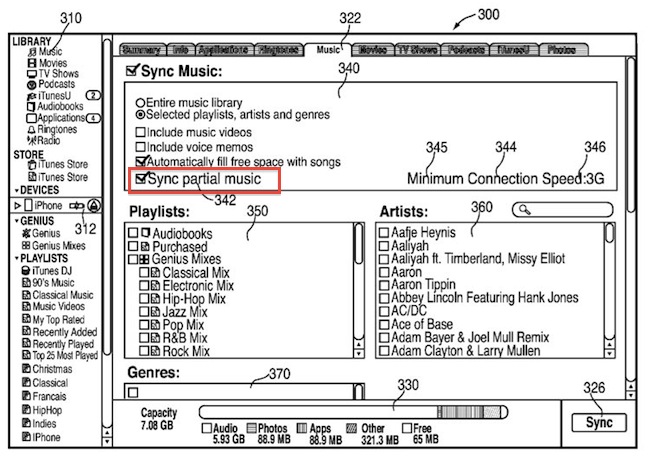
A new patent application published by the U.S. Patent and Trademark Office this week and discovered by AppleInsider today seems to provide some details about Apple’s rumored cloud-based music service, and how iTunes on the desktop and mobile devices like an iPhone could manage to improve streaming quality and speed by locally syncing snippets of songs. The patent, entitled ”Local Storage of a Portion of Streamed Media Items”, notes how most streaming services allow users to access an online library of music and cache contents locally on device to enable playback when an Internet connection is not available. This happens in popular service Spotify, which enables users to keep a local cache of albums and songs so they won’t be forced to always be connected to the Internet to listen to music. Whilst Spotify’s cache action has to be triggered manually by the user, other cloud music services automatically cache a song in the background once a user starts listening to it. Apple’s proposed solution is different, and it involves a new menu in iTunes (for the desktop) that syncs via USB “partial music” to an iOS device – that is, small snippets of a song, with the remaining parts available online.

Unlike cache, partial local sync has the advantage of letting users start listening to music immediately without waiting times. Because cache in other services is still obtained with an Internet connection, users have to wait for the caching process to finish before they can start playback. And if the song is not cached, users have to wait for the remote server to begin streaming – when quickly jumping between artists and songs (as most users do on iPods and iPhones), having to wait a few seconds for streaming to begin can be annoying. Assuming a user is syncing music that’s available both locally (on a Mac or PC) and in the cloud (the music service), Apple’s proposed solution skips cache and waiting times entirely by saving locally a first snippet of a song, and then fetching the rest remotely. This way, iTunes doesn’t have to sync full content (thus cutting syncing times) and a mobile device doesn’t have to stream the first seconds of a song. The benefit for users is that playback will start immediately regardless of how fast they’ll switch between songs; the obvious downside is that something will still have to be synced locally. AppleInsider also posts more details from the patent:

The application suggests that the remotely stored content could be a user’s own library, which they have streamed from a home computer or a remote server. Or, it could be streamed from a large “content source,” such as the iTunes Music Store. The described system would also utilize authentication methods, such as with an iTunes account username and password, to ensure that the user has purchased the items and has the right to stream them.

If this patent is of any indication, it could lend some credence to the reports that claimed Apple’s cloud music service was being set up in a way that users could both stream their own music libraries (by uploading them first) and music they didn’t purchase, with a subscription model similar to Spotify. The method described above would clearly require an update to the iTunes application, and it’s unclear whether Apple could also provide a way to “always stream”, avoiding partial sync and relying exclusively on a remote connection. Apple is expected to unveil iOS 5 with new cloud-based features at the WWDC, which kicks off in San Francisco on June 6.


Today Marks Ten Years Of Apple Retail Stores

On May 19 2001, Apple opened the first of its many retail Apple Stores; the Tysons Corner and Glendale stores. Ten years on, Apple’s retail ambitions have proven incredibly successful with over 300 stores in more than 10 countries.Along the way there have been some stunning stores, including the Regent street store in London (also the largest), the glass cube Fifth Avenue store in New York, the Paris Carrousel du Louvre Store and Pundong store in Shanghai.

As always, Wikipedia has some in-depth history and facts about the Apple Stores, as does ifoAppleStore which has an awesome list of unique factoids - did you know that the Bondi store has trees inside the store or that the Regent Street store has the longest Genius Bar at 46 feet? There have also been rumors in the past few days that Apple is planning to launch Apple Stores 2.0 - a relaunch of the stores with a shift in focus to ‘Personal Setups’, revamp of the actual stores with larger displays and deployment of iPad 2s for signatures being the key rumored changes.

Jump the break for pictures of these and other stunning stores, as well as a video of Jobs introducing that first Tysons Corner store - and see how much they’ve changed since!

Update: Added some pictures of the Tysons Corner store as it was on launch day (click on them for larger size), the original style of Apple Stores.

Read more


Phone, Tablet Owners Willing to Pay for Media Subscription Services

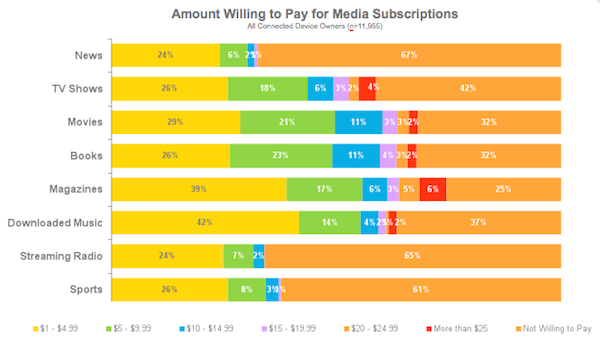
With rumors floating around about Apple’s upcoming cloud music service (especially after last night’s report on the company signing a deal with EMI) and others like Google and Amazon moving forward on the streaming bandwagon with products to upload and stream music at any time with smartphones, tablets and desktop web browsers, subscription-based payment systems are often seen as the only feasible solution to guarantee a continuos cloud service without interruptions, always available anywhere you go. Just like Spotify and Rdio let users stream large collections of music they don’t necessarily own by paying a monthly or annual fee, Apple is rumored to extend the iTunes subscription system it created for magazines to music, movies, and a combination of both for the ultimate iTunes Store cloud experience. But just how much are phone and tablet people willing to pay for these new cloud services based on subscriptions? That’s what research firm Nielsen takes a look at in its latest survey, asking users of “connected devices” how much they would pay for media subscriptions that would give them access to a variety of content on their mobile devices.

It turns out, music, movies, magazines, books and TV shows are something people would pay for – sure, there are different results, but take a look at the graph above and you’ll see that these 5 categories are the ones with less orange, which stands for “not willing to pay.” On the other side, sports content, streaming radio and news are something people would be less prone to subscribe to. Overall, the sweet spot for subscriptions seems to be around $4.99 - $9.99 per month, which is what most cloud services ask for these days. There’s an interesting difference about music, however: people would pay for “downloaded music”, and not for “streaming radio.” Assuming “downloaded music” stands for “music you own”, and people care about having online access to music that’s ultimately theirs, services like Amazon Cloud Player and Google Music Beta should be exactly what people are looking for, as they let you upload your own music to the cloud. Also assuming Apple is working on a similar solution, this survey suggests the company should allow for both uploads and Spotify-like streaming, enabling users to lock their own collections in the cloud, and get access to stuff they didn’t buy as well. Maybe that’s what these deals with music labels are all about.

Tablet and smartphone owners with proper Internet access on the go are willing to pay for online media available through apps, and if that’s their own media, there’s an incentive to subscribe. A report in the past weeks suggested Apple was considering offering a free initial trial for its new cloud music service, with a $20 yearly subscription once the demo is over.


China Mobile Claims It Reached A Consensus With Apple Over A 4G iPhone

In a report on MarketWatch, China Mobile states that it has reached a consensus with Apple regarding the use of 4G technology on future iPhones. The iPhone 4 currently uses 3G technology, 4G is the ‘next-generation’ technology for mobile data which promises even faster speeds.

Wang Jianzhou, China Mobile’s Chairman, didn’t specify many details about the agreement but says that they will be beginning 4G trials in China beginning next year and that discussions with Apple are continuing. Bloomberg today also got some additional details from Jianzhou, but in that report, the consensus with Apple was not mentioned.

The company may also be able to offer Apple Inc. (AAPL)s iPhone with the shift to TD-LTE, Wang said. While Apple has decided not to make a version of the phone for the third-generation TD-SCDMA system that is used only by China Mobile, the Cupertino, California-based company may produce one for the TD-LTE system, he said.

It follows yesterday’s report from DigiTimes that this year’s iPhone was originally meant to have LTE capability (a 4G technology) but was scrapped after it was discovered Qualcomm was having problems producing chips in large enough quantities. In that report it was said that China Mobile was expected to reach a deal with Apple soon to offer the next iPhone on it’s network this year – contradicting the Bloomberg report.

[Via MacRumors]


Infinity Blade 1.3 with Multiplayer Now Available

As announced earlier this week, Epic Games released today an update to Infinity Blade for iPhone and iPad, which reaches version 1.3 and introduces a new multiplayer mode, more gear to collect during the game, a new survivor mode, and much more. The new multiplayer section, called Arena, allows you to pick a knight or titan and fight with your friends using Game Center for easy match-making, leaderboard access, and so forth. I haven’t been able to play more than two fights for now (I don’t spend much time on Game Center), but the game didn’t seem to lag and was actually pretty stable and responsive.

As we previously reported, the new update also includes a survivor mode to see how far you can go fighting titans in a single game, new achievements, new rings, swords and shields. Admittedly though, the new big feature is multiplayer, and I’m sure Infinity Blade aficionados are going to spend hours trying to refine their fighting skills to make sure they’re on top of their Game Center stats.

Infinity Blade 1.3 is available now at $2.99 in the App Store.


Survey Reveals 63 Million iOS Gamers Download 5 Million Games Per Day

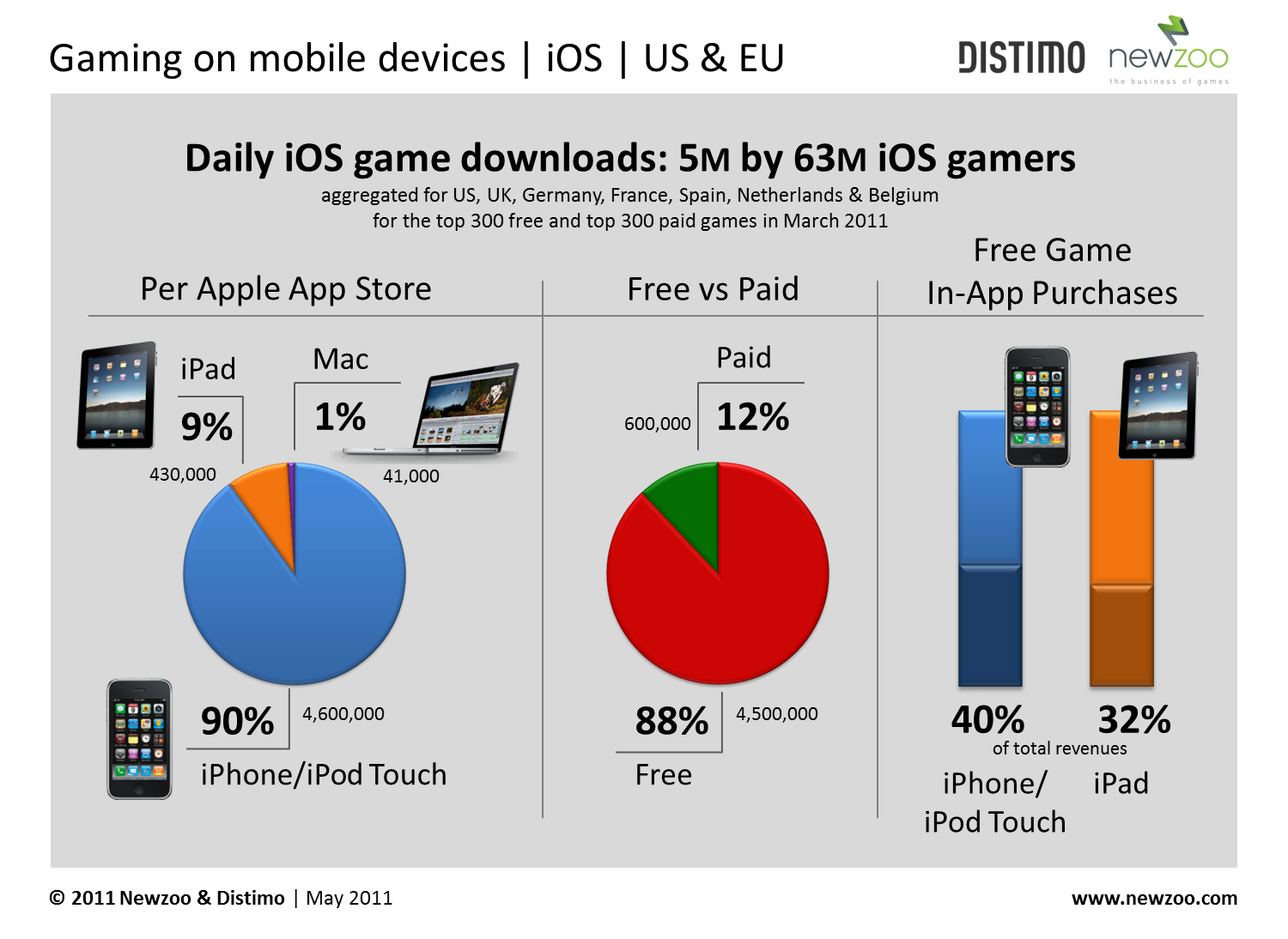
The National Gamers Survey, compiled by research firms Distimo and Newzoo from March data has revealed that there are roughly 63 million gamers on the iOS ecosystem who (individually) download, on average, 2.5 games per month. Games represent half of all apps downloaded across the iOS and Mac App Stores with more than 5 million games downloaded per day – based on the survey that included the US, UK and five other European countries. A clear majority of 4.6 million are downloaded for the iPhone or iPod Touch whilst just over 400,000 are for the iPad and just a sliver for the Mac with 41,000 per day.

The survey also revealed that in-app purchases within games is becoming an increasingly common feature found in games with revenue from in-app purchases also representing a large proportion of total revenues. 88% of the top 300 games on iOS are free, but across and free and paid games, two fifths of the revenue is now coming from in-app purchases. On the iPhone and iPod touch it represented 40% of gross revenue and 32% for the iPad. These high figures may give reason to why Lodsys has recently started to target developers that implement in-app purchases; it would certainly raise a lot of revenue if they received license fees from even just a portion of developers.

Some more statistical data about the spread of iOS devices was also revealed, noting that across some of the countries surveyed, including the US, UK, France and Germany, between 6% and 7% of the online population have an iPhone. Whilst of those iPhone users, between 50% and 75% play games. As for the iPad, the report claims 15 million Americans actively play games on it, whilst 7 million Europeans do so – exceeding the number of people using Sony’s PSP.

[Via RazorianFly]


Apple Inks Deal with EMI, Cloud Music Almost Finalized

Cnet reports tonight Apple has inked a deal with EMI over the upcoming launch of the rumored cloud music service that is expected to be unveiled at the WWDC in June. Cnet also claims the last two remaining deals with Sony and Music Entertainment and Universal Music Group (Warner Music Group reportedly signed a deal last month) could be signed as early as next week.

Apple has signed a cloud-music licensing agreement with EMI Music and is very near to completing deals with Universal Music Group and Sony Music Entertainment, multiple music industry sources told CNET.

The negotiations between Sony Music Group and Universal Music Group could be wrapped up as early as next week, the sources said. What this means is that signed contracts with all four of the top four record companies will be in Apple’s hip pocket on June 6 when Apple kicks off the company’s Worldwide Developers Conference. The sources who spoke with CNET did not know when Apple would announce the deals or roll out the cloud service.

With Apple signing the four major music labels in the United States, the cloud music service the company has been working on might include a subscription-based system where users simply stream music they don’t actually own (like in Spotify), the possibility to automatically beam to the cloud purchases from the iTunes Store or then again, as many suggest, Apple may be simply looking to having full support from the music industry in order to avoid possible lawsuits and debates surrounding cloud products from Google and Amazon, also recently launched.

Cloud is rumored to be a big part of iOS 5 and OS X Lion, set to be previewed on June 6 at the WWDC.