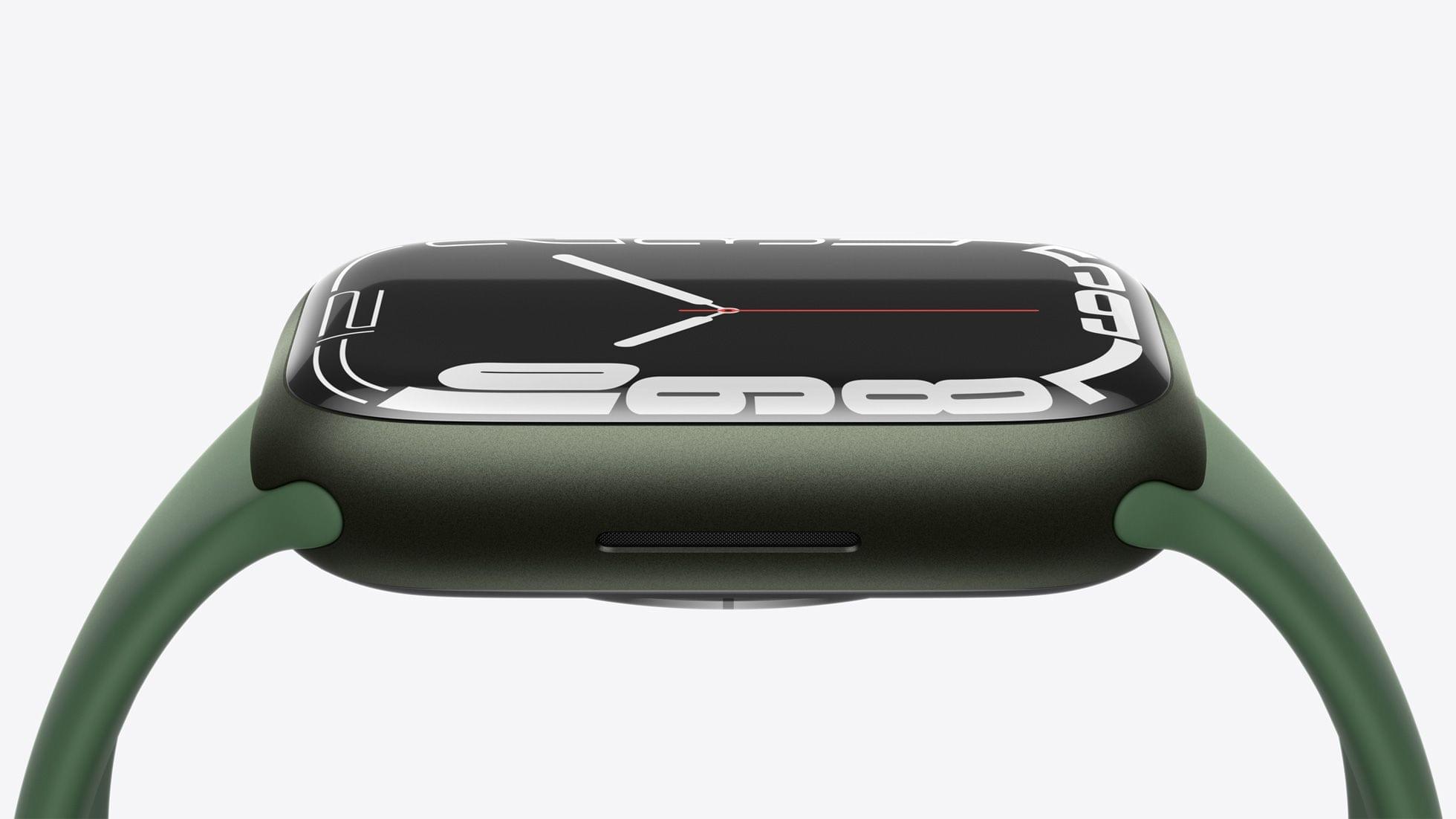
Apple has announced the Apple Watch International Collection comprised of 22 Sports Loop bands and downloadable Stripes watch faces that feature the colors of countries around the world.
The soft, breathable, and lightweight International Collection Sport Loop bands are available representing the following countries: Australia, Belgium, Brazil, Canada, China, Denmark, France, Germany, Great Britain, Greece, Italy, Jamaica, Japan, Mexico, the Netherlands, New Zealand, Russia, South Africa, South Korea, Spain, Sweden, and the US.
The US Sports Loop band from Apple’s International Collection modeled by Olympic gold medalist Amy Van Dyken.
Apple’s press release also features photos of Amy Van Dyken, a six-time Olympic swimming gold medalist and activist for the disabled community, showing off the US-themed band and watch face.
With the Olympics having been delayed until this summer, I suspect Apple has been sitting on these Watch band and face designs for a while. There are a lot of terrific color options available, so be sure to check out Apple’s press release or apple.com, to see all 22.
The team at Pixelmator has released an update to its Mac photo and image editing tool Pixelmator Pro that includes several new features.
Teased last month, Pixelmator Pro 2.1 has been updated with ML Crop, a machine learning-based cropping tool that algorithmically suggests ways to crop your images. The feature joins several other machine learning-based features that the app has added in the past couple of years. In my limited testing, ML Crop works well, suggesting crops based on the subject of photos that are more dramatic and focused on the image’s subject. The entire cropping process is non-destructive, so even if you aren’t entirely happy with a suggested crop, it can be used as a starting point and easily tweaked manually.
Source: Pixelmator.
Pixelmator Pro has evolved into more than just a photo editor. The app includes powerful image creation tools that got an update today too. Quick Fill is a fast way to fill an image layer with color by simply dragging the color from the app’s new color well that also supports switching between foreground and background colors.
The app has added a Stroke with Brush feature that facilitates painting with the app’s brushes along the path of shapes and image layers too. The feature joins a new brush picker and an option for smoothing strokes. Also, the Type tool has been updated to add a slider that quickly resizes text and the ability to control paragraph spacing.
There are other smaller refinements throughout the app too. For instance, when you hover the pointer over a predefined crop, your image updates with a preview of what the new crop will look like. The feature works dynamically in tandem with ML Crop when that feature is turned on, and there are now multiple crop overlay options in the latest update like the Rule of Thirds, the Golden Ratio, the Golden Spiral, and others. Image perspective can be adjusted, and the background of the app’s editor can be changed too. For a quick demo of the highlights, Pixelmator’s announcement video is worth watching:
I haven’t had a chance to try all the new features of Pixelmator’s latest release yet, but I like what I’ve seen so far. The app’s machine learning-based features are fast, especially on an M1 Mac, and they work well in most circumstances. Even when the results aren’t exactly what I want, the app’s machine learning tools are a handy head start with editing.
Pixelmator 2.1 is a free update on the Mac App Store, and currently, the app is available for $19.99, which is 50% off of its usual price until July 6th.
Photo editing and management app Darkroom, which added a new Clarity tool last month, has added substantial new Shortcuts actions to the app that allow users to automate a wide variety of its features for the first time. The update is notable because it allows Darkroom to work hand-in-hand with other apps, something which few photography apps do. For now, the shortcuts are available in Apple’s Shortcuts app on iPhones and iPads, but this fall, when macOS Monterey is released, the Darkroom team says that it plans to offer the same actions on the Mac.
The update features five Shortcuts actions:
Import to Darkroom
Flag Photos
Reject Photos
Add Photos to Favorites
Edit With Darkroom
Darkroom can automate cropping to a long list of aspect ratios.
The Import to Darkroom action adds images to Darkroom and can simultaneously apply a filter with the intensity you choose, set a frame aspect ratio with an inset, and optionally prepare the processed image for export. The Edit With Darkroom action can also apply filters and apply a frame to an image and adds the ability to crop an image to any of a long list of preset aspect ratios and add a watermark to images, all without opening Darkroom. Cropping an image has also been added as an edit that can be pasted to multiple images inside the Darkroom app itself.
The Flag, Reject, and Favorite actions do as you’d expect, allowing you to mark images accordingly without doing so from inside Darkroom itself. Flagging and rejecting photos is a recent addition to Darkroom, which I previously covered on MacStories.
It’s fantastic to see Darkroom adding such deep support for Shortcuts. The app itself is one of my favorite photo editors. However, by freeing its core features from the app itself, Darkroom gains the advantage of becoming part of more complex photo-editing workflows, automatically processing images in multiple apps, without the images having to be opened sequentially in each app. I’ve just begun to scratch the surface of what Darkroom’s new Shortcuts actions can do, but the possibilities are intriguing.
Sponsored by:
* MacStadium – The Developer Cloud for Mac.
This week on Unwind, John is joined by Alex Guyot to recap the week, including John’s story about the 5th anniversary of the App Store Review Guidelines comic book, milestones reached by Apple’s Shazam service, plus Apple Podcasts channels and subscriptions, developer reactions to WWDC, and TV and movie Unwind picks.
WWDC saw the introduction of ShazamKit, a new framework that will allow third-party developers to incorporate the song recognition service into their own apps. Less than a week later, Apple has said that the service has surpassed 1 billion songs recognized per month for a total of over 50 billion Shazams since the service launched.
“Shazam is synonymous with magic,” said Oliver Schusser, Apple’s vice president of Apple Music and Beats, “both for the fans getting a song recognition almost instantly, and for the artists being discovered. With 1 billion recognitions a month, Shazam is one of the most popular music apps in the world. Today’s milestones show not only people’s love for Shazam, but also the ever-growing appetite for music discovery around the world.”
To put the 1 billion per month figure into context, Shazam, which was founded as a text messaging service in 2002, took 10 years to reach its first billion songs recognized. The recognition rate has been steadily increasing since then for a lifetime total of over 50 billion songs matched.
This fall, when Apple’s updated OSes are released, the monthly rate of Shazam matches is poised to accelerate further as developers begin adding ShazamKit to their apps. The new song matching framework was announced last week at WWDC and will allow developers to add functionality to their apps to recognize songs and report information to users like the song’s name, the artist, genre, and other details.
I’ve used Shazam since it debuted when the App Store launched, and I’m intrigued to see what developers will do with it. For example, I could see it becoming a convenient way to add artists I’m following in Marcos Tanaka’s app MusicHarbor. With a wealth of third-party music apps already available on the App Store, I expect we’ll see many innovative uses of the new framework soon.
Podcast channels and subscriptions are now available as part of the new Apple Podcasts Subscriptions service first announced in April. As Apple explains in its press release:
…listeners in more than 170 countries and regions can purchase subscriptions for individual shows and groups of shows through channels, making it easy to support their favorite creators, enjoy new content, and unlock additional benefits such as ad-free listening and early access, directly on Apple Podcasts.
As we previously covered on MacStories, when a listener subscribes to a show, the page in the Apple Podcasts app is updated with subscriber content and a badge confirming for the listener that they’ve subscribed. Channels, which are collections of subscription-based and free podcasts, are incorporated into Apple Podcasts’ search, recommendation, and sharing functionality. After a listener has subscribed to two or more channels, a new row called ‘My Channels’ appears in the Listen Now tab to facilitate browsing them.
The company’s press release spotlights a long list of shows that are participating in Apple Podcasts Subscriptions. There’s a wide variety of podcasts represented, which makes the press release a good place to start if you’re looking for a channel or subscription to explore. Of course, channels and subscriptions are front-and-center in the Podcasts app too, and I’ve found it easy to find and understand what shows offer.
Sponsored by:
* Daylite – The CRM with Apple Fans in Mind.
* Raycast – Goodbye Spotlight. Hello Raycast.
This week, Federico and John look back at all of the WWDC announcements and coverage at MacStories, AppStories, and the Club, plus news about spatial and lossless audio, and game and music Unwind picks for the weekend.
The annual Apple Design Awards were handled a little differently this year. On June 1st, the company, for the first time, announced finalists in six categories: Inclusivity, Delight and Fun, Interaction, Social Impact, Visuals and Graphics, and Innovation. For each category, Apple picked six finalists for a total of 36 ADA contenders.
As a part of sessions held at WWDC today, Apple announced the 12 winners, an app and game in each category:
Apple picked Voice Dream Reader as the winner for the app Inclusivity ADA for its use of VoiceOver technology. The app is a text-to-speech reader that can turn any document or ebook into audio.