Federico Viticci

10775 posts on MacStories since April 2009

Federico is the founder and Editor-in-Chief of MacStories, where he writes about Apple with a focus on apps, developers, iPad, and iOS productivity. He founded MacStories in April 2009 and has been writing about Apple since. Federico is also the co-host of AppStories, a weekly podcast exploring the world of apps, Unwind, a fun exploration of media and more, and NPC: Next Portable Console, a show about portable gaming and the handheld revolution.

White iPhone 4 Coming In Two Weeks?

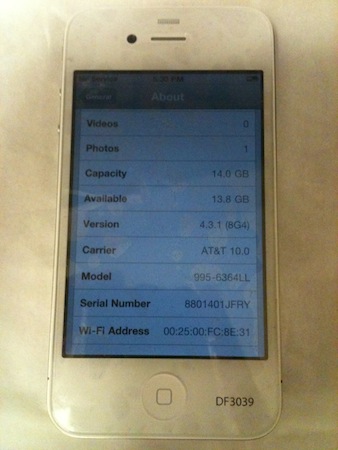
Bloomberg Businessweek reports Apple is readying the sale of the long-awaited white iPhone 4, which should become available by the end of April. The publication mentions “three people familiar with the plans”, and claims the device will be available both on AT&T and Verizon in the United States.

Apple Inc. will begin selling a white model of the iPhone 4 in the next few weeks after a 10- month delay, according to three people familiar with the plans.

The new version will be available from AT&T Inc. and Verizon Wireless by the end of April, said one of the people, who asked not to be identified because the plans aren’t public.

Last month, Apple’s Phil Schiller confirmed with a tweet to a customer that the white iPhone 4 would be available in Spring and that it’s a “beauty.” The release of the device was delayed multiple times in the past due to alleged production issues with the white panel. The exact reason why Apple delayed the initial June 2010 release date hasn’t been revealed by the company, but previous speculation suggested problems with the white paint caused the device to take bad photos due to light leaks. A rumor also pointed to Apple relying on a new Japanese paint for its white iPhone 4; it’s not clear at this point whether the unit will launch by the end of April only in United States, or internationally as well. Apple was also rumored to be considering a white version of the iPhone 5 for a summer 2011 launch – although recent rumors about a “delayed” iPhone 5 in September with a WWDC focused on software doesn’t leave much credence to the original report. The white iPhone 4 recently showed up on various international carrier websites and Best Buy internal inventory systems.


Safari 5.1 Gets “Do Not Track” On OS X Lion

As noted by The Wall Street Journal, Apple has enabled an option in the latest developer build of OS X Lion (Developer Preview 2 was released two weeks ago) to activate “Do Not Track”, an open project by Mozilla to prevent advertisers and other web companies from tracking you online.

Apple Inc. has added a do-not-track privacy tool to a test version of its latest Web browser for keeping peoples’ online activities from being monitored by marketers.

The tool is included within the latest test release of Lion, a new version of Apple’s Mac OS X operating system that’s currently available only to developers. The final version of the operating system is scheduled to be released to the public this summer. Mentions of the do-not-track feature in Apple’s Safari browser began to appear recently in online discussion forums and on Twitter.

Already offered by Internet Explorer 9 and Firefox 4, ”Do Not Track” can be enabled or disabled by a user at any time; the service will then tell advertisers, web app or companies to stop tracking your movements online and, in a typical scenario, won’t serve “targeted ads” anymore to the browser. The new option hasn’t been given a standalone preference panel in Safari 5.1 yet, but it’s very likely that there will be one come the final release of Lion this summer. Right now, developers can activate the option from the Develop -> Send Do Not Track HTTP Header.


Unofficial Final Cut Pro X Announcement Videos Now Online

Apple hasn’t posted an official video of yesterday’s Final Cut Pro X announcement at the Supermeet in Las Vegas (and some say it likely won’t), but as noted by MacRumors two unofficial videos has surfaced on Youtube showing the entire presentation. The video are in good quality, audio is decent and they can be viewed in 720p.

You can watch the videos below. More screenshots of Final Cut Pro X were posted this morning, as well as confirmation from Apple to “stay tuned” about other apps of the Final Cut Pro suite coming in the future. Final Cut Pro X will be released at $299 on the Mac App Store in June.
Read more


Squrl: Collect Videos From The Web, Watch Them Later on iOS

Released yesterday on the App Store and the web, Squrl is a new service powered by an HTML5 interface that allows you to save videos from several supported services, collect them on the iOS and web apps, and watch them later at any time. The concept behind the service is very simple and attractive: much like an Instapaper for video, Squrl enables you to save videos from Youtube, Vimeo, Hulu, Netflix and many other providers with the click of a bookmarklet (which you have to install from the website). Unlike Watchlater, though, Squrl doesn’t stop at collecting videos in a single place, it also packs social functionalities and organization features to let you create galleries and collections of videos, share them, or even subscribe to collections shared by other users in your social graph. Read more


Suppliers: iPhone 4 Demand Still High, No iPhone 5 Roadmap Yet

Speaking to suppliers “related” to the iPhone’s production in Asia, Digitimes reports today Apple still hasn’t released a roadmap for the next-generation iPhone – unofficially dubbed iPhone 5 until today – leading many to believe Apple might want to focus the upcoming WWDC in June (the usual stage for new iPhone announcements) on software and release a new model this Fall, or in early 2012. Digitimes, however, also reports another “theory” that has been formulated by component suppliers: unlike previous rumors that suggested the iPhone 5 would be a completely new device, the iPhone 5 could be a slight redesign of the current iPhone 4 and still launch this summer “to fend off the rising popularity of Android.”

Apple has not yet released a production roadmap for iPhone 5 as shipment volumes of iPhone 4 have continued to mount and related suppliers are not yet ready to shift their production lines for new products, according to sources at Taiwan-based touch panel makers.

While acknowledging there should be a roadmap for each generation of products, the sources insisted that touch panel shipments for iPhone 4 have remained steady, and that they have not seen a timetable to stop current production in preparation for the next-generation of iPhone.

A report surfaced yesterday indicated the iPhone 5’s production is set to start in September for a Fall release, with a cheaper iPhone model still in the works to grant Apple a larger share in different market segments. According to previous speculation, the iPhone 5 should be an updated version of the iPhone 4 (featuring the same design scheme), but with a metal back and redesigned antenna, 8 MP camera, NFC capabilities and Apple A5 processor.


New Final Cut Pro X Screenshots, Apple Says “Stay Tuned” For Other Apps

Last night, Apple officially announced a new version of Final Cut Pro during the Supermeet in Las Vegas, Nevada. As you might have read in our liveblog and announcement post, Final Cut Pro X has been completely rebuilt from the ground up to be as revolutionary as the first version of FCP released in 1999: full Cocoa, Core Animation, Grand Central Dispatch and 64-bit support, iMovie-inspired menus for easier navigation and media management, a whole new underlying engine that – according to people who saw the demo yesterday – makes the timeline incredibly fast and responsive. With keyboard-based nesting, magnetic timeline, background processing and automatic people and media detection on import, Apple aims at revolutionizing Final Cut Pro.

As announced yesterday by Chief Architect of Video Applications Randy Ubillos on stage, Final Cut Pro X will be released at $299 in June. Final Cut Pro went under a major price cut (it used to be sold at $999), and it will also be available on the Mac App Store – like every new Apple desktop app nowadays. But last night, many immediately wondered whether the lower price and Mac App Store distribution would lead to the demise of Final Cut Express (widely regarded as an “iMovie for Pros”, lacking many of the functionalities of Final Cut Pro) and boxed copies of FCP. Furthermore, Apple made no mention of all the other Final Cut Studio apps last night such as Motion, Soundtrack Pro, Compressor, Color and DVD Studio Pro. On Twitter, I speculated Apple could release them as standalone apps in the Mac App Store or – when they don’t make sense as apps because they’re basically “extensions” to Final Cut – as in-app purchases within Final Cut Pro X itself.

An Apple representative, speaking to The Loop, seems to confirm the theory that other apps will be released alongside FCP X:

Apple on Wednesday introduced Final Cut Pro X, but there was no mention of the other applications in the suite of video apps.

“Today was just a sneak peak of Final Cut Pro, stay tuned,” an Apple representative told The Loop.

The Loop has also received a series of high-res screenshots, one of them you can see above. We should know more about Final Cut Pro X in the coming weeks (Apple hasn’t posted a press release, or updated its website with a sneak peek) as Apple gets ready for a June launch, presumably during or soon after the WWDC.


Apple Announces Final Cut Pro X, Coming In June

Update #1: Final Cut Pro X will be released in June and it’ll be available through the Mac App Store. No mention of Final Cut Studio or Final Cut Express today. [via]

As widely expected, Apple just introduced a new version of Final Cut at the Final Cut Pro Supermeet during NAB 2011 in Las Vegas, Nevada. Touted as “revolutionary as the first version” from 1999, Apple introduced the new Final Cut Pro X saying that every major broadcaster and film maker nowadays relies on FCP for their video editing needs.

Basing on live updates coming from attendees at NAB 2011, Final Cut Pro X has been built from scratch, and it’s entirely 64-bit. It’s based on technologies like Cocoa, Core Animation, Open CL, Grand Central Dispatch and it focuses on image quality. It features a resolution independent timeline up to 4K for scalable rendering – in fact, it appears the old render dialog is gone entirely as the app uses the available CPU to keep files always rendered. FCP X allows you to edit while you’re importing thanks to its new engine, and it’s also got automatic media and people detection on import, as well as image stabilization.

Apple is promoting the new FCP X as a complete and total rebuild. Smart collections look very similar to iMovie, and overall there is a feeling Apple has borrowed some UI elements from the iLife application to make the general design more accessible, even for professionals. For instance, Apple has brought “single keystroke nesting” to Final Cut Pro – a new functionality that allows you to group chunks of media into a single clip in the timeline. The “inline precision editor” allows you to make edits by revealing media with an iOS-like menu.

More details from liveblogs:

  • “You can view the media in the browser in a film strip type view. You can completely customize how you view media prior to the timeline.” - robimbs
  • “4 window setup is now kind of truncated in 3 windows. The browser has the viewer built into it.” - robimbs

  • “Auditioning: collect options during edit, choose later (simplifies versioning). This is loosely similar to Logic’s feature for grouping” - fcpsupermeet

Some notes of interested from Photography Bay:

10:33: Randy Ubillos, Chief Architect, Video Applications on stage. Demo FCP X live now. Beta version. “We hope it behaves.”

10:35: Audi R8 commercial spot cut on FCP X…

10:36: Demo’ing it live now. Showing off the keywording ability of the sections of the clip instead of the whole clip.

10:37: Offers filmstrip view for content. Looks just like iMovie’s functionality.

10:38: You can highlight sections of content in the filmstrip view and add keywords that way. The keywords show up as items in event library. Selecting those keyword items brings up just those sections of content. Looks like subclips, but it’s not.

If the new FCP X is still in beta, there’s shouldn’t be a product launch (or press release) coming today. Several attendees are reporting on Twitter the new timeline is very, very fast and are also mentioning an iPad app being demoed on screen. With background processing and the possibility to use all cores on powerful machines like a Mac Pro, Apple has focused on improving the reliability of Final Cut’s timeline by making sure to clips can be accidentally “destroyed”. The redesigned UI with a touch of iOS here and there and “magnetic timeline” should – basing on what we’re hearing from people at NAB – dramatically improved navigation and organization of large chunks of media.

FCP X features instant render in the background that doesn’t affect editing, also with 1-click instant color matching. Color correction, for example, has been built right into the timeline, enabling users to, say, distribute a “Ken Burns Effect” with a single swipe. Apparently there’s a lot of animation going on with windows, and attendees are reporting that – judging from the demo – Final Cut Pro X is incredibly fast in every task and processing that’s been done on stage.
Read more


iPhone Tab Bar Lessons

iPhone Tab Bar Lessons

Over the last couple of years, the iPhone has greatly popularized the tab bar navigational model for mobile handsets. Apple has put together a design rationale for the tab bar in their Human Interface Guidelines (HIG) along with lots and lots of other information — they do however leave some question unanswered. Having worked with interaction and graphical design for iPhone applications during the last couple of years I’ve managed to pick up some lessons the hard way, and in this post I would like to share my thoughts on a couple of do’s and don’ts.

Petter Silfver compares different tab bar designs from popular iPhone apps and gives some insight into Apple’s subtle design decisions that most of us won’t even notice, but are important to build a consistent and natural experience on iOS. Such as colors and hues in the tab bar, the ideal number of tabs, or the problems with a “More” tab that distracts users and hides important functionalities of an app that should be discovered naturally.

If you’re an iOS geek like me, a designer, or simply interested in knowing more about this particular aspect of Apple’s Human Interface Guidelines, check out the post here. It’s full of details, and it’ll make you re-consider the implementation of Instagram’s Camera button.

Permalink

Acorn 3.0 Released With 50 New Features

Popular “image editor for humans” Acorn for Mac was updated to version 3.0 a few hours ago, and after trying the app with some images I had on my desktop I can say it’s one the best updates I’ve seen on the Mac platform recently. Acorn 3.0 not only brings a series of refinements and optimizations that make the app faster, more reliable and overall more stable – it also introduces a whopping 50 new features that aim at enhancing your experience with Acorn without overwhelming you with functionalities unlike some other pricey image editor for OS X and Windows we know very well. Plus, if you’ve been an Acorn user for a while you know you can expect elegance and minimalism from the app’s interface that’s always readable and accessible. I am a big fan of Acorn so maybe I’m a little biased in judging the app, but I think we can all agree version 3.0 brings a terrific new feature set that turns Acorn into an easy to use & powerful image editor.

Among the new features, layer styles: with drop shadow, inner shadow, bevel and more Acorn allows you to apply effects to layers and revert back at any time with a simple CMD+Z. PSD import and export have been improved, there are new filters to play with, and a cool ”Multistop Live Gradients” technology that enables you to apply more than 2 color gradients to your text or images. Text support, indeed, was improved in version 3.0: you can apply gradients on text and shapes, rotate text upside down to get to the layout you want, and you can convert text into Bezier shapes, too. Other new features in this 3.0 update include “Instant Alpha” to automatically remove unwanted pixels from an image, and a Quickmask functionality to select and move layers around by just hovering over them with your cursor. The Quickmask works really well, and combined with the layered screenshot capabilities of Acorn it makes for a great tool for Mac bloggers (see screenshot after the break). Last, Acorn 3.0 can export layered documents to PSD and PDF.

You can check out the full release notes here. Acorn 3.0 is a huge update that’s temporarily available at the discounted price of $29.99, but users who bought the app from the Mac App Store when it was released a few months ago will get the update to 3.0 for free. Once again, Acorn is the image editor for humans, and an excellent alternative to Photoshop or Pixelmator for OS X users. Read more