This Week's Sponsor:

Crickets

The first alarm app for families.


Posts tagged with "music"

Apple Reaches Deal with Sony Over Cloud Music

As work on the rumored cloud music service nears finalization for an official WWDC announcement, Bloomberg reported last night Apple has reached a deal with Sony Music Entertainment, following reports that the company managed to sign the Warner Music Group and EMI. This leaves Universal, the biggest label of all four in the United States, out of the equation, but according to the rumors Apple’s Eddy Cue is actively focused on closing all the remaining paperwork with music labels by next week.

Apple has reached licensing accords with Sony Corp. (6758)’s music division, EMI Group and Warner Music Group, the people said. Universal Music Group, the largest recording company, is close to a deal, another person said. The company also would need to reach agreements with music publishers, which control different rights than the labels.

Apple’s cloud music service is said to be part of a major MobileMe revamp the company has been working on for the past two years, which will include several new functionalities and a new price point with basic features offered for free. As for the music service, it’s unclear whether Apple will adopt an upload system like Google and Amazon or a subscription-based delivery with songs coming from the iTunes Store, but a patent surfaced yesterday seems to suggest Apple’s implementation will go as far as allowing users to upload their own songs, and stream others they don’t own from a larger “content source” like the iTunes Store.
Patent Reveals How Apple’s New Music Service Could Work

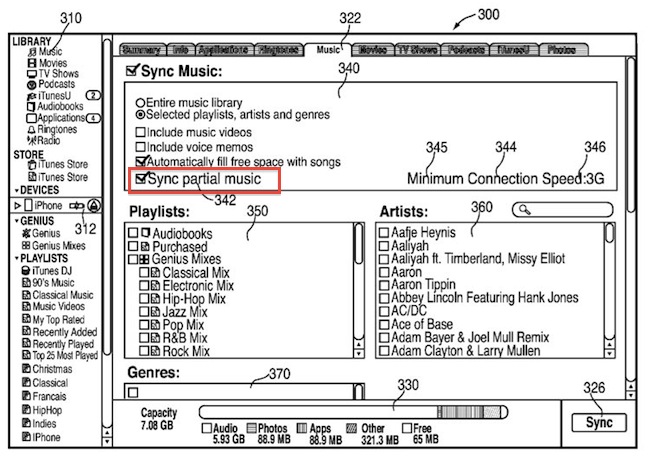
A new patent application published by the U.S. Patent and Trademark Office this week and discovered by AppleInsider today seems to provide some details about Apple’s rumored cloud-based music service, and how iTunes on the desktop and mobile devices like an iPhone could manage to improve streaming quality and speed by locally syncing snippets of songs. The patent, entitled ”Local Storage of a Portion of Streamed Media Items”, notes how most streaming services allow users to access an online library of music and cache contents locally on device to enable playback when an Internet connection is not available. This happens in popular service Spotify, which enables users to keep a local cache of albums and songs so they won’t be forced to always be connected to the Internet to listen to music. Whilst Spotify’s cache action has to be triggered manually by the user, other cloud music services automatically cache a song in the background once a user starts listening to it. Apple’s proposed solution is different, and it involves a new menu in iTunes (for the desktop) that syncs via USB “partial music” to an iOS device – that is, small snippets of a song, with the remaining parts available online.

Unlike cache, partial local sync has the advantage of letting users start listening to music immediately without waiting times. Because cache in other services is still obtained with an Internet connection, users have to wait for the caching process to finish before they can start playback. And if the song is not cached, users have to wait for the remote server to begin streaming – when quickly jumping between artists and songs (as most users do on iPods and iPhones), having to wait a few seconds for streaming to begin can be annoying. Assuming a user is syncing music that’s available both locally (on a Mac or PC) and in the cloud (the music service), Apple’s proposed solution skips cache and waiting times entirely by saving locally a first snippet of a song, and then fetching the rest remotely. This way, iTunes doesn’t have to sync full content (thus cutting syncing times) and a mobile device doesn’t have to stream the first seconds of a song. The benefit for users is that playback will start immediately regardless of how fast they’ll switch between songs; the obvious downside is that something will still have to be synced locally. AppleInsider also posts more details from the patent:

The application suggests that the remotely stored content could be a user’s own library, which they have streamed from a home computer or a remote server. Or, it could be streamed from a large “content source,” such as the iTunes Music Store. The described system would also utilize authentication methods, such as with an iTunes account username and password, to ensure that the user has purchased the items and has the right to stream them.

If this patent is of any indication, it could lend some credence to the reports that claimed Apple’s cloud music service was being set up in a way that users could both stream their own music libraries (by uploading them first) and music they didn’t purchase, with a subscription model similar to Spotify. The method described above would clearly require an update to the iTunes application, and it’s unclear whether Apple could also provide a way to “always stream”, avoiding partial sync and relying exclusively on a remote connection. Apple is expected to unveil iOS 5 with new cloud-based features at the WWDC, which kicks off in San Francisco on June 6.


Phone, Tablet Owners Willing to Pay for Media Subscription Services

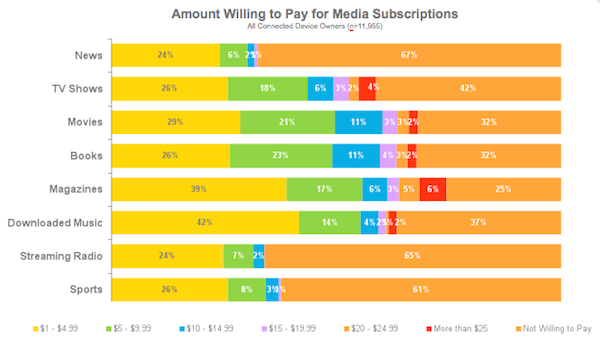
With rumors floating around about Apple’s upcoming cloud music service (especially after last night’s report on the company signing a deal with EMI) and others like Google and Amazon moving forward on the streaming bandwagon with products to upload and stream music at any time with smartphones, tablets and desktop web browsers, subscription-based payment systems are often seen as the only feasible solution to guarantee a continuos cloud service without interruptions, always available anywhere you go. Just like Spotify and Rdio let users stream large collections of music they don’t necessarily own by paying a monthly or annual fee, Apple is rumored to extend the iTunes subscription system it created for magazines to music, movies, and a combination of both for the ultimate iTunes Store cloud experience. But just how much are phone and tablet people willing to pay for these new cloud services based on subscriptions? That’s what research firm Nielsen takes a look at in its latest survey, asking users of “connected devices” how much they would pay for media subscriptions that would give them access to a variety of content on their mobile devices.

It turns out, music, movies, magazines, books and TV shows are something people would pay for – sure, there are different results, but take a look at the graph above and you’ll see that these 5 categories are the ones with less orange, which stands for “not willing to pay.” On the other side, sports content, streaming radio and news are something people would be less prone to subscribe to. Overall, the sweet spot for subscriptions seems to be around $4.99 - $9.99 per month, which is what most cloud services ask for these days. There’s an interesting difference about music, however: people would pay for “downloaded music”, and not for “streaming radio.” Assuming “downloaded music” stands for “music you own”, and people care about having online access to music that’s ultimately theirs, services like Amazon Cloud Player and Google Music Beta should be exactly what people are looking for, as they let you upload your own music to the cloud. Also assuming Apple is working on a similar solution, this survey suggests the company should allow for both uploads and Spotify-like streaming, enabling users to lock their own collections in the cloud, and get access to stuff they didn’t buy as well. Maybe that’s what these deals with music labels are all about.

Tablet and smartphone owners with proper Internet access on the go are willing to pay for online media available through apps, and if that’s their own media, there’s an incentive to subscribe. A report in the past weeks suggested Apple was considering offering a free initial trial for its new cloud music service, with a $20 yearly subscription once the demo is over.


Apple Inks Deal with EMI, Cloud Music Almost Finalized

Cnet reports tonight Apple has inked a deal with EMI over the upcoming launch of the rumored cloud music service that is expected to be unveiled at the WWDC in June. Cnet also claims the last two remaining deals with Sony and Music Entertainment and Universal Music Group (Warner Music Group reportedly signed a deal last month) could be signed as early as next week.

Apple has signed a cloud-music licensing agreement with EMI Music and is very near to completing deals with Universal Music Group and Sony Music Entertainment, multiple music industry sources told CNET.

The negotiations between Sony Music Group and Universal Music Group could be wrapped up as early as next week, the sources said. What this means is that signed contracts with all four of the top four record companies will be in Apple’s hip pocket on June 6 when Apple kicks off the company’s Worldwide Developers Conference. The sources who spoke with CNET did not know when Apple would announce the deals or roll out the cloud service.

With Apple signing the four major music labels in the United States, the cloud music service the company has been working on might include a subscription-based system where users simply stream music they don’t actually own (like in Spotify), the possibility to automatically beam to the cloud purchases from the iTunes Store or then again, as many suggest, Apple may be simply looking to having full support from the music industry in order to avoid possible lawsuits and debates surrounding cloud products from Google and Amazon, also recently launched.

Cloud is rumored to be a big part of iOS 5 and OS X Lion, set to be previewed on June 6 at the WWDC.


Digital Downloads Drive A Music Industry Recovery

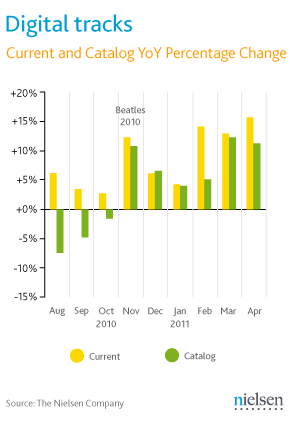
Well it looks as though things may be looking up for the music industry again, after its decade long slide in sales. A Nielsen Soundscan report yesterday said that US music sales (by unit) have increased by 1.6% over the course of this year.

The report gives the credit for the rise, unsurprisingly, to digital music sales, which in terms of albums was up 16.8% and in terms of individual tracks was up 9.6%. As for physical media, CDs were down by 8.8%, but Vinyl increased by 37%, although they only account for 1.2% of sales.

No one is exactly sure why digital is up dramatically this year, although Nielsen interestingly suggests the arrival of the Beatles on iTunes as a key reason, pointing to a dramatic increase starting from when it was released on iTunes (see graph above) – although this seems a bit of a stretch. That said, catalogue music sales have been on the rise by 5.4%, whilst current music is down 7%. As for the most popular genre’s, Rock had the greatest market share in album sales whilst Pop was the most popular for digital tracks.

[Via AllThingsD]


Angry Birds’ Theme Song Recreated with Real Instruments [Video]

Sure, you can play Angry Birds on multiple devices, install all the possible versions and spin-offs from the App Store – heck, I’ll even go on to say it’s fine if you bought some of those shady guides to get the most out of the game. But can you play the official theme song like those indie Pomplamoose folks did? As noted by TUAW, the duo seems to enjoy the world of Angry Birds quite a lot, and even if there’s some Samsung advertising weirdness going on in the video, the overall result for your viewing pleasure is undoubtedly nice.

Video is embedded below. As for anyone else willing to recreate his own version of the Birds’ song, I’m pretty sure GarageBand for iPad has a share button somewhere. [via YouTube]
Read more


My Artists Levels Up and Becomes A Real iPod.app Replacement

My Artists, a nifty iPod-integrated app for the iPhone I first reviewed last year, just received a major update to version 1.2 which, among several improvements to the interface and speed optimizations, turns the app into the ultimate iPod replacement the developer was aiming for since the first release. My Artist, in fact, used to provide a beautiful alternative view for the standard iPod.app installed on every iPhone, but that was nothing more than a custom extra layer that still relied on iPod.app for music playback and controls. Like most “iPod.app controllers” in the App Store, My Artists added a lot of functionalities but was unable to directly control and play music already synced on your device. This changes today, as My Artists 1.2 finally ditches iPod.app dependence, being able to directly play your music. This means you’ll see a My Artists icon in the multitasking tray when using the app, not the iPod app’s one, and yet you won’t have to give up on standard iOS features like AirPlay – which works just fine even without using the native iPod software. I don’t know how Top Drawer Apps did it, but it works – music is now both recognized and played by my Artists.

Version 1.2 also brings Last.fm integration for those willing to scrobble music to the service, but that will cost you $1.99 as in-app purchase. A little last.fm icon in the playing screen will allow you to activate or disable the feature at any time. Speaking of which, the Now Playing view got some interesting updates as well, namely an icon in the upper right to quickly jump to more albums or tracks from the artist you’re already listening to. Alternatively, you can open the (improved) Bio section, which uses Wikipedia to display artist and album info.

My Artists was a great app before this update, now it’s just a must have for heavy mobile music listeners and general music lovers who would like an app focused on artists, albums, and information coming from the web. My Artists can be downloaded at $1.99 from the App Store.


Labels Hoping Apple’s Music Service Will Launch at WWDC

According to a new report by Cnet, multiple “music industry sources” have told the publication the four major music labels in the US (Warner Music Group, EMI, Sony, Universal) are hoping Apple’s rumored cloud music service will launch next month during the WWDC. The labels, Cnet reports, are counting on Apple to provide a full-featured music service with iTunes Store integration that would force competitors like Amazon and Google to start paying licensing fees for their “music locker” services, which allow users to upload songs to the cloud, but have in no way official support or backing from the labels. The labels are seemingly unhappy with Amazon and Google services as users might be able to upload songs they illegally downloaded from the Internet, and it also appears that Google transcodes some uploads to a new format (making a copy), thus raising some questions on copyright issues as well.

Apple is in a strong position to deliver a cloud service that allows for both uploading and streaming of songs thanks to deals negotiated with the labels. Last month, it was indeed reported that Apple had inked a deal with the Warner Music Group, with more labels to follow soon or already signed according to other rumors.

But the services offered by Amazon and Google are not all that they can be because those companies had to tippy-toe around copyright issues. Since neither company was either able or willing to obtain licenses from the four major labels, neither of them could deliver the same range of options that Apple will be able to offer with its upcoming cloud service, according to multiple music industry sources.

Lots of people at the four major labels, however, now hope the service launch at Apple’s Worldwide Developer Conference on June 7. The risk for the record labels is that the services from Amazon and Google could prove good enough for most music consumers and that the companies don’t feel compelled to upgrade.

The WWDC ‘11 kicks off on June 6 in San Francisco, and previous speculation suggested it would be a software-focused event with on-stage demoes of iOS 5 and OS X Lion. iOS 5 has been in the middle of a debate recently, mainly as to whether Apple will really showcase its new cloud offerings revolving around a revamped MobileMe or other functionalities such as voice recognition, postponing the launch of all cloud services to this Fall. Reuters reported a few weeks ago that work on Apple’s new music service had been finalized on the technical side, and Apple was simply completing the process of signing deals with music labels to offer both upload features and streaming of songs you don’t own, likely through a subscription system. Google launched its new “Music Beta” service yesterday and, similarly to Amazon’s Cloud Player, it allows users to upload songs and albums to an online locker, but doesn’t provide any sort of subscription à la Spotify to enable users to listen to music without uploading it first.


Music Beta by Google: Mac Uploader, Flash, iOS Safari Playback

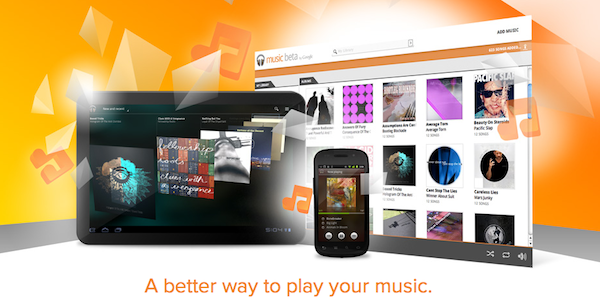
At its I/O conference earlier today, Google officially announced a new cloud service called “Music Beta” which, similarly to Amazon’s Cloud Player, allows users to upload their music collections and playlists to the company’s servers, and play them back anywhere on a web browser, tablet or smartphone. Like Amazon, Google’s service has a few limitations for now: it doesn’t come with a native iOS app as it’s only got an Android app for compatible smartphones and tablets, it requires Flash in some sections of the website and it’s restricted to US access only. Music Beta is, well, a beta product by Google, and it’s free for now – Google didn’t mention how much uploading and streaming 20,000 songs once the service hits stable status will cost you.

As detailed by MG Siegler at TechCrunch, Music Beta comes with a native Mac uploader that can look through your iTunes library and playlists or hard drive contents to find songs and albums to upload. On desktop browsers, MG Siegler says Flash is required for playback as indeed a screenshot of a technical error seems to prove, whilst Cnet claims Music Beta can stream songs on iOS devices as well, without Flash, using Mobile Safari. It was discovered a few days ago that Amazon’s Cloud Player quietly rolled out iOS Safari support, and it’s unclear at this point whether Music Beta really works on iPhones or iPads, meaning Flash is only required for some transitions and animations. As more users are invited to try the product, we’ll make sure to check Mobile Safari compatibility. Read more