Three Foxconn Employees Arrested for Leaking iPad 2 Design

In the months leading to the iPad 2 announcement, several “leaked” case designs coming from China and Taiwan seemed to provide good indication of what the device would look like. These cases were all based on the same design principles such as tapered edges, thinner body and flat back, clearly suggesting manufacturers had access to the same design documents that were quickly spreading across the tech industry. Digitimes reports today Chinese-language publication sznews.com claims three Foxconn employees were arrested and charged for violating Foxconn’s trade secrets and leaking the iPad 2 design weeks before Apple’s announcement.

Several online shopping retailers in China were able to sell iPad 2’s protective case products before the iPad 2 was even launched, leading Foxconn to suspect that there might have been some employees leaking the design of iPad 2 which it reported to the local police.

The local police on December 26, 2010, arrested three employees that were suspected of leaking the design, and officially charged the three employees for violating the company’s trade secrets on March 23, 2011, the reported added.

Foxconn assembles several Apple products such as iPhones, iPod touches and iPads. It’s not the first time products leaks from China have offered a glimpse of future Apple devices months ahead of the official launch, but you might remember the situation last year with case designs for the iPad 2 coming out every few days was pretty bad for Apple. Foxconn also announced its plans to invest in a $12 billion facility in Brazil, and start iPad production there in November.

Apple May Have Snagged iCloud For a Cool $4.5 Million

If you ever thought Apple might rebrand MobileMe to something more Apple-esque, the purchase of iCloud.com for $4.5 million could be a sign of things to come. While not confirmed, GigaOM reports that Xcerion (having recently rebranded iCloud to CloudMe) may have sold the iCloud.com domain. As of one o’clock tonight, Xcerion still shows up as the domain’s owner, though this could change in the coming hours. MacRumors reports that the domain will likely come under the control of MarkMonitor, a brand management firm that handles high-profile domain name registrations.

With Apple’s new cloud services preparing for launch, the purchase of iCloud.com could indicate that new services from Apple may be arriving sooner than later, as Apple is talks with record labels and have recently gotten Warner Music Group on board. A music subscription or storage service from Apple could cost $20 a year, and the iCloud also play a big role in a traffic and navigation app. Could MobileMe remain and entail its current email and contact sharing prowess, or would iCloud encompass the original service and expand to include new offerings? Don’t forget: Apple has recently stopped selling MobileMe on retail shelves, and have even turned down customers to opt for the free trial.

[GigaOM via MacRumors]


AViiQ Portable Quick Stand Now Available

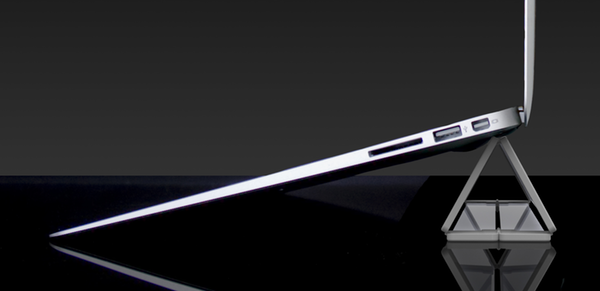
The AViiQ Portable Quick Stand launched a week ago, but being a fan of the company and the great products they make, we didn’t want to miss out on celebrating the launch of AViiQ’s next generation of portable stands. Following AViiQ’s Premium Portable Laptop Stand (and we thought the original was a grade A laptop stand), the Portable Quick Stand is the younger brother that folds out into a triangle to lift your laptop to comfortable heights. Just like the Portable Laptop Stand, the Portable Quick Stand snaps open and uses the weight of the laptop to secure its position, utilizing a colored grip (so it totally fits your style) to stay seated and prevent any shifting. I just got mine a couple days ago, and I can tell you I’m pretty impressed with the quality of AViiQ’s newest family member so far. I’ll be doing a full review next week, so keep yours eye glued to MacStories for the final verdict. In the meantime, you can check out AViiQ’s Portable Quick Stand in action past the break, along with the press release.

Read more


Developer Gets First iOS 5 Crash Report, Hints At New Map APIs

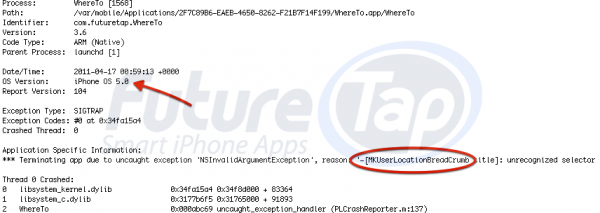
FutureTap, developer of popular augmented reality app for iPhone Where To? we covered here, received earlier today a crash report coming from a device running iOS 5. The crash report, also posted online, doesn’t come as a total surprise in the way it confirms Apple is field-testing the new OS internally with App Store applications; however, a selector named MKUserLocationBreadCrumb indicated as the cause of the crash seems to suggest Apple made some changes in the location and map APIs, as widely speculated.

Just received the first iOS 5.0 crash report. MKUserLocationBreadCrumb sounds interesting.

Already fixed the iOS 5 crash. Now the big question: Mention in the update notes?

No further technical details have been provided by the developers, but it appears that changes made in the map APIs for iOS 5 (still referred to as “iPhone OS 5.0” in the report) may cause obvious incompatibilities with current iOS 4-based apps. Apple is expected to officially introduce iOS 5 at the WWDC ‘11 in June; rumors in the past weeks claimed Apple would offer an on-stage demo, as well as first developer betas soon after the main event. Virtual assistant software Siri, bought by Apple last year, is rumored to play a big role in iOS 5, alongside new cloud, social and location-based features. [via 9to5mac]


Fring with Group Video Calling for iPhone Now Available

As announced earlier this month, web communication service fring has released an update to their official iPhone client that brings group video calling both on WiFi and 3G. As detailed a few weeks ago, the new group video calling feature allows iPhone users to communicate in real-time with up to three other friends – doesn’t matter if they’re using an iPhone or Android device. As long as you keep adding friends to a group video call from your fring’s buddy list, the session will go through even if multiple iPhones and Android handsets are using the app. This is some serious cross-platform technology fring has implemented here, and the fact that it works on 3G as well provides an interesting alternative to Apple’s FaceTime – which is free and integrated into the iOS phone app, but only works on WiFi. Fring also promised higher video calling quality than competitors (read: Skype) thanks to their Dynamic Video Quality technology, which also runs in fullscreen mode.

If you want to test the new fring app for iPhone with group video calling, you can download the latest update from the App Store. Read more


Apple: White iPhone Was Challenging, Needed More UV Protection

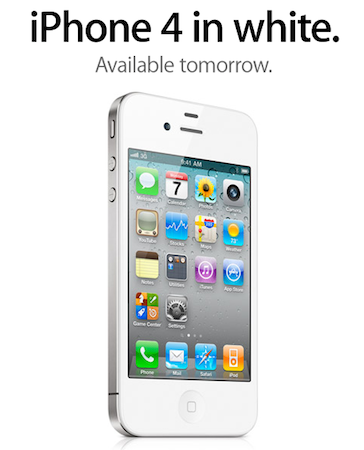
Following this morning’s official white iPhone 4 announcement after a 10-month delay since the original unveiling at the WWDC 2010, Steve Jobs and Phil Schiller told in an interview to Mobilized’s Ina Fried that the white iPhone was really “challenging” to make because of “unexpected interactions” of the white color with several internal components. Although Jobs and Schiller didn’t go into the production details in the interview, it was rumored in the past that Apple was forced to delay the release of the white iPhone multiple times because of light leaking issues, washed out photographs, and other front-panel related technical problems. The white iPhone, coming out tomorrow, indeed sports a different proximity sensor than the one found on the black iPhone 4.

It was challenging,” Apple senior vice president Phil Schiller said during a joint interview with CEO Steve Jobs on Wednesday. “It’s not as simple as making something white. There’s a lot more that goes into both the material science of it–how it holds up over time… but also in how it all works with the sensors.

Schiller also noted they discovered the white iPhone needed stronger UV protection from the sun than the standard iPhone 4. Perhaps this kind of UV protection is the reason Apple was rumored to be considering a Japanese paint that managed to fix the production issues of the white iPhone.

We thought we were there a year ago, or less than that, when we launched the iPhone 4 and we weren’t,” Schiller said. By waiting, he said that the company was able to deliver a product that will live up to expectations.

Jobs noted that the work that Apple had to do to get the white iPhone ready has benefited the company more broadly.

The white iPhone 4 goes on sale tomorrow in 28 countries at the same price of the black iPhone 4. In the United States, it will be available on both AT&T and Verizon Wireless. Lines are already starting to form around the globe, send us photos and videos if you plan to drive to the Apple Store to get a new, final, white iPhone 4.


iPhone App Transmits GPS Data to WiFi iPad Using Personal Hotspot

Back in March, a series of reports from several blogs and publications claimed a WiFi-only iPad connected to an iPhone via Personal Hotspot was able to receive GPS data through the established connection, even if the iPad itself didn’t have any GPS capabilities. If GPS data was being transmitted thanks to Personal Hotspot, many speculated getting a 3G iPad was basically useless as the last advantage of internal GPS could be replaced by an iPhone and proper tethering. With Personal Hotspot and wireless GPS data transmission, many said, users could install navigation software on a WiFi-only iPad and obtain GPS points thanks, again, to Personal Hotspot and iOS 4.3. However, while the reports about WiFi iPads displaying semi-accurate locations in the Maps app were accurate, rumors about GPS and Personal Hotspot were quickly debunked as, it turned out, a WiFi iPad couldn’t rely on tethering for location purposes for more than a few minutes, as also demoed on video here. Rather, it seemed like a WiFi iPad could get location info while on the move thanks to WiFi access point and hotspot discovery – considering the recent debate on Apple and location cache, this doesn’t surprise anymore.

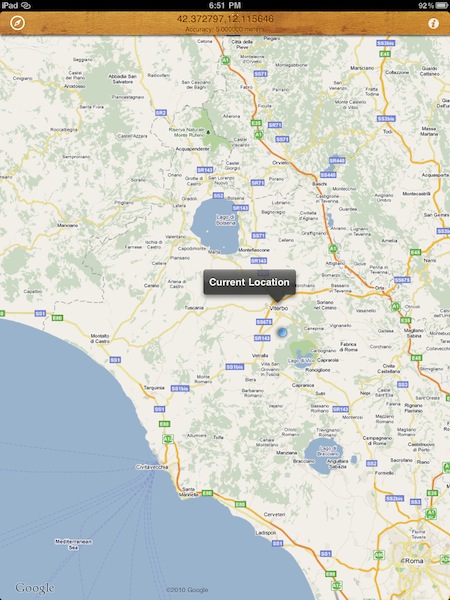
As it usually happens in the Apple community, though, what started as an inaccurate report or a simple proof of concept eventually turned into an app available for download on the App Store. AirLocation, a $0.99 universal app released today, enables WiFi iPad users to achieve the workflow described above: once connected to an iPhone using Personal Hotspot, an iPad running AirLocation will be able to fetch accurate GPS data from the iPhone and update your location in real-time as you move. AirLocation will have to run on the iPhone as well in order for the whole setup to work. I’ve personally tested the application during a 20-minute car trip to Viterbo, my town, and it really works as advertised: although AirLocation doesn’t come with all the features of the Maps app for iOS, it does keep track of your location in real-time on the iPad using GPS and it didn’t stop working after a few minutes. I could see the blue dot indicating my location moving on screen at the same time of the iPhone, which was transmitting data via Personal Hotspot.

AirLocation doesn’t come with many functionalities, but it does one thing well: getting accurate GPS data with iOS 4.3’s Personal Hotspot. Get it here.


Steve Jobs Discusses Location Tracking, Privacy

Steve Jobs Discusses Location Tracking, Privacy

Ina Fried at Mobilized reports some excerpts from a phone interview with Steve Jobs about the location tracking issues also addressed by Apple this morning:

The files they found on these phones, as we explained, it turned out were basically files we have built through anonymous, crowdsourced information that we collect from the tens of millions of iPhones out there.

He said Apple looks forward to testifying before Congress and other regulatory bodies and said the company will do what it can to clarify things further. “I think Apple will be testifying,” Jobs said. “They have asked us to come and we will honor their request of course.

Steve Jobs also reiterated the statements from today’s Q&A, saying much of the speculation last week arose from “wrong conclusions” – generated by the fact that Apple, and the tech industry overall, failed at educating users about several aspects of location data, anonymous tracking and privacy:

As new technology comes into the society there is a period of adjustment and education,” Jobs said. “We haven’t as an industry done a very good job educating people I think, as to some of the more subtle things going on here. As such (people) jumped to a lot of wrong conclusions in the last week.

Update: Mobilized has updated their original post with an edited transcript of the interview with Jobs, Schiller, and Forstall. Other interesting tidbits:

Is there anything that you guys have learned over the last week or so and take away from this?

Forstall: One thing I think we have learned is that, the cache we had on the system, the point of that cache, is we do all the location calculations on the phone itself so no location calculations are done separately. You can imagine in ideal world the entire crowdsourced database is on the phone and it just never has to talk to a server to do these calculations (or) to even get the cache.

What we do is we cache a subset of that. We picked a size, around 2MB, which is less than half a song. It turns out it was fairly large and could hold items for a long time.

We had that protected on the system. It had root protection and was sandboxed from any other application. But if someone hacks their phone and jailbreaks it, they can get to this and misunderstand the point of that.

It’s all anonymous and cannot be traced back to any individual phone or person. But we need to be even more careful about what files are on the phone, even if they are protected.

Schiller: Sometimes it helps people to understand an analogy that describes what these things are like because they are so new. I would think an analogy of a crowdsourced database is every time you walk into a retail store, many retailers have a clicker that counts how many people come in and out of the store. Nobody really cares about that because it is completely anonymous. It is not personal data. It is not anything to worry about. It’s not something that people feel is private because it is really not about them. It’s a coagulated total of all traffic. These crowdsourced databases are sort of like that.

Things like that aren’t so scary when you think about them in everyday terms.

Permalink