Sponsor: Smile

Our thanks to Smile for sponsoring MacStories with PDFpen for iPad.

PDFpen is the goto solution for signing and editing documents from your iPad or iPad mini. Correct typos, highlight and add notes, and annotate documents with simple taps. Because PDFpen works with iCloud and Dropbox, you can be sure that your documents are conveniently available at your Mac. And because sharing those documents is just as important as making changes, PDFpen lets you send documents to services like Evernote, Google Drive, and Box. The next time you receive an email with that all important document, sign it with your finger, correct glaring typos, and send it back in just a few moments. It’s fast, easy, and powerful.

PDFpen for the iPad is only $14.99. You can learn more and watch a product demonstration on Smile’s product page, or download it from the App Store. In addition, don’t forget to check out PDFpen for the Mac, the perfect companion for getting things done when you’re at your desk.


GIF Brewery 2.3

GIF Brewery, developed by Patrick Rogers, is my favorite app to create animated GIFs (with a hard G) on OS X. Every time I need to show an app’s particular animation or effect, I mirror my iOS device’s screen to my Mac with Reflector, capture a video, and turn a specific portion into a GIF.

The latest update, released last week, contains a new preference to automatically snap text overlays to horizontal center and, even better, settings to control fade-in/out times for overlays. These two minor additions make dealing with text overlays in GIF Brewery much easier, leading to better results.

GIF Brewery is $4.99 on the Mac App Store and I can’t recommend it enough.

Permalink


Ohio Man Sues Apple Over Breaking Bad Season Pass

Jeff John Roberts:

An Ohio man has filed a lawsuit against Apple, claiming the company owes him and other Breaking Bad fans $22.99 for not including all 16 episodes in a “Season Pass” to the show’s final season, which was split into two parts.

In a class action suit filed in San Jose, California, Noam Lazebnik says Apple engaged in false advertising by providing only 8 episodes to consumers even though its “Season Pass” page explains that viewers will get “every episode in that season.”

Better call Saul?

Permalink

Droplr Draw Adds Lightweight Annotation Features To Droplr for Mac

Skitch is my favorite image annotation tool on the desktop and Marco Arment’s Bugshot is on my iOS Home screen, so when I saw the announcement of Droplr Draw last week I knew that it was something I needed to check out. Even if I’m a big fan of Skitch’s feature set on OS X – unlike some, I do like the Evernote integration – the app doesn’t provide the fastest way to capture, annotate, and share a screenshot, and Droplr Draw seemed promising.

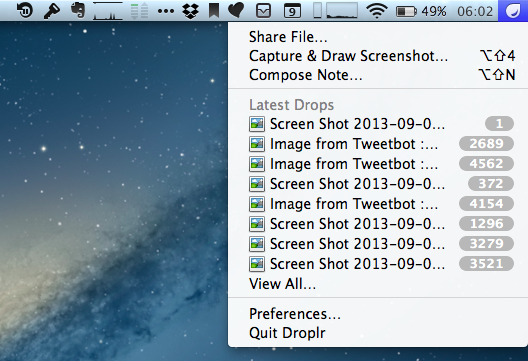
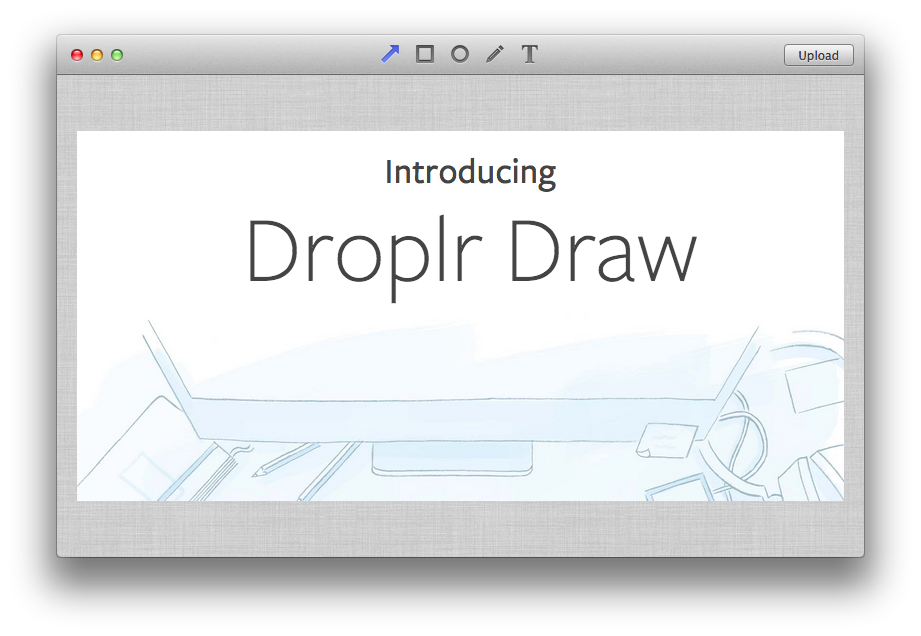
Droplr Draw isn’t a separate app: it’s a feature of the Droplr for Mac app for existing Droplr Pro subscribers. Droplr Draw lets you a take a screenshot as you normally would with Droplr, add some annotations to it, upload it, and share it to Droplr. It’s essentially an extra layer between the Finder and Droplr’s cloud that instead of taking a file and returning its public URL opens an editing window first.

Droplr’s Draw view is extremely simple. There are four tools (arrow, rectangle, oval, free form) and a Text button to add annotations to an image with only one color (light blue). Annotations can be moved and resized on the canvas, but there are no settings for thickness, additional shapes, colors, or strokes. Once you’re done adding text or shapes, you can hit the Upload button, and Droplr will upload your file and copy the resulting URL in your clipboard.

The decision to launch Droplr Draw as a feature of the existing Droplr was a good call because Draw isn’t advanced enough to justify a standalone app. As I mentioned above, the app lacks any sort of settings or annotation options, making it an inferior solution to Skitch or even Apple’s Preview.

In my workflow, I have tried to annotate screenshots, coming to realization, on a couple of occasions, that I needed to adjust colors and thickness and that Droplr Draw couldn’t allow me to do that. More importantly, you can’t add images to Droplr Draw as the only available trigger is “Capture and Draw” from the menubar; if I receive a screenshot via email and I need to send it back with annotations, I’d need to take a screenshot of the screenshot if I wanted to use Droplr Draw to annotate it.

Droplr Draw isn’t a Skitch competitor, but it’s a nice addition to Droplr Pro for simple and quick annotations. It doesn’t break any new ground, but it’s a good feature to have in a screenshot sharing service. I’m looking forward to an iOS version.


Opera Launches New Coast Browser for iPad

Released today on the App Store, Coast is a new browser by Opera based on iOS’ WebKit engine and built exclusively for the iPad. Coast is, according to Opera, “the result of its designers tossing out 20 years of preconceptions about what a browser should be”, as it tries to reimagine how a tablet browser should be in 2013 without toolbars, buttons, and URL fields but with a focus on gestures and web content.

The Opera team writes:

The iPad is nearly buttonless; why shouldn’t the apps for it be? Elements such as back and forward buttons are gone from Coast. All navigation is done by swiping the way you naturally would on an iPad – just like in a good iPad app. A single button takes you to the home screen, and another shows the sites you have recently visited – that’s about it for buttons in Coast.

When using touch-based navigation, small buttons that work on a regular computer don’t work well on a tablet. It’s not about just enlarging already existing elements; it’s about making the design interesting and uncluttered.

Essentials such as website security are handled in the background, with can’t-miss warnings when a suspicious site is accessed and extensive info on site reputation.

While I personally don’t need another iPad browser as I’m fine with Chrome, I think that Coast shows some interesting ideas and approaches. Sites are organized in Home screens, and Coast’s default behavior is to save a site’s “apple-touch-icon” file (the same one that Reeder uses) as a preview. Website icons can be rearranged like app icons on the iOS Home screen, and the effect is quite nice. You can’t personalize the background photo, and that’s too bad because I don’t like the built-in one.

There are some good animations in the app. You can delete icons and open pages by swiping up and putting them into a delete area that quickly bounces when it deletes content; icons flip to reveal a website’s homepage, and Google search is always accessible by swiping down on the Home screen. My favorite detail is how the dot indicators for open pages come up from the bottom of the screen when you open the “tab view” (they are not called tabs in Coast – in fact, there are no text-based menu labels at all).

I don’t think that Coast will revolutionize iPad web browsing because, admittedly, Safari offers a superior feature set for the average user with iCloud Tabs, the upcoming iCloud Keychain, Reader, Reading List, and more. But Coast does have some intriguing ideas and it’s worth checking out.


Bradley Chambers’ App Idea For Grocery Stores

This is the same idea that I discuss with my girlfriend every time we go grocery shopping: a grocery store app that is integrated with the store’s inventory system and that can guide me to the correct aisle for an item I need to buy:

Use your WiFi to determine my location and use that information to help me find the items on my list. This might be by organizing my list based on the order I will come across items or simply alerting me when I am on an aisle that has something on my list.

Imagine if the app could show you an indoor map of the store, plug into iOS’ Reminders list, learn from your shopping habits, and tell you when a product you usually buy and like is on sale. One can dream, right?

While such an idea may sound futuristic, it’s actually something that has been going around for years, only now we have better technology, more powerful devices, and more advanced software development kits. I wonder if iBeacons and iOS 7 will accelerate the development of smarter indoor location apps – supposedly, Apple is exploring this area as well.

Permalink

The Editorial Workflow Directory

After the launch of Editorial, several readers have asked me whether there was a good way to browse workflows shared by other Editorial users. While Pinboard has provided a good temporary solution with bookmarks and tags, you’ll be happy to know that developer Ole Zorn has launched a beta of the Workflow Directory, which will be deeply integrated with the next version of Editorial.

Right now, you can search for specific workflows in the Directory or view Staff Picks and Recently Added workflows; select a workflow, and you’ll get the usual preview page where you can tap a button to add someone else’s workflow to your Editorial library.

With the Workflow Directory, the default behavior of Editorial’s sharing feature is changing: shared workflows will be posted online but won’t be listed in the Workflow Directory unless you manually publish them there. This means that, when unlisted, only people knowing the direct URLs to the shared workflows will be able to find them. This is exactly what I’m doing with the extra workflows included in my Editorial book.

The best part of the Workflow Directory is that it’s got an API to programmatically search workflows, download them, and get descriptions. It returns data in JSON, so, if you bought Writing On The iPad, you should be able to adapt one of my existing workflows that use the request module to work with the Workflow Directory API. Zorn has already made a workflow to search and download workflows (as usual, meta).

Permalink

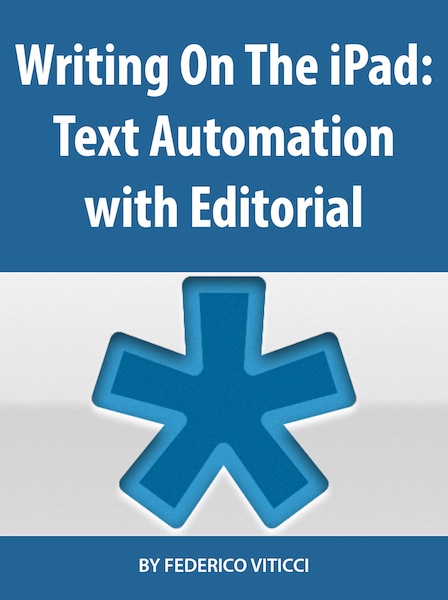
Introducing “Writing On The iPad: Text Automation with Editorial”

Short version

My first book is now available on the iBookstore. It’s an extended edition of my Editorial review that comes with:

  • Completely reformatted layout and design with Retina screenshots, annotated videos, interactive graphics, and more
  • 20 exclusive new workflows
  • 5 new videos
  • 10,000 additional words
  • A photo of yours truly in the Introduction

You can read the book on your iPad, and it’s $2.99 for a limited time.
Get it here.

Longer version (based on the book’s Preface)

Editorial is a text editor for the iPad that supports Markdown, syncs documents with Dropbox, comes with a snippet system to speed up typing, and – a feature that truly makes it stand out from similar apps – is powered by workflows and scripts to automate writing, editing, and publishing. Editorial is developed by Ole Zorn, an independent software developer based in Germany. Editorial was released on August 15th, 2013; prior to the public release, I had been testing the app since late November 2012.

“Writing On The iPad: Text Automation with Editorial” contains my review of Editorial with an in-depth explanation and critique of the app’s numerous features and workflow tools. My goal with this book is to provide a convenient, portable resource to learn more about Editorial, how the app changed the way I work on iOS, and how, through Editorial’s automation, scripts, and workflows, it’s possible to turn an iPad into a powerful tool for writers.

Originally, my Editorial review was here published at MacStories.net on August 15th, 2013, when Editorial for iPad was released on the App Store. However, following many readers’ suggestions due to the length and scope of the review, I decided to offer an iBooks version of it. “Writing On The iPad: Text Automation with Editorial” contains the original review reformatted for iBooks, plus 20 extra workflows and 5 additional videos. You can consider it a “Director’s Cut” edition of my Editorial review, now available in a multi-touch interactive book made exclusively for the iPad and iBooks.

The exclusive workflows included in the Extras chapter are:

  • Show Word Definition
  • Sort Lines Alphabetically
  • Convert Selection To HTML
  • Markdown Link from Clipboard
  • Markdown Image From Clipboard URL
  • Reference Link from Clipboard
  • Count Occurrences of Word
  • Count Links and Footnotes
  • Fill Login
  • Get RSS Feeds
  • URL Sharing Tools
  • Get Pinboard Bookmarks
  • Feed Wrangler
  • “Mark As…” On Feed Wrangler
  • Clean and Flip
  • Rich Text To Evernote
  • Save Tab
  • Reopen Tab
  • Manage Tabs
  • Clip Webpage

Alongside converting the review to the iBooks format and including new content, I also updated screenshots for Retina displays, created galleries to group multiple screenshots together, and annotated some screenshots to better describe the user interface of Editorial. The videos have been enhanced with textual overlays for comments, and I’ve created a glossary for common terms used throughout the book.

I consider this the best version of my Editorial review. Thanks to iBooks’ interactivity, clean layout, and embedded rich content, I hope that you will enjoy a pleasant and convenient reading experience that should help you in getting started with Editorial and understanding the capabilities of advanced workflows and iOS automation – an area that is often underestimated, but quickly growing among the iOS power user community.

I hope that you’ll like what I’ve done. This is a new experience for me, and I would love to receive your feedback either via email or Twitter.

Once again: my new book is available here, and it’s $2.99 for a limited time.