Posts in news

Kickstarter Project: “Full Metal Jacket Diary” - The iPad App

This Kickstarter Project isn’t about an iDevice accessory or a social networking game but something a little more serious and just as interactive - a book. Well, not exactly a book, but an iPad app based off the book “Matthew Modine’s Full Metal Jacket Diary.”

Back in 1985 actor Matthew Modine starred in a little movie called “Full Metal Jacket,” directed by the legendary Stanley Kubrick. The movie was an instant classic. Modine decided to keep a detailed diary of his experiences and Kubrick also gave Modine permission to photograph the film-making process as well, something he never allowed. Modine captured hundreds of behind-the-scenes moments in the two years it took to finish the film. Modine made a series of 10 x 10-inch prints from the movie and gave them to Kubrick and the others as gifts. When he returned to his home in New York City he put his diary, negatives, and extra prints in a box. In the mid-90s, Modine turned his documented writings and pictures into a hardcover book called Full Metal Jacket Diary. The first edition was limited to only 20,000 laser-etched numbered copies. A paperback edition was never released and many fans of Kubrick have been waiting for something.

Video after the break. Read more


iPhone Location Tracking A Bug To Be Fixed In Next iOS Update?

Following yesterday’s debate on a file discovered by two security researchers that keeps track of your entire location history in the form of cellular triangulation data stored unencrypted in the iPhone’s backup, Daring Fireball’s John Gruber weighed in to suggest this might be a simple bug or “an oversight” on Apple’s part. He claims that a “little-birdie” told him the consolidated.db file acts as a cache for your location, and it’s not meant in any way to be used by Apple to track your location history and moves; the file is never sent to Apple’s servers, but is kept locally on your 3G device and on your computer – if you decided to back up an iPhone or iPad using iTunes. Moreover, the location data doesn’t rely on accurate GPS information – instead, it uses antennas’ triangulation, meaning that in most cases data can be miles off your actual location on a specific day.

The big question of course, is why Apple is storing this information. I don’t have a definitive answer, but my little-birdie-informed understanding is that consolidated.db acts as a cache for location data, and that historical data should be getting culled but isn’t, either due to a bug or, more likely, an oversight. I.e. someone wrote the code to cache location data but never wrote code to cull non-recent entries from the cache, so that a database that’s meant to serve as a cache of your recent location data is instead a persistent log of your location history. I’d wager this gets fixed in the next iOS update.

iOS 4.3.2 was released last week, and Apple might push a 4.3.3 software update relatively soon to “improve overall stability” and introduce “bug fixes” – as they usually write in their changelogs for this kind of updates. Apple PR hasn’t issued a statement about the discovery of this location tracking system for iPhones and iPads 3G, but the story has quickly made the rounds of the Internet and ended up on mainstream media as well. If it’s really a bug, or an oversight, a software update should be the easiest solution to the problem.


Verizon CFO Fran Shammo Hints At Global iPhone 5

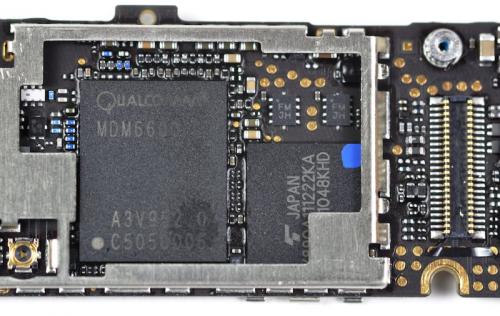
When iFixit tore down the Verizon iPhone 4 back in February, they found a Qualcomm Gobi that’s dual-mode GSM/CDMA capable, which indicates to us that the next iPhone on the CDMA spectrum would go global. During yesterday’s conference call, Verizon CFO Fran Shammo indicated that the next iPhone to be released on the network would be a global phone, allowing the next iPhone to become a world-phone as GSM capabilities are enabled. From Barron’s,

Verizon CFO Fran Shammo, asked about the sluggishness of the company’s ARPU growth in Q1, when the iPhone was introduced — growth was just 2.2%, compared to 2.5% in Q4, remarked:

The fluctuation, I believe, will come when a new device from Apple is launched, whenever that may be, and that we will be, on the first time, on equal footing with our competitors on a new phone hitting the market, which will also be a global device.

While Verizon could be poised to obtain an iPhone that was world-phone enabled, it might be a good time to rehash the universal SIM. Previously, Bloomberg reported that Apple is working on the ability to toggle between CDMA and GSM networks with a single SIM that would allow customers to willfully switch between CDMA and quad-band GSM. The iPhone 5 is also rumored to have a bigger display, NFC capabilities, but otherwise is expected to utilize a similar design to the iPhone 4 as a product refresh amongst other reports of an aluminum design with an internal antenna.

[Barron’s via MacRumors]
Image source: iFixit


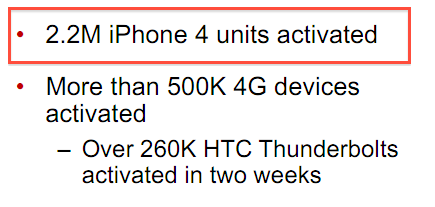
Verizon: 2.2 Million iPhones Activated In Two Months

Following yesterday’s official AT&T iPhone activations for the first quarter of 2011 (3.6 million units) and Apple’s Q2 financial results (18.65 million iPhones sold), Verizon reported its Q1 2011 earnings results this morning, confirming that the company activated more than 2 million iPhones 4s since February.

As noted by Peter Kafka at MediaMemo, Verizon’s earnings results public PDF document indicates the company activated 2.2 million iPhones in two months – the device went on sale on February 10th, thus granting Verizon only two months of availability during the quarter. Apple didn’t officially disclose Verizon iPhone sales numbers at its earnings call yesterday, however they did say that adding the iPhone to Verizon’s line-up meant begin offering the device to an enormous customer base.

The CDMA iPhone is expected to be released in more countries on different carriers in the next months, but Apple hasn’t confirmed any of these plans yet. Initial speculation on Verizon iPhone sales claimed numbers were “low” and “under Apple’s expectations”, but 2.2 million units activated in 2 months seems to suggest the device has been selling strongly in the quarter.


Apple Q2 2011 Financial Results: $24.67 Billion Revenue, 4.69 Million iPads, 18.65 Million iPhones Sold

Apple has just posted their Q2 2011 financial results. The company posted revenue of $24.67 billion, with 4.69 million iPads sold, 18.65 million iPhones and 3.76 million Macs. Wall Street consensus estimate was EPS of $5.36 and revenue of $23.34B. Mac sales saw a 28% increase over the year-ago quarter, while with 9.02 million iPods sold Apple saw a 17% unit decline. Overall, the company posted quarterly revenue growth of 83% and profit growth of 95%. International sales were 59% for the quarter, with Asia and Pacific regions featuring a 182% increase year over year. The reported iPhone sales were stronger than expected by most analysts, with a 113% increase year over year. iPhone revenues, however, grew faster than sales with a 126% increase [source]. Overall, this was the biggest non-holiday quarter in Apple’s history.

With quarterly revenue growth of 83 percent and profit growth of 95 percent, we’re firing on all cylinders,” said Steve Jobs, Apple’s CEO. “We will continue to innovate on all fronts throughout the remainder of the year.

In Q1 2011, the company posted a record revenue of $26.74 billion with 7.33 million iPads sold, 16.24 million iPhones and 4.13 million Macs. In the year-ago quarter, Apple posted revenue of $13.50 billion and net quarterly profit of $3.07 billion. The company sold 2.94 million Macs, 8.75 million iPhones and 10.89 million iPods during the quarter.

Apple will provide a live streaming audio feed of its Q2 2011 financial results conference call at 2:00 PM Pacific, and we’ll update this story with the conference highlights. Read more


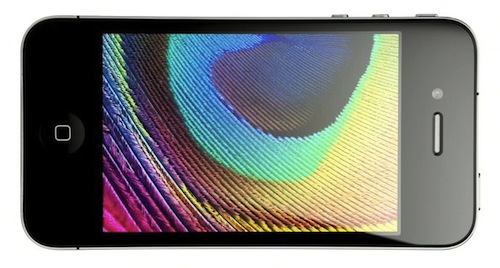
Apple Investing In Toshiba’s New Plant for iPhone Displays

According to a report by Japanese newspaper Nikkan Kogyo Shimbun, Apple is planning to invest in Toshiba’s new LCD plant in the Ishikawa Prefecture, central Japan, for the manufacturing of iPhone displays. The report, relayed by MarketWatch, claims that Apple has picked Toshiba as the sole Japanese supplier for iPhone LCDs, effectively ceasing talks with Sharp over an investment in their facility.

The report said that Sharp was no longer a candidate for Apple’s investment. Sharp said in a statement released Wednesday that the Nikkan Kogyo Shimbun report “contradicts the facts.”

A spokesman for Toshiba’s LCD display unit declined to comment.

After Apple’s Q1 earnings call in January, Apple COO Tim Cook told the press and analysts that the company had entered a $3.9 billion component supply deal in a key area that was “an absolutely fantastic use of Apple’s cash”. Many speculated that, after flash storage supply deals and agreements, Apple identified high-resolution LCD displays as a key factor to iOS’ devices manufacturing process. Back then, speculation and Tim Cook’s own words suggested that Apple had entered a deal with three manufacturers, including Toshiba and Sharp. A month before the the Q1 financial results, Apple was indeed rumored to be discussing with Toshiba an investment in a new $1.19 billion factory – the same that Nikkan Kogyo Shimbun is mentioning today. But at the same time, several reports suggested that Apple was also considering a second investment in a $1.2 billion facility from Sharp – with over $60 billion in cash, a double investment in LCD manufacturing wouldn’t have surprised anyone. But today’s report seems to confirm that the deal with Sharp hasn’t gone through, implying that Toshiba has been chosen as the only Japanese manufacturer of iPhone LCD screens.

Apple’s Q2 earnings call is scheduled later today at 5PM ET.


Qwiki iPad App Released, Lets You Explore 3 Million Topics

Qwiki, the “information experience” winner of TechCrunch Disrupt last year, released its first official iPad app today, allowing users to visually explore more than 3 million topics including people, places and facts directly from the tablet. For those unfamiliar with Qwiki, the service has built an incredibly appealing and engaging technology that, upon entering a keyword for a topic you want to know more about, will start “talking” to you with a human voice, also including text, animated images, videos, slides, infographics. Qwiki is a unique, rich experience built on top of web technologies – try it out here using your web browser to get the idea.

The iPad app is equally impressive. Once you fire up Qwiki for iPad, you’ll be asked to share your location so the system can load the nearest points of interest, and display them on a Google Map. From the main page, you can view the “Qwiki of the day”, see daily qwikis and popular ones, explore places near you or simply search for a new topic. A bar at the bottom allows you to share a qwiki with your friends on Facebook, Twitter, or via email. The interface design is clean and similar to the website, the app responsive and pretty fast overall. A qwiki takes a few seconds to load, and as soon as the voice starts speaking you’ll be able to tap on the images included in the slide to view them, tap on videos, hide the textual description. The app lets you swipe between slides, and quickly jump to related topics by tapping on a button in the toolbar. The results seem accurate, as they’re based on keywords and topics found in the qwiki you were playing. When you’re done browsing qwikis and related material, you can read more on a topic thanks to Wikipedia, Google, Fotopedia and Youtube integration.

Qwiki for iPad is a great visual experiment, and you can download it for free here. Check out more screenshots below. Read more


CalendarBar for Mac Updated with New Features

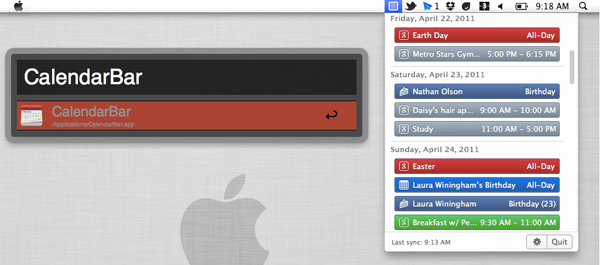
Clean Cut Code’s CalendarBar, a great menu bar app for OS X, lets you see events from iCal, Facebook and Google Calendar all inside one great looking app. We reviewed CalendarBar back in March and we really like it.

Today, Clean Cut Code has updated the app to version 1.1 with some very nice additions. iCal tasks/todos are now supported from the preferences pane and it now also supports Alfred / LaunchBar / QuickSilver quick launch applications. When CalendarBar is running, simply start typing “CalendarBar” into Alfred (LaunchBar or QuickSilver as well), and it forces the app to dropdown from the menu bar so you can access the app without using your mouse. (Thanks to Don Southard for helping us test multiple launch apps.)

The developers also added support for BusyCal and Google Calendar multiple sign-ins. You can now configure relative day formatting (today, tomorrow, etc) and make timed events not span multiple days. CalendarBar also received a new app icon along with some bug fixes. If you still haven’t picked up CalendarBar from the Mac App Store, maybe you should mark your calendar to do so. Check for updated via the Mac App Store or buy the app now for $2.99.


Researchers Discover iPhone File That Keeps Track Of Your Moves

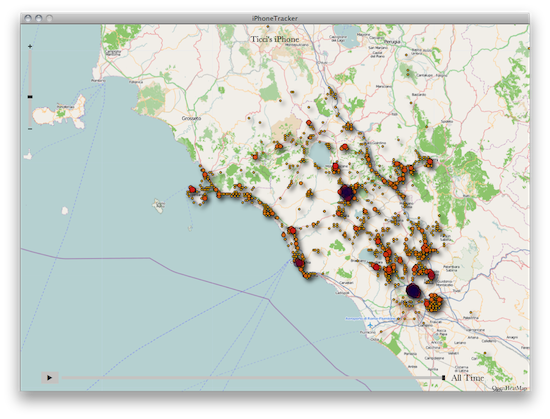
Security researchers Alasdair Allan and Pete Warden have discovered a file in Apple’s iOS local backup system that keeps track of your entire location history, in format perfectly readable by a computer. The file, by default stored unencrypted in the iOS database that can be backed up to a computer using iTunes, keeps track of “everywhere you go” by triangulating the 3G signal against the nearest cell towers, and offers a way to private detectives or people who might get their hands on your device / computer to have access to your moves in the past. The researchers have also created an open-source app called iPhoneTracker that recognizes the file from your local iOS backup, parses the results and displays your most-visited locations on a map. The screenshot above, for instance, was taken using my iPhone’s unencrypted backup.

As the researchers note on iPhoneTracker’s webpage, it is unclear why Apple is doing this. Cellphone network providers have been allegedly tracking users’ location for years through their towers, but they never stored the location info locally on a device, nor did they provide a way to back up this information on a computer and parse it. Allan and Warden (who’s a former Apple employee) speculate this might be functional to new location features Apple is working on for future versions of iOS; the location tracking was apparently introduced with iOS 4 last year, and data collected so far might come in handy for the company to build an online location-based social service for iPhone and iPad users. The file, however, was only discovered in the past weeks, and the researchers claim it’s present both on iPhones and iPad 3G units.

Apple has made it possible for almost anybody – a jealous spouse, a private detective – with access to your phone or computer to get detailed information about where you’ve been,” said Pete Warden, one of the researchers.

Warden and Allan point out that the file is moved onto new devices when an old one is replaced: “Apple might have new features in mind that require a history of your location, but that’s our specualtion. The fact that [the file] is transferred across [to a new iPhone or iPad] when you migrate is evidence that the data-gathering isn’t accidental.” But they said it does not seem to be transmitted to Apple itself.

Apple declined to comment, but it’s very clear that the file is created and stored locally without an explicit user’s agreement. As noted by the researchers and other security / privacy experts polled by the Guardian, Apple is storing both location data and timestamps in a readable format that can be accessed from a stolen (possibly also jailbroken) device or a computer. I have tried the iPhoneTracker application personally, and while it really works with unencrypted backups generated using iTunes, choosing to encrypt a backup breaks iPhoneTracker’s functionality – thus granting users an additional level of security. The file, however, is still there – Apple doesn’t offer a way to avoid tracking of your moves.

The discovery of this location-tracking file in the iOS backup system is worrying as it raises question on Apple’s user privacy policy, and the reason why such data is collected without a user’s consent. Apple has been rumored to working on new location features for iOS 5, so the location info might be a solid data foundation for the company to build a new social location service. You can download iPhoneTracker here and try for yourself. Read more