This Week's Sponsor:

Dropzone 5

Improve your Drag-and-Drop Workflow


Posts in Linked

Apple Pay and Security

Yoni Heisler has an in-depth overview of Apple Pay at TUAW today:

Remember that merchants in an Apple Pay transaction never have access to user credit card information and, as a result, users never have to worry about their information being compromised in a security breach. Further, security at the device level is effectively impenetrable as tokens, along with the encrypted keys responsible for the cryptogram, are all securely stored in the Secure Element.

And as an extra security precaution, iPhone owners will have the ability to unlink or temporarily suspend a token connected to a stolen device, thereby rendering Apple Pay inoperable until the device is retrieved.

I may be skeptical about Apple Pay in Europe, but the way it’s been built and will operate is fascinating. (I’m even more curious to know if integration with Safari will happen for web payments eventually).

Permalink

Evernote Wants to Go Beyond Note-Taking

At its conference in San Francisco today, Evernote announced a slew of updates for its core iOS and OS X experience as well as a redesigned web app (currently available as public beta), a redesign of Penultimate, a new scanner app, and new Market products.

Harry McCracken has an overview of the announcements at Fast Company. He concludes with a legitimate concern:

As a pretty committed Evernote user–I have more of my digital life stored there than any one other single place–all of these announcements leave me both excited and at least a tad concerned. Profoundly useful though the service is, it’s never quite felt like it’s nailed the best, simplest, most intuitive interface for what it does. (The fact that it has a habit of radically redoing its user interface on a regular basis is presumably an acknowledgement of that.) Adding more features will only make it tougher to keep Evernote coherent and approachable.

I’m curious to check out the updates to the iOS apps (I use Evernote for work every day) and the redesign of the Mac app for Yosemite looks nice. I’m a fan of the web app: by default, it lets you write a new note with just a few clicks, but it packs most of the features available in other versions of Evernote. It was a much needed change.

I have my doubts about the contextual and messaging features Evernote announced, but they also have potential and I’d rather wait until I can try them. I’m not sure I’d ever benefit from links pulled in from the WSJ or LinkedIn while I’m doing research, but other sources would be welcome. As for messaging, it is going to be hard for Evernote to beat the workplace integration that’s being built by Slack, but I imagine it could be a nice plus for businesses that rely heavily on Evernote internally.

I liked the tone and message of the keynote. Phil Libin is a good presenter and he genuinely seems to be invested in Evernote as a product. Evernote is often derided for their frequent redesigns, but they have struck a good balance with iOS 7 in the past year (both Evernote and Skitch are now highly polished and functional apps) and the Yosemite update looks like a moderate refresh rather than a ground-up redesign. Evernote has insanely high goals – software for “your life’s work” is the new slogan – and a willingness to adapt to people’s ever-changing needs can be a good thing. The partnership with News Corp. seems a little strange, but, overall, the event was solid.

Check out the Evernote blog for details on Context, the new web app, and Work Chat.

Permalink

Working with Mac OS 9 Today

Andrew Cunningham tried to work with Mac OS 9 and published an interesting account of his experience at Ars Technica. Make sure to reach the conclusion for some good points about software updates:

People love to complain about change. Those complaints aren’t always unwarranted. We live in an era of constant updates, where your browser changes every six weeks, and your operating system changes every 12 months. Who even knows how often they’re changing Gmail and Twitter and Facebook? The idea of supporting and using a single OS for 13 years seems completely absurd. Sometimes you just want everything to stand still for, like, a second.

Also, don’t miss Riccardo Mori’s counterpoints at System Folder.

Permalink

Twitter for Mac Updated with Image Features

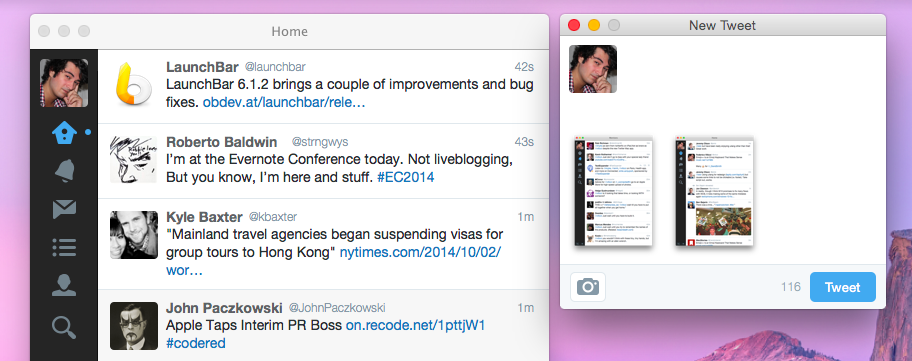
Speaking of Twitter apps, Twitter today released an update to their official app for Mac that brings support for images in direct messages and tweets with multiple images (first rolled out on the iPhone in December and March, respectively).

Progress on Twitter for Mac has been slow, but I’m glad the app isn’t completely abandoned. It would be nice to have all the recent features and design changes of the iOS app, though (particularly Cards and redesigned profiles).

Side note: you can use this Terminal command to enable circular avatars in the app.

Permalink


The Future of Apple and Google

A thoughtful article by Steve Cheney. This point was particularly interesting:

New frameworks for devices to interact with the physical world have arrived and will further Apple’s lead. These are important to the growth of the platforms. These include BLE, iBeacon, NFC and other areas adjacent to discovery and the purchase funnel. These short range technologies (when made developer-friendly through APIs) allow phones to connect with the nearby world (the ‘edge’ or last 50 feet), much like GPS allowed phones to connect with the outdoor sky 10 years ago. This short range RF stack is maturing rapidly, but it’s still a little bit like GPS was 5-10 years ago. Back then the apps sucked—remember the first Garmin device you had to plug in to your cigarette lighter, which had no real apps or expansion capability? Or the first time you used maps on a Nokia series 40 phone? The applications were bad, the devices sucked, and the developer tools were non-existent. Now every single app you download uses location and you can get a car delivered to your house in 5 minutes, all enabled by GPS.

It took years for GPS to become widespread, but it has changed how we live. Seems clear that near-field discovery and communication will do the same.

Permalink

The Man Behind the Apple Watch

Vogue has published an in-depth profile of Jony Ive today, revealing details of Ive’s friendship with Marc Newson, his passion for handcrafted objects, and the design process of the Apple Watch.

From the article:

Five years later, a disenchanted Ive was about to leave when Jobs returned to reboot the then-floundering Apple, which happened, by most analyses, when Jobs enabled Ive. By Ive’s account, the two hit it off immediately. “It was literally the meeting showing him what we’d worked on,” Ive says, “and we just clicked.” Ive talks about feeling a little apart, like Jobs. “When you feel that the way you interpret the world is fairly idiosyncratic, you can feel somewhat ostracized and lonely”—big laugh here—“and I think that we both perceived the world in the same way.”

And U2’s Bono on Ive and Newson:

“They’re a bit like non-identical twins separated at birth,” jokes Bono. They finish each other’s sentences. “They finish each other’s food,” adds Bono. “The kind of emotional and physical attraction people develop with Apple products shouldn’t really be possible, but take a look around you.” Friends marvel as Ive shifts from the guy cracking jokes to the solemn Sir Jonathan Ive. “Jony is deadly serious,” says Bono, who first met Ive when Jobs dispatched him to an Irish pub to salvage a U2–Apple iPod promotion. “He is also serious fun to be around. When you go out for a pint with Jony, it’s kind of like going for a pint with the future, which is cool except you know he’s not telling you what they’ve really got planned.”

According to the article, Vogue was given a private demo of the Apple Watch weeks ahead of the product’s announcement. Yesterday, Apple organized a special event at the Colette boutique in Paris that marked the public debut of the Apple Watch.

Permalink


Apple Pay and Europe

Kirk McElhearn makes some good points about Apple Pay in Europe:

On its website, Apple touts that fact that Apple Pay will save you time, by not forcing you to search for your wallet and then find the right card. These concerns, too, are specific to the United States. On average, Europeans carry only 1.46 payment cards (more than two thirds of which are debit cards). In the US, people have more than twice as many cards; 14% of Americans had more than ten cards in 2007. Credit cards are much less common in Europe (though adoption rates vary by country), and most people only have payment cards with their banks.

This is exactly why I’ve been struggling to get the excitement around Apple Pay. Sure, it looks cool, but Passbook was also cool and I never actually used it in a real life scenario in Italy. I’ve never owned more than one payment card in my life (the one supplied by my bank) and most people I know don’t have multiple cards. I’ve never understood the videos of modern payment solutions showing people fumbling to find their credit card – I have one, and it’s not that hard to find in my wallet. We still use cash every day for any kind of purchase, at least here in Italy.

I’m sure that Apple Pay will be easy to use and potentially more appealing than Passbook (especially for online payments). I’m just worried that it’s going to be another cool technology primarily meant for the United States.

Permalink