Federico Viticci

10758 posts on MacStories since April 2009

Federico is the founder and Editor-in-Chief of MacStories, where he writes about Apple with a focus on apps, developers, iPad, and iOS productivity. He founded MacStories in April 2009 and has been writing about Apple since. Federico is also the co-host of AppStories, a weekly podcast exploring the world of apps, Unwind, a fun exploration of media and more, and NPC: Next Portable Console, a show about portable gaming and the handheld revolution.

Tweetbot 2.8 Adds Media Timeline

Tweetbot

Tweetbot

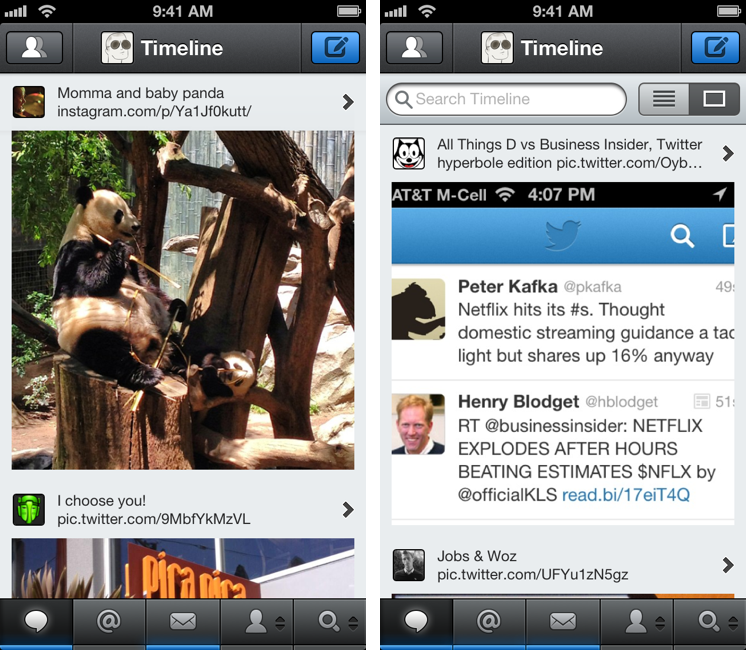
Ever since its original release two years ago, I’ve always wished Tweetbot could provide filters to separate the standard timeline from a “media” one containing pictures and videos. After the launch of Twitter’s own photo service and rise in popularity of services like Instagram, usage of pictures – either photos or screenshots – among the people I follow has skyrocketed. Apps like TweetGlass (nèe Quip) succesfully explored the concept of letting users browse “media updates” in a dedicated feed, so why not Tweetbot?

The latest version of Tapbots’ client, available today, does just that: it adds a media timeline to show only supported images and video tweets (the ones that you’d normally see displayed inline as thumbnails). Read more


Apple Restricting Special Characters In App Descriptions

Mikey Campbell:

As seen in the image above, Apple is no longer allowing developers to submit app description edits with the unique character sets, which in this case includes a checkmark, explosion, “no symbol” and a speech bubble. It is thought that others are included in the new restrictions, but that has yet to be verified.

It appears that Apple has also started restricting usage of glyphs that aren’t necessarily emoji.

I would welcome a change to text-only release notes. While emoji and other characters can add a bit of fun and personality to otherwise boring release notes, some developers were overusing them.

Permalink

Dark Sky Launches Forecast Lines

Another neat web app following the release of Forecast.io last month:

Forecast Lines shows you the forecast spread for each field (temperature, precipitation intensity, pressure, etc.), overlaid with our best guess of what will actually occur. It’s a simple idea, but a powerful one: at a glance, you can see what will happen over the course of the next week, and where we are most–and least–confident in our predictions.

Essentially, Lines looks like a consumer version of Forecast.io’s API raw data sources, which is also available here.

I’m a big fan of the Dark Sky team’s work with web apps and developer APIs for weather data. I can’t use the main Dark Sky app in Italy, but I am testing various third-party apps that are implementing Forecast.io and I’m impressed with their accuracy so far.

I like the idea of Lines’ statistically-aggregated graphs, and, unsurprisingly, the iOS web app is solid.

Permalink


Sponsor: DraftCode

My thanks to Freeridecoding for sponsoring MacStories this week with DraftCode.

DraftCode is a new PHP development tool for iPad. With built-in offline PHP code execution (using standard PHP 5.4.10), DraftCode lets you build and run PHP projects right on your iPad. In addition to offline PHP execution, DraftCode also includes CGI handling and fully supports working with POST and GET forms, includes, and linking to other PHP files in your workspace. Via its built-in webkit based preview, DraftCode lets you work on javascript/AJAX, HTML and CSS in conjunction with PHP, making it a full featured workspace to develop your PHP website.

Other features of DraftCode include the possibility of sending files to other iPad apps, an extended keyboard, and an easy to use workspace for all your files.

DraftCode is available on the App Store for $8.99, and you can find more information here.


Delicious Library 3 Announced

MacRumors’ Arnold Kim published a preview of Delicious Monster’s upcoming Delicious Library 3, a major update to 2008’s Delicious Library 2. In version 3.0, the app will evolve from being a catalogue of the media you own to become a recommendation tool based on the products you own:

We’re centered on the idea of your books (movies, cds, whatever) being an aspect of your unique personality, and our app does neat things with your personal data—like give you cool graphic summaries, or really good composite recommendations.

I have been struggling in the past months to find a system to help me keep track of things I want  to buy. Initially, I set up a Pinterest board, but I ended up not liking the service’s focus on social and sharing; then, I started appending URLs to a text file in Dropbox, but I missed the richness of Pinterest’s image thumbnails. Right now, I’m  using Evernote with a mix of rich text and inline photos/screenshots, but the solution isn’t ideal (although I believe it’s better than what I was doing before).

I’m intrigued by Delicious Library’s new focus on recommendations. I look forward to trying the app’s engine and iOS version (with sync – I assume).

Make sure to read MacRumors’ post for more information and screenshots.

Permalink

AppShopper Is Back On The App Store

Speaking of App Store discovery services, AppShopper is back on the App Store today (after last year’s removal) with a brand new iPhone app called AppShopper Social:

Our original AppShopper app was removed from the App Store due to a conflict with a new set of App Store rules introduced last year. Since that time we’ve been hard at work creating a new app to continue to provide useful functionality to our users and also remain in compliance with Apple’s rules. Today, we’re happy to announce that we’ve released AppShopper Social. The new version of the app still contains the core Wish List functionality that we’ve always had, but also introduces a social discovery portion to the app.

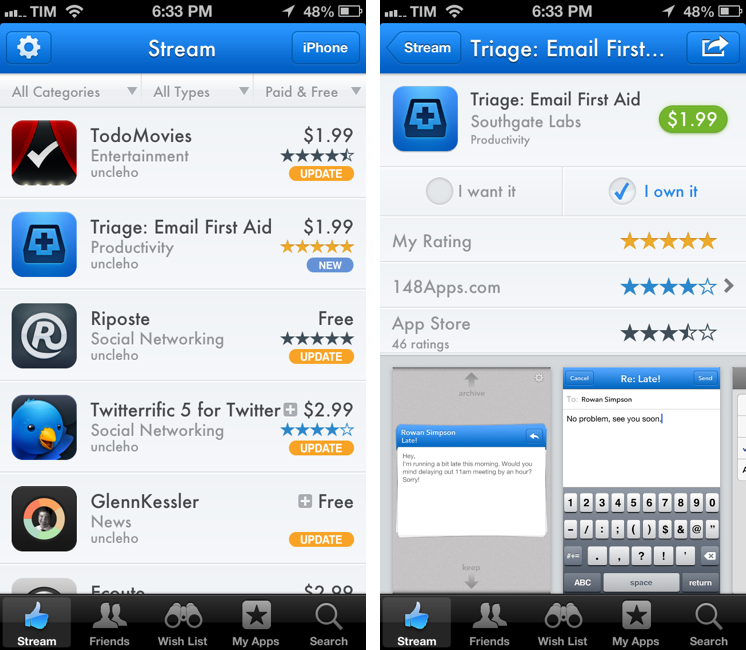
AppShopper is, by far, my favorite service when it comes to finding new apps and receiving notifications for updates and price changes. I have been beta testing AppShopper Social for the past months, and I think the new version makes a lot of sense: rather than offering a better interface for the App Store charts, the main area is now a Stream of app recommendations from people you follow. You can follow websites like AppShopper and TouchArcade, or log in with your Twitter account and find friends who are using AppShopper. When I say that App Store discovery needs more human curation, this is exactly what I mean (in addition to the work Apple itself is doing with sections and collections).

The new app resembles the old version of AppShopper, if only with a fresh coat of paint. In the Stream, you can view All/iPhone/iPad/Universal apps, filter by category, type of app, and paid/free/both. Tapping on an app in the list opens the usual single app page with “I want it/I own it” buttons (the Wish List is still there), screenshots, description, changelog & app activity, and ratings by websites with a link to their reviews. Presenting App Store ratings mixed in with reviews from writers who do this professionally is a very welcome addition in my opinion.

There are some things in the new AppShopper that could be improved: the process of adding friends from Twitter could be further developed with a screen showing how many Twitter friends are also using the app, and, currently, it’s not possible to view a user’s complete profile to show all the apps he/she is recommending to others. I like the refreshed design of the app pages, but I’d like to see a list of friends who have recommended the app in there as well. And, of course, the app isn’t Universal yet and essential features like What’s New haven’t still been enabled as the AppShopper team is figuring out how to get them past Apple’s review process. Fortunately, the team also says they’re working hard on improving the app, and I’m looking forward to the next updates.

The App Store doesn’t come with any social features (besides sharing) or connections to reviews from trusted sources, and I believe AppShopper Social fills an important gap in terms of app discovery and recommendations.


The AppGratis Removal

Jean-Louis Gassée has a solid summary of the whole story behind AppGratis’ App Store removal. If you missed it, here’s Apple’s official stance.

I did comment on the topic – six months ago:

Second, we should consider the manipulation of charts. While not specifically mentioned in the new rule, it’s easy to imagine Apple doesn’t want marketing and promotion campaigns to be capable of altering their ranking algorithm for the App Store. Apple has been rumored to dislike these promotion campaigns in the past, tweaking its ranking algorithm to reflect “real” popularity of an app among users. But maybe that’s not enough at this point, and Apple really does want to limit the relevance of this kind of services by, well, enforcing rules that would get them out of the App Store.

And:

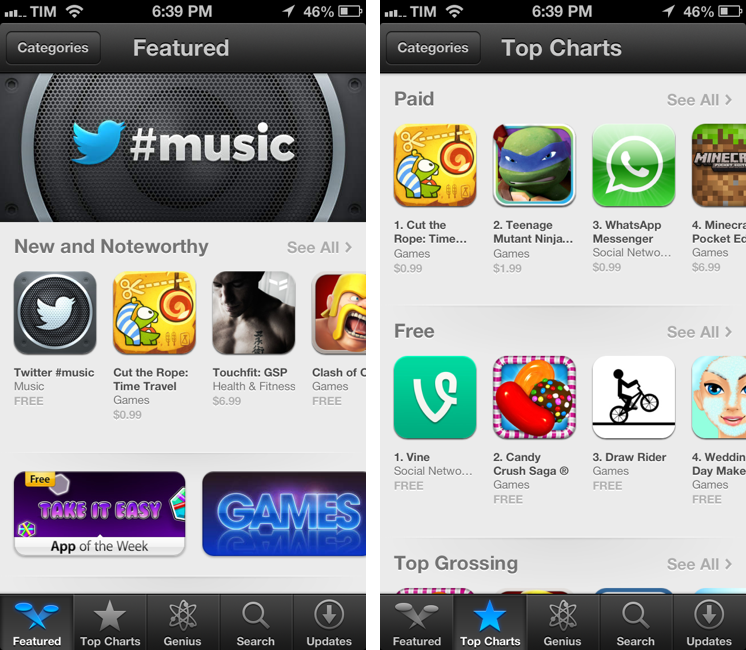
This is pure speculation on my side. But I’d consider this: Apple recently revamped the App Store homepage with its own Free App of the Week initiative (alongside a new Editor’s Choice). Would it be a surprise if they thought all these other “free app a day” and “free app download” services could be confusing to the user?

I also added this in regards to “gaming the system”:

But more importantly, rule 2.25 could be enforced for those marketing tools that get users “rewards” for downloading other apps for free — a technique that, consequently, also increases the popularity of the apps that get downloaded as part of the promotion. The problem is that users download those apps only for the rewards — they’re not really interested in them. For this reason, developers could — even slightly — game the system and, to an extent, trick Apple’s algorithm. I don’t see how that can be a good thing.

Back to Gassèe’s article:

Apple isn’t wrong to reserve the right to make such decisions. Although insiders may depict the company as obsessive control freaks, “normal” customers seem to appreciate Apple’s efforts to keep the App Store a Clean, Well-Lighted Place.

But maintaining a stony silence when imposing a judgment call is a bad choice, it distances developers, and it inevitably triggers controversy. A few words of explanation would invite respect for having courageously taken a difficult stance.

This is a fair point. Here’s what I wrote – again, in October 2012:

After talking to several developers today, my understanding is that rule 2.25 has been enforced on some cases, but that it’s not clear how much Apple will enforce it going forward. Apple has notoriously made exceptions in the past: there used to be a rule for apps that “duplicated” existing functionality, but then Apple started approving third-party browsers and, recently, email clients. For all we know right now, it is possible that rule 2.25 will never be seriously enforced and that it’ll slowly “fade away” with time. Or more simply, developers will find ways to work around the rule.

“It’s not clear”, I said. My sources were correct. Here’s John Paczkowski for AllThingsD:

Sources familiar with Apple’s thinking tell AllThingsD that AppGratis’ ouster was a first step in a broader enforcement action generally targeted at app-discovery apps that run afoul of clauses 2.25 and 5.6.

And:

If it has been confusing, it’s because Apple, while being quite clear in citing the rules it is enforcing, has been unclear and scattershot in their actual enforcement.

I don’t know if this BusinessInsider’s report is true. AppGratis CEO Simon Dawlat calls their business model “just regular advertising”; Jason Calacanis says this is “lame on Apple’s part” and that “this is not gaming, this is called forecasting”.

I didn’t link to the AppGratis story previously because, frankly, I thought Apple’s position on the matter had already been amply discussed last year. The way I see it, nothing has changed in regards to how Apple sees third-party apps that mimic the App Store’s appearance while simply linking to other apps. And I thought it was pretty clear that Apple didn’t appreciate developers who kept coming up with advertising models to circumvent the Guidelines and “connect” users with promoted apps in the top Charts. But, apparently, AppGratis’ ouster was publicized enough to make a French minister comment on the matter. Read more