Federico Viticci

10758 posts on MacStories since April 2009

Federico is the founder and Editor-in-Chief of MacStories, where he writes about Apple with a focus on apps, developers, iPad, and iOS productivity. He founded MacStories in April 2009 and has been writing about Apple since. Federico is also the co-host of AppStories, a weekly podcast exploring the world of apps, Unwind, a fun exploration of media and more, and NPC: Next Portable Console, a show about portable gaming and the handheld revolution.

Instacast for Mac Public Beta Now Available

A beta release of my default podcast client for iOS. Here’s our review of Instacast 3 from last year.

Nate Boateng, who has been testing the app, posted a first look on his personal blog:

The Vemedio team once again worked with Marcelo Marfil to create a wonderful UI that is easy to understand, and looks beautiful. The interface has many of the same components as the iOS counterparts, but restructured nicely for the Mac. You have two main views; Subscriptions and Lists. Like on iOS, Subscriptions show your full list, while Lists are the equivalent of Playlists on the iPhone and iPad —showing your default and custom lists.

I look forward to playing more with the app. From what I’ve seen so far, it looks good, but, being a beta, sync reliability will need more time.

Permalink

Briefs Review: A Great Prototyping Tool For iOS Apps

Briefs

Briefs

Briefs has a complicated history.

In September 2009, independent developer Rob Rhyne showed a demo of an iPhone prototyping tool called “Briefs” at the C4[3] conference in Chicago. The day after the presentation, Daring Fireball’s John Gruber called Briefs “impressive” in the way it hit “the sweet spot between simplicity and usefulness”. Back then, Briefs was often described as a “framework” for turning image-based app mockups into animated prototypes; in January 2010, Alex Vollmer published an in-depth review of the first version of Briefs, explaining how you could use Xcode, the command line, and image files to create a “brief” (the name of Briefs’ file format) that, once loaded on a device, would become an animated prototype. Briefs was meant to let developers better understand the “flow” of an app design before turning it into actual code; on the flip side, it also enabled the creation of more realistic mockups that wouldn’t necessarily ship as commercial products. An example of this was the popular “Services Menu for iPhone” concept posted by Chris Clark and created with Briefs.

In the summer of 2010, Briefs’ rejection spiral began. Apple first rejected Briefs for iPhone in June 2010, citing rule 3.3.2 of the App Store Review Guidelines, which said that no app could download interpreted code. Developer Rob Rhyne assumed that the aforementioned notion of an “app framework” could be the culprit, so he resubmitted the app. In August 2010, after attending WWDC 2010 and waiting three months for App Store approval, Rhyne decided to take a break from the project and he open-sourced the 1.0 code. “I still have some good ideas for the platform”, he wrote, “and I hope to get back to them in good time. However, it’s time to focus on other work and projects that can get into the App Store”.

In late March 2011, after nearly a year spent talking to Apple’s review team about Briefs and after another rejection, Rhyne formally announced Briefs would never come out on the App Store, recommending people to keep on using the open-source version on GitHub. For many, that appeared like the end of Briefs.

Three months ago, Rhyne sent me an email introducing a new beta of Briefs, this time with a dedicated “Author” app for Mac, plus iPhone and iPad “Players”. After two years of hiatus, I was skeptical: I thought that Briefs was destined to be perpetually relegated in the limbo of cool app ideas that never were.

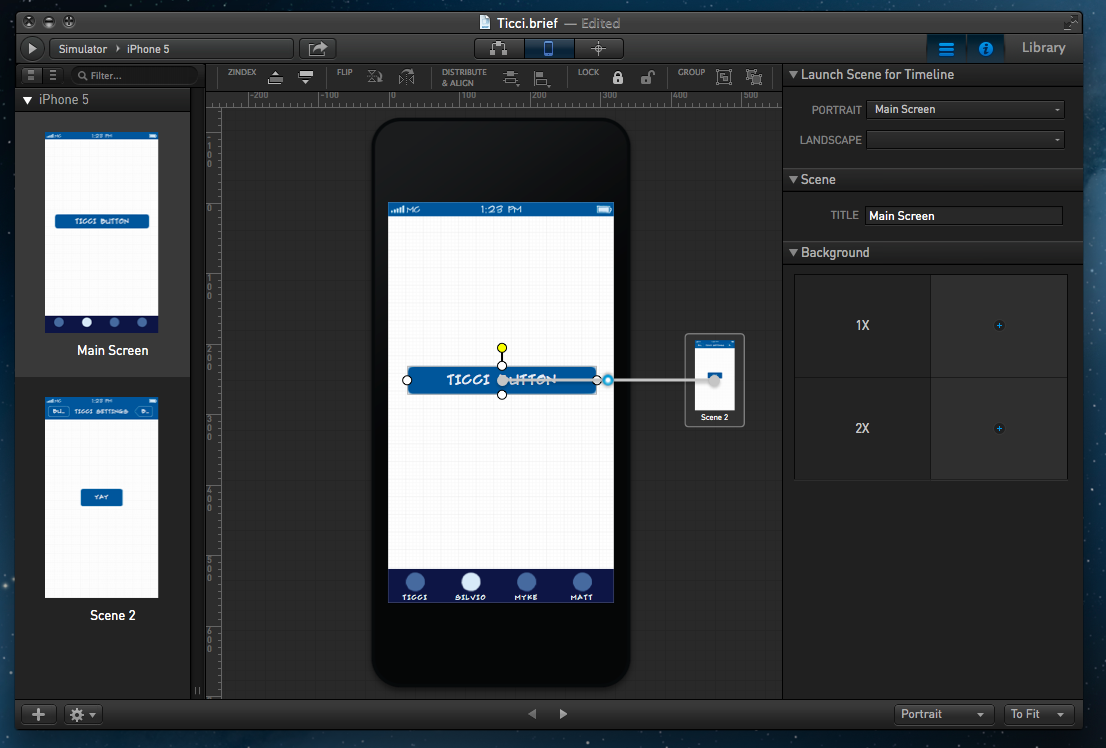
Briefs, available today at $199, is an iOS prototyping tool for professionals. It comes with a standalone Mac app that allows you to build and test live prototypes, and a free Briefscase iOS app that lets you test prototypes directly on your iPhone and iPad.

Read more


Tim Cook To Speak at D11 Conference

Kara Swisher and Walt Mossberg, announcing Tim Cook as a speaker for D11:

There’s lots to talk about, from the explosive growth of the mobile market to intense competition from a range of rivals, most especially Google’s Android, as well as innovative offerings from Korea’s Samsung. It will also be interesting to talk about the changes at Apple under Cook’s leadership, who took over from the late co-founder and industry legend Steve Jobs, as well inquiring about what new products are in the pipeline and how the company is faring in an increasingly high-pressure market.

D11 will take place in Rancho Palos Verdes, California, on May 28-30, 2013. Cook joins a list of speakers that includes Twitter CEO Dick Costolo, Facebook’s Sheryl Sandberg, and Google’s Sundar Pichai.

Last year, Tim Cook spoke at D10 and covered topics such as Apple’s growth, leading the company without Jobs, and the post-PC era. Here’s our recap from last year’s interview, and here’s the full video.

Permalink

Many Tricks’ New Safari Extensions

Cool new Safari extensions by Many Tricks, developers – among other apps – of Name Mangler (which I plan on covering soon). I like the vBulletin one:

This extension is for those who use vBulletin forum sites. It adds a contextual menu that lets you open all unread article links in new tabs, with a single click. As of now, it only works for vBulletin, but if you use forum sites based on other systems, we may be able to get it working if you can give us a URL to look at.

It’d be nice to have Chrome versions, though.

(via Dan Frakes)

Permalink


Feed Wrangler: A New RSS Reader With Smart Streams, Filters, Read Later Integration

Feed Wrangler

Feed Wrangler

“I wanted to take a slightly different take on the concept of what an RSS platform should do”, David Smith, independent developer and podcaster, told me about his new product, Feed Wrangler.

Soon after Google revealed they would discontinue their RSS service Reader this July, a slew of companies were quick to announce their existing news reading apps would either support “importing” features to let Google Reader users quickly migrate or, in some cases, be updated with APIs cloning the unofficial Reader one, allowing other developers to tweak their RSS clients for new API endpoints. This is what apps and services like Flipboard, Zite, Digg, and Feedly are doing. Instead, David Smith did something different: he announced he’d be launching an entirely new RSS syncing service, called Feed Wrangler, for an annual fee:

I believe the reason that Google turned its back on Reader and left its users hanging is that they were users not customers. I’m not interested in building a platform designed to attract as many users as possible and then work out how to sustain it later. I want to instead build something that is sustainable from Day 1. I want my customers to feel confident that they can expect this to be around long into the future. I want to build a relationship with them and make something they really, really love.

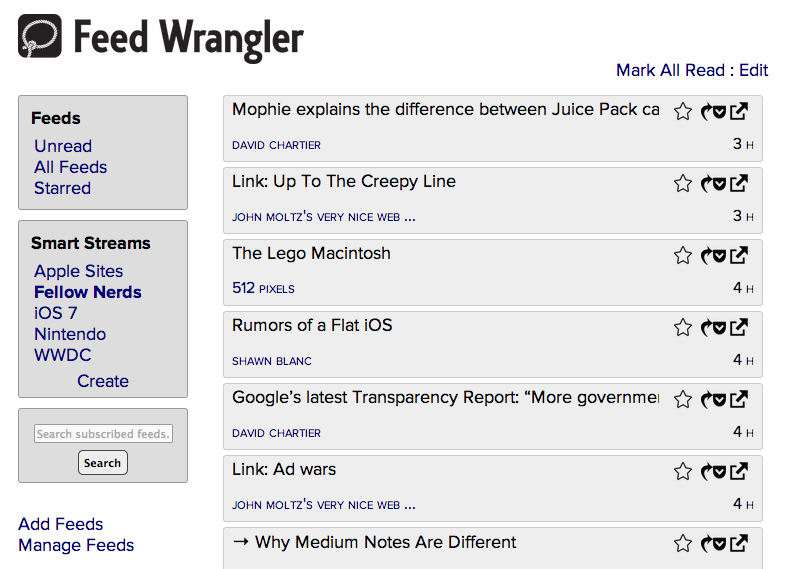
Feed Wrangler, open to the public today, comes with a website, a suite of native apps, and a $19 annual subscription. Read more


Happy Birthday iTunes Store

Good roundup of iTunes Store numbers (with subsequent inferences) by Horace Dediu.

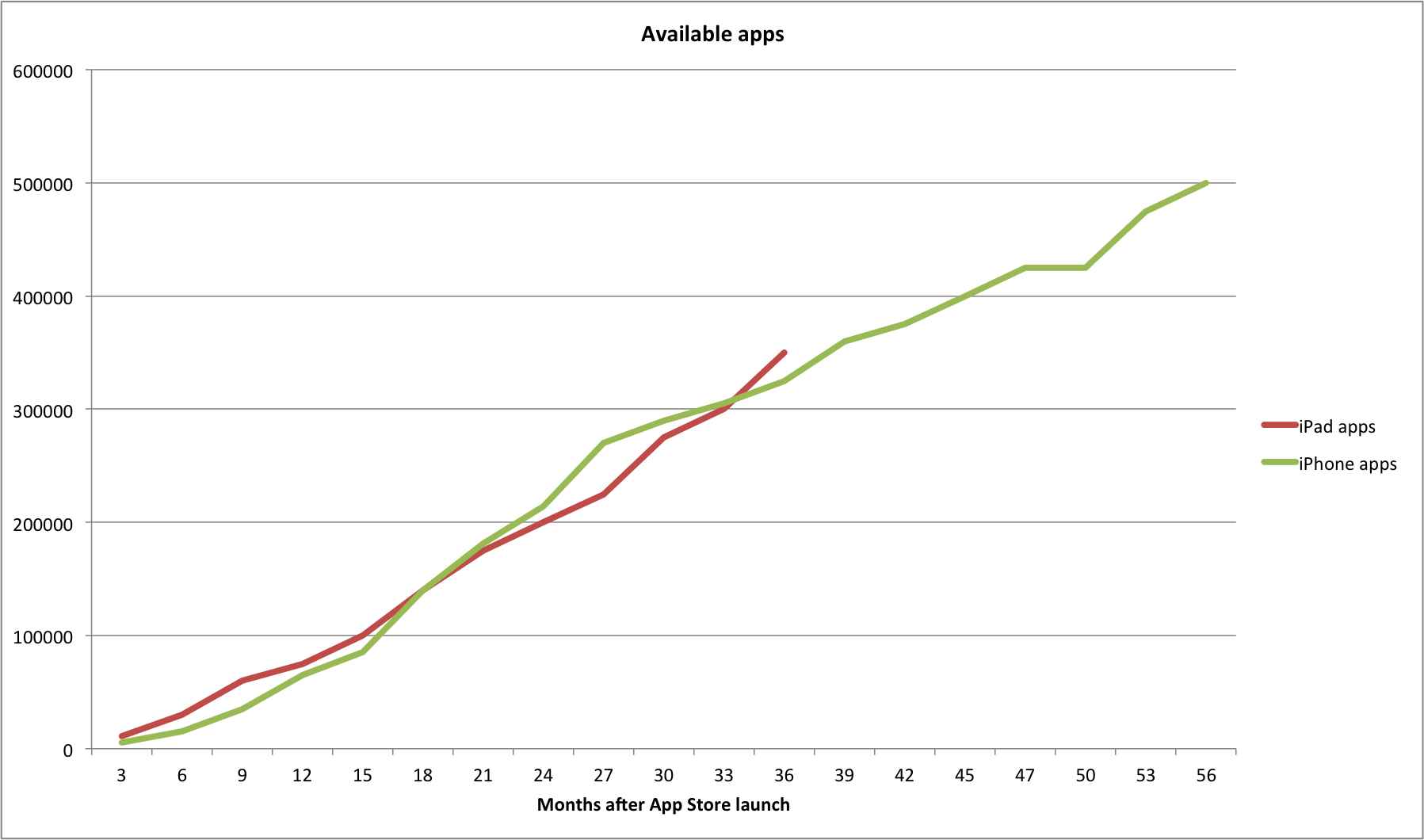
I meant to include the following chart in our Q2 2013 overview, but I didn’t have time to create it. Below, you can see how the 850,000 App Store apps Apple touted last week are divided across the iPhone and iPad after the launch of each device’s App Store (July 2008 for iPhone, April 2010 for iPad).

The increase you see after the iPad’s 30th month corresponds to October 2012 – when Apple unveiled the iPad mini.

(click for full size)

Permalink

Lessons From The Yahoo Weather App

Dan Frommer:

“Do we really need another weather app?” Actually, if it’s better, we do. Imagine if they’d stopped making new search engines after HotBot or new smartphones after the Samsung BlackJack.

I couldn’t agree more.

For free/inexpensive apps, the traditional rules of market saturation allow consumers to more comfortably try new apps; at the same time, annual OS updates enable developers to constantly experiment with more powerful technologies to fix problems consumers didn’t even think they had.

Apps are not refrigerators. With software, the diffusion of innovations is cyclic, and that’s why, as far as the App Store is concerned, editorial curation, smart recommendations, and new discovery algorithms will be key areas of improvement. We should never stop thinking about tomorrow.

Permalink

Google Now Comes To iOS with Search App Update

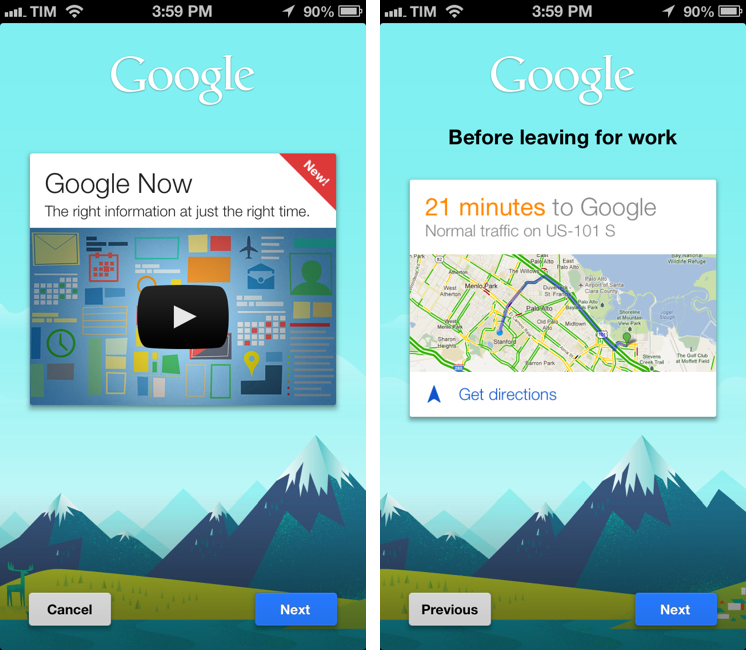
Last month, it was rumored that Google would release Google Now for iOS through an update to its existing Search app for iPhone and iPad. Version 3.0 of the app, released today on the App Store, indeed adds Google Now functionality by displaying weather and traffic data, updates on sports teams and “breaking news”, and more directly within the iOS app. Read more